On this page
How to identify it
- Soldiers are white with large heads and jaws, about 4.8 mm long, with two small pale spots next to the antennae; they release toxic substances against enemies from a hole in the front of the head (the fontanelle). The University of Florida says soldiers make up about 10 to 15 percent of foraging groups, bite aggressively when challenged and ooze a white, mucous-like secretion from the fontanelle; seen from above, the head is teardrop-shaped like a Formosan soldier's.[1][3]
- Telling soldiers from Formosan soldiers takes a microscope: Asian soldiers have one hair on each side of the fontanelle, Formosan soldiers two. The fontanelle is roughly round rather than triangular, and the top of the head bulges. The University of Florida describes one pair of hairs near the rim of the fontanelle in the Asian soldier versus two pairs in the Formosan, and a weak bulge behind the fontanelle in side view.[1][4][3]
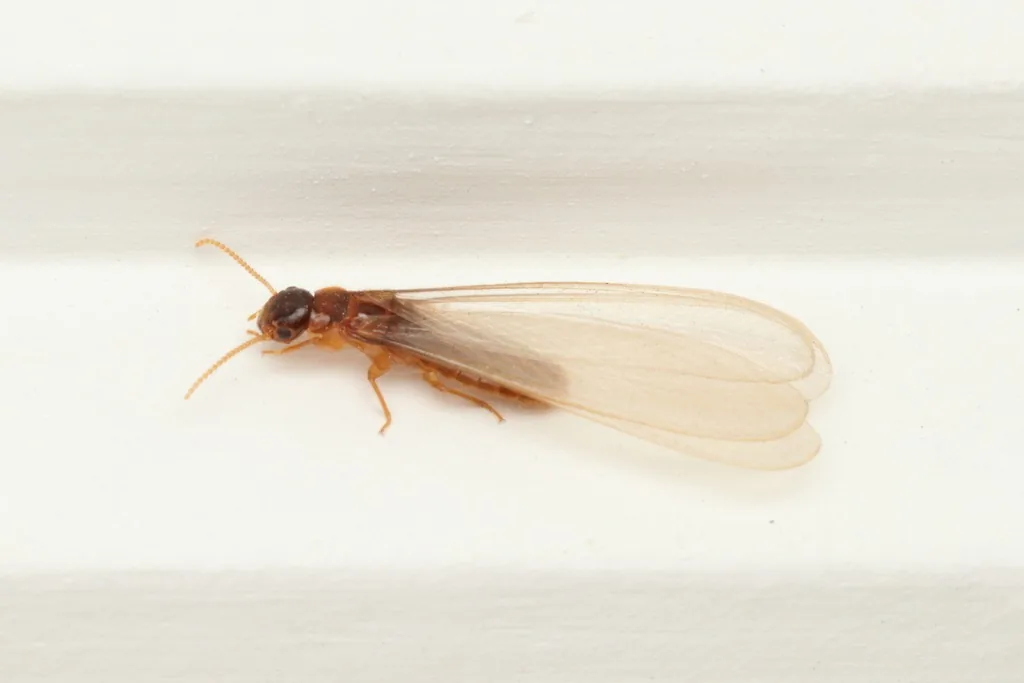
- Winged swarmers are smaller than Formosan swarmers and have dark heads. The University of Florida gives a total length with wings of about 13 to 14 mm (Formosan 14 to 15 mm) and a head width of 1.4 mm (Formosan 1.5 mm). The head, pronotum and upper abdomen are dark brown, which makes two light antennal spots on the face stand out, and the wing hairs are somewhat shorter.[1][3]
Look-alikes
| Look-alike | How to tell them apart |
|---|---|
| Formosan subterranean termite | Formosan swarmers are yellowish brown and 12 to 15 mm long, larger than Asian swarmers, which have dark heads; soldiers differ only in microscopic features. The University of Florida says Formosan swarmers are entirely lighter yellow-brown or orange-brown with antennal spots barely visible, and their flight season starts about when the Asian termite's ends.[5][1][4][3] |
| Native subterranean termites | Workers look much alike. Coptotermes termites regularly build above-ground carton nests inside the buildings they infest, and swarm in the evening or at night, while native subterranean termites swarm by day. The University of Florida says Coptotermes termites often bring soil into their feeding galleries and fill voids with carton nest, a blend of soil, wood pulp, saliva and feces.[5][1][6] |
Where it lives
Native to Southeast Asia and now also in Taiwan, Hawaii, Florida, Brazil, Mexico, parts of Africa and Oceania. In Florida it was first confined to South Florida but has established in new localities beyond it. The University of Florida traces its first continental U.S. find to a storefront and a church in Miami in 1996, then Key West in 1999 and Fort Lauderdale and Riviera Beach in 2005, at the time the northernmost established colonies worldwide. A 2026 UF/IFAS report says it is moving steadily north.[1][7][2][3][13]
Biology and life cycle
Winged swarmers fly in large numbers in the evening or at night in spring. Since 2013 Asian and Formosan termites have been seen swarming at the same time in South Florida, and mixed-species pairs form.[1][7]
It is a tropical species but has increasingly turned up in the subtropics, and lives alongside the Formosan termite in Taiwan, Hawaii and Florida.[7]
Swarmers start new colonies nearby, and people carry it farther: in shipping pallets, and in Florida on leisure boats, which a 2025 study says make Florida a launching point for spread farther afield. The University of Florida calls shipboard infestations the most likely way people spread it, when swarmers fly from a boat to land; three infested private boats found in Florida had arrived from Jamaica, Virgin Gorda and Providenciales.[1][8][3]
Swarms happen at dusk or at night, and in Florida and the West Indies they have been recorded from February to April. Porch lights, indoor lights and video monitors draw swarmers inside, especially through open doors and unscreened windows. Swarmers indoors dry out and die quickly, but most flights probably produce a few new colonies.[3]
Damage and signs
- It eats sawn timber and other cellulose such as paper, and hollows out living and dead trees; in Florida it is found in buildings, nearby trees and boats. The University of Florida says damage can become severe in a relatively short time, especially when a large, mature colony invades a structure, and that advanced infestations show carton nest material in hollowed wood or wall voids.[1][3]
- A Coptotermes colony with a nest in the soil near a building and an above-ground carton nest inside it can do much more damage.[5]
- Signs are swarms, mud tubes over the ground to woodwork, shed wings, and holes or raised paint on wood; swarmers inside a house strongly suggest an infestation. The University of Florida says hundreds to thousands of swarmers indoors usually mean the building itself is infested.[1][5][3]
Health risk
The risk is to buildings and trees; none of the sources, including the University of Florida fact sheets, describes a health risk to people.[1][5][3]
Control
Prevention
Remove wood-to-soil contact and reduce moisture in and around the structure. The University of Florida also lists pressure-treated wood as a preventive measure.[5][6]
Pesticides
Professional baits, which use insect growth regulators and can be placed in the ground or above ground on active tubes, can suppress or eliminate whole colonies. The University of Florida says in-ground bait stations contain chitin synthesis inhibitors, which kill workers when they try to molt, so the rest of the colony starves; above-ground stations can be attached to infested trees.[9][5][6]
Non-repellent liquid termiticides such as chlorantraniliprole, fipronil and imidacloprid are applied to the soil around the foundation or to nests through shelter tubes; UC says there are no reliable over-the-counter termite products for the public in California. The University of Florida says non-repellent liquid termiticides are applied by trenching around the structure or drilling and injecting through the foundation or slab, and recommends the same baits and soil treatments used for Formosan termites.[9][5][6][3]
When to call a professional
Get the species identified first: some Texas termite contracts exclude Formosan termites, and Coptotermes treatments may need to target aerial nests as well as soil.[5]
Hybrids with the Formosan termite
Where the two species overlap, mixed pairs have founded F1 hybrid colonies in the field in Florida that have matured and produced their own swarmers, and hybrids have been confirmed in Taiwan too.[8][10]
Hybrids can't be told apart by size: soldier head measurements overlap, but a 2023 study found that a combination of four features, including the number of hairs beside the head's front opening and a bulging head, identifies hybrid soldiers. In Taiwan, swarmers with unusual looks were confirmed as hybrids by DNA tests.[4][10]
How common hybrids are: in a three-year Taiwan survey, 4.4% of 27,601 swarmers were hybrids.[10]
In Florida, hybrid swarmers were found in Broward County from 2021 and hybrid field colonies in October 2024. The University of Florida says none had been seen outside Broward County, and as of 2025 only 0.1% of swarmers were hybrids in parts of the county.[11]
Hybrids are not a new species and are not worse: in laboratory studies hybrid colonies grew and ate wood at rates similar to both parents, so damage should be on par, and UF/IFAS says current professional products work on hybrid colonies as well as on either parent species.[11][12]
Hybrids cannot be positively identified by eye; every natural hybrid in the literature was confirmed by DNA tests. The University of Florida says none of the samples sent to its Termite ID Service by pest professionals or homeowners had been identified as hybrids.[11]
In laboratory studies hybrids tolerated the combined temperature range of both parent species, which the University of Florida flags as a concern because boats and shipped goods can carry Coptotermes to new areas.[11]
Where sources disagree
How far it will spread: earlier expectations kept it in South Florida, but 2026 monitoring shows it established in new localities beyond South Florida; about half of the South Florida metro area may be at risk from one of the two Coptotermes species by about 2040. The University of Florida's Featured Creatures profile still says climate will probably keep its U.S. range from extending far beyond southern Florida.[2][3]
How common hybrids are: the University of Florida's 2025 data put hybrids at 0.1% of swarmers in parts of Broward County, and a UF/IFAS news release says less than 1%; in a three-year Taiwan survey, 4.4% of 27,601 swarmers were hybrids.[11][12][10]
Formosan swarmer size: Texas A&M gives 12 to 15 mm; the University of Florida gives about 14 to 15 mm including wings.[5][3]
Family: the University of Florida's Asian subterranean termite profile uses Rhinotermitidae; its newer Formosan termite profile uses Heterotermitidae (formerly Rhinotermitidae), the family this page follows.[3][6]
Common questions
- Are hybrid super termites a reason to panic?
- No. They are real but, so far, uncommon: hybrid colonies have been confirmed in the field in Florida and Taiwan, and in a three-year Taiwan survey 4.4% of swarmers were hybrids. UF/IFAS says hybrids behave like the parent species, cause no more damage and are controlled the same way.[8][10][11][12]
- How can I tell if my termites are Asian or Formosan?
- Not reliably by eye. Asian swarmers are smaller with dark heads, but soldiers differ only in microscopic hairs and head shape; have a sample identified. In Florida, the UF/IFAS Termite ID Service identifies samples.[1][4][11]
- Is the Asian subterranean termite only in South Florida?
- No. It is established beyond South Florida now, and outside the U.S. it occurs in Southeast Asia, Taiwan, Hawaii, Brazil, Mexico and parts of Africa and Oceania.[2][1][7]
- Why are termites swarming around my lights at night in spring?
- In Florida, Asian subterranean termites swarm at dusk or at night, recorded from February to April, and lights draw them indoors. The University of Florida says hundreds to thousands of swarmers inside usually mean the building itself is infested.[3]
Sources
- Pacific Pests, Pathogens and Weeds fact sheets (University of Queensland and the Pacific Community, ACIAR project), “Asian subterranean termite (Fact Sheet 384).” apps.lucidcentral.org/ppp_v9/pdf/web_full/asian_subterranean_termite_384.pdf (accessed 2026-11-14)
- Journal of Economic Entomology, via PubMed, “Ongoing monitoring of the spread of 2 invasive subterranean termite species (Coptotermes) in Florida, 1990 to 2025 (Chouvenc 2026).” pubmed.ncbi.nlm.nih.gov/41578451/ (accessed 2026-11-14)
- University of Florida/IFAS Extension (Featured Creatures), “Asian Subterranean Termite, Coptotermes gestroi (=havilandi) (Wasmann), EENY-128/IN285 (R. H. Scheffrahn and N.-Y. Su).” ask.ifas.ufl.edu/publication/IN285 (accessed 2026-11-14)
- Journal of Insect Science, via PubMed, “Soldier phenotypic differences among 2 invasive and destructive Coptotermes species and their hybrids (Patel et al. 2023).” pubmed.ncbi.nlm.nih.gov/37952215/ (accessed 2026-11-14)
- Texas A&M AgriLife Extension, “Formosan Subterranean Termites (E-367).” extensionentomology.tamu.edu/wp-content/uploads/sites/3/2017/01/Formosan-subterranean-termites-E367.pdf (accessed 2026-11-14)
- University of Florida/IFAS Extension (Featured Creatures), “Formosan Subterranean Termite, Coptotermes formosanus Shiraki, EENY-121/IN278 (N.-Y. Su, R. Scheffrahn, J. Gordon and T. Chouvenc).” ask.ifas.ufl.edu/publication/IN278 (accessed 2026-11-14)
- Insects, via PubMed, “Potential Hybridization between Two Invasive Termite Species, Coptotermes formosanus and C. gestroi (Chouvenc et al. 2017).” pubmed.ncbi.nlm.nih.gov/28125068/ (accessed 2026-11-14)
- Proceedings of the Royal Society B, via PubMed, “Ongoing human-mediated spread and hybridization of two major invasive termite species (Chouvenc et al. 2025).” pubmed.ncbi.nlm.nih.gov/40393488/ (accessed 2026-11-14)
- University of California Statewide IPM Program, “Pest Notes: Subterranean and Other Termites.” ipm.ucanr.edu/legacy_assets/PDF/PESTNOTES/pntermites.pdf (accessed 2026-11-14)
- Heredity, via PubMed, “Hybrids of two destructive subterranean termites established in the field (Chen et al. 2024).” pubmed.ncbi.nlm.nih.gov/38509263/ (accessed 2026-11-14)
- University of Florida/IFAS Extension (EDIS), “Hybrid Coptotermes Termites: Separating Fact from Fiction, ENY-2137/IN1476 (J. Gordon, T. Chouvenc, F. Oi and N.-Y. Su).” ask.ifas.ufl.edu/publication/IN1476 (accessed 2026-11-14)
- UF/IFAS News, “Here's what homeowners need to know about hybrid termites in Florida (June 8, 2026).” blogs.ifas.ufl.edu/news/2026/06/08/heres-what-homeowners-need-to-know-about-hybrid-termites-in-florida/ (accessed 2026-11-14)
- UF/IFAS News, “New study shows invasive termites threatening homes in Florida are spreading farther than predicted (February 4, 2026).” blogs.ifas.ufl.edu/news/2026/02/04/new-study-shows-invasive-termites-threatening-homes-in-florida-are-spreading-farther-than-predicted/ (accessed 2026-11-14)
- iNaturalist, “Coptotermes gestroi taxon page (order and family).” www.inaturalist.org/taxa/209098 (accessed 2026-11-14)