On this page
How to identify it
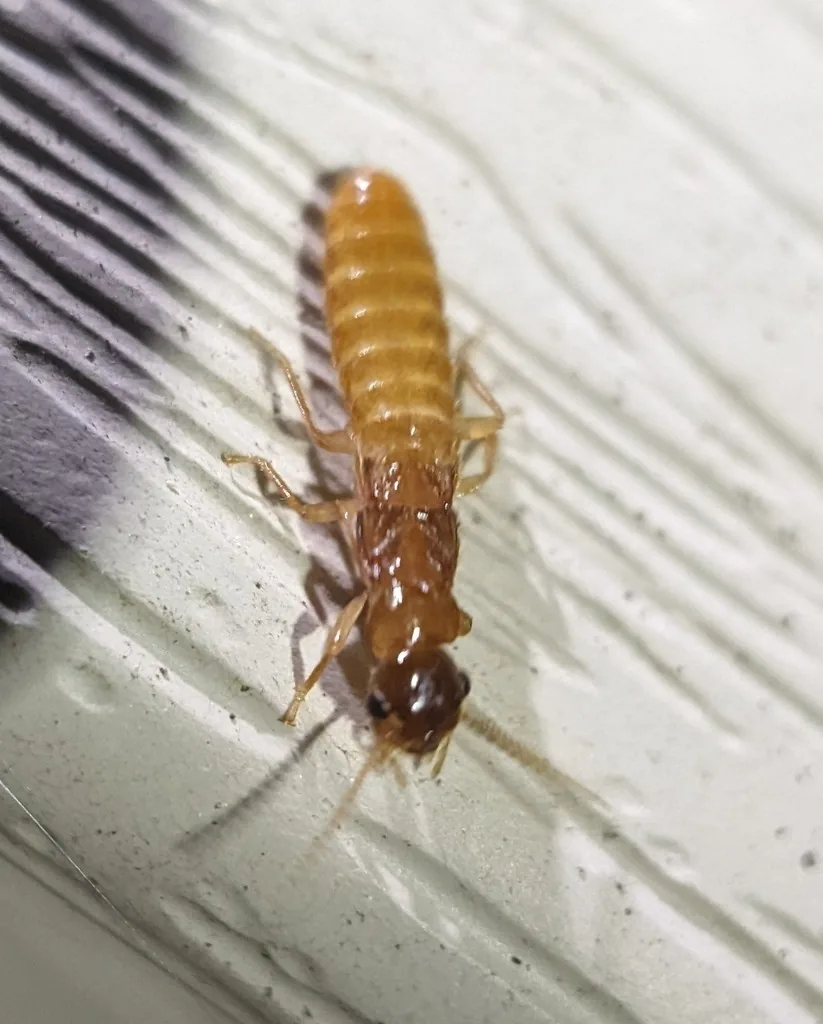
- Swarmers are yellowish brown to tan and about 1/2 inch long including the wings (Texas A&M gives 12 to 15 mm), with a dense covering of fine hairs on the wings. UF/IFAS describes swarmers as 12 to 15 mm long, orange or light amber-brown, with hairs covering both the body and the wings, and wings with two darkened veins along the front edge and no cross-veins between them.[1][4][3]
- Soldiers have teardrop-shaped heads with large, dark jaws, unlike the rectangular heads of native subterranean soldiers, and can release a white defensive fluid from the front of the head. UF/IFAS gives soldiers at about 4 to 5 mm, with a white body, a brownish-orange teardrop-shaped head and dark curved jaws; the white glue-like defensive fluid comes from an enlarged opening on the front of the head called the fontanelle.[1][4][3]
- Colonies have a relatively high share of soldiers, roughly one for every ten workers; Mississippi State puts the eastern subterranean termite at about one per 50. UF/IFAS puts soldiers at 10 to 15% of a Formosan colony, against 1 to 2% in native Reticulitermes colonies.[4][3]
- Workers look like native subterranean termite workers: white, eyeless and hard to tell apart. UF/IFAS gives workers at about 3 to 4 mm, wingless and white to cream.[4][1][3]
Look-alikes
| Look-alike | How to tell them apart |
|---|---|
| Native subterranean termites | Smaller, dark-bodied swarmers (about 3/8 inch in Mississippi) that swarm in daylight rather than at night (see where the sources disagree on the hour), and soldiers with rectangular heads.[4][1] |
| Drywood termites | Some are a similar honey-brown color and also fly at night to lights, but their wings lack hairs, and they leave fecal pellets instead of mud tubes or carton.[1] |
| Asian subterranean termite | A closely related invasive Coptotermes termite in South Florida. UF/IFAS researchers have confirmed that the two species hybridize in Broward County; hybrids are rare and were identified with molecular (DNA) tests.[5][6] |
Where it lives
Native to East Asia (UC IPM says China) and introduced to the U.S. In Texas it was first found in 1956 at the Houston Ship Channel and is now in at least 30 counties; Mississippi State says it has spread to 26 of the state's 82 counties since it was first detected there in 1984; in South Carolina Clemson reports it in Charleston County, Hilton Head Island, Orangeburg, Burton and, most recently, Rock Hill; and UC IPM describes it as restricted to a small area near San Diego in California. It spreads mainly in infested wood such as railroad ties, landscape timbers and lumber. GBIF's public U.S. records since 1990 (621 as of November 2026) come from 9 states, most from Louisiana, Texas and Florida. UF/IFAS says it is endemic to Taiwan and southern China; early U.S. mainland introductions included New Orleans, Charleston and Hallandale, Florida, and it now occurs in Hawaii and across the Southeast, north along the Atlantic coast to Virginia, inland to Tennessee, and in southern California. In Florida it is found throughout the state, mainly in densely populated urban areas.[1][7][4][8][9][3]
Biology and life cycle
Colonies are at least four times as large as those of native subterranean termites and can grow to more than a million individuals.[1]
Swarmers fly at night, usually at or just after dusk, and are strongly attracted to lights. In south Mississippi they usually swarm from late April through mid-May; in Texas from early May through June.[1][4]
Besides soil nests, they often build above-ground (aerial) nests of carton, a material of chewed wood, soil, saliva and feces, inside walls where a leak keeps the wood wet. Swarmers can even start aerial colonies in moist wood above ground, such as rooftop planter boxes.[1][4]
An aerial nest can survive for months or years cut off from the soil, living on the moisture held in the carton.[1]
UF/IFAS describes colonies of several million individuals, usually underground, with a central nest holding the king and queen, eggs and larvae, and satellite nests of workers and soldiers near food or inside trees. Foragers have been found travelling up to 100 m in the field and 300 m (328 ft) in laboratory studies.[3]
In Florida, UF/IFAS says it typically swarms between early April and late June, shortly after sunset, with a peak in May. Flights can involve tens of thousands of swarmers and can happen indoors in an infested building, and the lights that draw them can lead them to buildings or boats.[3]
After pairing, a male and female shed their wings and run in tandem while the female looks for a moist crack or crevice to start a colony. UF/IFAS says a colony takes 5 to 8 years to mature and produce its own swarmers.[3]
Damage and signs
- Workers attack and consume wood faster than native species, so they can do more damage in a shorter time.[1][4]
- They attack more than 50 kinds of living trees, including pecan, citrus, wild cherry and white oak, and trees weakened by feeding may blow over in strong winds.[1]
- While foraging they can chew through non-wood materials such as plaster, rubber and plastic.[1]
- Workers are the only caste that feeds on wood, so they cause the damage. Like other Coptotermes, Formosan termites often bring soil into their feeding galleries and fill voids with carton, and they build mud tubes as they travel; UF/IFAS notes that live termites, not tubes or damage alone, are needed to confirm an active infestation.[3]
- In living trees they usually hollow out the dead wood at the center. UF/IFAS says this doesn't directly harm the tree's health but can weaken it so it is more likely to fall, especially in high winds, so trees near a house should be inspected regularly.[3]
Health risk
Texas A&M notes that soldiers may clamp onto a finger with their jaws. Texas A&M, Mississippi State, Clemson, UC IPM and EPA treat it as a threat to wood in buildings and to trees, and don't describe a risk to people or pets.[1][4][8][7][2]
Control
Prevention
Fix roof and plumbing leaks, remove wood-to-soil contact, and don't use old railroad ties or dock timbers in landscaping; creosote often doesn't reach the core of the wood.[1][4]
The best time to protect a building is before and during construction, when the soil under the slab can be treated.[1]
Reducing moisture in and around the structure and using pressure-treated wood help prevent attack, though UF/IFAS notes treated wood carries no guarantee of permanent protection.[3]
Pesticides
Soil-applied termiticides and baits are the main treatments and stop infestations that start from the ground, which is how most begin, but they won't reach an aerial colony living off a leak.[4][1]
Termite baits use chitin-synthesis inhibitors that kill workers when they next molt, and because the bait is shared through the colony they can eliminate it. UF/IFAS says it takes about 3 months for all the workers to molt and die; above-ground bait stations can be placed directly on foraging sites in buildings and trees.[3]
Non-repellent liquid termiticides applied around or under a structure, as the label directs, can protect the building, but UF/IFAS says they are unlikely to eliminate termite activity in the surrounding area.[3]
When to call a professional
Treatments used against eastern subterranean termites also work on Formosan termites; the main difference is finding and treating any aerial nests.[4][1]
UF/IFAS says controlling Formosan subterranean termites requires professional pest control services and over-the-counter products are unlikely to be effective. Where these termites are common, frequent inspections or preventive treatments help catch infestations early.[3]
Hybrids between Formosan and Asian subterranean termites have been found in southeast Florida, mainly Broward County, where UF/IFAS says they account for less than 1% of termite swarmers. UF/IFAS says hybrids behave like the parent species and their presence does not change management recommendations.[5][6]
Where the sources disagree
When native subterranean termites swarm: Mississippi State says swarming usually occurs in the morning; Texas A&M says native subterranean termites swarm during the day, usually in the afternoon.[4][1]
Mississippi counties: Mississippi State's page says in one place that Formosan termites occur in portions of 25 counties and in another (with a map dated July 2024) that they are established in 26.[4]
Family: GBIF's backbone taxonomy and Texas A&M place Coptotermes in Rhinotermitidae; UF/IFAS and iNaturalist use Heterotermitidae (UF notes it was formerly Rhinotermitidae), the family shown on this page.[10][1][3][11]
Which wood they eat: Texas A&M says Formosan termites eat both early- and late-season wood, which makes them more destructive; UF/IFAS says that, like other subterranean termites, they feed on the less dense spring wood, leaving damage that follows the grain.[1][3]
Common questions
- Are Formosan termites harder to kill than other termites?
- The same treatments work; what makes them harder is their large colonies and the need to find and treat any above-ground carton nests.[4]
- Why are termites swarming around my porch light at night?
- In the South, a spring swarm of yellowish-brown termites at lights after dusk points to Formosan termites: Texas A&M says they swarm at night and are strongly attracted to lights, while native subterranean termites swarm during the day. Mississippi State says they usually swarm from late April through mid-May in south Mississippi.[1][4]
- Are hybrid Formosan termites a bigger threat?
- No. UF/IFAS says hybrids behave much like Formosan and Asian subterranean termites, are rare and limited to parts of southeast Florida, and that the professional products used against either parent should be as effective on hybrid colonies.[5]
Sources
- Texas A&M AgriLife Extension, “Formosan Subterranean Termites, E-367.” extensionentomology.tamu.edu/wp-content/uploads/sites/3/2017/01/Formosan-subterranean-termites-E367.pdf (accessed 2026-11-14)
- U.S. Environmental Protection Agency, “Termites: How to Identify and Control Them.” www.epa.gov/safepestcontrol/termites-how-identify-and-control-them (accessed 2026-11-14)
- University of Florida/IFAS Extension (Featured Creatures), “Formosan Subterranean Termite, Coptotermes formosanus Shiraki, EENY121/IN278 (N.-Y. Su, R. Scheffrahn, J. Gordon and T. Chouvenc).” ask.ifas.ufl.edu/publication/IN278 (accessed 2026-11-14)
- Mississippi State University Extension, “Species of Termites in Mississippi.” extension.msstate.edu/insects/termites/species-termites-mississippi (accessed 2026-11-14)
- UF/IFAS News, “Here's what homeowners need to know about hybrid termites in Florida (June 8, 2026).” blogs.ifas.ufl.edu/news/2026/06/08/heres-what-homeowners-need-to-know-about-hybrid-termites-in-florida/ (accessed 2026-11-14)
- The Royal Society, via PubMed Central, “Ongoing human-mediated spread and hybridization of two major invasive termite species (Chouvenc et al. 2025, Proceedings of the Royal Society B 292:20250413).” pmc.ncbi.nlm.nih.gov/articles/PMC12092118/ (accessed 2026-11-14). Full text read through NCBI E-utilities (PMC).
- University of California Statewide IPM Program, “Pest Notes: Subterranean and Other Termites, Publication 7415 (May 2014).” ipm.ucanr.edu/legacy_assets/PDF/PESTNOTES/pntermites.pdf (accessed 2026-11-14)
- Clemson Cooperative Extension, Home & Garden Information Center, “Termites of South Carolina (HGIC 2448).” hgic.clemson.edu/factsheet/termites-of-south-carolina/ (accessed 2026-11-14)
- Global Biodiversity Information Facility (GBIF), “Coptotermes formosanus: occurrence records in the U.S., 1990-2026 (GBIF occurrence search).” api.gbif.org/v1/occurrence/search?taxonKey=2007383&country=US&hasGeospatialIssue=false&occurrenceStatus=PRESENT&year=1990%2C2026&facet=stateProvince&facetLimit=400&limit=0 (accessed 2026-11-14). State counts are records reported (iNaturalist research-grade, museum specimens, surveys), not abundance.
- Global Biodiversity Information Facility (GBIF), “Coptotermes formosanus Shiraki, 1909 (GBIF Backbone Taxonomy).” api.gbif.org/v1/species/2007383 (accessed 2026-11-14)
- iNaturalist, “Coptotermes formosanus taxon page (order and family).” www.inaturalist.org/taxa/199393 (accessed 2026-11-14)