The short answer
- Swarmer size and color: Formosan swarmers are about 1/2 inch long with the wings and tan, yellowish brown or light amber-brown. Eastern subterranean swarmers are about 3/8 inch and dark brown to nearly black.[4][5][1][2]
- Swarm time: Formosan termites fly at night, at or just after dusk, and come to lights, mostly in late spring. Eastern subterranean termites usually swarm in the daytime, mostly in late winter and spring.[4][5][1][2][7]
- Soldier heads: Formosan soldiers have a teardrop- or oval-shaped head and ooze a white, sticky fluid when disturbed. Eastern subterranean soldiers have a rectangular head.[4][5][1][2]
- Soldier numbers: a break in a mud tube or other entry point that fills with soldiers points to Formosan termites, whose colonies are about 10 to 15% soldiers. Native Reticulitermes colonies have only 1 to 2%.[1][2][4]
Termite profiles on this site
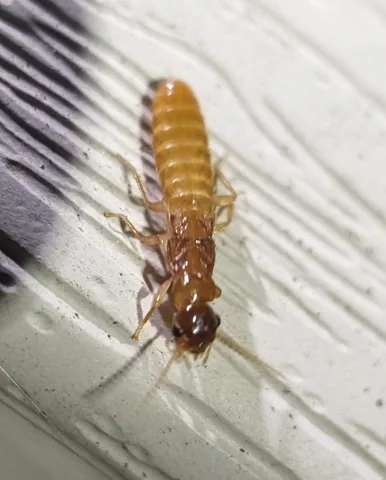 Formosan Subterranean Termite
Coptotermes formosanus
The Formosan subterranean termite is an invasive species from East Asia and one of the most aggressive and economically damaging termites in the world; its colonies are much larger than those of native subterranean termites. EPA lists it among the less common termites in the U.S., behind the native subterranean termite. UF/IFAS says it has consistently been listed among the 100 worst invasive species in the world.
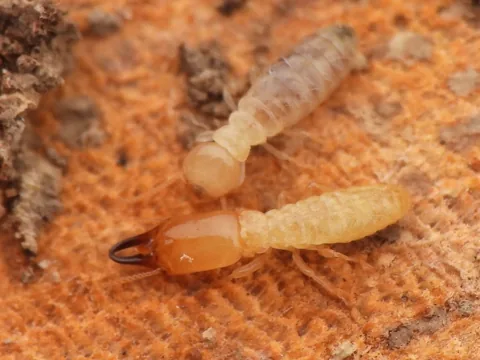 Eastern Subterranean Termite
Reticulitermes spp. (shown: R. flavipes)
Subterranean termites live in the soil and travel into buildings through earthen shelter tubes; they are the most destructive termites in most of the United States and usually warrant a professional.
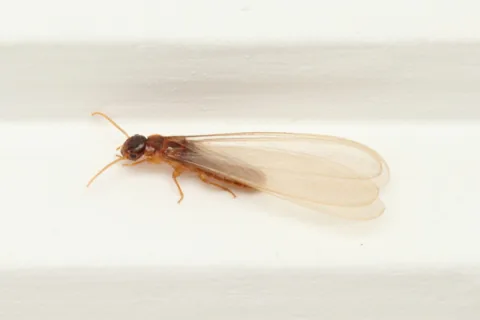 Asian Subterranean Termite
Coptotermes gestroi
The Asian subterranean termite is a very destructive tropical termite, considered second only to its relative the Formosan subterranean termite. In the U.S. both invasive Coptotermes species are established in Florida, and the Asian species has spread beyond South Florida, where it was first confined.
Side by side: Formosan and eastern subterranean termites
Each line gives the Formosan termite first, then the eastern subterranean termite.[4][2]
- Name: the Formosan subterranean termite is Coptotermes formosanus, an invasive species native to Taiwan and southern China. The eastern subterranean termite is Reticulitermes flavipes, a native species.[1][5][2][4]
- Swarmer size: Formosan swarmers are about 1/2 inch including the wings per Mississippi State, and 12 to 15 mm (0.5 to 0.6 inch) per Texas A&M and UF/IFAS. Eastern subterranean swarmers are about 3/8 inch per Mississippi State and about 0.4 inch per UF/IFAS.[4][5][1][2]
- Swarmer color: Formosan swarmers are tan to light brown per Mississippi State, yellowish brown per Texas A&M, and orange or light amber-brown per UF/IFAS. Eastern subterranean swarmers are dark brown to black, almost black to the naked eye, with white or translucent wings.[4][5][1][2]
- Swarmer wings: Texas A&M describes a dense covering of gold to reddish hair on Formosan wings, and UF/IFAS says both the bodies and wings are covered in small hairs. Mississippi State says eastern subterranean wings extend well beyond the end of the abdomen.[5][1][4]
- Time of day: Formosan termites swarm at night, usually at or shortly after dusk, and are strongly attracted to lights. Eastern subterranean termites usually swarm in the morning per Mississippi State, and on warm, sunny, windless early afternoons, usually after rain, per UF/IFAS.[4][5][1][2]
- Season: Formosan swarms run from early April to late June in Florida with a peak in May (UF/IFAS), early May through June in Texas (Texas A&M), and late April through mid-May in south Mississippi (Mississippi State). Eastern subterranean flights run from early January to April in Florida; in Mississippi they start as early as late January on the coast and peak from late February to early April, and run April through June in the north.[1][5][4][2]
- Soldier head: Formosan soldiers have a brownish-orange, teardrop-shaped head with dark, curved mandibles and an opening on the front of the head called a fontanelle. Eastern subterranean soldiers have a large, rectangular head with heavy, curved mandibles.[1][5][4][2]
- Soldier behavior: when threatened, Formosan soldiers exude a white, glue-like substance from the fontanelle. UF/IFAS says this behavior separates Coptotermes soldiers from native subterranean soldiers, and Texas A&M says the bite and fluid are harmless to people.[1][5]
- Soldier share: Mississippi State puts Formosan colonies at roughly one soldier for every ten workers and eastern subterranean colonies at roughly one per 50. UF/IFAS gives 10 to 15% soldiers for Formosan colonies and 1 to 2% for native Reticulitermes colonies.[4][1][2]
- Workers: hard to tell apart. Mississippi State says Formosan workers look very similar to eastern subterranean workers. UF/IFAS describes Formosan workers as about 3 to 4 mm, wingless and white to cream.[4][1]
- Colony size: UF/IFAS says Formosan colonies can hold several million termites, and Texas A&M says they are at least four times as large as native subterranean colonies and a new colony may pass 1 million within 5 years. UF/IFAS says a single eastern subterranean colony may contain 100,000 to 1,000,000 termites.[1][5][2]
- Foraging distance: UF/IFAS says Formosan termites have been found foraging up to 100 m in the field, and that eastern subterranean colonies forage up to 150 ft for food.[1][2]
- Nests: both nest in the soil and build mud tubes. Formosan termites also fill voids with carton, a mix of soil, chewed wood, saliva and feces, and regularly build aerial (above-ground) carton nests inside the buildings they infest. Mississippi State and UF/IFAS describe carton and aerial nests for the Formosan termite, not for the eastern subterranean termite.[1][5][4][2]
- Trees: Texas A&M says Formosan termites attack living trees, and UF/IFAS shows carton nests inside trees. UF/IFAS says Reticulitermes species live in dead trees and rotting wood in natural areas as well as in buildings.[5][1][2]
Where each one occurs
Eastern subterranean termite: UF/IFAS calls it the most widely distributed Reticulitermes species, found across eastern North America from Ontario, Canada, south to Key Largo, Florida, and also found at two locations in California. Mississippi State says it occurs through much of the eastern United States, and Clemson says it is one of the two most commonly encountered termites across South Carolina.[2][4][6]
Formosan subterranean termite: UF/IFAS says it is found in Hawaii and the southeastern continental United States, north along the Atlantic coast to Virginia, as far inland as Tennessee, and in southern California. UF/IFAS adds that native Reticulitermes termites range across temperate climates while the Formosan termite is mainly limited to the subtropical Southeast.[1][2]
State reports: Texas A&M says Formosan termites are in at least 30 Texas counties and all major metropolitan areas and are spreading. Mississippi State says they now occur in parts of 25 Mississippi counties. Clemson says they are established in many areas of Charleston County and have reached Hilton Head Island and Orangeburg. In Florida, UF/IFAS says they occur statewide, mainly in densely populated urban areas.[5][4][6][1]
How they spread: Texas A&M says infested shoring timbers and recycled railroad ties used in landscapes are thought to be a main way they move, and Mississippi State says they first reached that state in infested railroad crossties. Clemson ties the South Carolina infestations to infested lumber.[5][4][6]
So outside the Southeast, Hawaii and the few spots named above, a subterranean termite swarm is far more likely to be a native Reticulitermes species. Within Formosan range, either one is possible.[2][1]
A third termite that gets mixed up with Formosan
The light southern subterranean termite (Reticulitermes hageni) is a native relative of the eastern subterranean termite. Its swarmers are light or yellowish brown, so Mississippi State says they can be mistaken for Formosan termites, but they are smaller: UF/IFAS gives about 0.3 inch with the wings.[4][2]
Its timing also differs from the other two. Mississippi State says it usually swarms in fall; UF/IFAS gives early December to early February in Florida, with flights in the evening. A soldier, which will have the rectangular Reticulitermes head, settles it.[4][2]
How to confirm which one you have
Soldiers and swarmers are the two castes used to name a termite species, so those are the ones to collect.[2][5]
- Collect soldiers. Mississippi State calls finding and collecting soldiers one of the easiest and surest ways to identify Formosan termites. Look for the head shape and, with Formosan soldiers, the white droplet from the front of the head.[4][5]
- Count soldiers at a break. UF/IFAS says that if many soldiers gather at a break in a mud tube or other intrusion point it is most likely Coptotermes, and if few or none show up it is most likely Reticulitermes.[2]
- Note the swarm time. A swarm at dusk or after dark around porch lights in late spring fits Formosan termites; a daytime swarm inside in late winter or spring fits eastern subterranean termites.[4][1][2][7]
- Use magnification. UF/IFAS says termite identification usually needs a microscope or high-resolution camera, even for experienced identifiers, and that soldiers and swarmers are the castes used to name the species. Clemson notes the eastern and dark southern subterranean termites can only be told apart under a microscope.[3][2][6]
- Get it identified. UF/IFAS says a termite sample should be identified to species before you look at treatment options and offers an identification service; Texas A&M says doubtful samples can go to its Center for Urban and Structural Entomology.[3][5]
Why the difference matters for treatment
The way in is usually the same. Mississippi State says Formosan termites normally first enter a building from the ground through foraging tunnels, just as eastern subterranean termites do, which is why soil-applied termiticides and in-ground bait stations are the main preventive treatments for both. UF/IFAS names non-repellent liquid termiticides and chitin-synthesis inhibitor baits as the two primary ways to manage subterranean termites.[4][2][1]
The aerial nest is the difference. Mississippi State says once Formosan termites set up an above-ground carton nest near a water leak, they no longer have to return to the soil for moisture and can live apart from the mother colony. Those nests are not controlled by in-ground bait stations or soil treatments and need targeted above-ground treatment. Texas A&M says Formosan management may differ from that for other subterranean termites because aerial nests become more likely once a colony is established.[4][5]
Scale and speed. Texas A&M says having both a nearby soil nest and an aerial nest inside the structure greatly increases the damage these termites can do, and UF/IFAS says their large colonies and long foraging distances can cause significant structural damage. In areas with many Formosan termites, UF/IFAS calls frequent inspection and preventive treatment critical.[5][1]
Contracts. Texas A&M says some Texas termite contracts exclude Formosan termites, so identify the species before agreeing to any contract. Read the service agreement for which termites it covers.[5]
What to do for each
Both live in the soil and need moisture, so the first steps are the same; Formosan termites add the chance of a nest above ground.[2][4]
- Either one: save a few swarmers and, if you can, soldiers for identification, and have the building inspected. UF/IFAS says a suspected subterranean termite infestation should be inspected by a licensed professional.[2][3]
- Either one: fix leaky plumbing, air conditioning condensate and any spot that stays wet, and keep mulch and plants off the lower foundation walls so mud tubes are easy to see, as UF/IFAS advises for subterranean termites.[2]
- Formosan termites: UF/IFAS says control requires professional pest control services and over-the-counter products are unlikely to work. Ask the company how it will find and treat any above-ground nest, check walls near leaks, and check landscape trees, which UF/IFAS says should be inspected regularly where these termites occur.[1][4]
- Eastern subterranean termites: the colony lives in the soil, so the two main options UF/IFAS describes, non-repellent liquid termiticides and bait stations, are aimed at termites coming up from the ground. The treatment types are compared on the termite treatment options page.[2]
Common questions
- Do Formosan termites eat wood faster than eastern subterranean termites?
- The sources point to colony size rather than a faster bite. Texas A&M says Formosan colonies are at least four times as large as native subterranean colonies, and UF/IFAS says their large population and long foraging distance let one colony cause significant structural damage.[5][1]
- Are Formosan termite soldiers dangerous?
- No. Texas A&M says the soldiers can grab a finger with their mandibles, but the bite and the white fluid they secrete are harmless to people.[5]
- Why do Formosan swarmers show up around streetlights?
- They fly at night and are strongly attracted to lights. Mississippi State says the numbers at lights in heavily infested areas can be large enough to delay outdoor events, and UF/IFAS says lights can draw them to buildings and boats.[4][1]
- How long before a new colony swarms?
- UF/IFAS says Formosan colonies mature and begin producing swarmers in 5 to 8 years, and that a new Reticulitermes colony may take five to 10 years. NC State says a subterranean colony can mature in 3 to 5 years.[1][2][7]
- Can the two kinds be in the same yard?
- Yes, where their ranges overlap. Mississippi State lists both as major termites in that state, and Clemson describes the eastern subterranean termite statewide in South Carolina alongside established Formosan infestations around Charleston.[4][6]
Photo credits
- Formosan Subterranean Termite: (c) ncb1221, some rights reserved (CC BY) — via iNaturalist, CC BY 4.0
- Eastern Subterranean Termite: (c) Sam Kieschnick, some rights reserved (CC BY) — via iNaturalist, CC BY 4.0
- Asian Subterranean Termite: (c) Carlos Alexandre Mattos Raposo, some rights reserved (CC BY) — via iNaturalist, CC BY 4.0
Sources
- University of Florida IFAS Extension, “EENY121/IN278: Formosan Subterranean Termite, Coptotermes formosanus Shiraki.” ask.ifas.ufl.edu/publication/IN278 (accessed 2026-11-14)
- University of Florida IFAS Extension, “EENY-212/IN369: Native Subterranean Termites: Reticulitermes flavipes, R. virginicus, R. hageni.” ask.ifas.ufl.edu/publication/IN369 (accessed 2026-11-14)
- University of Florida IFAS Extension, “ENY-2079/IN1360: Termite Species Distribution in Florida and UF Termite Identification Services.” ask.ifas.ufl.edu/publication/IN1360 (accessed 2026-11-14)
- Mississippi State University Extension Service, “Species of Termites in Mississippi.” extension.msstate.edu/insects/termites/species-termites-mississippi (accessed 2026-11-14)
- Texas A&M AgriLife Extension Service, “E-367: Formosan Subterranean Termites.” extensionentomology.tamu.edu/wp-content/uploads/sites/3/2017/01/Formosan-subterranean-termites-E367.pdf (accessed 2026-11-14)
- Clemson Cooperative Extension, Home & Garden Information Center, “Termites of South Carolina.” hgic.clemson.edu/factsheet/termites-of-south-carolina/ (accessed 2026-11-14)
- NC State Extension, “Termites: Biology and Control.” content.ces.ncsu.edu/termites-biology-and-control (accessed 2026-11-14)