The short answer
- Earthen tubes about pencil-width running from soil up foundations, piers, sill plates or joists: subterranean termites. Break one open and look for small, creamy-white workers.[1][2]
- Vertical, side-by-side mud tubes up to six or more inches long, or blocky mud cells a couple of inches long, under eaves, in garages or on patios: mud daubers.[6][7]
- If you suspect termites, get an inspection from a licensed professional; termiticide treatment usually requires one.[4][5]
Profiles of what builds mud tubes
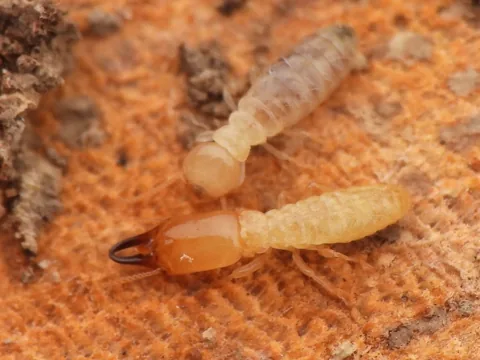 Eastern Subterranean Termite
Reticulitermes spp. (shown: R. flavipes)
Subterranean termites live in the soil and travel into buildings through earthen shelter tubes; they are the most destructive termites in most of the United States and usually warrant a professional.
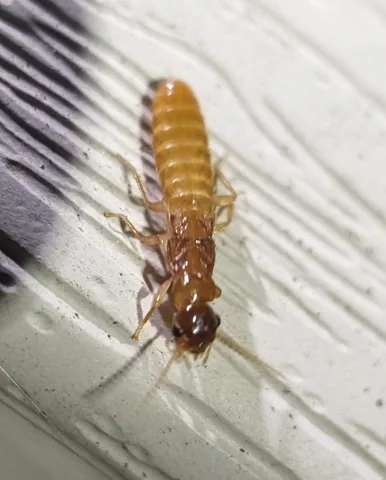 Formosan Subterranean Termite
Coptotermes formosanus
The Formosan subterranean termite is an invasive species from East Asia and one of the most aggressive and economically damaging termites in the world; its colonies are much larger than those of native subterranean termites. EPA lists it among the less common termites in the U.S., behind the native subterranean termite. UF/IFAS says it has consistently been listed among the 100 worst invasive species in the world.
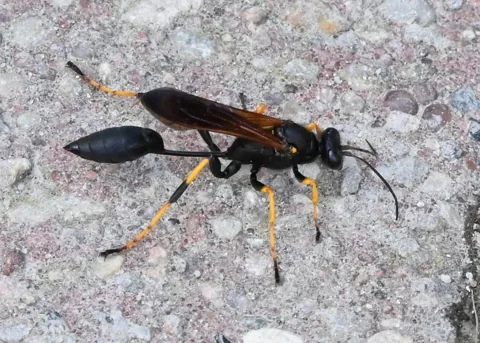 Black and Yellow Mud Dauber
Sceliphron caementarium
Mud daubers are solitary wasps that build mud nests on walls, ceilings, eaves and equipment and stock them with paralyzed spiders. They don't defend their nests and rarely sting.
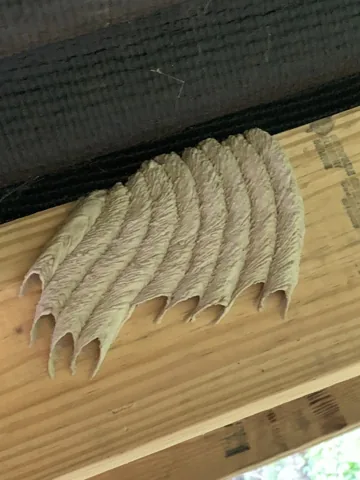 Organ pipe mud dauber
Trypoxylon politum
The organ pipe mud dauber is a black, solitary wasp that builds long mud tubes side by side on walls, eaves and equipment, so the finished nest looks like the pipes of an organ. Females stock the tubes with paralyzed orb weaver spiders, and the male stays at the nest to guard it.
Mud tube clues and the likely culprit
Location is the biggest clue: termite tubes connect soil to wood, while mud dauber nests are built in protected spots away from the ground.[1][2][6]
- Tubes on foundation walls, support piers, sill plates or floor joists, typically about the diameter of a pencil, sometimes thicker: subterranean termites traveling between their underground colony and the house.[1][2]
- Tubes hanging from above, or made with wood and drywall bits rather than soil: NC State notes this can mean an above-ground colony living in the building.[2]
- Vertical, parallel mud tubes up to six or more inches long, like a pipe organ: organ pipe mud dauber nests.[6][8]
- Blockier mud nests a couple of inches long, usually horizontal, in garages, attics, patios or covered areas: black and yellow mud dauber nests.[6][7]
How to confirm the cause
- Break open a section of tube and check for small, creamy-white worker termites. An empty tube does not prove the infestation is inactive, since termites often abandon sections while foraging elsewhere.[1]
- Mud dauber nest cells are stocked with paralyzed spiders, one egg per cell, and the young wasp leaves through a hole cut in the side.[6][7]
- Other signs to look for include swarms and damaged wood; EPA advises inspecting periodically so colonies don't become established.[4]
What to do next
- Termite tubes: termites rarely come out into the open, so most people don't know they have them until they see a swarm or damage. Inspect periodically, and have a licensed pest management professional assess any tubes.[4][5]
- EPA notes termiticide application can in most cases only be properly performed by a trained pest management professional, who is licensed and trained to take proper precautions.[4]
- UC IPM and NPIC advise destroying the shelter tubes termites have built between soil and wood.[3][5]
- Mud daubers: they are solitary, non-aggressive and rarely sting unless threatened. Clemson suggests removing nests by hand, sealing entry points and reducing spider habitat.[7]
Common questions
- If I knock down a mud tube and it isn't rebuilt, are the termites gone?
- Not necessarily. An empty tube doesn't mean the infestation is inactive; termites often abandon sections of tube while foraging elsewhere in the structure.[1]
- Are mud daubers dangerous?
- They are solitary, non-aggressive wasps that rarely sting unless threatened, and they mainly hunt spiders.[7][8]
- Can I treat termites myself?
- EPA says termiticide application in most cases can only be properly performed by a trained pest management professional.[4]
Photo credits
- Eastern Subterranean Termite: (c) Sam Kieschnick, some rights reserved (CC BY) — via iNaturalist, CC BY 4.0
- Formosan Subterranean Termite: (c) ncb1221, some rights reserved (CC BY) — via iNaturalist, CC BY 4.0
- Black and Yellow Mud Dauber: (c) Maciej Boenisch, some rights reserved (CC BY) — via iNaturalist, CC BY 4.0
- Organ pipe mud dauber: (c) Jeff Clark, some rights reserved (CC BY) — via iNaturalist, CC BY 4.0
Sources
- University of Kentucky Entomology, “ENTFACT-604: Termite Control: Answers for Homeowners (revised March 2026).” entomology.mgcafe.uky.edu/ef604 (accessed 2026-11-12)
- NC State Extension, “Termites: Biology and Control.” content.ces.ncsu.edu/termites-biology-and-control (accessed 2026-11-12)
- University of California Statewide IPM Program, “Pest Notes: Subterranean and Other Termites, Publication 7415 (May 2014).” ipm.ucanr.edu/legacy_assets/PDF/PESTNOTES/pntermites.pdf (accessed 2026-11-12)
- U.S. Environmental Protection Agency, “Termites: How to Identify and Control Them.” www.epa.gov/safepestcontrol/termites-how-identify-and-control-them (accessed 2026-11-12)
- National Pesticide Information Center, “Termites.” npic.orst.edu/pest/termite.html (accessed 2026-11-12)
- Mississippi State University Extension Service, “Bug's Eye View: Organ Pipe Mud Dauber, Vol. 6, No. 20 (2020).” extension.msstate.edu/newsletters/bugs-eye-view/2020/organ-pipe-mud-dauber-vol-6-no-20 (accessed 2026-11-12)
- Clemson Cooperative Extension Home & Garden Information Center, “Mud Daubers: Identification, Habits, and Control (HGIC 2512).” hgic.clemson.edu/factsheet/mud-daubers/ (accessed 2026-11-12)
- Missouri Department of Conservation, “Mud Daubers (Field Guide).” mdc.mo.gov/discover-nature/field-guide/mud-daubers (accessed 2026-11-12)