The short answer
- Powder vs pellets vs mud: powderpost beetles leave fine, flour-like powder. Drywood termites push out hard fecal pellets with six sides. Subterranean termites leave no pile at all; look for pencil-wide mud tubes and galleries lined with dried soil.[2][4][1][9][12]
- Holes: beetle holes are round exit holes the adults chew on their way out. Drywood termites make tiny kick-out holes (less than 2mm) to push pellets out. Subterranean termites stay hidden inside wood and tubes.[1][9][13]
- Wood: lyctid powderpost beetles attack only hardwoods such as oak, ash and hickory, while anobiids attack softwood framing in damp crawl spaces. Drywood termites infest dry, sound wood including lumber and furniture, and subterranean termites need contact with soil or a mud tube.[2][4][10]
- Which one it is changes the fix: drywood termite methods such as fumigation and heat don't work on subterranean termites, and powderpost beetle infestations are often old and need checking for activity before anyone treats.[10][2]
Pests on this page
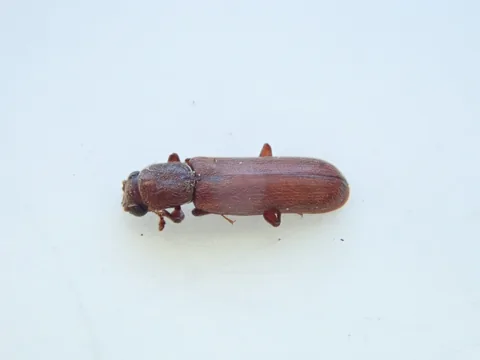 Powderpost Beetles
Lyctinae (e.g., Lyctus brunneus, Lyctus planicollis)
Powderpost beetles are small brown beetles whose larvae tunnel through dry, seasoned hardwood. Often the first clues are tiny round exit holes and little piles of flour-fine dust on floors, furniture or paneling.
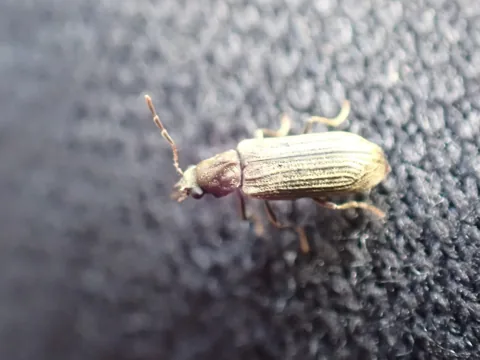 Deathwatch beetles
Anobiinae
Of the three groups of beetles that bore wood inside buildings, the deathwatch beetles are the ones a crawl space should worry about. True powderpost beetles stick to hardwood trim and furniture, but anobiids attack the spruce, pine, fir and Douglas-fir used for floor joists, studs, sills and beams, and because they digest cellulose rather than depending on the starch that fades from aging wood, they can keep reinfesting a house year after year. They need damp wood to do it, which is why Kentucky and NC State treat them as a moisture problem first and an insecticide problem second.
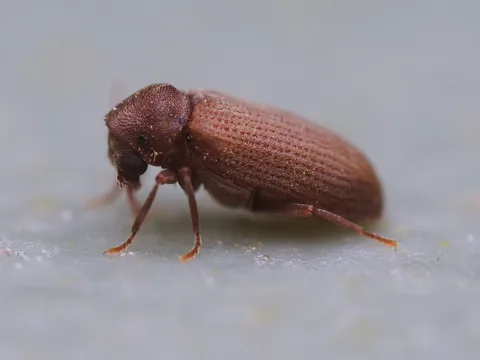 Common Furniture Beetle
Anobium punctatum
The common furniture beetle, Anobium punctatum, is a small anobiid powderpost beetle, often called woodworm. Its larvae tunnel through seasoned wood for a year or more, and despite the name it also attacks floors, framing and structural timbers.
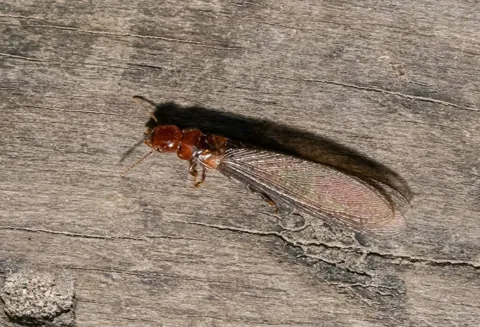 Western Drywood Termite
Incisitermes minor
Drywood termites live entirely inside wood without needing soil contact; the western drywood termite is California's second most important termite pest after subterranean termites. Clemson Extension says drywood termites get the moisture they need from humid air and are most common along humid coastal areas of South Carolina.
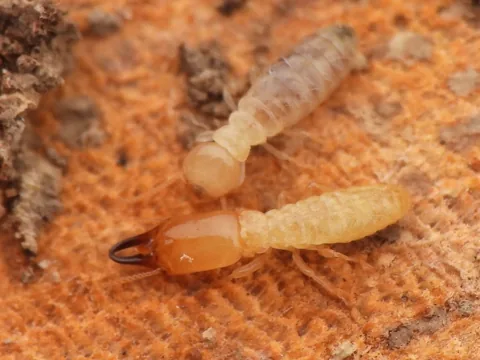 Eastern Subterranean Termite
Reticulitermes spp. (shown: R. flavipes)
Subterranean termites live in the soil and travel into buildings through earthen shelter tubes; they are the most destructive termites in most of the United States and usually warrant a professional.
Side by side
Who they are: "powderpost beetle" covers several small wood-boring beetles. The three most destructive groups are lyctids, anobiids (deathwatch or furniture beetles) and bostrichids (false powderpost beetles). The termites that damage homes are mainly drywood termites, which nest inside wood, and subterranean termites, which nest in soil.[2][1][6][9][10]
- Adult beetles: Kentucky gives powderpost beetles as 1/8 to 3/4 inch long and Washington State 1/8 to 3/8 inch; lyctids are 1/16 to 1/4 inch, narrow and reddish-brown to black. UC IPM says adult powderpost beetles are usually shades of brown to red, and false powderpost beetles are dark brown or black with a humpback look that hides the head from above. Missouri describes anobiids as cylindrical with the head covered by a hoodlike thorax.[2][1][6][7]
- Adult termites: the ones you see are winged swarmers. Termites have straight antennae, a uniformly thick waist and wings of equal size. Texas A&M gives the most common Texas drywood termite swarmer as light yellow and 7/16 inch; UC IPM gives subterranean swarmers as dark brown to brownish-black with brownish-gray wings. Workers are small, creamy-white and wingless.[12][11][10]
- Who you actually see: Kentucky says people are more likely to see beetle damage than the beetles, which are secretive and active mainly at night. UC IPM says drywood termites live deep inside wood and are seldom seen except when they swarm.[2][9]
- Holes, beetles: round exit holes made by emerging adults. Lyctid holes are about 1/32 to 1/16 inch (NC State) or 1/16 to 1/8 inch (Penn State, Iowa State); Missouri gives 0.8 to 1.6 mm for lyctids, 1.6 to 3.0 mm for anobiids and 3 to 7 mm for bostrichids, and Kentucky gives anobiid holes as 1/16 to 1/8 inch and bostrichid holes as 1/8 to 1/4 inch.[4][3][5][6][2]
- Holes, drywood termites: kick-out holes less than 2mm across, through which termites push fecal pellets out of the wood. Pellets pile up on surfaces below the openings.[9][10]
- Holes, subterranean termites: none to look for. NC State says termites don't roam in the open; they tunnel through soil or wood or travel inside mud tubes.[13]
- Debris, lyctids: frass that looks and feels like talcum powder or flour, often in small piles under the holes. Missouri lists it as fine powder that sifts out readily, with no pellets.[4][2][6][7]
- Debris, anobiids and bostrichids: anobiid frass is powdery but gritty and contains elongate or bun-shaped pellets. Bostrichid frass is the grittiest of the three, like powdered borax soap, and stays tightly packed in the tunnels.[4][6][1][2]
- Debris, drywood termites: hard fecal pellets with six flattened sides and ridges along them. UC IPM says they are larger and more granular than powderpost frass, almost like pepper. Texas A&M says the pellets are about the color of the wood being eaten and about 1/32 inch long.[9][10][1][11]
- Debris, subterranean termites: mud tubes about the diameter of a pencil on foundation walls, piers, sill plates and joists, and damaged wood hollowed along the grain with bits of dried mud or soil lining the galleries. Texas A&M notes their galleries contain soil but not fecal pellets.[12][13][11]
- Wood type, beetles: lyctids attack only hardwoods such as oak, ash, walnut, hickory, poplar or cherry, plus bamboo; softwood framing and construction plywood are not suitable for them. Bostrichids are mainly hardwood pests. Anobiids attack both hardwoods and softwoods, and NC State says they are the main concern there in pine, spruce and fir joists and studs.[2][1][4]
- Wood type, termites: termites feed on almost anything with cellulose. UC IPM says drywood termites infest dry, sound wood including structural lumber, decks, fences and furniture, and subterranean termites feed along the grain, eating the softer springwood.[13][10]
- Moisture: lyctids can infest wood as dry as about 8% moisture. Anobiids need damp wood, 13% to 30% per Kentucky or over 14% per UC IPM, so they turn up in crawl spaces and basements. Drywood termites get their water from the wood and don't need soil, while subterranean termites keep a connection to soil for moisture.[2][1][4][11][9][10]
- Season: powderpost beetles usually emerge in late winter, spring or summer depending on species. Subterranean termites often swarm in spring, and UC IPM says drywood termites swarm in daytime in summer and fall.[2][12][9]
How serious is each one?
Sources differ on beetles. Oregon's Department of Forestry says damage from these beetles is generally cosmetic and not structural, unlike termites. Kentucky says lyctids and bostrichids pose little risk to softwood framing, but anobiids can seriously damage beams, joists and other structural parts.[8][2]
- Subterranean termites are serious pests of buildings and usually warrant a professional, says Kentucky; swarmers coming out indoors almost always mean an infestation that needs treatment.[12]
- Many beetle infestations are old. Kentucky says these beetles have a hard time reinfesting wood after emerging indoors, since most surfaces are finished and starch and moisture decline, though small numbers can keep emerging for up to about five years. Missouri lists anobiids as able to reinfest, and Kentucky notes some in Europe still infest buildings centuries old.[2][6]
How to confirm which one you have
Rub the debris between your fingers. Talc-like powder points to lyctids; gritty powder to anobiids; hard grains with six sides point to drywood termites. UC IPM says final confirmation of drywood pellets may need an expert.[4][2][1][9]
- Note the wood. Hardwood flooring, trim, cabinets or furniture fits lyctids. Damp softwood joists in a crawl space fit anobiids. Mud on the wood or a tube coming up from the soil means subterranean termites.[2][4][5][12]
- Check for activity, beetles: Kentucky says active infestations usually have fresh powder the color of new-sawn wood. Mark or seal the holes, clean up the powder, and look again for new holes and powder, ideally in spring or summer when most beetles emerge. NC State says yellowed, caked frass usually means old activity.[2][4][7]
- Check for activity, drywood termites: clean up pellets around a kick-out hole and look again a few days later. UC IPM notes vibration can shake some old pellets loose, and pellets alone can't tell you how widespread an infestation is.[9]
- Check for activity, subterranean termites: break open a mud tube and look for creamy-white workers. An empty tube doesn't prove they're gone, and termites often rebuild broken tubes, which is another sign of current activity.[12][13]
- Keep any winged swarmers you find: Texas A&M says the wings are needed for proper identification, and UC IPM says confirming drywood pellets may need an expert. New beetles collecting on windowsills are another clue to check.[11][9][1]
Why the difference changes treatment
Subterranean termites can't be controlled with drywood termite methods such as fumigation, heat, freezing or electrocution devices, because most of the colony lives in nests near or below the soil. Control relies on soil-applied insecticides, treating nests through tubes, or bait stations.[10]
- Drywood termites are treated either whole-structure (fumigation or heat, which should reach hidden infestations) or locally on a board or a few boards, which UC IPM says can miss hidden ones.[9][10]
- Powderpost beetles are handled by removing and replacing infested wood, borate products on unfinished wood, moisture control for anobiids, or whole-building fumigation for widespread infestations. Borates must soak into bare wood, so finished wood can't be treated that way.[1][4][2]
- Treating an old, inactive beetle infestation wastes effort. Kentucky says a wait-and-see approach often makes the most sense when it's unclear whether beetles are still active.[2]
What to do for each
Lyctid or bostrichid holes in furniture or flooring: confirm activity first. Small items can be removed and fumigated; UC IPM gives oven heating at 120° to 140°F for 6 hours for small wooden items without fabric, pelts or paint. Painting or varnishing seals the pores beetles lay eggs in.[2][1]
- Anobiids in a crawl space: dry the wood. Kentucky and NC State recommend a plastic moisture barrier over the crawl-space soil, better drainage and ventilation; NC State says wood moisture needs to be closer to 13% to become less favorable to the beetles.[2][4]
- Drywood termites: have a professional inspect, since UC IPM says sizing up an infestation takes experience, and ask whether a quote is whole-structure or localized.[9]
- Subterranean termites: get a professional inspection and treatment. UC IPM says to break up shelter tubes and keep soil and wood apart, with a 12-inch barrier of smooth concrete, coarse sand or other inorganic material between soil and structural wood.[12][10]
Common questions
- Are the tiny holes in my hardwood floor from termites?
- Usually not. Small round holes with flour-like powder in hardwood point to lyctid powderpost beetles. Drywood termite kick-out holes come with hard six-sided pellets, and subterranean termites leave mud, not holes and powder.[2][4][9][12]
- Is a pile of powder always active beetles?
- No. Fresh powder the color of new-sawn wood suggests activity; yellowed, caked frass is usually old. Clean it up and check for new powder and holes later.[2][4]
- Do powderpost beetles eat pine framing?
- Lyctids don't; they attack only hardwoods. Anobiids can attack softwood joists and beams, mostly where the wood stays damp.[2][4]
- Can drywood termite pellets be confused with beetle frass?
- Yes, at a glance. UC IPM says drywood pellets are larger, granular and have ridges along their sides, while powderpost frass is fine powder. Anobiid frass can contain small pellets too, smaller than drywood termite pellets.[1][6]
Photo credits
- Powderpost Beetles: Karel Schoonvaere, public domain (CC0), via iNaturalist
- Deathwatch beetles: (c) Lee Cain, some rights reserved (CC BY) — via iNaturalist, CC BY 4.0
- Common Furniture Beetle: (c) Tom, some rights reserved (CC BY) — via iNaturalist, CC BY 4.0
- Western Drywood Termite: (c) Jeremiah Degenhardt, some rights reserved (CC BY) — via iNaturalist, CC BY 4.0
- Eastern Subterranean Termite: (c) Sam Kieschnick, some rights reserved (CC BY) — via iNaturalist, CC BY 4.0
Sources
- University of California Statewide IPM Program, “Pest Notes: Wood-Boring Beetles in Homes.” ipm.ucanr.edu/home-and-landscape/wood-boring-beetles-in-homes/ (accessed 2026-11-14)
- University of Kentucky Entomology, “ENTFACT-616: Powderpost Beetles.” entomology.ca.uky.edu/ef616 (accessed 2026-11-14)
- Penn State Extension, “Powderpost Beetles.” extension.psu.edu/powderpost-beetles (accessed 2026-11-14)
- NC State Extension, “Powderpost Beetles and Wood-Inhabiting Fungi.” content.ces.ncsu.edu/powderpost-beetles-and-wood-inhabiting-fungi (accessed 2026-11-14)
- Iowa State University Extension and Outreach, Yard and Garden, “Powderpost Beetles.” yardandgarden.extension.iastate.edu/encyclopedia/powderpost-beetles (accessed 2026-11-14)
- University of Missouri Extension, “G7422: Wood-Boring Beetles.” extension.missouri.edu/publications/g7422 (accessed 2026-11-14)
- Washington State University Pestsense, “Powderpost beetles.” pestsense.cahnrs.wsu.edu/fact-sheet/powderpost-beetles/ (accessed 2026-11-14)
- Oregon Department of Forestry, “Forest Health Fact Sheet: Structural Wood Pests.” egov.oregon.gov/odf/Documents/forestbenefits/structural-wood-pests.pdf (accessed 2026-11-14)
- University of California Statewide IPM Program, “Pest Notes: Drywood Termites.” ipm.ucanr.edu/home-and-landscape/drywood-termites/ (accessed 2026-11-14)
- University of California Statewide IPM Program, “Pest Notes: Subterranean and Other Termites.” ipm.ucanr.edu/home-and-landscape/subterranean-and-other-termites/ (accessed 2026-11-14)
- Texas A&M Urban and Structural Entomology Program, “Drywood Termites.” urbanentomology.tamu.edu/urban-pests/termites/drywood/ (accessed 2026-11-14)
- University of Kentucky Entomology, “ENTFACT-604: Termite Control: Answers for Homeowners.” entomology.ca.uky.edu/ef604 (accessed 2026-11-14)
- NC State Extension, “Termites: Biology and Control.” content.ces.ncsu.edu/termites-biology-and-control (accessed 2026-11-14)