On this page
How to identify it
- Also called the southern, eastern or light southeastern drywood termite, depending on the source.[3][4][5]
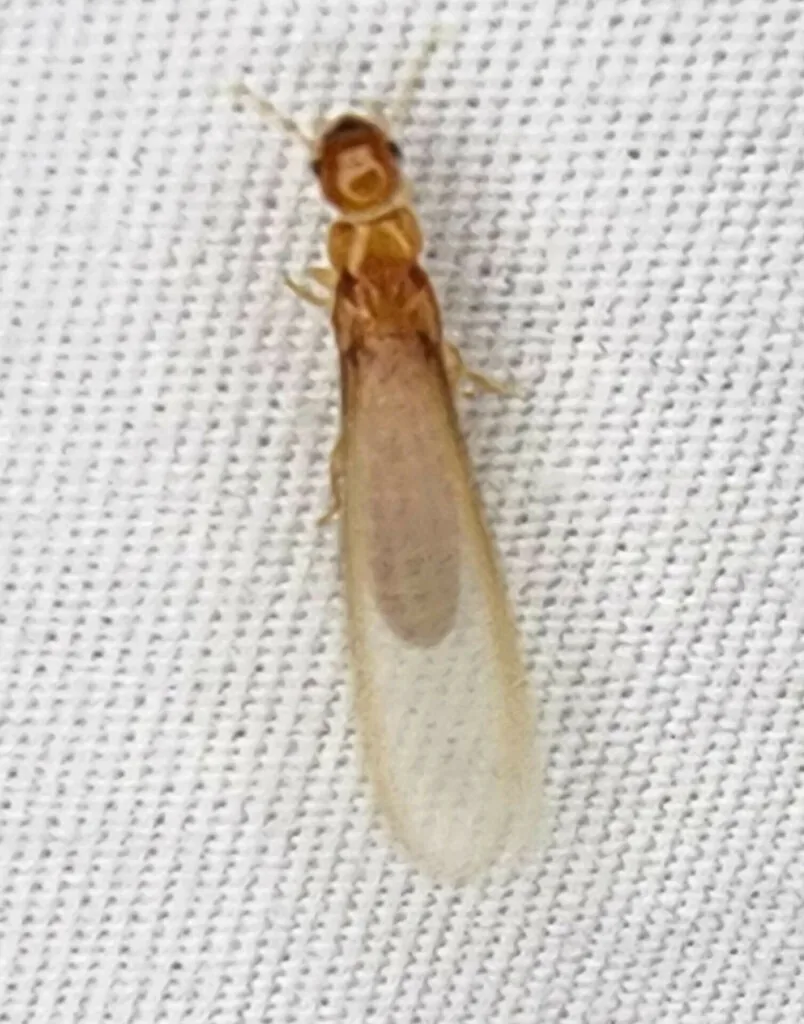
- Swarmers are light yellow, about 7/16 inch long, with clear, uncolored wings.[2]
- Soldiers are about 5/16 inch long, with dark yellow-brown heads and strong jaws.[2]
- Like other drywood termites, workers and soldiers have a plate behind the head that is as wide as the head, unlike subterranean termites.[5]
- Its droppings are hard, six-sided pellets about 1 millimeter long, which pile up below infested wood.[5][3]
- Termites push their pellets out through pencil-tip-sized kick-out holes 1 to 2 mm across. UF/IFAS says the pellets feel gritty when rolled between the fingers, range from light brown to almost black, and their color has nothing to do with the age or color of the wood.[1]
Look-alikes
| Look-alike | How to tell them apart |
|---|---|
| Western drywood termite | Swarmers are larger, about 9/16 inch, with dark bodies and yellow, brown or colorless wings, and they fly during the day instead of at night. UF/IFAS says this non-native termite has been found in many parts of Florida and usually swarms there from the end of August through November.[2][3][1] |
| West Indian drywood termite | West Indian drywood termite soldiers have a square head that resembles a burnt match. Its colonies are generally smaller, and it is almost never found outside the wood of buildings. UF/IFAS says it is never found in natural settings, only in wood in buildings, where it infests picture frames, furniture, boxes and structural woodwork.[2][3][1] |
| Subterranean termites | Nest in soil and build mud tubes, and the plate behind their heads is narrower than the head.[3][5] |
Where it lives
It is found in Florida and the other Gulf Coast states and in coastal South Carolina; finds farther inland, as in Tennessee, are mostly traced to wood or furniture from the Gulf.[5][4][2]
Biology and life cycle
Colonies are generally larger than those of the West Indian drywood termite, fill larger pieces of wood, and occur in both natural and human-made settings.[3]
Swarms usually happen at night from May through November, and the swarmers fly toward lights.[3][2]
Colonies grow slowly and generally don't produce swarmers until they are about five years old.[3]
Like other drywood termites, colonies need no soil contact or outside water source; they get their moisture from the wood they eat.[3]
In South Carolina, all recorded samples came from structures or light traps in six coastal counties, plus one inland record.[4]
Swarming is seasonal, happening once or perhaps twice a year, so shed wings on window sills, floors and countertops are only a brief clue.[1]
Damage and signs
- It attacks dry, sound wood such as flooring, framing, window sills, doors, fascia boards and furniture, and it can infest hot attics.[3]
- Damage builds slowly, but it can become extensive when several colonies live in the same building.[3]
- Drywood termites eat both the hard and soft layers of the wood grain, leaving smooth, sculpted galleries that hold pellets but no soil.[2]
- In advanced infestations the wood surface can blister or warp where termites have tunneled just under it; tapping with a screwdriver handle or probing with a sharp tool helps find damage that isn't obvious. UF/IFAS says damaged wood sounds hollow, and a papery, rustling sound means tunnels just beneath the surface.[3][1]
Health risk
The pellets themselves aren't harmful; their importance is as evidence of an active colony slowly eating the wood.[3]
Control
Prevention
Screen attic and other vents, keep soffits in good repair, and inspect used lumber and wooden furniture before bringing them inside.[3]
Fill cracks and crevices with putty or plastic wood and keep exposed wood painted; pressure-treated wood resists attack. UF/IFAS advises screening vents, doors and windows, especially in the attic, with 20-mesh screen, and notes that the heartwood of redwood, bald cypress, mahogany and Spanish cedar resists termites but becomes susceptible after several years of aging and weathering.[3][1]
Traps and physical control
If an infestation is isolated, removing and replacing the infested wood, such as a window frame or an old piece of furniture, may be the best option. UF/IFAS says to check all the woodwork for pellets and damage first, especially attics, baseboards, window sills, floor joists and furniture.[3][1]
Pesticides
Spot treatments inject insecticide into drilled galleries or kick-out holes, but they miss colonies nobody knows about, and survivors can rebuild.[3]
Soil treatments, whether liquid insecticides or termite baits, won't work, because drywood termite colonies live inside the wood, not in the ground. Unlike subterranean termites, they keep no contact with the soil and get their moisture from the wood they live in.[1][3][2]
When to call a professional
Heat treatment works only if the inside of the wood reaches at least 120 degrees F long enough, so results depend heavily on the technician.[3]
When an infestation is too extensive for spot treatment, tenting and fumigating the whole building is frequently the only effective option. UF/IFAS calls fumigation the only treatment that kills all the termites in a structure when done correctly. The gas, sulfuryl fluoride, leaves nothing behind once the building is cleared, so it gives no protection against new termites; chloropicrin is added as a warning odor. Only a pest control operator licensed in the fumigation category may do it, and infested items can instead go into a fumigation vault.[3][1]
UF/IFAS says most drywood infestations are no cause for panic or immediate treatment: take time to research pest control companies in your area and the treatment options for your home, and get inspections from several companies.[1]
Common questions
- Why are small pale termites flying to my lights on summer nights?
- Along the Gulf Coast and in Florida, that is typical of the southeastern drywood termite, which swarms toward lights at night from May through November.[3][2]
- How do I get a termite identified?
- Collect swarmers or soldiers in a sealed container of rubbing alcohol and take them to your county Extension office; wings alone can also be used. UF/IFAS adds that soldiers and swarmers shrivel quickly, so keep them in rubbing alcohol; pellets can also be submitted.[3][1]
- Is this the same as the western drywood termite?
- No. Both are Incisitermes species, but the western drywood termite has larger, darker swarmers that fly during the day.[2]
Sources
- University of Florida/IFAS Extension (Oi, Scheffrahn, Kern and Ruppert; journals.flvc.org copy), “Drywood and Dampwood Termites, ENY-211 (IG098), revised February 2008 (EDIS archival copy).” journals.flvc.org/edis/article/view/117299 (accessed 2026-11-14). ask.ifas.ufl.edu/publication/IG098 returns 410; read from the archival EDIS journal copy.
- Texas A&M AgriLife Extension, Urban and Structural Entomology, “Drywood Termites.” urbanentomology.tamu.edu/urban-pests/termites/drywood/ (accessed 2026-11-14)
- Cooperative Extension (eXtension Foundation), “How to Get Rid of Drywood Termites (Pests in the Home).” pestsinthehome.extension.org/termites/how-to-get-rid-of-drywood-termites/ (accessed 2026-11-14)
- Clemson Cooperative Extension, Home and Garden Information Center, “Termites of South Carolina (HGIC).” hgic.clemson.edu/factsheet/termites-of-south-carolina/ (accessed 2026-11-14)
- University of Tennessee Extension, Entomology and Plant Pathology (Karen Vail), “Drywood Termites in Tennessee (Insec(tc)ure newsletter, Vol. 3 Issue 3, March 2022).” epp.tennessee.edu/wp-content/uploads/sites/267/2023/11/2022-03DrywoodV3I3.pdf (accessed 2026-11-14)
- iNaturalist, “Incisitermes snyderi taxon page (order and family).” www.inaturalist.org/taxa/261633 (accessed 2026-11-14)