On this page
How to identify it
- Soldiers have a square, black head with very short jaws, shaped like a burnt match; they use it to plug tunnels against ants and other intruders. UF/IFAS describes the soldier's head capsule as dark and rough and calls this plug-shaped head phragmotic.[2][1][17][19]
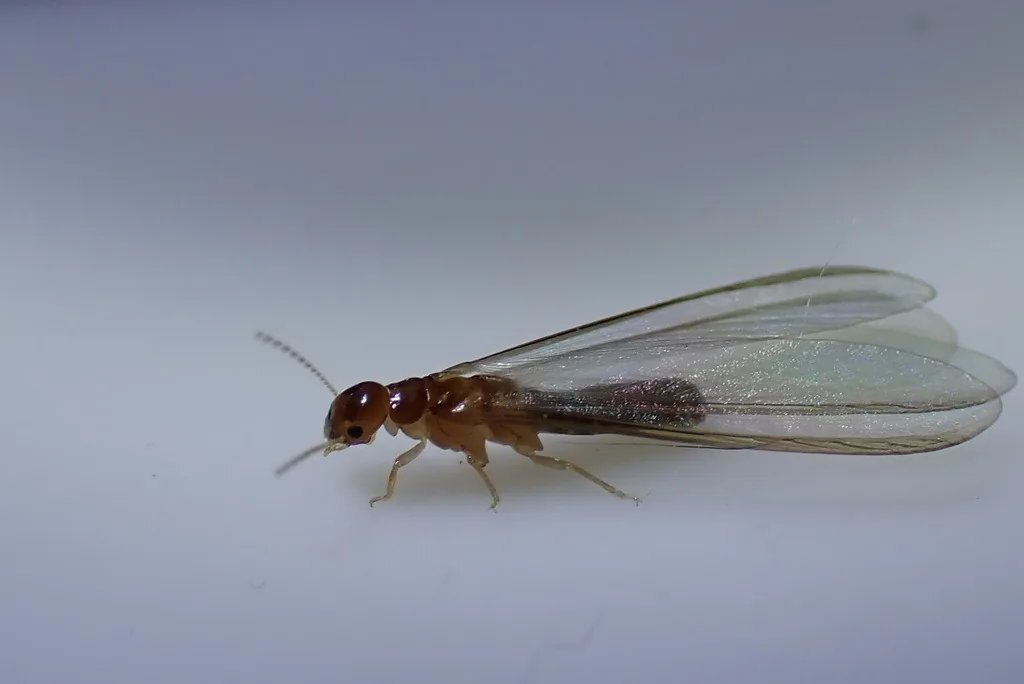
- Swarmers have four wings of about equal size. In drywood termites, the front edge of the forewing has three or more darkened veins near the base, though these are hard to see unless the wing is removed, flattened and magnified. UF/IFAS says swarmers are darker than the other castes, with two pairs of hairless but vividly iridescent wings carrying three to four darkened veins along the front edge, and that this species lacks the pad (arolium) between the claws that other Cryptotermes have.[1][4][17]
- As in other drywood termites, the plate just behind the head is as wide as the head itself, in workers and soldiers alike. UF/IFAS says the drywood soldier's pronotum is always as wide as or wider than the head.[4][17]
- The droppings are hard pellets about 1 mm long with six concave sides that show under a magnifier (Clemson gives about 1/16 inch, Texas A&M about 1/32 inch). Sources split on color: Clemson describes black, cream or mixed salt-and-pepper pellets and UT Extension says color isn't tied to the wood eaten, while Texas A&M says pellets are generally the color of the wood. UF/IFAS describes the pellets as hexagonal in cross section and cream, red or black, says color is not tied to age or to the color of the wood, and gives kick-out holes as usually 1 to 2 mm across; it measured C. brevis pellets at a mean of 0.87 mm long, smaller than the western drywood termite's 0.98 mm.[4][1][6][2][17][19][18]
Look-alikes
| Look-alike | How to tell them apart |
|---|---|
| Western drywood termite | The main drywood termite of the western U.S. Its swarmers are about 9/16 inch long with dark bodies and fly by day from late August into November, and its soldiers have dark yellow-brown heads with strong jaws rather than a plug-shaped head. UF/IFAS says it is a much bigger species with larger colonies; its soldiers have an enlarged, club-like third antennal segment, its swarmers have an orange-brown head and pronotum and smoky-tinted wings, and unlike the West Indian drywood termite it infests natural as well as structural wood.[2][1][18] |
| Southeastern drywood termite | Similar-looking swarmers, but light yellow with clear wings, flying at night toward lights, usually May through November; colonies are larger, live in natural settings as well as buildings, and cause more serious structural damage. UF/IFAS says its colonies are generally larger than the West Indian drywood termite's and occupy larger pieces of wood, in natural and human-made settings, and that it usually swarms from May through November.[2][1][19] |
| Subterranean termites | Nest in the ground and build mud tubes; their galleries follow the soft springwood and contain soil, and the plate behind the head is narrower than the head.[1][2][4] |
| Cryptotermes cavifrons | A close relative in Florida whose swarmers also come to lights, but UF/IFAS says it infests only dead tree branches, not buildings.[19] |
Where it lives
Cooperative Extension says it is concentrated in Florida and around the Gulf Coast. Outside that core it turns up in buildings: Texas A&M lists it among the three common drywood termites in Texas, Clemson has records from seven South Carolina counties and none from natural habitats, and UT Extension traces most Tennessee drywood termite cases to furniture or wood from Florida and other Gulf Coast states. GBIF holds only about 30 public U.S. records since 1990, nearly all from Florida plus a couple from Hawaii. Abroad it is a major invasive pest and a common catch at Australia's border, and it is spreading in two eastern Australian states. UF/IFAS says it was first recorded in Florida in 1918, in a Key West building, and has spread through the state's coastal regions; its U.S. range, in order of establishment, is Florida, Hawaii, Puerto Rico, the U.S. Virgin Islands and the southeastern Gulf Coast, with the largest populations in older buildings in the southern half of Florida.[1][2][3][4][16][8][9][17]
Biology and life cycle
The colony lives entirely inside wood and needs no contact with soil. Sources differ on its water: Cooperative Extension and Texas A&M say drywood termites get all the moisture they need from the wood they eat, while Clemson says they take it from humid air, which is why they concentrate in humid coastal areas. UF/IFAS says drywood termites get moisture both from water bound in the wood they eat and from their own metabolism.[1][2][6][17]
Swarmers are poor fliers that drift on the wind; after landing they drop their wings and enter wood through cracks, joints or exposed end grain to start a colony. UF/IFAS says flights happen mostly from April to June, before the rainy season, though they can occur any time of year; a dealated male and female then pair off, the male following the female, to find a crack, hole or knot in wood to start a colony.[1][17]
Swarmers are drawn to light, and lab tests on populations from South Florida and the Azores found they preferred white, blue and green light over yellow, red or ultraviolet.[1][13]
Colonies grow slowly. Clemson says a two-year-old drywood colony may hold fewer than 50 workers and one soldier and that swarmers come only after four years or more; Cooperative Extension puts first swarmers at about five years. For this species, UF/IFAS says soldiers first appear two to three years after a colony starts and swarmers at about five years, and a colony can live more than ten years.[6][1][17]
A mature drywood colony may have only a few hundred to a few thousand members, but colonies reinfest after swarming, so older buildings often hold several.[6]
Like other invasive termites, it eats wood, nests inside its food and readily produces replacement reproductives, the three traits a worldwide review found shared by all invasive termites.[14]
UF/IFAS traces its native range to the coastal desert of Peru and Chile; Spanish ships and goods likely spread it from there, and it has never been found in natural habitat anywhere else.[17]
Damage and signs
- It infests furniture and picture frames as well as wood flooring, framing, windowsills, doors, fascia boards and attics. UF/IFAS says it infests hardwoods and softwoods shielded from rain, including building lumber and furniture, appears to prefer sapwood, and is more common in older metropolitan areas, though it can attack new wood too.[1][17]
- Damage stays hidden: drywood termites tunnel up to the surface and leave only a thin skin of wood, cutting smooth galleries across both the light and dark growth rings. Outward signs are pellet piles under tiny kick-out holes and shed wings near windows. UF/IFAS adds blistering or peeling of thin surface wood or paint as a sign.[6][1][2][17]
- Wood type matters: in lab tests, pine was among the most heavily attacked woods, while denser, harder tropical hardwoods resisted.[15]
- Elsewhere in the world it ranks among the most destructive invasive termites of the tropics and subtropics.[8]
Health risk
Drywood termite droppings are not dangerous the way some animal droppings are; the concern is slow damage to wood, and fresh pellets mean termites are active.[1]
Control
Prevention
Check used furniture, frames and other wooden items, especially pieces from Florida or the Gulf Coast, for pellets and kick-out holes before bringing them indoors.[1][4]
Keep soffits in good repair and screen vents to keep swarmers out of attics, though Cooperative Extension cautions that in termite-rich places such as south Florida nothing can guarantee against termites. UF/IFAS says caulk and mesh screening with holes smaller than a swarmer's head (about 1 mm) can keep swarmers out, but complete exclusion is almost impossible.[1][17]
A borate treatment on exposed wood kills termites that feed on it. UF/IFAS also lists borate sprays or foams on raw wood, drying dusts such as borax in attics and wall voids, and pressure-treated wood as preventives, noting that residential use of CCA-treated wood has been largely restricted since 2003.[1][17]
Traps and physical control
If the infestation is confined to a door, trim or piece of furniture, removing and destroying the infested wood is one of the best fixes. UF/IFAS lists complete removal of infested wood in isolated pieces such as a door among localized options.[6][17]
Small furniture can be wrapped in plastic and frozen for about two weeks, then left wrapped until it warms to room temperature.[6]
Pesticides
Spot treatments drill into the galleries and inject a dust or liquid, but they reach only the colonies you know about, and Cooperative Extension says the product must be non-repellent. Results vary: in infested shipping pallets, single-point injections killed no more than about 60% of the termites, while a lab test found a pyrethrin aerosol penetrated pellet-filled galleries and killed nearly all of them. UF/IFAS describes drill-and-treat injections into galleries or kick-out holes, plus less common localized methods such as microwave heating and handheld electrocution devices.[6][1][12][11][17]
When to call a professional
Whole-structure heat holds all wood at 120 F or more for at least 33 minutes and needs the house empty for hours rather than days, but large beams and heat sinks such as wood on concrete are hard to heat, and heat-sensitive items can be damaged. In lab tests, an hour at 45 C or three minutes at 50 C killed these termites, while Clemson calls heat and cold variations of fumigation controversial and not available in South Carolina. UF/IFAS says technical and economic limits usually confine heat to a single room or apartment rather than a whole house.[7][9][6][17]
Widespread or hidden infestations call for tent fumigation with sulfuryl fluoride by licensed professionals. A monitored fumigation has the highest success, occupants, pets and plants must leave for several days, and neither fumigation nor heat leaves any protection against new colonies. UF/IFAS calls tent fumigation with sulfuryl fluoride the primary method for inaccessible or widespread infestations.[1][7][17]
Where the sources disagree
Most common drywood termite in Florida: UF/IFAS's western drywood termite profile calls the West Indian drywood termite the most common structure-infesting drywood termite in Florida, while UF/IFAS's older drywood and dampwood guide calls the southeastern drywood termite the most common drywood in the state, counting natural settings as well as buildings.[18][19]
Pellet color: UF/IFAS and UT Extension say pellet color is not tied to the wood eaten, while Texas A&M says pellets are generally the color of the wood.[17][19][4][2]
First swarmers: Clemson says drywood colonies swarm only after four years or more, while UF/IFAS and Cooperative Extension put first swarmers at about five years.[6][17][1]
Common questions
- How can I tell whether a drywood termite treatment worked?
- Clean up all pellets and wings, then watch. More pellets a few days after cleanup, or live termites, mean an active infestation, but old pellets can be shaken loose by vibration. Telling old frass from new is hard; one study found chemical differences between pellets under six months old and those over a year, though the method needs laboratory equipment. UF/IFAS says removing all pellets and wings after a treatment makes a good monitoring system, and new, growing pellet piles or swarmers usually mean the treatment failed.[1][10][17]
- Can I bring drywood termites home in furniture?
- Yes. Because they live in wood with little moisture, drywood termites travel easily in furniture, and UT Extension traced most Tennessee cases, including a set of cabinets, to wood from Florida or other Gulf Coast states.[4][1]
- Do I need to tent my house right away?
- Usually not. Drywood termite damage happens slowly, and Cooperative Extension says there should be no need to rush into a fumigation. A small infestation in one piece, like the Tennessee cabinets, can be removed and fumigated off-site instead of tenting the whole building. UF/IFAS likewise says most drywood infestations are not cause for panic and immediate treatment, advises taking time to compare companies and treatment options, and notes that soil treatments and termite baits would be ineffective because the colony lives in the wood.[1][4][19]
Sources
- Cooperative Extension (eXtension Foundation), “How to Get Rid of Drywood Termites (Pests in the Home).” pestsinthehome.extension.org/termites/how-to-get-rid-of-drywood-termites/ (accessed 2026-11-11)
- Texas A&M AgriLife Extension, Urban and Structural Entomology, “Drywood Termites.” urbanentomology.tamu.edu/urban-pests/termites/drywood/ (accessed 2026-11-11)
- Clemson Cooperative Extension, Home and Garden Information Center, “Termites of South Carolina (HGIC).” hgic.clemson.edu/factsheet/termites-of-south-carolina/ (accessed 2026-11-11)
- University of Tennessee Extension, Entomology and Plant Pathology (Karen Vail), “Drywood Termites in Tennessee (Insec(tc)ure newsletter, Vol. 3 Issue 3, March 2022).” epp.tennessee.edu/wp-content/uploads/sites/267/2023/11/2022-03DrywoodV3I3.pdf (accessed 2026-11-11)
- iNaturalist, “Cryptotermes brevis taxon page (order and family).” www.inaturalist.org/taxa/296455 (accessed 2026-11-11)
- Clemson Cooperative Extension, Home & Garden Information Center, “Drywood Termites (HGIC).” hgic.clemson.edu/factsheet/drywood-termites/ (accessed 2026-11-11)
- University of California Statewide IPM Program, “Pest Notes: Drywood Termites, Publication 7440 (August 2014).” ipm.ucanr.edu/legacy_assets/PDF/PESTNOTES/pndrywoodtermites.pdf (accessed 2026-11-11)
- Scientific Reports, via PubMed, “A loop-mediated isothermal amplification (LAMP) assay for the detection of Cryptotermes brevis West Indian drywood termite (Andjic et al. 2022).” pubmed.ncbi.nlm.nih.gov/36068251/ (accessed 2026-11-11). Cited from the PubMed abstract.
- Journal of Thermal Biology, via PubMed, “Thermal tolerance of an invasive drywood termite, Cryptotermes brevis (McDonald et al. 2022).” pubmed.ncbi.nlm.nih.gov/35180975/ (accessed 2026-11-11). Cited from the PubMed abstract.
- Insects, via PubMed, “Use of chemical and colorimetric changes to age Cryptotermes brevis frass for termite management (Haigh et al. 2024).” pubmed.ncbi.nlm.nih.gov/39769526/ (accessed 2026-11-11). Cited from the PubMed abstract.
- Insects, via PubMed, “Potential of gas-propelled aerosol containing synergized pyrethrins for localized treatment of Cryptotermes brevis (Hassan & Fitzgerald 2023).” pubmed.ncbi.nlm.nih.gov/37367338/ (accessed 2026-11-11). Cited from the PubMed abstract.
- Journal of Economic Entomology, via PubMed, “Comparison of localized injections of spinosad and selected insecticides for the control of Cryptotermes brevis in naturally infested structural mesocosms (Woodrow, Grace & Oshiro 2006).” pubmed.ncbi.nlm.nih.gov/16937692/ (accessed 2026-11-11). Cited from the PubMed abstract.
- Journal of Economic Entomology, via PubMed, “Attraction of alates of Cryptotermes brevis to different light wavelengths in South Florida and the Azores (Ferreira et al. 2012).” pubmed.ncbi.nlm.nih.gov/23356089/ (accessed 2026-11-11). Cited from the PubMed abstract.
- Annual Review of Entomology, via PubMed, “Biology of invasive termites: a worldwide review (Evans, Forschler & Grace 2013).” pubmed.ncbi.nlm.nih.gov/23020620/ (accessed 2026-11-11). Cited from the PubMed abstract.
- Pest Management Science, via PubMed, “Tropical wood resistance to the West Indian drywood termite Cryptotermes brevis: if termites can't chew (Cosme et al. 2018).” pubmed.ncbi.nlm.nih.gov/29095561/ (accessed 2026-11-11). Cited from the PubMed abstract.
- Global Biodiversity Information Facility (GBIF), “Cryptotermes brevis: occurrence records in the U.S., 1990-2026 (GBIF occurrence search).” api.gbif.org/v1/occurrence/search?taxonKey=2007322&country=US&hasGeospatialIssue=false&occurrenceStatus=PRESENT&year=1990%2C2026&facet=stateProvince&facetLimit=400&limit=0 (accessed 2026-11-11). Very few records; the page map uses the states named in the cited sources instead.
- University of Florida IFAS Extension, EDIS (Featured Creatures), “West Indian Drywood Termite, Cryptotermes brevis (Walker), EENY-79/IN236 (Featured Creatures).” ask.ifas.ufl.edu/publication/IN236 (accessed 2026-11-14)
- University of Florida IFAS Extension, EDIS (Featured Creatures), “Western Drywood Termite, Incisitermes minor (Hagen), EENY-248/IN526 (Featured Creatures).” ask.ifas.ufl.edu/publication/IN526 (accessed 2026-11-14)
- University of Florida IFAS Extension, EDIS (journals.flvc.org archive), “Drywood and Dampwood Termites, ENY-211 (archival copy).” journals.flvc.org/edis/article/download/117299/115411/170335 (accessed 2026-11-14). Archival EDIS copy hosted by the Florida Virtual Campus journal platform.