The short answer
- Look for silk. Clothes moth larvae spin webbing, silk feeding tubes or a carried silk case. Carpet beetle larvae make no webs; they leave brown, bristly, shell-like cast skins and droppings about the size of a grain of salt.[1][2][3]
- Look at the larva. A clothes moth larva is a shiny, creamy-white caterpillar with a dark head. A carpet beetle larva is a slow, tan to brown grub densely covered in hairs or bristles.[1][3][4]
- Look at where the adults are. Clothes moths avoid light and stay in dark closets close to the infested items. Adult carpet beetles are drawn to light, so they turn up on windowsills indoors and on flowers outdoors.[3][1][2][4][5]
- Look at the damage pattern. UC IPM says carpet beetles more often damage one larger area of a garment or carpet, while moth damage more often shows up as scattered holes, though the damage alone is not always enough to tell.[2]
Fabric pests on this page
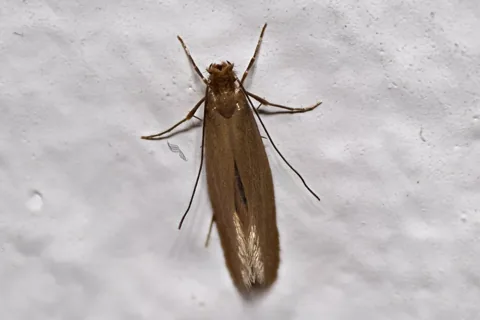 Webbing Clothes Moth
Tineola bisselliella
The webbing clothes moth is probably the most commonly encountered clothes moth in the United States. Its larvae feed on wool, fur, feathers and other animal fibers in hidden spots, and the moths are seldom seen because they avoid light.
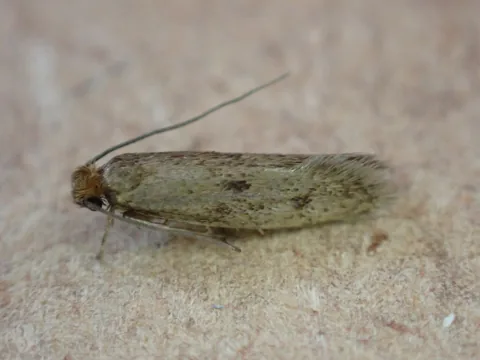 Casemaking Clothes Moth
Tinea pellionella
The casemaking clothes moth is a small fabric pest whose larvae feed on wool, fur, feathers and other animal fibers. Each larva lives inside a portable silk tube that takes on the color of whatever it has been eating.
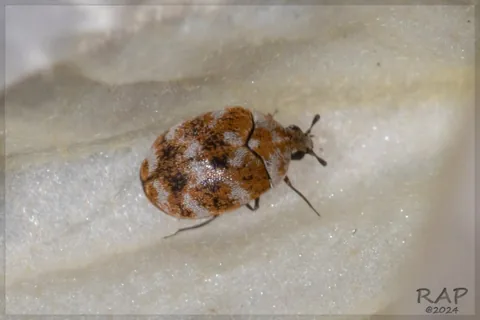 Varied Carpet Beetle
Anthrenus verbasci
Carpet beetles are small beetles whose larvae damage wool, silk, fur, feathers, leather and other animal products; the adults feed on pollen outdoors and often fly in through windows.
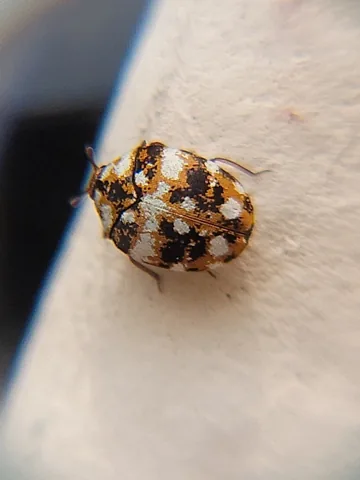 Furniture Carpet Beetle
Anthrenus flavipes
The furniture carpet beetle is a small, round dermestid beetle whose hairy larvae chew upholstery, carpets, fur and other animal-fiber items. UF/IFAS calls it a cosmopolitan pest that is most destructive in warmer parts of the world; in the United States it is mainly a pest of the southern states, though it also turns up in heated buildings farther north.
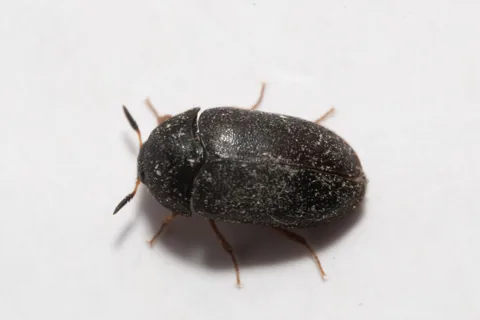 Black Carpet Beetle
Attagenus unicolor
The black carpet beetle is a shiny black carpet beetle whose larvae feed on wool, fur, feathers and other animal products, plus grains and other stored foods. In dry areas such as California, it is more often a pantry pest than a fabric pest. Colorado State Extension calls it one of the most common dermestid beetles.
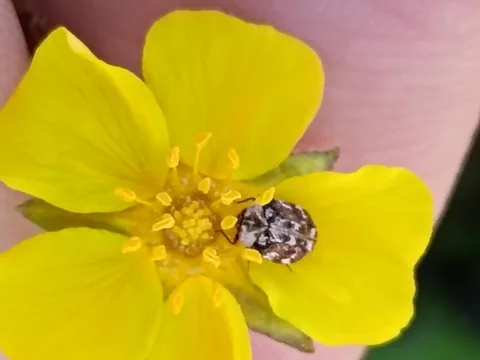 Common Carpet Beetle
Anthrenus scrophulariae
The common carpet beetle is a small, nearly round dermestid beetle whose larvae eat wool, carpets, fur and other animal products. UF/IFAS says it is found worldwide and also attacks preserved museum specimens.
Side by side
What they are: clothes moths are small moths; the two common ones are the webbing clothes moth (Tineola bisselliella) and the casemaking clothes moth (Tinea pellionella). Carpet beetles are small beetles in the dermestid family; UC IPM names the varied, furniture and black carpet beetles as the ones that damage fabrics in California.[3][1][2]
- Adult size and shape: a clothes moth is about 1/4 inch long at rest, with a wingspan of about 1/2 inch, and narrow wings fringed with hairs. A carpet beetle is a small, round to oval beetle, about 1/16 to 1/8 inch long per UKY (UC IPM gives about 1/10 to 1/8 inch); the black carpet beetle is larger, 1/8 to 3/16 inch.[1][3][4][2]
- Adult color: webbing clothes moths are a plain buff or gold with a tuft of reddish hairs on top of the head; casemaking clothes moths are browner with faint dark specks on the wings. Carpet beetles are either solid black or mottled with white, brown, yellow and orange scales.[1][3][4]
- Larvae: clothes moth larvae are shiny, creamy-white caterpillars with a dark head capsule, up to 1/2 inch long per UKY (Clemson says about 1/3 inch). Carpet beetle larvae are hairy or bristly and tan to brown, about 1/8 to 1/4 inch per UKY and up to 1/2 inch per Clemson; UC IPM describes them as looking like fuzzy or hairy maggots.[1][3][5][4][2]
- What the larvae leave: webbing clothes moth larvae spin silk tubes and patches of webbing mixed with fibers and droppings, then abandon them as they move on. Casemaking larvae carry an open-ended silk case, about 3/8 inch long when full grown, that takes on the color of the fabric. Carpet beetle larvae spin no webbing but leave cast skins and tiny droppings where they feed.[1][3][2]
- Damage: both larvae graze along the surface of the material. UKY says clothes moth grazing leaves threadbare spots where fibers are removed at the base, and carpet beetle grazing leaves threadbare spots and irregular holes. On fur and mounted animals, clothes moth feeding lets clumps of hair come loose from the skin.[3][4][2]
- Adult behavior: adult clothes moths don't feed, aren't attracted to light, and are weak fliers that flutter around the infested area. Adult carpet beetles feed on flower pollen and nectar, are good fliers, and are attracted to light.[5][1][3][2]
- What the larvae eat: clothes moths feed only on animal fibers such as wool, fur, silk, feathers, felt and leather, plus items like natural-bristle brushes, wool piano felts and fish meal. Carpet beetles eat the same animal materials and also dead insects, bird nests and animal carcasses, and occasionally stored foods such as certain spices and grains.[3][1][2][4]
- Cotton and synthetics: both UKY fact sheets say cotton and synthetics such as polyester and rayon are rarely attacked unless blended with wool or heavily soiled with food stains or body oils. UC IPM says carpet beetles don't feed on synthetic fibers.[3][4][2]
- Where you find them: clothes moths stay in dark, undisturbed spots such as closets, basements and attics, close to what they are eating. Either one can also breed in a bird or animal nest in an attic, chimney or wall cavity. Carpet beetle larvae hide from light too, and they have more places to breed away from your clothes: rodent and old wasp nests, and piles of dead insects such as cluster flies and lady beetles in attics, basements and light fixtures.[3][1][5][4]
- Season: adult carpet beetles usually show up in spring or early summer, often on windowsills. Clothes moths in heated buildings keep developing through the winter, and UC IPM says there are usually two generations a year.[2][4][1]
Little brown shells: moth case or beetle skin?
The confusing find is a small, empty-looking husk on a shelf or in a rug. A casemaking clothes moth case is a cigar-shaped silk tube, open at both ends and about 3/8 inch long when the larva is full grown, often with bits of the fabric worked into it. It is usually the color of the fabric, and a live larva may still be inside, sometimes with the case attached to the material at one end.[1][3]
- A carpet beetle cast skin is the molted outer skin of the larva: brown, shell-like and bristly. It is hollow, and there will be no silk around it.[2][4]
- Clemson notes that carpet beetle larvae shed many times, so a pile of skins can make an infestation look larger than it really is. Colorado State adds that the larvae generally don't feed over a wide area, so skins tend to build up where they are feeding.[5][6]
How to confirm which one you have
Search the hidden spots first: under collars and cuffs, in seams and folds, in crevices of upholstered furniture, under heavy furniture on rugs, along baseboards where hair and lint collect, and in vents.[1][3]
- Catch an adult moth and look at its head with a hand lens. UC IPM says clothes moths have a tuft of hair on top of the head that food-infesting moths lack, and clothes moths are about half the length of most pantry moths.[1]
- Use a pheromone trap for moths. The lure copies the female clothes moth's sex pheromone and draws males, which helps reveal early infestations that are hard to find by looking. UKY says webbing and casemaking clothes moths each have their own pheromone, so match the lure to the moth you have.[3][1]
- Use glue traps for beetles. UKY says glue traps with or without a lure help detect carpet beetle infestations; UC IPM suggests plain sticky traps on windowsills to catch adults flying to the light, and traps placed through the building to show where beetles are coming from.[4][2]
- Check windowsills. Adult carpet beetles on sills in spring point to beetles; a clothes moth is rarely seen in bright light.[4][2][3]
Why the difference matters
The search area differs. Clothes moths usually start on wool or fur stored for a long time and fly only around that part of the house, though UKY says they occasionally come from a bird or animal nest. Carpet beetles also breed in dead insects and nests and disperse through the building; UC IPM calls them among the most difficult indoor pests to control because they find food in obscure places and spread widely.[1][3][4][2]
- The traps differ. A clothes moth pheromone lure targets male moths, while carpet beetle monitoring uses its own lures or plain sticky traps on windowsills.[3][2][4]
- The fix outdoors differs. Carpet beetles fly in from flowering plants and ride in on cut flowers, so screens and checking flowers matter for beetles. Clothes moths aren't attracted to lights, so the work stays indoors with the infested items.[2][5][1]
What to do about each
Both: find and deal with every infested item, then launder, dry clean, freeze or heat what can be saved, and pack clean items in tight-fitting plastic bags or containers. The step-by-step methods are on our clothes moth and carpet beetle removal guide and the freezing guide.[1][2][3][4]
- Clothes moths: clean seldom-cleaned spots under furniture, along baseboards and in closets where woolens and furs are kept, and keep indoor humidity low, which UC IPM says makes conditions less favorable for clothes moths. Brush and clean woolens before storing them.[1][5]
- Carpet beetles: also vacuum lint, hair and dead insects from windowsills, check the attic and chimney for old bird or squirrel nests and dead insects, and seal gaps around windows, doors, vents and eaves. Colorado State notes that storing susceptible materials below 40°F helps.[6][4][5][2]
Common questions
- Do adult clothes moths or adult carpet beetles eat my clothes?
- No. Adult clothes moths don't feed, and adult carpet beetles feed on pollen and nectar outdoors. All of the fabric damage is done by the larvae.[5][2][4]
- I see small beetles on my windowsill. Do I have carpet beetles in my closet?
- Maybe. UKY says adults on windowsills in spring suggest an infestation may be inside the home, but UC IPM notes they also fly in from flowers or come in on cut flowers. Check stored woolens, rugs and the attic for larvae and skins.[4][2]
- Will a clothes moth trap catch carpet beetles?
- It isn't designed to. The lure mimics the female clothes moth's sex pheromone, so it draws male moths. Use carpet beetle lures or plain sticky traps on windowsills for beetles.[3][2][4]
- Can either one eat cotton or polyester?
- Rarely. Both feed on keratin from animal materials, and cotton and synthetics are rarely attacked unless blended with wool or soiled with food or body oils.[3][4]
Photo credits
- Webbing Clothes Moth: (c) David Kleuker, some rights reserved (CC BY) — via iNaturalist, CC BY 4.0
- Casemaking Clothes Moth: Stephen James McWilliam, public domain (CC0), via iNaturalist
- Varied Carpet Beetle: (c) RAP, some rights reserved (CC BY) — via iNaturalist, CC BY 4.0
- Furniture Carpet Beetle: (c) Rodolfo Salinas Villarreal, some rights reserved (CC BY) — via iNaturalist, CC BY 4.0
- Black Carpet Beetle: (c) Поляков Александр, some rights reserved (CC BY) — via iNaturalist, CC BY 4.0
- Common Carpet Beetle: (c) Alexander Petrunin-Suharev, some rights reserved (CC BY) — via iNaturalist, CC BY 4.0
Sources
- University of California Statewide IPM Program, “Pest Notes: Clothes Moths.” ipm.ucanr.edu/home-and-landscape/clothes-moths/ (accessed 2026-11-14)
- University of California Statewide IPM Program, “Pest Notes: Carpet Beetles.” ipm.ucanr.edu/home-and-landscape/carpet-beetles/ (accessed 2026-11-14)
- University of Kentucky Entomology, “ENTFACT-609: Clothes Moths.” entomology.mgcafe.uky.edu/ef609 (accessed 2026-11-14)
- University of Kentucky Entomology, “ENTFACT-601: Carpet Beetles.” entomology.mgcafe.uky.edu/ef601 (accessed 2026-11-14)
- Clemson Cooperative Extension Home & Garden Information Center, “Controlling Fabric Pests (HGIC 2416).” hgic.clemson.edu/factsheet/controlling-fabric-pests/ (accessed 2026-11-14)
- Colorado State University Department of Agricultural Biology, “Dermestid beetles.” agsci.colostate.edu/agbio/ipm-pests/dermestid-beetles/ (accessed 2026-11-14)