The short answer
- Wings: the Indian meal moth's front wings are two-toned, coppery reddish brown on the outer two-thirds and whitish gray near the body. Clothes moths are a plain buff or gold color; the casemaking clothes moth adds faint dark specks.[2][6][4][1][3]
- Size and head: at rest a clothes moth is only about 1/4 inch long, and most food moths are about double that. Clothes moths have a tuft of reddish or light hairs on top of the head that food moths lack.[1][3]
- Where and how they fly: clothes moths avoid light, stay in dark closets, basements and attics, and flutter near the infested items. Moths in kitchens and other bright rooms are more likely pantry moths, which are attracted to light and wander to other rooms.[3][1][8]
- What the larvae leave: clothes moth larvae graze holes and threadbare spots in wool, fur, silk and feathers. Pantry moth larvae fill food with silk webbing, droppings and cast skins.[1][3][8][2]
Moths on this page
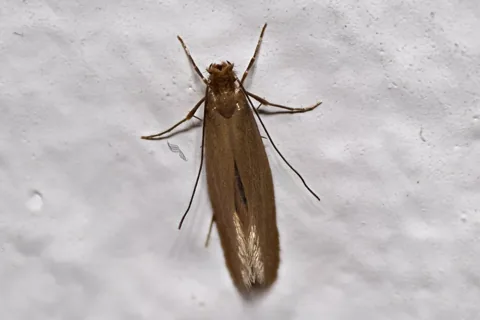 Webbing Clothes Moth
Tineola bisselliella
The webbing clothes moth is probably the most commonly encountered clothes moth in the United States. Its larvae feed on wool, fur, feathers and other animal fibers in hidden spots, and the moths are seldom seen because they avoid light.
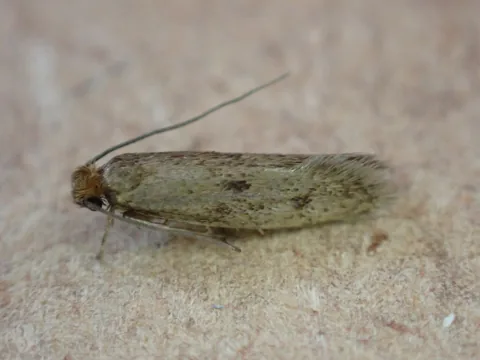 Casemaking Clothes Moth
Tinea pellionella
The casemaking clothes moth is a small fabric pest whose larvae feed on wool, fur, feathers and other animal fibers. Each larva lives inside a portable silk tube that takes on the color of whatever it has been eating.
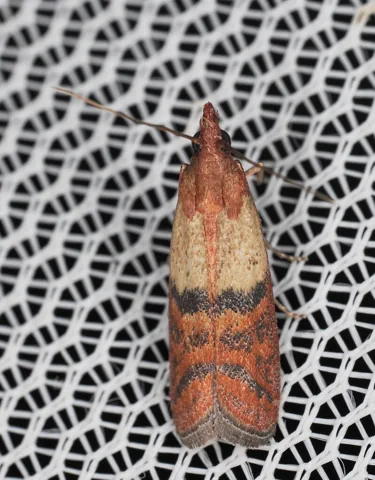 Indianmeal Moth
Plodia interpunctella
The Indianmeal moth is the most common moth infesting stored food in the home; all damage is done by the larvae, which feed in cereals, flour, nuts, dried fruit, chocolate and pet food.
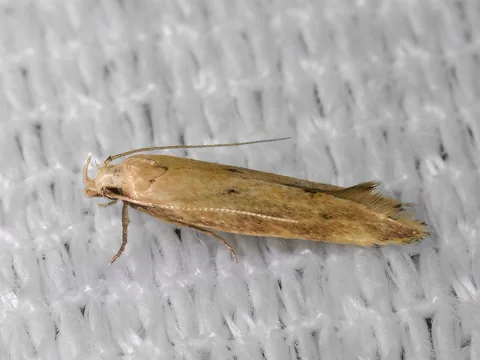 Angoumois Grain Moth
Sitotroga cerealella
The Angoumois grain moth is a primary pest of stored grain: its caterpillars develop entirely inside single kernels, so infested corn or wheat can look normal until moths appear. USDA's stored-grain handbook calls it the moth most commonly found in infested grain in the United States. UF/IFAS ranks it second only to the grain and rice weevils in importance as a pest of stored grain in the United States, and a UF grain-storage circular calls it most important in stored corn.
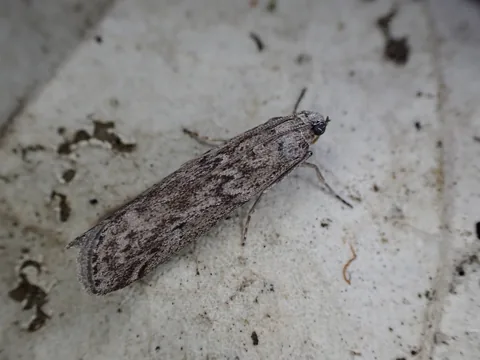 Mediterranean Flour Moth
Ephestia kuehniella (also listed as Anagasta kuehniella)
The Mediterranean flour moth is a gray pantry moth whose caterpillars line flour and other dry foods with silk webbing. Washington State University calls it a frequent food-infesting moth in homes, though less common than the Indian meal moth.
Side by side
Two clothes moths are common in North America, the webbing clothes moth (Tineola bisselliella) and the casemaking clothes moth (Tinea pellionella). The usual pantry moth is the Indian meal moth (Plodia interpunctella), the most common moth on food products in homes.[3][1][2]
- Wing color, clothes moths: the webbing clothes moth is a uniform buff to gold with a fringe of golden hairs on narrow wings. The casemaking clothes moth is similar but more brownish, with faint dark spots on the wings.[1][3][5]
- Wing color, Indian meal moth: reddish brown front wings with a copper luster on the outer two-thirds and gray to whitish gray on the inner third, so the folded moth looks gray near the head and coppery toward the tip.[2][6][7][8]
- Head: clothes moths have little tufts of hair on the head (reddish on the webbing clothes moth, lighter on the casemaking). Food moths don't have them.[1][3]
- Size: UC IPM puts a resting clothes moth at about 1/4 inch and gives a wingspan of about 1/2 inch for the webbing clothes moth. For the Indian meal moth, UC IPM gives 1/3 to 2/5 inch long with a wingspan of about 3/5 inch, Kentucky and Florida about 1/2 inch long, and the wingspan ranges from about 1/2 inch (Clemson) to 1/2 to 3/4 inch (Washington State).[1][2][4][8][6][7]
- Flight: UC IPM says clothes moths are weak flyers that flutter about only near the infestation, while food moths fly in a direct, steady way and often fly around the house. Florida's fact sheet notes that flying Indian meal moths can also look like they flutter, so treat flight as a hint, not proof.[1][8]
- Light: clothes moths avoid light and are not drawn to lamps. Indian meal moths are attracted to light and may turn up in rooms far from the infested food, which is why they are often mistaken for clothes moths.[3][1][5][8]
- Where you see them: clothes moths stay in dark, undisturbed places such as closets, basements and attics. Similar moths in kitchens and other well-lit areas are more likely grain moths from cereals, dried fruit, nuts or other stored food.[3][1]
- Larvae: clothes moth larvae are creamy or shiny white caterpillars with a dark head, up to about 1/2 inch long (Clemson gives about 1/3 inch when full grown). Indian meal moth larvae are dirty white, sometimes pink, green, yellowish or brown depending on the food, about 1/2 inch long when grown; Clemson gives 1/4 to 3/4 inch.[1][3][5][2][6][7]
- What the larvae eat: clothes moth larvae eat animal fibers that contain keratin, especially wool, fur, silk, feathers, felt and leather; cotton and synthetics are rarely attacked unless blended with wool or heavily soiled. Indian meal moth larvae eat cereals, flour, cornmeal, rice, dried fruit, nuts, chocolate, powdered milk, dry pet food, bird seed and similar dry foods.[3][1][2][6][4]
- Adults: neither moth feeds as an adult, so the flying moths cause no damage themselves. All of the damage is done by the larvae.[3][5][8][2]
Holes in wool or webbing in food
Clothes moth damage shows up in hidden spots: under collars and cuffs, in folds, in crevices of upholstered furniture and in carpet under furniture. Larvae graze the surface and leave threadbare spots and holes, plus tiny fecal pellets that can take on the color of the dyed fabric. Fabrics with food, sweat or urine stains are attacked more.[1][3]
The two clothes moths leave different signs. Webbing clothes moth larvae spin patches of silk or temporary feeding tubes that collect droppings and fabric bits, and leave them behind when they move on. Casemaking clothes moth larvae carry a silken case everywhere, enlarge it as they grow, and the case takes on the color of the fabric they're eating.[1][3][5]
Pantry moth damage is mostly contamination. Florida's Featured Creatures says the larvae feed at the surface and spin large amounts of silk that collects fecal pellets, cast skins and eggshells, and the food spoiled this way exceeds what the larvae eat. UC IPM lists webbing in the tight corners of a package and tiny holes in food containers as signs of a pantry infestation.[8][2]
Holes in fabric can also come from carpet beetle larvae, which eat the same materials and are very common in homes. If you find small bristly larvae or shed skins instead of silk, see our bed bugs vs carpet beetles and holes-in-clothes pages.[3][5]
Caterpillars on the ceiling
Small caterpillars crawling up walls or across the ceiling usually point to the pantry. Indian meal moth larvae often travel a considerable distance from their food to pupate, commonly on walls, countertops and ceilings, which can send you searching in the wrong room.[4][7][2][6]
Casemaking clothes moth larvae can do something similar: Kentucky Extension says they often crawl off the item to spin cocoons in crevices of shelving or along the line where walls meet the ceiling. A larva dragging a fabric-colored case points to clothes moths; a bare caterpillar with silk threads behind it points to the pantry.[3][1][2]
Other small moths that confuse the picture
The Angoumois grain moth is a pale yellow-brown pantry moth about 1/2 inch long that may be seen fluttering in the house. Kentucky Extension says it resembles a clothes moth but can be recognized by the finger-like projection at the tip of the hind wing. Its larvae develop inside whole kernels of grain and decorative ear corn.[4]
How fast each one builds up
Indian meal moths move fast. UC IPM says egg, larva and pupa take about six to eight weeks in warm weather, and Kentucky Extension says the life cycle can be as short as 25 days.[2][4]
Clothes moths are slower and can go unnoticed for a long time. UC IPM gives four to six months from egg to egg with usually two generations a year, and a larval period from 35 days to 2 1/2 years; Kentucky gives one month to as much as two years, depending on temperature and food.[1][3]
Clothes moth females lay about 40 to 50 eggs according to Kentucky, or 100 to 150 according to Clemson. Indian meal moth females lay eggs singly or in groups directly on food.[3][5][6][2]
How to confirm what you have
- Catch a moth and look at its head with a magnifying glass or hand lens. A tuft of hair on top of the head means clothes moth.[1]
- Look at the folded wings. A two-tone moth, gray near the head and coppery toward the tip, is an Indian meal moth; a plain buff or golden moth is a clothes moth.[2][6][1][3]
- Follow the clues to the source. For clothes moths, check wool scarves, felt hats, old rugs, the edges of carpet along baseboards, upholstered furniture, vents with pet hair and lint, and bird or squirrel nests in the attic. For pantry moths, check partly used boxes and bags at the back of shelves, then decorative corn, dried flowers and bird seed.[3][4]
- Use the right pheromone trap. The lure attracts only male moths of the species it was made for: clothes moth traps won't catch other moths, and traps for grain-infesting moths won't catch clothes moths. Kentucky says webbing and casemaking clothes moths each have their own pheromone, so know which one you have before ordering.[1][3][2]
- Pantry traps vary too. UC IPM notes that traps made for the Indian meal moth won't attract pantry beetles, and that some traps, such as Pantry Patrol, carry lures for several pantry pests.[2]
- Read the catch. In a large storage area, Kentucky suggests setting clothes moth traps in a grid: the traps catching the most moths tend to be closest to the infested items.[3]
Why the difference matters
The cleanup happens in different places. Clothes moths mean finding the infested woolens, rugs or nest and cleaning fabrics; pantry moths mean throwing out infested food. Killing the flying adults alone doesn't solve either problem, because the larvae are in the source.[3][4][2]
Traps don't cross over either: a trap for grain-infesting moths won't catch clothes moths, and a clothes moth trap won't catch other moth species, so the wrong trap tells you nothing.[1]
What to do for each
- Clothes moths: launder, dry-clean or discard infested items and bag heavily infested ones before throwing them out. UC IPM says washing for 20 to 30 minutes in water at least 120°F kills all stages; dry cleaning is the option for wool that can't take hot water.[3][1]
- Clothes moths: freeze what you can't wash. Kentucky says items need at least one week at 0°F or below; UC IPM says several days below 18°F in a sealed plastic bag. Check first whether cold could damage the item.[3][1]
- Clothes moths: vacuum closets, carpet edges, furniture crevices and vents, then empty the vacuum promptly. Clean woolens before storing them and pack them in tight plastic bags or containers. Our clothes moth and carpet beetle guide has the full steps.[1][3][5]
- Clothes moths: insecticide sprays are of limited use, since the larvae are often inside materials sprays can't reach.[3]
- Pantry moths: find and throw away every infested food item, then vacuum shelves top and bottom with a crevice tool. Kentucky Extension says disposal is the best way to end the problem, and one thorough cleanup beats repeated hasty ones.[4][2][6]
- Pantry moths: store dry foods in containers with tight lids, and keep little-used flour, grains and spices in the freezer. Kentucky gives 0°F for 4 days to treat decorative items and bird feed; Clemson suggests freezing grain products for 3 days after purchase.[2][6][4]
- Pantry moths: insecticides aren't recommended for pantry pests. Keep using pheromone traps after the cleanup, because pantry pests can live for many weeks without food. Our pantry moth guide covers the cleanout step by step.[2][7]
Common questions
- Do pantry moths eat clothes?
- No. Indian meal moth larvae feed on dry foods such as grains, flour, nuts, dried fruit and pet food. Moths that damage fabric are clothes moths, and carpet beetles do similar damage.[2][6][3]
- Do clothes moths get into food?
- Not as a rule. Their larvae digest keratin, so they eat animal fibers such as wool, fur, silk and feathers, and in nature they feed in bird and mammal nests or on carcasses. UC IPM adds fish meal in fish food to their diet.[3][1]
- I see moths in my bedroom. Are they clothes moths?
- Not necessarily. Indian meal moths are attracted to light and can fly to rooms far from the kitchen. Clothes moths avoid light, stay in dark closets and are seldom seen. Check the wings and head before you start pulling clothes out.[8][3][1]
- Will a pantry moth trap catch clothes moths?
- No. Pheromone traps attract only the species they were made for, so use a clothes moth trap for clothes moths, and Kentucky says to match it to webbing or casemaking clothes moths.[1][3]
- Do the moths themselves eat anything?
- No. Adults of both kinds don't feed. All the damage is done by the larvae, which is why killing flying moths doesn't end an infestation.[3][8][4]
- What are the little worms in my flour or cereal?
- If there is silk webbing in the food and the larvae are whitish caterpillars with legs, Indian meal moth larvae are likely. Beetle larvae are grublike and legless or have only three pairs of legs near the head, while moth larvae have three pairs of true legs plus extra leglike structures farther down the body. Our pantry pests page covers the beetles and weevils.[2][8]
Photo credits
- Webbing Clothes Moth: (c) David Kleuker, some rights reserved (CC BY) — via iNaturalist, CC BY 4.0
- Casemaking Clothes Moth: Stephen James McWilliam, public domain (CC0), via iNaturalist
- Indianmeal Moth: (c) Rosario Douglas, some rights reserved (CC BY) — via iNaturalist, CC BY 4.0
- Angoumois Grain Moth: Boza48, public domain (CC0), via iNaturalist
- Mediterranean Flour Moth: (c) dr_robert, some rights reserved (CC BY) — via iNaturalist, CC BY 4.0
Sources
- University of California Statewide IPM Program, “Pest Notes: Clothes Moths.” ipm.ucanr.edu/home-and-landscape/clothes-moths/ (accessed 2026-11-14)
- University of California Statewide IPM Program, “Pest Notes: Pantry Pests.” ipm.ucanr.edu/home-and-landscape/pantry-pests/ (accessed 2026-11-14)
- University of Kentucky Entomology, “Clothes Moths (ENTFACT-609).” entomology.mgcafe.uky.edu/ef609 (accessed 2026-11-14)
- University of Kentucky Entomology, “Stored Product Pests in the Home (ENTFACT-612).” entomology.mgcafe.uky.edu/ef612 (accessed 2026-11-14)
- Clemson Cooperative Extension Home & Garden Information Center, “Fabric Pest Control (HGIC 2490).” hgic.clemson.edu/factsheet/controlling-fabric-pests/ (accessed 2026-11-14)
- Clemson Cooperative Extension Home & Garden Information Center, “Indian Meal Moth.” hgic.clemson.edu/factsheet/indian-meal-moth/ (accessed 2026-11-14)
- Washington State University Extension, “Indian meal moth (Pestsense fact sheet).” pestsense.cahnrs.wsu.edu/fact-sheet/indian-meal-moth/ (accessed 2026-11-14)
- University of Florida IFAS Extension, “Featured Creatures EENY-026/IN153: Indianmeal Moth, Plodia interpunctella.” ask.ifas.ufl.edu/publication/IN153 (accessed 2026-11-14)