On this page
How to identify it
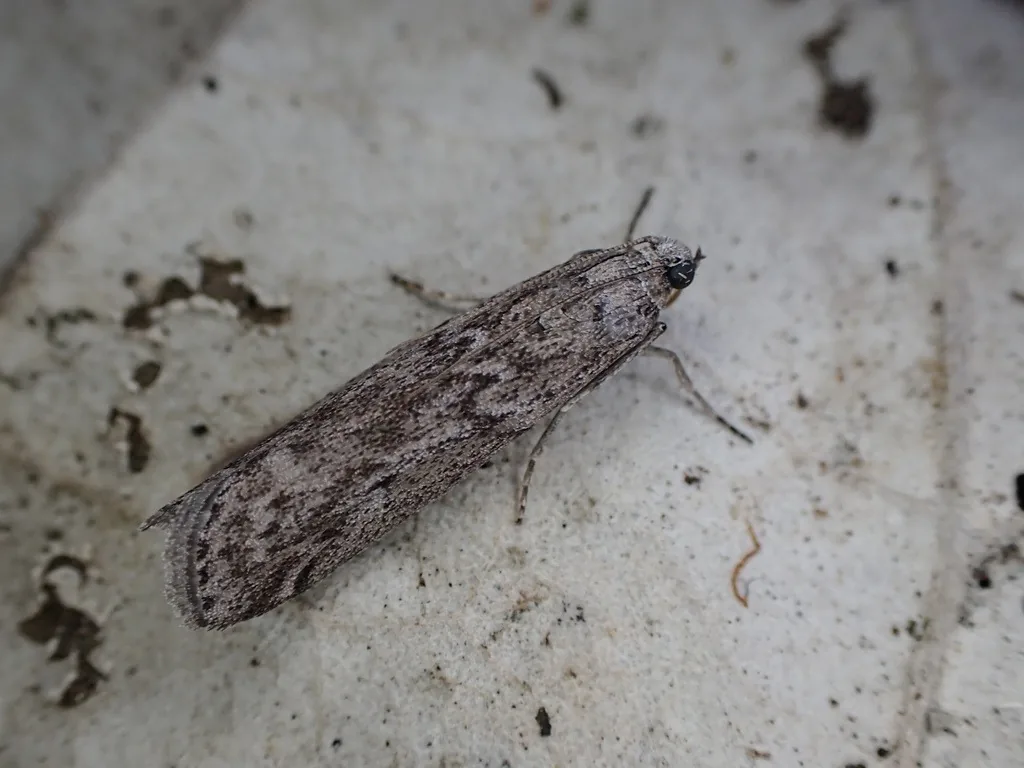
- The forewings are gray with dark zigzag or wavy crossbars, and the hind wings are off-white.[2][4]
- At rest it raises the front of its body so the wings slope downward, with the tip of the abdomen poking up between them.[2][4]
- Caterpillars are white to whitish pink, reach about 1/2 inch, and spin a great deal of webbing on or near their food.[2][4]
Look-alikes
| Look-alike | How to tell them apart |
|---|---|
| Indian meal moth | Its forewings are two-toned, whitish gray near the body and reddish brown with a coppery luster on the outer two-thirds, not evenly gray with wavy bands, and it is smaller.[1][4] |
| Clothes moths | Smaller and hairier than pantry moths, with plain golden or buff wings; their larvae are fabric pests that attack woolens rather than pantry food.[1][4] |
Where it lives
Widely distributed in temperate and subtropical climates; in homes it usually arrives in an infested food package.[3][1]
Biology and life cycle
A female lays her eggs on or near food; the University of Minnesota says up to 300, the University of Arkansas 360 to 600.[3][4]
Minnesota gives a minimum life cycle of one to six months; Arkansas lists three to four generations a year.[3][4]
Adults don't feed and live only a short time, so all the damage comes from the caterpillars. Larvae typically leave the food to pupate.[3][4]
Larvae particularly favor flour, and heavy infestations produce enough webbing to choke mill machinery.[3][4]
Where they pupate: Arkansas says larvae typically leave the food to pupate; Minnesota says pupae form in the produce from overwintered larvae.[4][3]
Damage and signs
- Caterpillars infest flour and meal, grains and cereal products, bran, dry pet food, nuts, seeds, beans, chocolate and dried fruit.[2][4][3]
- They also feed in candy, dried milk and many other dry foods.[2]
- They feed at the surface, spinning large amounts of silk in and over the food, which is spoiled by the webbing and droppings.[4][1]
Health risk
The moths don't bite or sting. Infested food is contaminated with webbing, droppings, insect hairs and secretions, and UC notes that pantry pests can bring in microbes that rot food and could produce mycotoxins, especially in warm, humid storage.[1]
Control
Prevention
Keep flour, cereal and pet food in tightly sealed jars or containers, and store rarely used flours and grains in the freezer. Kentucky gives 0 °F for 4 days in a non-self-defrosting freezer, or 155 °F for about 20 minutes in an oven with the door propped open, for items such as bird seed or dried decorations.[2][1][5]
Sanitation
Find the infested package that started the problem and get rid of it; killing the moths alone won't solve it. Forgotten, partly used boxes and bags at the back of shelves are a common source.[2][5][1]
Check every opened package for webbing in folds and corners or tiny holes, then vacuum shelves top and bottom, using a crevice tool on cracks, before restocking.[1][5]
Traps and physical control
Crush wandering caterpillars and pupae before they become breeding adults, and swat adult moths.[2]
Pesticides
Washington State University lists no recommended chemical controls, and UC IPM advises against insecticides for pantry pests.[2][1]
Where sources disagree
Wingspan: Washington State says about 1 inch; Arkansas says 3/4 inch.[2][4]
Eggs per female: Minnesota says up to 300; Arkansas says 360 to 600.[3][4]
Common questions
- Why is my flour full of webbing and clumps?
- Mediterranean flour moth caterpillars spin silk as they feed, binding flour into webbed clumps. Throw the flour out and check nearby packages.[2][4][1]
- Is this the same as the Indian meal moth?
- No. Both are pantry moths handled the same way, but the Indian meal moth has two-toned, coppery forewings while this moth is gray with wavy crossbars.[1][4]
Sources
- University of California Statewide IPM Program, “Pest Notes: Pantry Pests, Publication 7452.” ipm.ucanr.edu/home-and-landscape/pantry-pests/ (accessed 2026-11-11)
- Washington State University Extension, “Mediterranean flour moth (PestSense fact sheet, reviewed December 2025).” pestsense.cahnrs.wsu.edu/fact-sheet/mediterranean-flour-moth/ (accessed 2026-11-11)
- University of Minnesota, “Mediterranean Flour Moth (Radcliffe's IPM World Textbook).” ipmworld.umn.edu/mediterranean-flour-moth (accessed 2026-11-11)
- University of Arkansas Cooperative Extension Service, “Household Pest and Rodent Control, Classification 2 Training Manual (AG1156).” uaex.uada.edu/farm-ranch/pest-management/docs/training-manuals/AG1156.pdf (accessed 2026-11-11)
- University of Kentucky Entomology, “Stored Product Pests in the Pantry (ENTFACT-612, revised 3/26).” entomology.ca.uky.edu/ef612 (accessed 2026-11-11)
- iNaturalist, “Ephestia kuehniella taxon page (order and family).” www.inaturalist.org/taxa/324640 (accessed 2026-11-11)