On this page
How to identify it
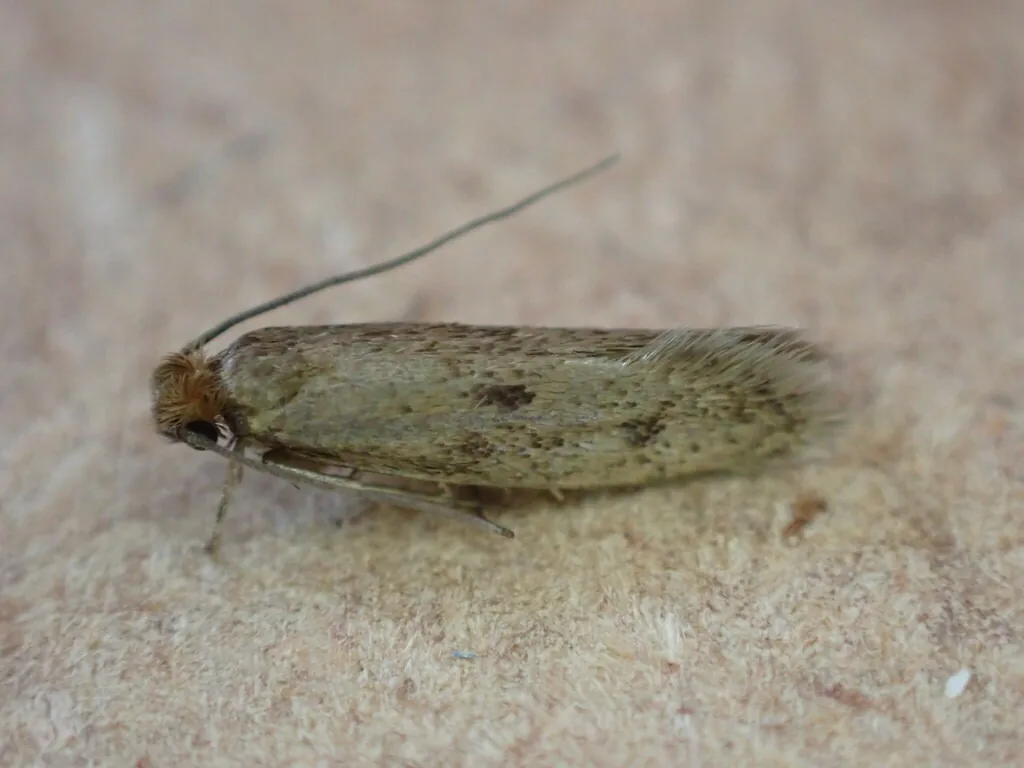
- Adults are small, buff to brownish moths with narrow, fringed wings. Size figures differ: UC IPM says about 1/4 inch long at rest, while the University of Kentucky (UK) describes clothes moths as 1/2-inch moths.[1][2]
- The wings carry faint dark spots or specks, and the hairs on the head are lighter than the webbing clothes moth's reddish tuft.[1][2]
- Larvae are shiny creamy-white caterpillars with dark heads that always stay inside an open-ended silken case they drag along and enlarge as they grow.[1][2][4]
- Full-grown cases are cigar-shaped, about 3/8 inch long, with bits of the infested fabric woven in.[1][2]
- Adults are weak fliers that avoid light and flutter near the infested items rather than flying steadily around the house.[1][2][4]
Look-alikes
| Look-alike | How to tell them apart |
|---|---|
| Webbing clothes moth | A uniform golden-buff moth without wing spots, with a reddish hair tuft; its larvae leave silk feeding tubes and webbing behind instead of carrying a case.[1][2][4] |
| Indianmeal moth and other pantry moths | About twice as long at rest, lack the hair tufts on the head, fly steadily in lit rooms like kitchens, and come from stored food.[1][2] |
| Carpet beetles | Their larvae eat the same animal-fiber materials, so damage blamed on moths may be carpet beetles; the insects themselves look very different.[2] |
Where it lives
One of the two clothes moths common in North America; it is less common than the webbing clothes moth and of far less economic importance.[1][2]
Biology and life cycle
Larvae digest keratin, the protein in animal fibers; in nature they feed in bird and mammal nests or on carcasses.[2]
Females lay about 40 to 50 eggs over 2 to 3 weeks, gluing them to fabric threads, then die; eggs hatch in 4 to 10 days in warm weather.[1][2]
Clemson gives higher numbers for clothes moths in general: 100 to 150 pinhead-sized white eggs that usually hatch in about five days.[4]
The larval stage lasts from about a month to more than 2 years depending on temperature and food, and larvae can feed from either end of the case.[1][2]
Clemson's range for the larval stage is six weeks to several years, depending on the species and conditions.[4]
When ready to pupate, larvae crawl off the item to find crevices in shelving or where walls meet the ceiling.[1][2]
UC IPM says pupation lasts 8 to 10 days in summer and 3 to 4 weeks in winter, and egg-to-egg development generally takes four to six months; Clemson gives one to four weeks for the adult to emerge.[1][4]
Heated homes let them keep developing through winter; there are usually two generations a year.[1]
The casemaking clothes moth is less common, and of far less economic importance, than the webbing clothes moth, according to UC IPM.[1]
Damage and signs
- Only larvae damage fabric; adults don't feed.[1][2]
- They eat wool, fur, silk, feathers, felt and leather, plus blends containing wool; pure cotton and synthetics are rarely attacked unless heavily soiled.[1][2]
- Damage shows up in hidden spots such as under collars and cuffs, in upholstery crevices, along rug edges and beneath furniture; stained fabrics are hit harder.[1][2][4]
- Infestations can also start from lint and pet hair in vents, or from old bird or animal nests in attics, chimneys or wall cavities.[2]
- UC IPM also lists animal bristles in brushes, wool felt pads in pianos and fish meal in fish food, and notes larvae may use cotton fibers to build their pupal cases.[1]
Health risk
Adult clothes moths don't feed, bite or sting. The health concern is the mothballs, flakes and crystals used against them: NPIC says breathing the vapors can cause headaches, nausea, vomiting, diarrhea, eye and nose irritation and coughing, and longer exposure can damage the liver and kidneys. Keep them away from children and pets.[1][2][5]
Control
Prevention
Clean woolens before storing them, then pack them in airtight bags or containers; cedar chests are of debatable or little value.[1][2][4]
If you use mothballs, seal them in an airtight container with the clothes. NPIC says they have little or no effect as repellents and that if you can smell them you are breathing the pesticide; UC IPM adds that they can soften plastic buttons, hangers and garment bags.[1][5]
Sanitation
Find every infested item, then hot-launder, dry clean or bag and discard it; hot washing for 20 to 30 minutes at 120 degrees F or higher kills all stages.[1][2][4]
Vacuum closets, carpet edges, baseboards, under furniture and inside vents, and empty the vacuum promptly since it may hold eggs and larvae.[1][2][4]
Traps and physical control
Freeze sealed, bagged items at 0 degrees F for at least a week, or heat items above 120 degrees F for at least 30 minutes if the fabric can take it.[1][2]
UK adds that a freezer reaching -20°F kills all stages within 72 hours, and that frozen items should be left to return to room temperature, about 24 hours, before unwrapping. UC IPM's shorter guideline is several days below 18°F.[2][1]
Use pheromone traps made for this species to detect moths early; webbing and casemaking moths respond to different lures.[1][2]
Pesticides
For articles that can't be cleaned, heated, frozen or fumigated, use a spray that lists clothes moths on its label, usually pyrethrins, and test a hidden spot for staining first.[1]
UK and Clemson take a stricter line on fabric: don't treat clothing or bedding with insecticide at all, and keep sprays to cracks and crevices, carpet edges and closet floors where larvae hide.[2][4]
When to call a professional
Persistent or widespread infestations, and stuffed furniture that needs fumigation, may require a professional pest control firm.[1][2]
Common questions
- What are the little cases stuck to my closet wall?
- Larvae crawl off the fabric to pupate in crevices and wall-ceiling joints, so cases there point to an infested wool, fur or feather item nearby.[2][1]
- Do mothballs work?
- Their vapors kill only when sealed in an airtight container with the clothes; in an open closet they barely repel adults, and larvae keep feeding.[1][2][5]
- Why is the case the same color as my sweater?
- Larvae weave fibers of the fabric they eat into the silk case, so it takes on that color.[1][2]
- Are casemaking clothes moths attracted to lights?
- No. UC IPM and Clemson say clothes moths aren't drawn to lights; small moths flying steadily around a lit kitchen are more likely pantry moths.[1][4]
Sources
- University of California Statewide IPM Program, “Pest Notes: Clothes Moths, Publication 7435.” ipm.ucanr.edu/home-and-landscape/clothes-moths/ (accessed 2026-11-11)
- University of Kentucky Entomology, “Clothes Moths (ENTFACT-609, revised March 2026).” entomology.mgcafe.uky.edu/ef609 (accessed 2026-11-11)
- iNaturalist, “Tinea pellionella taxon page (order and family).” www.inaturalist.org/taxa/193928 (accessed 2026-11-11)
- Clemson Cooperative Extension Home & Garden Information Center, “Fabric Pest Control (HGIC 2416).” hgic.clemson.edu/factsheet/controlling-fabric-pests/ (accessed 2026-11-11)
- National Pesticide Information Center, “Mothballs: Frequently Asked Questions.” npic.orst.edu/faq/mothball.html (accessed 2026-11-11)