The short answer
- Black widow: watch for restlessness, anxiety, fast or irregular breathing, painful muscle cramps, muscle tremors, vomiting and a hard belly. Merck says widow venom causes severe, painful cramping of the large muscle groups.[1][2]
- Cats are the ones at greatest risk from widow venom. Merck says cats are highly vulnerable to black widow envenomation and fatal outcomes occur frequently, while dogs have some resistance and usually do well.[2]
- Brown recluse: watch for a red, itchy spot that turns into a blister, sometimes a pale or bluish center with a red ring like a bull's-eye, then a slow-healing sore or black scab. Merck says rarer whole-body signs include fever, vomiting, weakness, red or dark urine and shock.[1][2]
- Call your vet now if you saw a spider bite your pet, or if a cat or dog suddenly has muscle cramps, a rigid belly, trouble breathing, collapse, or a spreading dark sore. Merck says early treatment of recluse bites works better than treatment after the skin damage has spread.[1][2]
- A sore alone does not prove a spider bite. Merck says diagnosing a recluse bite means weighing where you live, the signs and, ideally, the spider itself.[2]
If someone may be poisoned
- Emergency vet now: a cat that may have met a black widow, or any pet with severe muscle cramps, a rigid belly, tremors, trouble breathing, weakness or collapse. Merck says cats are highly vulnerable and that severely affected animals can develop high blood pressure, breathing distress and partial paralysis.[2][1]
- Emergency vet now: fever, vomiting, weakness, red or brown urine, or shock after a suspected recluse bite. Merck says these whole-body signs are rare but potentially lethal, and that such animals should be hospitalized.[2][1]
The spiders and scorpion on this page
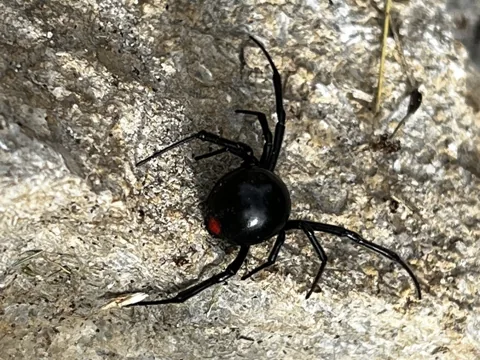 Southern Black Widow
Latrodectus mactans
Black widows are shy, web-building spiders with a neurotoxic venom; they live throughout North America and are most common in the southern and western United States. The southern black widow is found throughout states such as South Carolina.
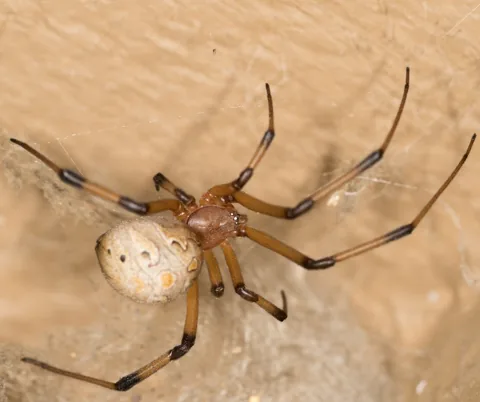 Brown Widow
Latrodectus geometricus
The brown widow is a non-native widow spider. It was found only in Florida for decades, then in the 2000s turned up from Texas along the Gulf Coast and up the Atlantic coast and became common around homes and parks in Southern California.
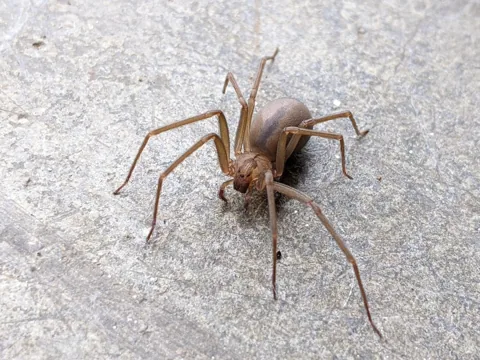 Brown Recluse
Loxosceles reclusa
The brown recluse is a secretive spider of the south-central and Midwestern United States whose bite can occasionally cause serious wounds; it is widely over-reported outside its range. The Illinois Department of Public Health says it occurs in roughly the southeastern quarter of the country and that bites are uncommon even where the spider is common.
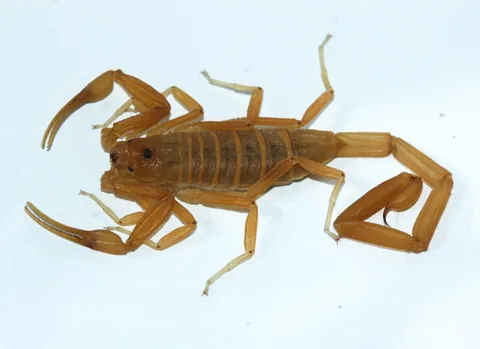 Arizona Bark Scorpion
Centruroides sculpturatus
The Arizona bark scorpion is a slender, climbing scorpion of the desert Southwest that often lives in and around homes. It is the only scorpion in the United States whose sting is considered a hazard to human health.
Which spiders can hurt a pet
Merck's veterinary chapter says the US spiders capable of causing real envenomation belong to two groups: widow spiders (Latrodectus) and recluse or violin spiders (mostly Loxosceles). It also notes that most veterinary widow-bite cases are reported in dogs and cats.[2]
Black widow females are shiny and black with a red or orange hourglass on the underside of the round abdomen. Clemson's Home and Garden Information Center notes the northern black widow may show two red spots or a broken hourglass instead, and that males and young females are smaller and more colorful. Merck adds that immature females may lack the hourglass but can still envenomate.[4][2]
Brown widows are a related widow species. Clemson says brown widow bites are generally much less severe than black widow bites. Our black widow vs brown widow page covers telling them apart.[4]
Brown recluses are tan to dark brown with a dark violin-shaped mark on the back, legs and abdomen of one even color with no stripes or bands, and six eyes in three pairs. The University of Kentucky says many harmless brown spiders are mistaken for the brown recluse and recommends having a specimen confirmed by an expert.[3][2]
Where you live matters. Kentucky's fact sheet says the brown recluse is found in the south-central and Midwestern US, and that suspected bites outside that native range are particularly unlikely. Merck likewise describes a range centered on the central and southern states. Our brown recluse vs look-alike spiders page walks through the features.[3][2]
Tarantulas sold as pets rarely envenomate, Merck says, and US species are harmless; the bigger risk is the fine defensive hairs, which can lodge in a pet's eye or irritate the skin and mouth. Call your vet if a pet tangled with a tarantula and is pawing at its eye.[2]
Black widow bites in dogs and cats
Widow venom acts on the nerves that drive the muscles. Merck says the main toxin, alpha-latrotoxin, triggers a flood of nerve signals to the voluntary muscles, and that a single bite can deliver a deadly dose to a companion animal, although the spider controls how much venom it injects and some bites deliver none.[2]
The bite itself may be hard to find. Merck's professional page says there may be mild redness but no local tissue damage; muscle pain and cramps start near the bite and spread to the larger muscle groups.[2]
Other signs Merck lists: agitation, vomiting, diarrhea, severe pain from cramping, muscle twitching and tremors. A rigid belly without tenderness can point to widow envenomation. The owner page describes rigid muscles that relax now and then.[2][1]
Signs can begin quickly and come and go before they settle, according to Merck. Dogs have some resistance and their overall outlook is good, and many do not need medical treatment; cats, guinea pigs and horses are highly susceptible.[2]
What the vet does depends on how sick the pet is. Merck describes supportive care for pain and muscle cramping in most cases, with antivenom considered case by case. This page gives no drug names or doses; your vet decides.[2][1]
Brown recluse bites in dogs and cats
Recluse venom damages tissue. Merck says it causes blood vessels to narrow, reduces blood flow, causes blood clots and destroys red blood cells, and the professional page names an enzyme in the venom as the main cause of the skin damage.[1][2]
The skin sign comes first. Merck describes a small red, itchy spot that blisters and can become a bull's-eye, with a pale, bluish or dark center. The blister can open into an ulcer that spreads into deeper tissue, including muscle, or fill with pus and leave a black scab, and the area can be very slow to heal.[1][2]
Whole-body signs are rare in pets, Merck says, but can include fever, vomiting, weakness, destruction of red blood cells, abnormal clotting, blood in the urine, kidney failure and shock, and they can take a while to show up after the bite.[1][2]
Merck says there is no antivenom for recluse bites in the US, so care centers on the wound and on supporting the animal. Merck adds that many cases are not recognized until skin damage is extensive, which is why an early vet visit matters.[2][1]
What to do, and what not to do
Do call your vet or an emergency clinic right away and describe what you saw. Merck notes that diagnosis without a witnessed bite rests on the signs, so details like where the pet was and when the signs began help.[1][2]
Do bring the spider if you can do it safely, sealed in a jar or bag, without handling it bare-handed. Merck says identifying the spider is ideal for diagnosing a recluse bite, and Kentucky's fact sheet says even crushed or damaged specimens can usually be identified.[2][3]
Don't cut, squeeze or try to remove tissue at the bite. Merck says surgical removal of a recluse wound is not recommended and often worsens the lesion; the owner page calls it of questionable value.[2][1]
Don't give your pet human pain pills or other medicine on your own, and don't wait for a bite mark before calling. Merck describes pain control as part of the supportive care a vet provides, and says a widow bite may leave no more than mild redness.[2][1]
Don't assume a sore is a spider bite. Merck says a recluse diagnosis weighs geography, signs and the spider. On the human side, Kentucky's fact sheet says bacterial and fungal infections and bites of other arthropods often look like recluse wounds; our spider bites page covers people.[2][3]
Scorpion stings in dogs and cats
Most US scorpions are unlikely to envenomate a pet, Merck says, though a sting can be very painful. The Arizona bark scorpion is the exception that can cause more widespread effects in some animals; Merck places it in Arizona, western New Mexico, southern Utah and Nevada, and sometimes along the Colorado River in California.[2]
In most dogs a bark scorpion sting stays local: pain shown by pawing, limping or crying out, plus swelling, redness and itching, and sometimes peeling skin at the site, according to Merck.[2]
Whole-body signs are not common, Merck says, but watch for them: a racing heart, agitation, twitching and heavy drooling, with fluid in the lungs possible. An allergic reaction with swollen eyelids or tongue and vomiting is rare but possible. Any of these means an emergency vet visit.[2]
Merck says first steps are washing the sting site and using cold compresses to reduce swelling, with any further treatment up to the vet. Our scorpion stings page covers people, and how to get rid of scorpions covers sealing and blacklight checks.[2]
Keeping spiders away from pets
Widows live in dark, sheltered spots close to the ground, Clemson says, such as woodpiles, empty containers, crawl spaces, basements, sheds and barns, and bites are rare and usually happen when a spider is crushed or its web disturbed. Keep pets out of those spots and pick up clutter in the yard.[4]
Brown recluses hide outdoors under rocks, logs, woodpiles and debris and indoors in dark, undisturbed places, and most bites happen when a spider is pressed against skin, Kentucky's fact sheet says. Shake out pet bedding stored in garages or basements before use.[3]
Clemson suggests removing widows and egg sacs with a vacuum, then sealing the bag and throwing it out outdoors. Our black widow and brown recluse removal guides cover the rest, and the pet-safe pest control guide covers using treatments around pets.[4]
Common questions
- Are cats more at risk from black widow bites than dogs?
- Yes. Merck says cats are highly vulnerable to black widow envenomation and fatal outcomes occur frequently, while dogs have some resistance and their overall outlook is good.[2]
- What does a brown recluse bite look like on a dog?
- Merck describes a red, itchy spot that blisters and can form a bull's-eye with a pale or bluish center, sometimes turning into a spreading sore or black scab. Many other skin problems look similar, so have your vet examine it.[1][2]
- My dog was bitten by a black widow. Will it be okay?
- Many dogs recover, and Merck says some need no medical treatment, but a single bite can deliver a dangerous dose and signs can be severe. Call your vet now rather than waiting.[2]
- Is a scorpion sting dangerous for my dog?
- Usually it causes local pain and swelling, Merck says. The Arizona bark scorpion can occasionally cause whole-body signs such as a racing heart, agitation and drooling; call your vet if you see them.[2]
- Should I catch the spider?
- Only if you can do it safely without touching it. Merck says identifying the spider helps the diagnosis, and Kentucky's fact sheet says even crushed specimens can usually be identified.[2][3]
Photo credits
- Southern Black Widow: Carol Spence, public domain (CC0), via iNaturalist
- Brown Widow: Jesse Rorabaugh, public domain (CC0), via iNaturalist
- Brown Recluse: iamfindingplants, public domain (CC0), via iNaturalist
- Arizona Bark Scorpion: (c) Andrew Meeds, some rights reserved (CC BY) — via iNaturalist, CC BY 4.0
Sources
- Merck Veterinary Manual, “Spider Bites (Pet Owner Version).” www.merckvetmanual.com/special-pet-topics/poisoning/spider-bites (accessed 2026-11-15)
- Merck Veterinary Manual, “Spider and Scorpion Bites and Stings to Animals.” www.merckvetmanual.com/toxicology/bites-and-stings-from-spiders-scorpions-and-insects/spider-and-scorpion-bites-and-stings-to-animals (accessed 2026-11-15)
- University of Kentucky Entomology, “Brown Recluse Spider (ENTFACT-631).” entomology.ca.uky.edu/ef631 (accessed 2026-11-15)
- Clemson Cooperative Extension Home and Garden Information Center, “Widow Spiders in South Carolina (HGIC 2518).” hgic.clemson.edu/factsheet/widow-spiders/ (accessed 2026-11-15)