The short answer
- The snout: a rice weevil's head stretches into a long snout with the mouthparts at the tip. Flour beetles have no snout; they are flat, shiny, oval beetles.[3][6][2]
- The spots: a rice weevil has four pale yellowish or reddish spots on its wing covers (wetting them slightly makes faint spots show). Red and confused flour beetles are plain reddish brown.[5][3][4][2]
- The food: rice weevils need whole grain, seeds, popcorn, beans or nuts to breed in. Flour beetles can't attack sound kernels and live in flour, mixes, cereal and other milled or broken products.[5][4][1][8]
- The damage: weevils leave small round exit holes in kernels. Flour beetles leave food with a pungent odor and sometimes a gray tint.[4][7][11][8]
Profiles on this site
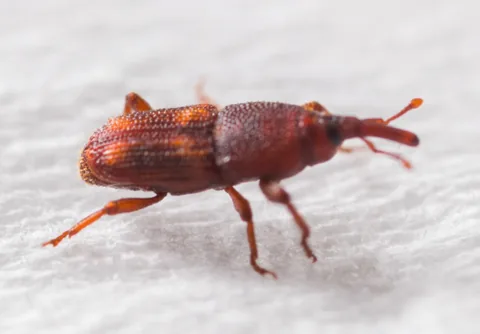 Rice Weevil
Sitophilus oryzae
Rice and granary weevils develop inside whole grains and seeds. Weevils in the house usually mean an infested package of whole grain or seed somewhere, such as popcorn, dried beans, saved seeds or decorative corn.
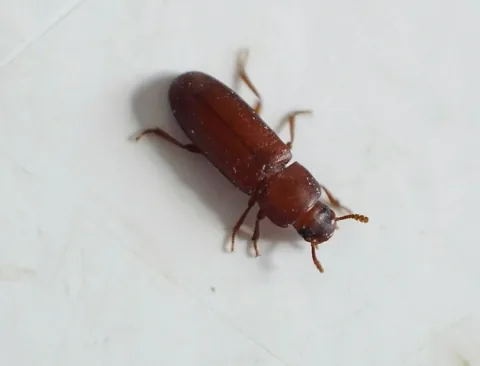 Red Flour Beetle
Tribolium castaneum
The red flour beetle is a shiny reddish-brown beetle that lives in flour, mixes and other processed or broken grain products; it can't chew into whole, sound kernels. Researchers call it a major storage pest. The University of Florida counts it among the most important pests of stored products in homes and grocery stores, and says every life stage can turn up in infested grain products at the same time.
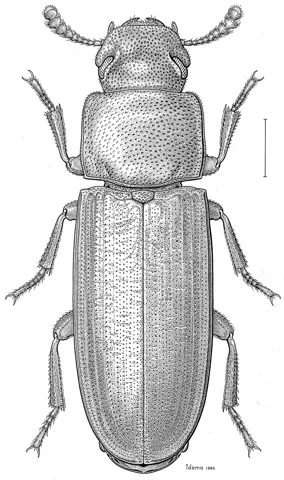 Confused Flour Beetle
Tribolium confusum
The confused flour beetle is a common pantry pest that feeds on flour, cereals, broken grain, nuts, dried fruit and many other dry foods. UF/IFAS counts it and the red flour beetle among the most important pests of stored products in homes and grocery stores.
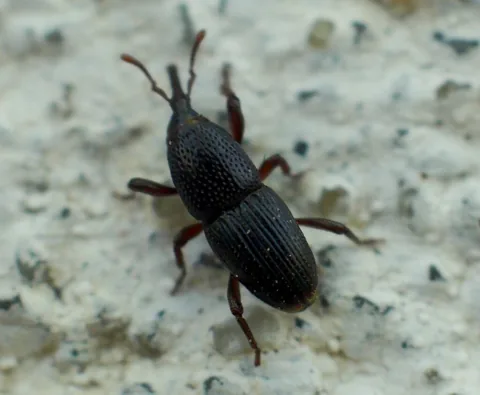 Granary Weevil
Sitophilus granarius
The granary weevil is a pest of stored grain and seeds. Its young develop hidden inside whole kernels, so the first sign in a home is usually small dark weevils near seeds, popcorn or decorative corn. UF/IFAS counts it among the most important grain pests: it can completely destroy commercially stored grain, but it cannot fly, depends on people to spread it and is not often found in homes.
 Maize Weevil
Sitophilus zeamais
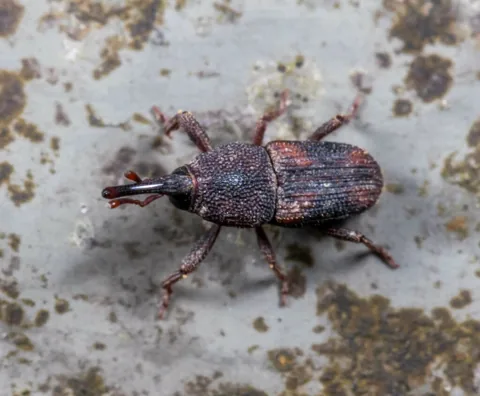
The maize weevil is one of the most destructive pests of stored grain worldwide. Its larvae feed and grow hidden inside individual kernels, so the first thing most people notice is small, dark snout beetles near stored corn, grain or pasta.
 Sawtoothed Grain Beetle
Oryzaephilus surinamensis
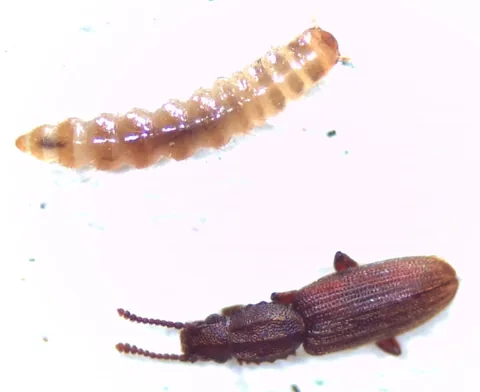
The sawtoothed grain beetle is one of the most common beetles in home pantries; Georgia Extension rates it nearly as common as the Indianmeal moth. Both adults and larvae feed in dry foods of plant origin, and the first thing most people notice is small beetles crawling over shelves and counters. UF/IFAS calls it one of the most important stored-product pests in homes and grocery stores.
Side by side
Each line gives the rice weevil first, then the red and confused flour beetles. The granary and maize weevils share the snout and the inside-the-kernel habit, and the confused flour beetle is named for how hard it is to tell from the red one.[10][3][6]
Size, rice weevil: about 1/8 inch per Iowa State, Illinois and Georgia; Kentucky gives 1/8 to 1/4 inch. In metric, Florida gives 2.5 to 3.5 mm and the Canadian Grain Commission 2.5 to 4 mm.[5][3][4][1][6][7]
Size, flour beetles: about 1/8 inch per Texas A&M, Illinois, Kentucky and Florida's IN566; UC IPM says about 1/7 inch and Georgia 1/8 to 3/16 inch. Florida gives about 3.5 mm for the red flour beetle and the Canadian Grain Commission about 4 mm for the confused.[10][3][1][8][2][4][9][11]
Head, rice weevil: a snout beetle, with its mandibles at the tip of a long snout. Illinois says the snout is what sets weevils apart from other pantry beetles.[6][3][4]
Head, flour beetles: no snout. The antennae end in a club: an abrupt three-segmented club on the red flour beetle, a gradual widening on the confused flour beetle.[2][8][10]
Color and markings, rice weevil: dark reddish brown to nearly black, with a pair of pale spots on each wing cover (four in all). Florida says the deep pits on the thorax are round, and Georgia says the whole body is covered in small round pits.[3][4][6][5][7]
Color and shape, flour beetles: shiny reddish brown, flattened and oval, with no spots. The red flour beetle's thorax has slightly curved sides; the confused flour beetle's sides are straighter.[2][8][9][10]
Flight, rice weevil: flies well. Florida says the granary weevil, its look-alike, cannot, and Illinois agrees.[6][3][7][4]
Flight, flour beetles: Florida, Illinois and Georgia say the red flour beetle can fly and the confused flour beetle does not. Kentucky's fact sheet says the reverse, so don't lean on flight to tell the two flour beetles apart; use the antennae.[8][9][3][4][1]
Larvae, rice weevil: small, white, wrinkled, legless grubs that stay inside one kernel and are rarely seen.[5][1][7][6]
Larvae, flour beetles: slender, creamy yellow to light brown and wiry, with two dark pointed projections on the last body segment. UC IPM says they reach about 3/16 inch when fully grown.[8][9][2]
Where found, rice weevil: Florida says it matters most in warm regions and in the U.S. more in the southern states.[6]
Inside the kernel or loose in the flour
This is the biggest practical difference. A female rice weevil chews a small pit in a kernel, lays an egg in it and seals it with a plug; the larva eats, grows and pupates inside that kernel. Iowa State says there's generally no outside sign for about a month, until the adult chews its way out.[4][5]
So rice weevils need something hard to grow in: whole grains, rice, popcorn, dried beans and peas, nuts, bird seed, saved garden seeds, decorative Indian corn and seed decorations. The Canadian Grain Commission says the larvae won't develop in flour unless it has been compacted.[5][4][3][7]
Flour beetles work from the outside. Kentucky, Georgia and Florida all say they can't attack sound, undamaged grain; they live in flour, meal, cake mixes, cereal, crackers, pasta, dried fruit, nuts, chocolate, spices and dry pet food.[1][4][8][9][3]
Flour beetle females lay small white eggs loosely in the food. UC IPM says the eggs are sticky, get coated in flour and cling to the sides of sacks and boxes, which is why a box can look clean and still be infested.[2][8]
- Florida's IN566 adds that flour beetles survive on the smallest bits of spilled grain and turn up in cracks and crevices where grain has spilled, not only in packages.[8]
Life cycle and how long adults live
Rice weevil development: as little as 32 days per Florida, or as little as 1 month per Kentucky. Florida says females lay 300 to 400 eggs.[6][1]
Rice weevil adults: 3 to 6 months per Florida and Georgia, 4 to 5 months per the Canadian Grain Commission, and 6 to 8 months per Kentucky.[6][4][7][1]
Flour beetle development: 40 to 90 days per Florida, about 7 weeks per Kentucky. All stages can be in the same product at once, and they breed year-round in warm places.[8][9][1]
Reading the damage
Weevils: small round exit holes in kernels, beans or popcorn where adults chewed out. The Canadian Grain Commission notes the rice weevil's hole is small and circular, unlike the larger oblong hole of the granary weevil.[4][7]
Flour beetles: no holes, but the food changes. When disturbed they release a secretion that gives flour a pungent odor and can make milled products unfit to eat, the Canadian Grain Commission says; Florida notes a gray tint to infested grain and more mold.[11][8][2]
- The Canadian Grain Commission adds that big confused flour beetle numbers can give food a pinkish tinge.[11]
How to confirm which one you have
Use a hand lens or a phone camera on macro. Look first for a snout; if there is one, check the wing covers for four pale spots, wetting them slightly if they're faint.[2][4][5]
If there's no snout and the beetle is flat and shiny, look at the antenna tips to separate red from confused flour beetles: an abrupt three-segment club is the red, a gradual widening the confused.[2][8][10]
Sift or spread out a little of the suspect food. Flour beetle larvae and adults live loose in it; weevil larvae stay inside kernels, and the Canadian Grain Commission says sieving won't find them. Kernels with round holes point to weevils.[8][2][7][4]
Shake open containers lightly before you look; Georgia says shaking brings small beetles to the surface. Start with the foods closest to where most adults are showing up.[4]
Adults wander, so beetles on windowsills or far from the pantry don't tell you which one you have. Kentucky says rice weevils may be found some distance from infested items, and Georgia says red flour beetles are active, can fly and are sometimes drawn to light.[1][4][8]
Some multi-species pheromone traps attract red and confused flour beetles, UC IPM says; traps made only for the Indian meal moth won't catch beetles. Georgia says traps are for monitoring, not a cure.[2][4]
- Still unsure? Georgia's bulletin tells residents to take stored product pest questions to their county Extension agent.[4]
Why the difference matters
It tells you where the source is. Weevils mean whole grain or seed somewhere in the house, including bird seed, popcorn, bean bags, decorative corn and old grain-based mouse bait. Iowa State says weevils inside a home usually mean infested whole grain or seeds.[5][3]
Flour beetles mean milled or broken food: flour, mixes, cereal, pasta, pet food and spilled crumbs in cracks.[8][1][9]
What to do for each
Both: find and throw out every infested package in a sealed bag. Kentucky says killing the adults alone doesn't solve it.[1][8][2]
Both: vacuum shelves, especially cracks and corners, then wash with soap and water. Iowa State says bleach, ammonia or disinfectants have no effect on the insects.[5][2]
Weevils: grain, beans or seed you want to keep can be heated or frozen. Iowa State says 140 degrees F for 15 minutes or 0 degrees F for 3 days kills all stages; Kentucky gives 0°F for 4 days, and Georgia six days at 0 °F to -2 °F. Our freezing guide has the steps.[5][1][4]
Flour beetles: discard infested flour and mixes rather than trying to save them, and clean up spilled flour in cracks, under appliances and in drawer corners, since the beetles live on tiny bits.[8][11][2]
Both: store food in containers with tight-fitting lids; UC IPM says plastic bags aren't enough. UC also suggests keeping seldom-used flour and grain in the freezer.[2][4][1]
Common questions
- Are rice weevils and flour beetles the same bug?
- No. Rice weevils are snout beetles whose larvae grow inside whole kernels. Red and confused flour beetles are flat, shiny beetles with no snout that live loose in flour and other milled foods.[6][3][2][1]
- Can rice weevils live in flour?
- Adults feed on flour, but the larvae need a kernel or a piece large enough to live inside. The Canadian Grain Commission says they won't develop in flour unless it's compacted.[7][4]
- Why is my flour gray and smelly?
- That points to flour beetles. They release a secretion that gives infested flour a pungent odor, and Florida says they can give grain a gray tint.[11][8][2]
- Do flour beetles bore into rice or whole wheat?
- No. Kentucky, Georgia and Florida say flour beetles can't attack sound, undamaged grain. If whole kernels have round holes, look for weevils.[1][4][8]
Photo credits
- Rice Weevil: (c) portioid, some rights reserved (CC BY) — via iNaturalist, CC BY 4.0
- Red Flour Beetle: (c) Roman, some rights reserved (CC BY) — via iNaturalist, CC BY 4.0
- Confused Flour Beetle: Bousquet et al. 2018, Catalogue of Tenebrionidae of North America, ZooKeys 728, Figure 30 (CC BY 4.0) — via Wikimedia Commons, CC BY 4.0
- Granary Weevil: (c) Roman, some rights reserved (CC BY) — via iNaturalist, CC BY 4.0
- Maize Weevil: (c) portioid, some rights reserved (CC BY) — via iNaturalist, CC BY 4.0
- Sawtoothed Grain Beetle: (c) aubrey_moore, some rights reserved (CC BY) — via iNaturalist, CC BY 4.0
Sources
- University of Kentucky Entomology, “ENTFACT-612: Stored Product Pests in the Pantry (L. Townsend).” entomology.mgcafe.uky.edu/ef612 (accessed 2026-11-14)
- University of California Statewide IPM Program, “Pest Notes: Pantry Pests (Home and Landscape).” ipm.ucanr.edu/home-and-landscape/pantry-pests/ (accessed 2026-11-14)
- University of Illinois Extension, “Common Pantry Pests.” extension.illinois.edu/sites/default/files/common_pantry_pests.pdf (accessed 2026-11-14)
- University of Georgia Cooperative Extension, “Bulletin 1378: Stored Product Pests in the Home (Suiter, Toews and Ames).” fieldreport.caes.uga.edu/publications/B1378/ (accessed 2026-11-14)
- Iowa State University Extension and Outreach, Yard and Garden, “Rice Weevil and Granary Weevil.” yardandgarden.extension.iastate.edu/encyclopedia/rice-weevil-and-granary-weevil (accessed 2026-11-14)
- University of Florida/IFAS, Entomology and Nematology Department, “Rice weevil, Sitophilus oryzae (Stored Product Pests Photographs CD-ROM).” entnemdept.ufl.edu/projex/gallery/dl/stored_product_pests/text/rice_weevil.htm (accessed 2026-11-14)
- Canadian Grain Commission (Government of Canada), “Rice weevil (Identify an insect: primary insect pests).” grainscanada.gc.ca/en/grain-quality/manage/identify-an-insect/primary-insect-pests/rice-weevil.html (accessed 2026-11-14)
- University of Florida IFAS Extension, EDIS, “Confused Flour Beetle, Tribolium confusum, and Red Flour Beetle, Tribolium castaneum, EENY289/IN566 (Featured Creatures).” ask.ifas.ufl.edu/publication/IN566 (accessed 2026-11-14)
- University of Florida/IFAS, Entomology and Nematology Department, “Red flour beetle, Tribolium castaneum (Stored Product Pests Photographs CD-ROM).” entnemdept.ufl.edu/projex/gallery/dl/stored_product_pests/text/red_flour_beetle.htm (accessed 2026-11-14)
- Texas A&M AgriLife Extension, Urban and Structural Entomology Program, “Flour Beetles.” urbanentomology.tamu.edu/flour-beetles/ (accessed 2026-11-14)
- Canadian Grain Commission (Government of Canada), “Confused flour beetle (Identify an insect: primary insect pests).” grainscanada.gc.ca/en/grain-quality/manage/identify-an-insect/primary-insect-pests/confused-flour-beetle.html (accessed 2026-11-14)