The short answer
- Look at the wing covers. The drugstore beetle has lengthwise grooves, rows of tiny pits that make the back look lined. The cigarette beetle's wing covers are smooth.[6][3][2][1][4][9]
- Look at the antennae. A cigarette beetle's antennae are saw-toothed (serrate) and the same thickness from base to tip. A drugstore beetle's antennae end in three enlarged segments, a loose club.[3][1][4][2][10]
- Look at the outline. The cigarette beetle is stouter and rounder, with a more humped look from the side. The drugstore beetle is longer for its width, more cylindrical and a little less humpbacked.[1][2][10][8]
- Either way, the fix is the same: find the infested food or dried item, throw it out or treat it, and clean the shelf.[3][7][6]
Profiles on this site
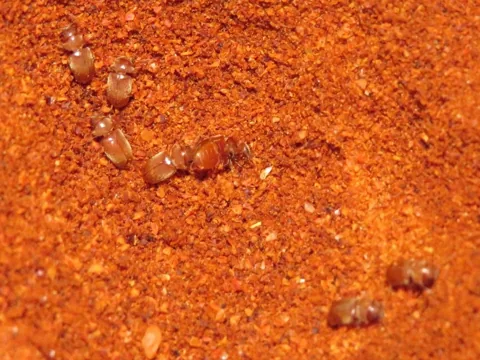 Cigarette Beetle
Lasioderma serricorne
The cigarette beetle is the most important insect pest of stored tobacco, and Texas A&M calls it the most common pantry pest in Texas. In homes its larvae feed in spices, pet food, flour, cereals and dried plant decorations. The University of Florida calls it the most damaging pest of stored tobacco and a major pest of many stored foods.
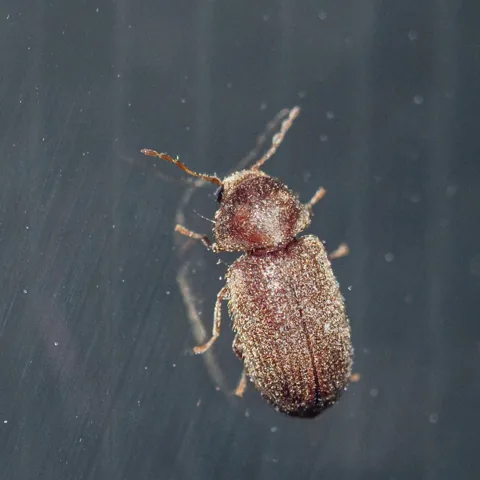 Drugstore Beetle
Stegobium paniceum
The drugstore beetle is a very general feeder said to "eat anything except cast iron"; in homes it most often infests pet food, drugs, cereals and spices.
Side by side
These are the field marks extension fact sheets give. Each line describes the cigarette beetle first, then the drugstore beetle.[1][2][3]
- Names: the cigarette beetle is Lasioderma serricorne, also called the tobacco beetle. The drugstore beetle is Stegobium paniceum. Both are anobiid beetles, a family of over 1000 described species, most of them wood borers.[3][6]
- Size: Penn State and UF/IFAS give the cigarette beetle about 0.1 inch (2 to 3 mm); Clemson gives 1/8 inch (2.0 to 3.7 mm) and Texas A&M 1/16 to 1/8 inch. Penn State gives the drugstore beetle about one-tenth inch, and UC IPM about 1/8 inch for both.[1][3][4][5][2][6]
- Color: the cigarette beetle is reddish-yellow to brownish-red (Penn State), reddish brown (UF/IFAS) or light to dark brown (Clemson). The drugstore beetle is light brown to reddish brown with fine, silky hairs. UC IPM calls both uniformly light brown.[1][3][4][2][6]
- Shape: the cigarette beetle is stout and oval, with the head bent down at nearly a right angle, so it looks humped from the side. The drugstore beetle is more elongate for its width, cylindrical and humpbacked, but less oval and less humped than the cigarette beetle.[1][4][2][10]
- Head: in both, the head is tucked under the hood-like plate behind it (the pronotum) and can't be seen from above.[11][3][10]
- Wing covers: smooth on the cigarette beetle. Rows of pits or lengthwise grooves on the drugstore beetle.[6][3][4][2][9][10]
- Antennae: saw-like segments of the same thickness from base to tip on the cigarette beetle. The last three segments enlarged into a club on the drugstore beetle.[3][1][4][5][2][10]
- Behavior: UF/IFAS says disturbed cigarette beetles pull in their legs, tuck their head and lie still, and are most active from dusk through the night. Penn State says drugstore beetles are very active and known for a rapid skittering run.[3][2]
- Flight: adults of both fly and are attracted to light, so they often turn up on windowsills away from the food they came from. Clemson calls the cigarette beetle a strong flier above 65°F.[7][11][4]
- Larvae: both are small, creamy white, C-shaped, hairy grubs. Cigarette beetle larvae are the hairier of the two, with longer hair, according to Penn State, Texas A&M and UF/IFAS.[1][5][3][11][2]
- Grown larva size: the sources differ for the cigarette beetle (about 0.1 inch from Penn State, about 1/6 inch from UC IPM, up to 3/16 inch from Texas A&M). Penn State gives about two-tenths inch for the drugstore beetle.[1][6][5][2]
- Favorite foods: UC IPM says cigarette beetles in homes turn up most in pet foods, cereals, nuts and candy, plus dried pepper arrangements, wreaths and spices such as chili powder and paprika; Kentucky finds them most in dry dog food and paprika. Drugstore beetles turn up most in pet foods, drugs and cereals (UC IPM), and in bread, flour, meal, breakfast foods and red pepper (Kentucky).[6][7]
- Odd items: cigarette beetles are the main pest of stored tobacco, and Penn State adds old rodent baits and the flax tow stuffing in upholstered furniture. Utah State's ID guide says cigarette beetles can damage books and furniture, and drugstore beetles books.[3][4][1][8][9]
Life cycle compared
Cigarette beetle: females lay their eggs in the food; UF/IFAS gives 10 to 100 eggs, Penn State up to 100, Clemson 30. Eggs hatch in 6 to 10 days. The whole cycle runs 40 to 90 days depending on temperature and food (UF/IFAS), 45 to 50 days (Penn State) or about six weeks (UC IPM). UF/IFAS says there may be five or six overlapping generations a year in warm climates.[3][1][4][6]
Drugstore beetle: females lay eggs singly in almost any dry organic material, and they hatch in six to ten days. Penn State says the cycle can finish in forty to fifty days; UC IPM says fewer than two months. Kansas State's training manual says it lays fewer eggs (75 per female) and has a slightly longer cycle (40 days) than the cigarette beetle's (about 35 days).[2][6][10]
Adult lifespan: Penn State gives the cigarette beetle 2 to 4 weeks and UF/IFAS one to four weeks; Clemson says most live about 3 weeks, and Kansas State's manual says only a few days. UF/IFAS says adult cigarette beetles don't feed, though they drink liquids, so the damage is done by the larvae.[1][3][4][10]
How to confirm which one you have
Catch a few beetles from the windowsill or shelf and look at them under a hand lens or a phone camera's zoom, from above and from the side. The wing covers and the antenna tips are the two features UF/IFAS calls easy to see.[3][7]
Grooves running the length of the back, like ruled lines, and antennae with a three-segment club point to the drugstore beetle. A smooth, shiny back and saw-toothed antennae point to the cigarette beetle.[3][2][1][4][8][9]
Check where they're breeding. UC IPM lists tiny holes in food containers as a sign of pantry pests, and UF/IFAS describes larvae, cocoons, droppings and beetles chewing through cardboard boxes and packaging.[6][3]
A pheromone trap baited with serricornin, the female cigarette beetle's sex attractant, catches male cigarette beetles; UF/IFAS says these traps are mostly used for monitoring. UC IPM recommends pantry pheromone traps to keep checking after the source is gone.[3][6]
Why it matters
Treatment is the same for both, so naming the beetle mainly helps you find the source faster. A cigarette beetle sends you to spices, pet food, dried flower or pepper arrangements and tobacco. A drugstore beetle sends you to dry baked goods, flour, cereals, pet food and old medicines.[6][7][4][3]
Look beyond the kitchen. Clemson says infestations can start from bird seed or pet food that mice have stashed in an attic or wall, and Penn State lists old rodent baits and upholstered furniture stuffing for the cigarette beetle.[4][1]
Because both beetles fly to lights, finding them on windows doesn't mean the infestation is near the window. The source can be in another room.[7][11]
What to do about each
Find and remove the source. UF/IFAS calls locating the infested item the first and most important step: wrap heavily infested items in plastic, take them outside and throw them away, and check every other container.[3][7][6]
Treat what you want to keep. Kentucky suggests heating decorative items such as dried flowers or bird seed at 155°F for about 20 minutes with the oven door propped open. UF/IFAS lists 190°F for one hour or 120°F for 16 to 24 hours. Clemson suggests freezing at 0°F and freezing grain products for 3 days after purchase.[7][3][4]
Clean and store. Vacuum shelves and cracks where the infested food sat, then keep dry goods and pet food in glass, metal or hard plastic containers with tight lids rather than bags. Clear containers make checking easier.[3][6][1][4]
Skip the spray in most kitchens. UC IPM says insecticides aren't recommended for pantry pests, and UF/IFAS says chemical treatment is usually not necessary. Penn State mentions a registered crack-and-crevice insecticide for cigarette beetles after cleanup; read and follow the label if you use one.[6][3][1]
Buy less at once. Clemson suggests purchasing only what you'll use in 2 to 4 months, especially in warm weather.[4]
Common questions
- Are cigarette beetles and drugstore beetles the same thing?
- No. They're two species in the same family. The cigarette beetle is Lasioderma serricorne and the drugstore beetle is Stegobium paniceum. They look almost identical, but the drugstore beetle has grooved wing covers and clubbed antennae.[3][6][2]
- Which one is more common?
- UC IPM says the cigarette beetle is the more common of the two, and Texas A&M calls it the most common pantry pest in Texas.[6][5]
- Do they bite people?
- None of the fact sheets used here describe either beetle biting people. They damage and contaminate food and dried goods, and adult cigarette beetles don't feed at all.[3][6][1][2]
- Will they eat the wood in my house?
- UF/IFAS says many beetles in this family are wood borers, but these two are pests of stored products. Utah State's ID guide does say cigarette beetles can damage books and furniture and drugstore beetles books, and Penn State lists upholstered furniture stuffing for the cigarette beetle.[3][8][9][1]
- Why do I keep finding them on the window?
- Adults of both species fly and are attracted to light, so they gather at windows and lights away from the food they're breeding in.[7][11]
Photo credits
- Cigarette Beetle: (c) Ezequiel Vera, some rights reserved (CC BY) — via iNaturalist, CC BY 4.0
- Drugstore Beetle: (c) Arsen Vorobei, some rights reserved (CC BY) — via iNaturalist, CC BY 4.0
Sources
- Penn State Extension, “Cigarette Beetle.” extension.psu.edu/cigarette-beetle (accessed 2026-11-14)
- Penn State Extension, “Drugstore Beetle.” extension.psu.edu/drugstore-beetle (accessed 2026-11-14)
- University of Florida IFAS Extension, EDIS (Featured Creatures), “Cigarette Beetle, Lasioderma serricorne (F.), EENY-227 / IN384.” ask.ifas.ufl.edu/publication/IN384 (accessed 2026-11-14)
- Clemson Cooperative Extension, Home & Garden Information Center, “Cigarette Beetles, HGIC 2413.” hgic.clemson.edu/factsheet/cigarette-beetles/ (accessed 2026-11-14)
- Texas A&M AgriLife Extension, Urban and Structural Entomology Program, “Cigarette Beetles.” urbanentomology.tamu.edu/cigarette-beetle/ (accessed 2026-11-14)
- UC Statewide IPM Program, “Pest Notes: Pantry Pests.” ipm.ucanr.edu/home-and-landscape/pantry-pests/ (accessed 2026-11-14)
- University of Kentucky Entomology, “Stored Product Pests in the Pantry, EF612.” entomology.mgcafe.uky.edu/ef612 (accessed 2026-11-14)
- Utah State University Extension, “Cigarette Beetle (School IPM structural pest ID guide).” extension.usu.edu/planthealth/ipm/structural-pest-id-guide/cigarette-beetle (accessed 2026-11-14)
- Utah State University Extension, “Drugstore Beetle (School IPM structural pest ID guide).” extension.usu.edu/planthealth/ipm/structural-pest-id-guide/drugstore-beetle (accessed 2026-11-14)
- Kansas State University Research and Extension, “Stored Products Pest Control (Pesticide Application Training, Category 7B, S-16).” bookstore.ksre.ksu.edu/download/stored-products-pest-control-7b_S16 (accessed 2026-11-14)
- University of Illinois Extension, “Common Pantry Pests.” extension.illinois.edu/sites/default/files/common_pantry_pests.pdf (accessed 2026-11-14)