On this page
How to identify it
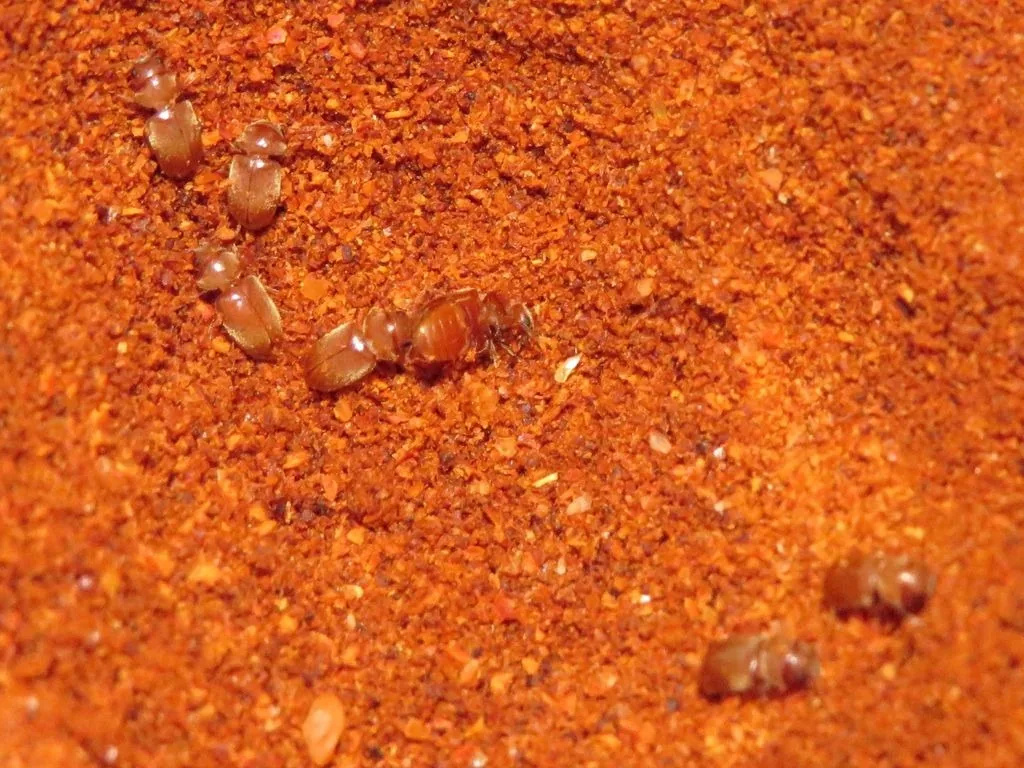
- Adults are about 1/8 inch long, oval and light brown to reddish brown, with smooth wing covers that lack rows of pits. UF/IFAS gives 2 to 3 mm and notes the wing covers are covered with fine hairs.[4][1][3][15]
- The head is bent sharply down, nearly at a right angle, and is hard to see from above, so from the side the beetle looks humpbacked.[4][1][2][5]
- The antennae are saw-toothed and the same thickness from base to tip.[4][1][5]
- Adults are strong fliers and are attracted to light, so they often turn up on windows and around lamps.[6][4][2]
- Larvae are small, creamy to yellowish-white, C-shaped grubs with a brown head, covered in fine hairs that are more noticeable than on drugstore beetle larvae. UF/IFAS describes older larvae as white, scarab-like and hairy, with longer hair than drugstore beetle larvae.[3][4][2][1][15]
- When disturbed, adults often pull in their legs, tuck their head and lie motionless.[15]
Look-alikes
| Look-alike | How to tell them apart |
|---|---|
| Drugstore beetle | Nearly identical, but more elongate, with rows of pits that look like grooves along the wing covers, and antennae that end in a club instead of being saw-toothed. UF/IFAS adds that the two carry symbiotic yeasts of completely different species.[3][1][5][4][15] |
| Sawtoothed grain beetle | A slender, flat beetle that neither flies nor comes to lights; cigarette beetles fly and are attracted to light.[6] |
Where it lives
Found worldwide; a review of its fungal symbiosis describes the cigarette and drugstore beetles as economically important stored-product pests found worldwide. In the United States, Penn State calls it common in Pennsylvania and Texas A&M the most common pantry pest in Texas. UF/IFAS says it is pan-tropical but found worldwide, especially wherever dried tobacco is stored as leaves, cigars, cigarettes or chewing tobacco.[7][1][2][15]
Biology and life cycle
Females lay their eggs in or on the food, often in crevices, folds or depressions; the eggs hatch in about 6 to 10 days. Counts per female differ (see below).[2][1][4]
Newly hatched larvae move away from light, are very active, and can get into packaging through very small holes. They tunnel through the food, then pupate in a cell or silken cocoon covered with bits of food.[4][2][1][3]
Development depends on food and conditions: Texas A&M gives 26 to 100 days from egg to adult, best at 68° to 86°F and 70-80% relative humidity, and says it stops below 59° or above 94°F.[2]
Clemson says there are five to six generations a year in warm areas but usually only one in colder regions, and the beetles overwinter as larvae or adults. Utah State notes adults hide in crevices indoors over winter.[4][5]
Most adults live two to four weeks, though Clemson says some live 70 to 90 days. They fly in the late afternoon and on dull, cloudy days above 65°F, and Clemson says they can fly up to 2 miles.[4][1]
Cigarette beetles carry yeast-like fungal symbionts (Symbiotaphrina) inside gut cells, and the nutritional benefits these partners provide are well characterized. UF/IFAS says the yeasts make B vitamins, are deposited on the eggs and are eaten by the larvae at hatching, which lets the beetle live on foods and other items of poor nutritional quality.[8][9][7][15]
UF/IFAS says the life cycle usually takes 40 to 90 days, depending on temperature and food. Females lay 10 to 100 eggs in the food, larvae hatch in six to 10 days and feed for five to 10 weeks through four to six instars, pupation takes one to three weeks, and adults live one to four weeks. Warmer climates may see five or six overlapping generations.[15]
Temperature matters: UF/IFAS cites development times of 26 days at 98.6°F and 120 days at 68°F, says development is incomplete at 62.6°F, and says adults die after six days at 39.2°F.[15]
Adults prefer dark or dimly lit cracks and crevices but fly readily in bright, open areas. They are most active at dusk and continue through the night, and they don't feed, though they will drink liquids.[15]
Its link with people is old: UF/IFAS notes cigarette beetles were found in dried resin from the tomb of King Tutankhamun.[15]
Damage and signs
- In homes it is most often found in pet foods, cereals, nuts and candy, and in spices such as chili powder and paprika; Kentucky singles out dried dog food and paprika.[3][6]
- It also attacks flour, wheat bran, rice, cornmeal, legume seeds, peanuts, ginger, nutmeg, curry powder, raisins, figs, dates, dried fish and even drugs. UF/IFAS adds dates and raisins, cocoa, coffee beans, herbs, dry dog food and hurricane food supply storage containers.[4][1][15]
- Non-food targets include dried flower arrangements, wreaths, potpourri, herbarium specimens, leather, woolen clothes, glue in book covers, and furniture stuffed with straw or flax tow. UF/IFAS adds prescription drugs and pills, medicinal herbs, pinned insects, papier-mâché and bookbinding paste.[4][3][2][1][15]
- Penn State notes it even feeds on pyrethrum powder strong enough to kill cockroaches, and that unopened items such as cake mixes can be infested without showing it.[1]
- Packaged tobacco, cigars and cigarettes attacked by the beetles end up with holes eaten through them.[1][4]
- Products are contaminated by beetles, larvae, pupae, cocoons, droppings and insect parts. Cocoons stick to solid surfaces and can form large clusters, and larvae sometimes bore through cardboard boxes and other packaging looking for a place to pupate.[15]
- Beyond homes, UF/IFAS lists flour mills, bakeries, pet food factories, cereal plants, chocolate factories, confectionaries, distribution centers and sometimes retail stores among the places it infests.[15]
Health risk
The harm is mostly to food. In rare cases young children have passed the larvae: doctors in China, Malaysia and Japan have reported cigarette beetle larvae in the stool of children aged 8 months, 1 year and 4 years, a condition called canthariasis. The Malaysian authors suspected contaminated food, and the Japanese child had no symptoms. Throw out infested food.[10][11][12][3]
Control
Prevention
Buy sealed, undamaged packages in amounts you'll use within 2 to 4 months, store food in hard, insect-proof containers with tight lids (including unopened mixes), and keep the storage area ventilated. UF/IFAS notes clear containers make it easier to check for infestations.[4][1][15]
Sanitation
Find the source first: check every food container and stored item, and discard or freeze anything infested. UF/IFAS calls finding the source the first and most important step: wrap heavily infested items in heavy plastic, take them outside and throw them away.[4][1][6][15]
Look beyond the kitchen at dried straw flowers and other stored decorations, and at bird seed or pet food that mice may have stashed in an attic or behind a wall.[4]
Vacuum dust, spilled flour and crumbs from shelves, cracks and floors. Clemson advises against washing cabinets with water, which can leave a pasty residue the beetles like.[4]
Traps and physical control
Freezing kills them. Clemson suggests freezing grain products at 0°F for 3 days after purchase as a habit; Kentucky treats decorative items at 0°F for 4 days, or with heat at 155°F for about 20 minutes. UF/IFAS gives 16 days at 36°F, 7 days at 25°F, or four to seven days at 32°F, with items bagged in plastic to cut condensation as they thaw, or oven heating at 190°F for one hour or 120°F for 16 to 24 hours. Uninfested items can be treated the same way to kill any infestation you missed.[4][6][15]
Pheromone traps mostly catch males. Use them to detect beetles and check your progress; finding and removing the infested item is what ends the problem. UF/IFAS says the traps use the female sex pheromone serricornin; mass trapping has been tried, but it works poorly because only males come to the traps.[13][3][15]
Pesticides
Insecticides are a last resort. UC doesn't recommend them for pantry pests, and Clemson says never to treat surfaces where food is stored or prepared. UF/IFAS also says insecticides are usually not necessary in homes and should be a last resort.[3][4][15]
Where sources disagree
Eggs: Clemson says females lay about 30 eggs; Penn State and Texas A&M say up to about 100.[4][1][2]
Life cycle: UC gives about six weeks from egg to adult, Penn State 45 to 50 days (typically 6 to 8 weeks), and Texas A&M anywhere from 26 to 100 days. For the larval stage, Clemson gives 5 to 10 weeks and Penn State 30 to 50 days.[3][1][2][4]
Larva size: Penn State gives about 0.1 inch when fully grown, UC about 1/6 inch, and Texas A&M up to 3/16 inch.[1][3][2]
Insecticides: Penn State suggests a crack-and-crevice treatment with an insecticide registered for in-home use after cleanup, while UC says insecticides aren't recommended for pantry pests and Clemson calls them a last resort.[1][3][4]
Eggs per female: Clemson says about 30, Penn State and Texas A&M up to about 100, and UF/IFAS 10 to 100.[4][1][2][15]
Adult life span: Clemson and Penn State put most adults at two to four weeks, with Clemson noting some live 70 to 90 days; UF/IFAS gives one to four weeks.[4][1][15]
Cold treatment: Clemson gives 0°F for 3 days and Kentucky 0°F for 4 days; UF/IFAS gives 7 days at 25°F or 16 days at 36°F. For heat, Kentucky gives 155°F for about 20 minutes and UF/IFAS 190°F for one hour.[4][6][15]
Common questions
- Do cigarette beetles only eat tobacco?
- No. Despite the name, they infest a wide range of dried foods, especially pet food, cereals and spices like paprika and chili powder.[3][6][2]
- Why are tiny beetles flying around my lamp at night?
- Cigarette beetles fly well and are attracted to light, and they fly most in the late afternoon and on cloudy days.[6][4]
- Will pheromone traps get rid of cigarette beetles?
- No. Sex pheromone traps mainly catch males and are meant for detecting and monitoring; removing the infested item solves the problem.[13][3]
- Can cigarette beetles get into medicine?
- Yes. The University of Florida lists prescription drugs and pills and medicinal herbs among the non-food items it infests.[15]
- How do I tell it from a drugstore beetle?
- Look at the antennae and wing covers. UF/IFAS says the cigarette beetle's antennae are saw-toothed and its wing covers smooth, while the drugstore beetle's antennae end in a 3-segmented club and its wing covers have rows of pits.[15]
Sources
- Penn State Extension, “Cigarette Beetle.” extension.psu.edu/cigarette-beetle (accessed 2026-11-11)
- Texas A&M AgriLife Extension, Urban and Structural Entomology Program, “Cigarette Beetles.” urbanentomology.tamu.edu/cigarette-beetle/ (accessed 2026-11-11)
- University of California Statewide IPM Program, “Pest Notes: Pantry Pests, Publication 7452.” ipm.ucanr.edu/home-and-landscape/pantry-pests/ (accessed 2026-11-11)
- Clemson Cooperative Extension, Home & Garden Information Center, “Cigarette Beetles, HGIC 2413.” hgic.clemson.edu/factsheet/cigarette-beetles/ (accessed 2026-11-11)
- Utah State University Extension, “Cigarette Beetle (School IPM).” extension.usu.edu/planthealth/ipm/structural-pest-id-guide/cigarette-beetle (accessed 2026-11-11)
- University of Kentucky Entomology, “ENTFACT-612: Stored Product Pests in the Pantry.” entomology.mgcafe.uky.edu/ef612 (accessed 2026-11-11)
- Genes, via PubMed, “Martinson (2020), Rediscovering a forgotten system of symbiosis: historical perspective and future potential.” pubmed.ncbi.nlm.nih.gov/32916942/ (accessed 2026-11-11)
- Applied and Environmental Microbiology, via PubMed, “Noda and Kodama (1996), Phylogenetic position of yeastlike endosymbionts of anobiid beetles.” pubmed.ncbi.nlm.nih.gov/8572692/ (accessed 2026-11-11)
- Scientific Reports, via PubMed, “Alina et al. (2026), The stored product beetles Lasioderma serricorne and Stegobium paniceum are associated with a flexible and hidden diversity of Symbiotaphrina symbionts.” pubmed.ncbi.nlm.nih.gov/41507251/ (accessed 2026-11-11)
- Journal of Medical Entomology, via PubMed, “Mokhtar et al. (2016), First case report of canthariasis in an infant caused by the larvae of Lasioderma serricorne.” pubmed.ncbi.nlm.nih.gov/27208008/ (accessed 2026-11-11)
- Infectious Diseases of Poverty, via PubMed, “Sun et al. (2016), A rare case of infant gastrointestinal canthariasis caused by larvae of Lasioderma serricorne.” pubmed.ncbi.nlm.nih.gov/27138301/ (accessed 2026-11-11)
- Parasitology International, via PubMed, “Mizuno et al. (2024), Infant gastrointestinal canthariasis caused by cigarette beetle (Lasioderma serricorne).” pubmed.ncbi.nlm.nih.gov/38972540/ (accessed 2026-11-11)
- University of Georgia Extension, “Stored Product Pests in the Home (Bulletin 1378).” fieldreport.caes.uga.edu/publications/B1378/ (accessed 2026-11-11)
- iNaturalist, “Lasioderma serricorne taxon page (order and family).” www.inaturalist.org/taxa/47493 (accessed 2026-10-06)
- University of Florida IFAS Extension, EDIS, “Cigarette Beetle, Lasioderma serricorne (F.), EENY-227/IN384 (Featured Creatures).” ask.ifas.ufl.edu/publication/IN384 (accessed 2026-11-14)