The short answer
- Antennae are the quickest tell. Lady beetle antennae are short and stubby and can be hard to see; cucumber beetle antennae are long, dark and threadlike.[1][2][8][12]
- Shape: lady beetles are round to oval and domed like half a ball, flat underneath. Cucumber beetles are about 1/4 inch long and longer than wide; Minnesota gives about 1/5 inch long by 1/10 inch wide for the striped species.[4][12][2][1][5]
- Color pattern: the spotted cucumber beetle is yellow-green with 12 black spots (six on each side) and a black head; the striped cucumber beetle is yellow with three black stripes. Lady beetles are most often red or orange with black spots, but some are yellow, pink or all black.[10][5][3][7][4][12]
- Where it is and what it's doing: cucumber beetles cluster on cucumber, squash and melon leaves and inside the flowers. Lady beetles hunt on plants that have aphids, mealybugs or scale insects.[6][10][4]
Profiles on this site
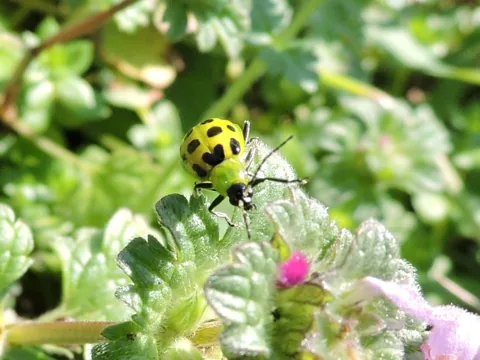 Spotted Cucumber Beetle
Diabrotica undecimpunctata
The spotted cucumber beetle, also called the southern corn rootworm, is a yellow-green beetle with 12 black spots. Adults feed on cucurbits and many other plants and can carry bacterial wilt into cucumbers and muskmelons.
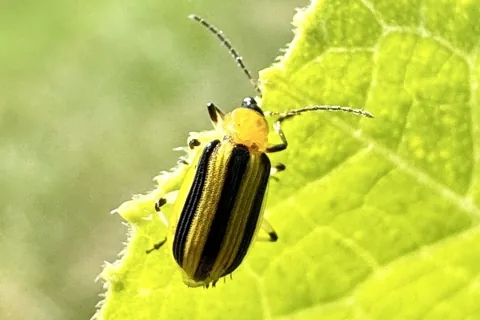 Striped Cucumber Beetle
Acalymma vittatum
Cucumber beetles are small yellow-and-black beetles that feed on squash, cucumbers, melons and other cucurbits. The striped cucumber beetle is the main concern because it can carry bacterial wilt into cucumbers and muskmelons.
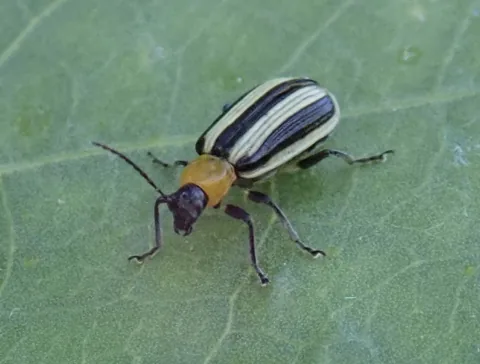 Western striped cucumber beetle
Acalymma trivittatum
The western striped cucumber beetle is a small yellowish orange beetle with three black stripes down its back. It feeds on cucurbits in western gardens and fields, and its larvae feed only on cucurbit roots.
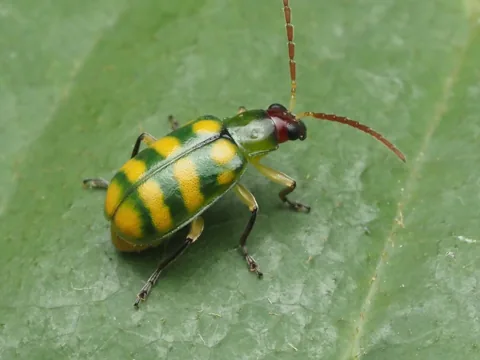 Banded Cucumber Beetle
Diabrotica balteata
The banded cucumber beetle is a leaf beetle native to the American tropics whose range has expanded into the southern United States. Adults chew leaves, flowers and pods of many crops, and the larvae feed on roots underground. UF/IFAS calls it nearly omnivorous: it injures every part of the plant, and its larvae feed only on roots.
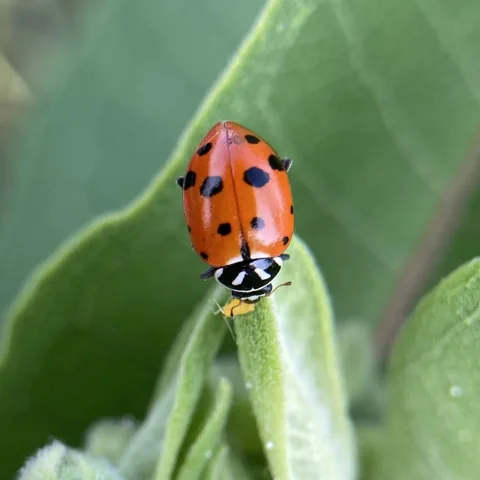 Convergent Lady Beetle
Hippodamia convergens
The convergent lady beetle is a native lady beetle named for the two short white marks on its thorax that angle toward each other. Adults and larvae eat aphids and other soft-bodied insects, and it is essentially the only lady beetle sold in stores and catalogs for aphid control.
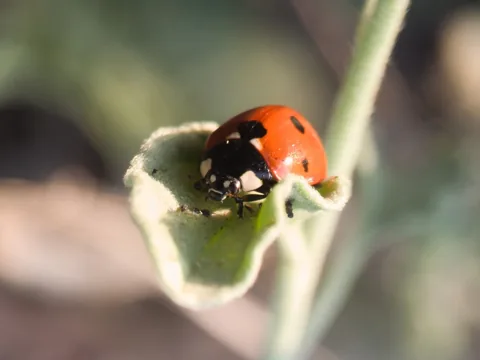 Sevenspotted Lady Beetle
Coccinella septempunctata
The sevenspotted lady beetle is native to Eurasia and is said to be the most common lady beetle in Europe. It was brought into North America on purpose to fight aphids and is now established here.
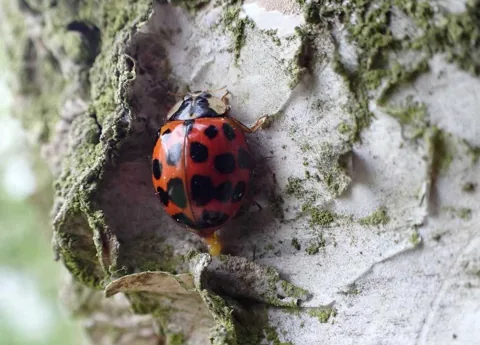 Multicolored Asian Lady Beetle
Harmonia axyridis
The multicolored Asian lady beetle is a beneficial aphid predator outdoors but becomes a nuisance when it flies to buildings in fall to overwinter and ends up indoors. Clemson and Colorado State extension both describe it as a valuable aphid predator on crops, trees and shrubs.
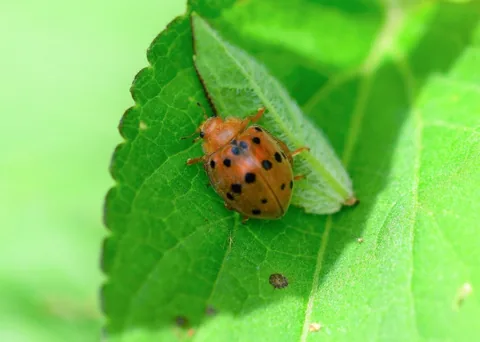 Mexican Bean Beetle
Epilachna varivestis
The Mexican bean beetle is a plant-eating member of the lady beetle family. Adults and spiny yellow larvae feed almost entirely on the undersides of bean leaves, leaving them lacy, and heavy infestations can defoliate plants and cut yields.
Side by side
Each line gives the cucumber beetle first, then the lady beetle.[1][12]
- What they are: cucumber beetles are leaf beetles (family Chrysomelidae); the spotted cucumber beetle is also called the southern corn rootworm. Lady beetles, ladybugs and ladybird beetles are all one family, Coccinellidae.[7][8][12]
- Size: spotted and striped cucumber beetles are about 1/4 inch long (UF/IFAS gives 6.4 mm for the spotted); Wisconsin gives 3/16 to 1/4 inch for the striped and Minnesota about 1/5 inch long by 1/10 inch wide. Lady beetles vary by species, up to about 1/2 inch; the tiny twenty-spotted lady beetle is about 1/16 inch.[5][7][8][6][3][12][2]
- Shape: the spotted cucumber beetle has an ovoid body. Most adult lady beetles have domed, hard, round to oval bodies, hemispherical on top and flat underneath.[9][4][12][2]
- Color: the spotted cucumber beetle is yellow-green (UC IPM says greenish yellow) with 12 black spots; the striped cucumber beetle is yellow or yellow-green with three black stripes, and the western striped cucumber beetle is yellowish orange. Lady beetles are most often red, orange or yellow and usually spotted, often with black, and several species are all or mostly black.[5][1][3][10][12][4]
- Spot count doesn't settle it: the convergent lady beetle can have 0 to 13 spots and the multicolored Asian lady beetle none to 19, while the spotted cucumber beetle has 12, six on each wing cover.[2][10]
- Head: cucumber beetles have a black head, and the striped species has an orangish area just behind it. A lady beetle's head can tuck partly or fully under the shield behind it (the pronotum), which is often patterned to look like a head.[1][9][3][12]
- Antennae: cucumber beetles have long, threadlike dark antennae. Lady beetles have short antennae that can be hard to see.[1][8][2][12]
- Legs: cucumber beetles have black legs (UF/IFAS and Utah State for the spotted species).[7][9]
- Larvae: cucumber beetle larvae are slender, creamy white grubs about 3/8 to 1/2 inch long that live in the soil and feed on roots. Lady beetle larvae live on plants and look like tiny alligators: long, tapered, six-legged, often gray or black with yellow, orange or blue spots and sometimes spines.[3][1][8][2][4][11][12]
- Eggs: cucumber beetles lay pale orange-yellow eggs in groups at the base of plants or in soil cracks. Lady beetles lay spindle- or football-shaped yellowish eggs in clusters on leaves near aphids and other prey.[3][1][11][2]
- Food: cucumber beetle adults eat leaves, petals, pollen and fruit of vine crops and many vegetables. Lady beetle adults and larvae eat aphids, scales, mealybugs, mites and other soft-bodied insects, with some pollen, nectar or honeydew.[6][1][11][4]
- Damage: cucumber beetles can defoliate seedlings, scar fruit, crowd flowers and disrupt pollination, and striped cucumber beetles carry the bacteria that cause bacterial wilt, which makes cucumbers and melons wilt and die early. Lady beetles don't damage plants, with exceptions such as the Mexican bean beetle, a plant-eating lady beetle that feeds on bean leaves and pods.[6][3][5][11]
- Season: cucumber beetles overwinter as adults in weeds, leaves and plant debris and move onto plants as they come up in spring; in Wisconsin only the striped species overwinters, and spotted cucumber beetles migrate in from the south in early to mid July. Lady beetles are found throughout the growing season, and in fall the multicolored Asian lady beetle flies to buildings to overwinter and can end up indoors.[1][7][6][11][13]
Other beetles in the mix
Bean leaf beetle: Iowa State says it closely resembles the spotted cucumber beetle but is usually darker, with 0 to 3 black spots on each side bordered by a black stripe. It feeds mainly on soybeans.[10]
Western corn rootworm: it looks like the striped cucumber beetle, but its stripes are usually more mottled, and the striped cucumber beetle has straighter stripes.[5][10]
Plant-eating lady beetles: the Mexican bean beetle is a lady beetle that eats bean leaves and pods. The ladybugs vs Asian lady beetles guide covers it and the squash beetle.[11]
How to confirm which one you have
Get a close look at the front end. Long threadlike antennae and a black head mean cucumber beetle; short, stubby or hidden antennae on a domed body mean lady beetle. If you take a photo for an ID, make sure the antennae show.[1][2][8][12]
Check the host plant. Look on the tops and undersides of cucurbit leaves, along stems, at the base of the plant and inside the flowers; that's where cucumber beetles gather. Lady beetles turn up where aphids, mealybugs or scale insects are.[10][4]
Look for the young. Alligator-shaped larvae walking over leaves among aphids are lady beetles. Cucumber beetle larvae stay in the soil on the roots, so you rarely see them.[2][4][3][1]
Look at the damage. Chewed leaves on seedlings, beetles packed into squash or cucumber flowers, or vines that wilt and die point to cucumber beetles.[6][3][5]
Still not sure? University of Minnesota Extension suggests Ask a Master Gardener when you can't tell what's wrong with a plant; your county extension office can also help identify a beetle.[4]
Why it matters
Lady beetles are on your side. Both adults and larvae eat pest insects, and the larvae eat more pests than adults do, so killing them removes free aphid control.[4][11]
Cucumber beetles are worth acting on early. Feeding does the most harm to small cucurbit plants, and bacterial wilt carried by striped cucumber beetles can kill cucumber and melon vines.[3][5][6]
Many garden insecticides kill lady beetles, so a spray aimed at cucumber beetles can take out the predators on the same plants.[11]
What to do about each
Cucumber beetles: cover young cucurbits with floating row cover right after planting, and uncover them when female flowers open so bees can pollinate; female flowers have a swollen base under the petals.[6][3]
Cucumber beetles: in small plantings, knock beetles into a container of soapy water, and clean up plant debris at the end of the season, since it shelters overwintering striped cucumber beetles.[6]
Cucumber beetles: most older plants can support a lot of beetles without serious damage, and Minnesota says striped cucumber beetles seen later in summer cause little or no damage. The cucumber beetle control guide covers trap crops, kaolin clay and labeled insecticides.[1][3]
Lady beetles: leave them. Keep some aphids on plants so lady beetles stay, and control ants that tend aphids, since ants drive lady beetles off.[4][11]
Lady beetles: if you must spray, Colorado State says soaps, horticultural oils, pyrethrum and neem are largely compatible with lady beetles as long as the beetles aren't sprayed directly, and Bacillus thuringiensis products don't affect them.[11]
The lady beetles that fly to houses in fall and end up indoors are multicolored Asian lady beetles; the Asian lady beetle guide covers sealing and removal.[13][11]
Common questions
- Is a yellow ladybug with black spots a cucumber beetle?
- Maybe. Some lady beetles are yellow, so check the antennae: long and threadlike means cucumber beetle, short and stubby means lady beetle. A spotted cucumber beetle also has a black head and exactly 12 spots.[4][1][10][5]
- Do cucumber beetles eat aphids like ladybugs do?
- No. Cucumber beetles are plant feeders: adults eat leaves, petals, pollen and fruit, and larvae feed on roots. Lady beetles are the aphid eaters.[6][1][11]
- Are spotted cucumber beetles and southern corn rootworms the same insect?
- Yes. The southern corn rootworm is another name for the spotted cucumber beetle; its larvae feed on the roots of corn, small grains, beans and several grasses.[8][5][1]
- Can a ladybug damage my garden?
- Almost never. Lady beetles mostly eat pest insects, but the Mexican bean beetle, a lady beetle, eats bean leaves and pods.[11][4]
- Why do I see cucumber beetles inside my squash flowers?
- They're drawn to compounds called cucurbitacins in the flowers and gather there in high numbers, which can disrupt pollination by bees and reduce fruit set.[6]
Photo credits
- Spotted Cucumber Beetle: (c) Sam Kieschnick, some rights reserved (CC BY) — via iNaturalist, CC BY 4.0
- Striped Cucumber Beetle: (c) L.J. Lamera, some rights reserved (CC BY) — via iNaturalist, CC BY 4.0
- Western striped cucumber beetle: (c) Cricket Raspet, some rights reserved (CC BY) — via iNaturalist, CC BY 4.0
- Banded Cucumber Beetle: Zygy, public domain (CC0), via iNaturalist
- Convergent Lady Beetle: (c) Jody, some rights reserved (CC BY) — via iNaturalist, CC BY 4.0
- Sevenspotted Lady Beetle: (c) Atalay Karakuş, some rights reserved (CC BY) — via iNaturalist, CC BY 4.0
- Multicolored Asian Lady Beetle: (c) Sascha Nunheim, some rights reserved (CC BY) — via iNaturalist, CC BY 4.0
- Mexican Bean Beetle: (c) Neptalí Ramírez Marcial, some rights reserved (CC BY) — via iNaturalist, CC BY 4.0
Sources
- University of California Statewide IPM Program, “Cucumber Beetles.” ipm.ucanr.edu/home-and-landscape/cucumber-beetles/ (accessed 2026-11-14)
- University of California Statewide IPM Program, “Lady Beetles.” ipm.ucanr.edu/home-and-landscape/lady-beetles/ (accessed 2026-11-14)
- University of Minnesota Extension, “Cucumber beetles.” extension.umn.edu/yard-and-garden-insects/cucumber-beetles (accessed 2026-11-14)
- University of Minnesota Extension, “Lady beetles.” extension.umn.edu/yard-and-garden-insects/lady-beetles (accessed 2026-11-14)
- University of Kentucky Entomology, “Cucumber Beetles (ENTFACT-311).” entomology.ca.uky.edu/ef311 (accessed 2026-11-14)
- University of Wisconsin-Madison Extension, “Cucumber Beetle.” hort.extension.wisc.edu/articles/cucumber-beetles/ (accessed 2026-11-14)
- UF/IFAS Extension, “EENY572/IN1008: Spotted Cucumber Beetle, Diabrotica undecimpunctata howardi.” ask.ifas.ufl.edu/publication/IN1008 (accessed 2026-11-14)
- Texas A&M AgriLife Extension Vegetable IPM, “Southern Corn Rootworm.” vegetableipm.tamu.edu/southern-corn-rootworm (accessed 2026-11-14)
- Utah State University Extension, “Spotted Cucumber Beetle (Hemp).” extension.usu.edu/planthealth/ipm/notes_ag/hemp-spotted-cucumber-beetle.php (accessed 2026-11-14)
- Iowa State University, Current Cucurbit, “How do I identify cucumber beetles?.” www.cucurbit.plantpath.iastate.edu/post/how-do-i-identify-cucumber-beetles (accessed 2026-11-14)
- Colorado State University Extension, “Lady Beetles (5.594).” extension.colostate.edu/topic-areas/insects/lady-beetles-5-594/ (accessed 2026-11-14)
- Missouri Department of Conservation, “Lady Beetles (Ladybird Beetles; Ladybugs).” mdc.mo.gov/discover-nature/field-guide/lady-beetles-ladybird-beetles-ladybugs (accessed 2026-11-14)
- University of Kentucky Entomology, “Asian Lady Beetle Infestation of Structures (ENTFACT-416).” entomology.mgcafe.uky.edu/ef416 (accessed 2026-11-14)