The short answer
- Look at the cut. Rabbits bite stems and twigs off cleanly at about a 45-degree angle, as if with a knife. Deer have no upper front teeth, so they grab and tear, leaving a ragged, shredded end.[1][8][10][7]
- Look at the height. Rabbit damage sits close to the ground, within about 2 feet unless snow lets them reach higher. Deer feed as high as they can reach, often 4 to 5 feet up.[1][9][10]
- Look at what they left behind. Rabbits leave pea-sized round pellets and paired tracks. Deer leave piles of jellybean-shaped droppings and split hoofprints 2 to 3 inches long.[8][7][9]
Animals on this page
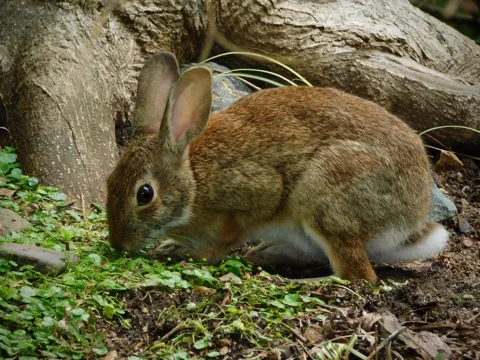 Rabbits (cottontails; eastern cottontail shown)
Sylvilagus species (shown: eastern cottontail, S. floridanus)
Cottontail rabbits are common in yards with brush and dense landscaping. They clip vegetables and flowers in spring and summer and gnaw the bark of young trees and shrubs in fall and winter.
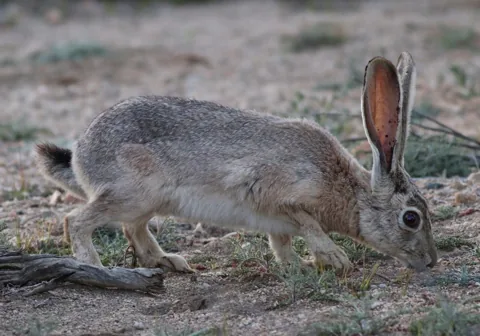 Black-tailed Jackrabbit
Lepus californicus
The black-tailed jackrabbit is a hare, not a true rabbit, common in open country of the western U.S. UC IPM calls it the most destructive rabbit in California gardens and landscapes because of its size and numbers.
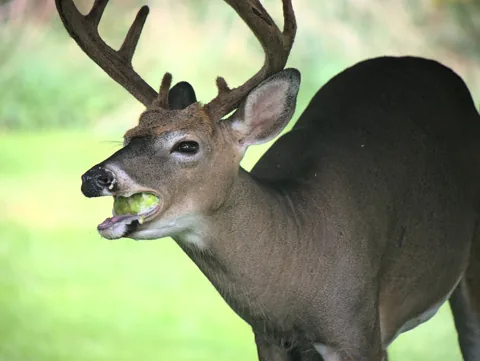 Deer (white-tailed deer shown; mule deer similar)
Odocoileus species (shown: white-tailed deer, O. virginianus; also mule deer, O. hemionus)
White-tailed and mule deer browse gardens, shrubs, young trees and flowers, often at dawn and dusk when no one sees them. Fencing is the most reliable fix, with repellents and plant choice helping in lighter cases.
Side by side
Most of the time you won't see the animal: UC IPM says deer usually feed in the late evening and very early morning. So this comparison focuses on the damage and signs each one leaves.[9][12]
- Cut on stems and twigs: rabbits nip pencil-sized stems cleanly at a 45-degree angle. Deer leave a jagged, torn edge on stems that size or larger, because they have no upper incisors and must twist and pull when browsing.[7][8][1][10]
- Height: most rabbit damage is close to the ground; UC IPM puts the most a rabbit can reach at about 2 feet. Deer eat leaves and small stems as high as they can reach, and UC IPM says the browse line they leave on oaks is usually about 4 to 5 feet up.[1][9][10]
- Snow changes the height for rabbits. ICWDM says young plants are clipped off up to 2 inches above the snow, and the University of Nebraska says rabbits will eat young bark higher than 3 feet up, especially in deep snow. Don't rule out rabbits just because winter damage sits above 2 feet.[2][7][1]
- Twig size: Minnesota Extension says deer usually browse branches less than one inch in diameter. Rabbits clip twigs, buds from saplings and flower heads, and often prune garden plants like peas, beans and beets right to ground level.[10][1][2]
- Bark: rabbits gnaw the smooth, thin bark of young trees, a few inches above the ground and sometimes on exposed roots, and can girdle a trunk. A cottontail's incisor mark is about 1/4 to 3/8 inch wide; Minnesota Extension describes it as the width of the tip of a spoon. Deer typically do not leave tooth marks in bark.[1][7][10]
- Antler rubs: buck deer rub their antlers on small trees, limbs and posts, shredding the bark of saplings. UC IPM places this in mid to late summer when bucks shed antler velvet, while Minnesota Extension ties it to the fall breeding season, the rut, and says rubbing can do more harm than browsing. Rabbits leave nothing like it.[9][10][11]
- Droppings: rabbits leave coarse, round, pea-sized pellets scattered over an area. Cottontail pellets are about 1/4 inch across; jackrabbit pellets are up to 1/2 inch. Deer leave piles of small, jellybean-shaped droppings.[1][7][8][9]
- Tracks: a rabbit's hind-foot prints are much longer than its front prints and land in pairs ahead of the slightly staggered front feet, with indistinct toes because the feet are furred. Deer hoofprints are 2 to 3 inches long, split in the middle, pointed at the front and more rounded at the rear.[7][8][9]
- Other damage: deer can completely eat or trample leafy vegetables, legumes, ground covers and flowers, and UC IPM lists trampled plants among deer signs. Rabbits gnaw and cut plastic irrigation lines, especially small-diameter tubing.[9][1]
- Favorite plants: rabbits go for tulips, especially the first shoots in early spring, plus peas, beans, beets, carrots and lettuce, and in winter young trees and shrubs such as fruit trees, maples, willow, rose and dogwood. Deer eat shrubs, vines, fruit and nut trees, garden vegetables, grasses and small flowering plants, with roses and apple trees highly palatable.[2][7][1][9]
- Season: rabbits feed on flowers and vegetables in spring and summer and turn to clipping and gnawing woody plants in fall and winter, worst in heavy snow. Deer browse woody plants all year; Minnesota Extension says their damage is most common on new growth in spring, when hungry deer move into gardens.[3][8][13][10]
- When they feed: deer usually feed late in the evening and very early in the morning, though suburban deer used to people may be out during the day. Missouri's guide says cottontails are active during the day and easy to watch; Nebraska says rabbits can be active day or night in summer and in the warmer part of the day in winter.[9][12][8][7]
How to confirm which one it is
Pick up a freshly damaged twig and look at the end. A clean, slanted cut points to rabbits (or rodents, which also clip at a 45-degree angle); a rough, torn end points to deer.[10][1][8]
- Measure how high the damage goes. Damage above about 2 feet with no snow on the ground is out of a rabbit's reach.[1][10]
- Check soft soil, mulch or snow near the plants for tracks, and look for droppings. UC IPM says tracks, droppings and trails confirm deer, and Nebraska and Missouri use paired tracks and pea-sized pellets to identify rabbits.[9][7][8]
- Look at the bark of young trees. Spoon-tip-wide tooth marks low on the trunk are a rabbit sign; shredded bark on a sapling with no tooth marks fits a buck's antler rub.[10][7][9]
- Check more than once. Minnesota Extension warns that deer may only pass through an area where other animals are doing the feeding, so one set of deer tracks doesn't prove the deer did the damage. To see deer, NC State suggests scouting at dawn, dusk and night when they feed.[10][12]
- You may have both. Minnesota Extension notes that deer compete with rabbits for food, and both feed year-round, so fresh low, clean cuts and high, ragged browsing in the same bed can mean two problems.[10][8]
Why it matters
The fixes are different sizes. Cottontails won't jump a 2-foot fence, so a low wire fence protects a garden from rabbits. Deer need a fence 7 to 8 feet high; Colorado State calls an 8-foot woven-wire fence the conventional deer-proof fence.[1][7][9][11]
- Tree guards differ too. A rabbit guard is a low cylinder of 1/4-inch hardware cloth around the trunk. Deer need protection to their full reach: UC IPM puts plants out of reach of deer browsing at usually 5 to 7 feet, and Minnesota Extension says tall tubes or guards against antler rubbing should be in place from August through December.[6][8][9][10]
- Repellents are applied to different heights. Colorado State and Minnesota Extension say to treat for deer up to 6 feet above the expected snow depth, from the top down, because deer browse from the top down.[11][10]
If it's rabbits
Fence gardens and flower beds with wire 2 feet high with holes 1 inch or smaller, buried about 4 inches or staked tight at the bottom so rabbits can't go under. Use 3 feet for jackrabbits, and go higher where snow piles up.[5][7][1][6]
- Wrap young trees with cylinders of 1/4-inch hardware cloth 18 to 24 inches high, set into the ground; if the wire has larger holes, keep it at least 2 inches from the trunk. Iowa State suggests caging shrubs from November to April.[6][8][5]
- Cover tulips with wire until they're big enough to interest rabbits less, or plant daffodils, which ICWDM says resist rabbit damage.[5][4]
- Clear brush piles and tall weeds, and close off spaces under sheds and decks with 1/4-inch mesh so rabbits have less cover nearby.[7]
- For traps, repellents and local rules, see the full rabbit guide linked below.[1][8]
If it's deer
A properly built fence 7 to 8 feet high is the most effective control; it may need to be higher on steep slopes. Colorado State lists electric, invisible mesh, slanting and single-wire baited fences as other options.[9][11]
- Protect single trees and shrubs with plastic or woven-wire cylinders, and protect sapling trunks from antler rubbing with tall tubes or guards.[12][10]
- Repellents can help with light pressure: apply on a dry day above freezing, cover young trees completely, and on older trees treat the new growth.[11]
- For fence designs and repellent choices in detail, see the deer repellents and fencing guide linked below.[9][11]
Handling rabbits and safety
Tularemia is a disease that rabbits, hares and rodents are especially susceptible to, and people can catch it through contact with infected animals and through tick and deer fly bites. CDC advises wearing gloves when handling animals, especially rabbits.[14][15]
Common questions
- Do rabbits or deer cut stems at an angle?
- Rabbits. Their incisors leave a clean, diagonal 45-degree cut. Deer lack upper front teeth and leave a ragged, torn end.[1][8][7]
- How high can a rabbit reach?
- About 2 feet on bare ground, according to UC IPM. On snow they reach higher: ICWDM says plants get clipped up to 2 inches above the snow line, and Nebraska reports bark eaten above 3 feet in deep snow.[1][2][7]
- My tulips were eaten to the ground. Rabbits or deer?
- Rabbits especially target the first tulip shoots in early spring, and deer eat small flowering plants too, so check the stems and the ground. Clean, angled cuts low down with pea-sized pellets nearby mean rabbits; torn stems with hoofprints and piles of droppings mean deer.[2][9][10][8]
- Does a rabbit fence keep deer out?
- No. A 2-foot rabbit fence is far below the 7 to 8 feet a deer fence needs.[7][9][11]
- Why is the bark shredded on my young tree but nothing is eaten?
- That fits a buck rubbing its antlers. Deer don't typically leave tooth marks in bark, while rabbit gnawing leaves spoon-tip-wide tooth marks low on the trunk.[10][9]
Photo credits
- Rabbits (cottontails; eastern cottontail shown): (c) Michael J. Papay, some rights reserved (CC BY) — via iNaturalist, CC BY 4.0
- Black-tailed Jackrabbit: (c) Jan Ebr & Ivana Ebrová, some rights reserved (CC BY) — via iNaturalist, CC BY 4.0
- Deer (white-tailed deer shown; mule deer similar): (c) Blake Ross, some rights reserved (CC BY) — via iNaturalist, CC BY 4.0
Sources
- University of California Statewide IPM Program, “Rabbits (Pest Notes, Home and Landscape).” ipm.ucanr.edu/home-and-landscape/rabbits/ (accessed 2026-11-14)
- Internet Center for Wildlife Damage Management, “Rabbit Damage Identification.” icwdm.org/species/other-mammals/rabbits/rabbit-damage-identification/ (accessed 2026-11-14)
- Internet Center for Wildlife Damage Management, “Rabbit Biology.” icwdm.org/species/other-mammals/rabbits/rabbit-biology/ (accessed 2026-11-14)
- Internet Center for Wildlife Damage Management, “Rabbit Damage Prevention and Control Methods.” icwdm.org/species/other-mammals/rabbits/rabbit-damage-prevention-and-control-methods/ (accessed 2026-11-14)
- Iowa State University Extension and Outreach, Natural Resources, “Rabbits: Damage Management.” naturalresources.extension.iastate.edu/encyclopedia/rabbits-damage-management (accessed 2026-11-14)
- Missouri Department of Conservation, “Cottontail Rabbit Control.” mdc.mo.gov/index%2Ephp/node/97 (accessed 2026-11-14)
- University of Nebraska-Lincoln Extension, “Managing Rabbit Damage (NebGuide G2019).” extensionpubs.unl.edu/publication/g2019/na/html/view (accessed 2026-11-14)
- University of Missouri Extension, “Preventing and Controlling Damage Caused by Cottontail Rabbits (G9441).” extension.missouri.edu/publications/g9441 (accessed 2026-11-14)
- University of California Statewide IPM Program, “Deer (Pest Notes, Home and Landscape).” ipm.ucanr.edu/home-and-landscape/deer/ (accessed 2026-11-14)
- University of Minnesota Extension, “White-tailed deer damage.” extension.umn.edu/planting-and-growing-guides/white-tailed-deer-damage (accessed 2026-11-14)
- Colorado State University Extension, “Preventing Deer Damage (Fact Sheet 6.520).” extension.colostate.edu/topic-areas/natural-resources/preventing-deer-damage-6-520/ (accessed 2026-11-14)
- NC State Extension, “Management Strategies to Minimize Deer Damage in the Landscape.” gardening.ces.ncsu.edu/integrated-pest-management/wildlife-5/management-strategies-to-minimize-deer-damage-in-the-landscape (accessed 2026-11-14)
- Internet Center for Wildlife Damage Management, “Deer Biology.” icwdm.org/species/other-mammals/deer/deer-biology/ (accessed 2026-11-14)
- Centers for Disease Control and Prevention, “About Tularemia.” www.cdc.gov/tularemia/about/index.html (accessed 2026-11-14)
- Centers for Disease Control and Prevention, “Preventing Tularemia.” www.cdc.gov/tularemia/prevention/index.html (accessed 2026-11-14)