On this page
How to identify it
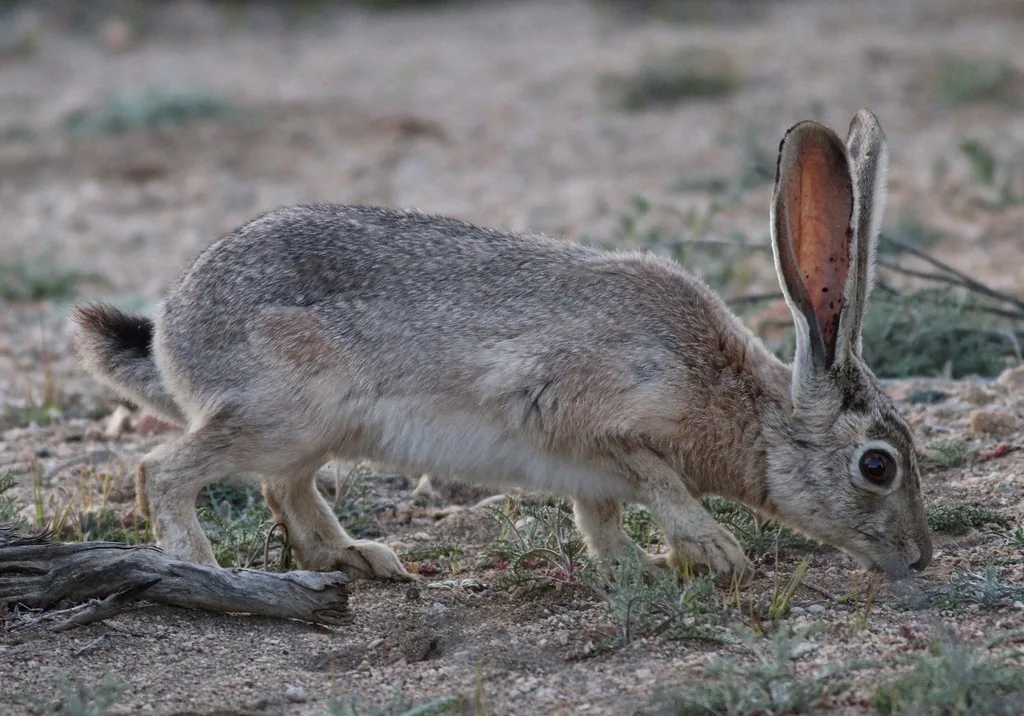
- About the size of a house cat: 3 to 7 pounds and 17 to 21 inches long.[1][2]
- Grayish-brown body with very long, black-tipped ears, long front legs and even longer hind legs.[1][2]
- The top of the tail has a black streak, which gives the black-tailed jackrabbit its name.[1][2]
- Droppings are round pellets up to about 1/2 inch across, roughly twice the size of cottontail pellets.[1]
- Clipped twigs and stems show a clean, angled 45-degree cut, as if made with a knife, usually within about 2 feet of the ground.[1]
Look-alikes
| Look-alike | How to tell them apart |
|---|---|
| Cottontails and brush rabbits | Smaller, with shorter ears: desert cottontails are 12 to 15 inches and under 3 pounds. They stay near dense cover and their young are born nearly furless with closed eyes.[1] |
| White-tailed jackrabbit | A larger hare of the north-central and northwestern U.S., weighing 5 to 10 pounds, with an all-white tail and often a white or pale coat in winter.[2] |
| Deer browsing | Deer lack upper front teeth and leave ragged, torn twig ends, often higher than a rabbit can reach. Jackrabbits leave clean, angled cuts.[1] |
Where it lives
Found mainly in the southwestern U.S. and the southern Great Plains, reaching no farther north than central South Dakota and southern Washington.[2]
Biology and life cycle
Jackrabbits prefer open or semi-open land and adapt well to urban fringes, golf courses, parks, airports and farmland. They rest by day in a shallow scrape, called a form, under a bush.[1]
Breeding runs from late January through August, or year-round where winters are mild. Sources differ on litters: UC IPM says they average 2 to 4 young, with up to 5 or 6 litters a year, while ICWDM says females may have up to 4 litters a year of 2 to 8 young.[1][3]
Young are born fully furred with open eyes and can move about quickly within a day.[1][3]
They feed mainly from evening through the night into early morning, eat mostly green grasses and herbaceous plants, and can survive without drinking water.[1]
When food and shelter are apart, jackrabbits travel 1 to 2 miles each way on the same trails daily, and up to 10-mile round trips in dry periods.[1][3]
Damage and signs
- They eat vegetables such as beans, lettuce, carrots and peas, plus fruit, berry and nut crops, herbs, flowers, shrubs and turf.[1]
- Jackrabbits gnaw the smooth bark of young trees and can girdle them, and they chew plastic drip irrigation tubing.[1]
- Unlike cottontails, jackrabbits feed far out into open areas and can eat 1/2 to 1 pound of green vegetation each day.[1][3]
- Damage near rangeland is often worst when wild vegetation dries out. Alfalfa, lettuce, young cotton and young grapevines are favorites, while corn is usually safe past the seedling stage.[4][5]
- When jackrabbits are numerous they can overgraze rangeland; ICWDM estimates eight of them eat as much as one sheep.[4][3]
Health risk
CDC says rabbits and hares are especially susceptible to tularemia, a bacterial disease people can catch from tick or deer fly bites, skin contact with infected animals, contaminated water or inhaled dust; it is treatable with antibiotics. CDC advises wearing gloves when handling animals, especially rabbits, cooking game meat thoroughly and not mowing over sick or dead animals.[6][7]
Control
Keep them out
A fence is the most reliable long-term protection, though sources differ on the details. UC IPM suggests poultry netting with mesh no larger than 1 inch and the bottom buried 6 to 10 inches; ICWDM calls for mesh smaller than 1 1/2 inches, 30 to 36 inches high, with at least the bottom 6 inches buried.[1][5]
Jackrabbits rarely jump a 2-foot fence unless chased, so UC IPM advises at least 3 feet above ground to discourage jumping.[1]
Electric netting can also keep jackrabbits out and suits seasonal gardens. ICWDM describes an electric fence of six strands spaced 3 inches apart.[1][5]
Protect young trees and vines with cylinders of 1-inch poultry netting, buried 2 to 3 inches and braced away from the trunk so jackrabbits can't chew through.[1][5]
Jackrabbits chew plastic drip irrigation lines; protect them by hanging them out of reach or encasing them in 3/4-inch PVC pipe.[1]
Traps and physical control
Trapping rarely works, since jackrabbits are reluctant to enter a cage or other enclosed space. Removing brush also does little, because they rest far from where they feed.[1][5]
Pesticides
Taste and odor repellents help most on woody plants. UC IPM says research shows fear-inducing repellents containing dried blood (such as Plantskydd) or putrescent whole-egg solids (such as Bobbex) can reduce rabbit browsing; ICWDM lists products based on ammonium soaps, capsaicin, dried blood, thiram and ziram. Follow the label.[1][5]
Repellents usually fail in vegetable gardens full of favorite foods, and many cannot be used on plants people eat.[1]
When to call a professional
Toxic baits are restricted-use products for agricultural crop damage and aren't practical for most homeowners. Contact your local Cooperative Extension office for help.[1][5]
Legal status
Jackrabbits are non-game animals in most states, but a few states protect them, so check with your state wildlife agency before using lethal control.[2][5]
In California they are game mammals, but owners or tenants may control jackrabbits damaging crops, landscaping or gardens without a license. Shooting requires nonlead ammunition and must follow local firearm rules.[1]
Some states require permits to shoot from vehicles or with spotlights.[5]
Texas sets no closed season and no bag or possession limits for rabbits and hares, which may be hunted at any time by lawful means on private property.[8]
North Dakota keeps the rabbit season open statewide all year with no daily bag limit.[9]
Common questions
- How high does a fence need to be to stop jackrabbits?
- UC IPM recommends about 3 feet above ground with the bottom buried. Jackrabbits rarely clear 2 feet, but a scared or chased one may.[1]
- Is it a jackrabbit or a cottontail eating my garden?
- Jackrabbits are bigger, with very long black-tipped ears and larger droppings up to 1/2 inch. Cottontails are smaller, short-eared and stay near cover.[1]
- Will a live trap catch a jackrabbit?
- Rarely. Both UC IPM and ICWDM note that jackrabbits avoid entering box or cage traps, so fencing and tree guards work better.[1][5]
- Do jackrabbits carry rabies?
- Rarely. Wisconsin's health department says rabbits and hares, wild or pet, are rarely found infected with rabies and have not been known to transmit it to people.[10]
Sources
- University of California Statewide IPM Program, “Rabbits (Pest Notes, Home and Landscape).” ipm.ucanr.edu/home-and-landscape/rabbits/ (accessed 2026-11-12)
- Internet Center for Wildlife Damage Management, “Hares: Identification.” icwdm.org/species/other-mammals/hares/ (accessed 2026-11-12). Run by university wildlife damage specialists (maintained at the University of Wisconsin-Stevens Point); species modules are based on Prevention and Control of Wildlife Damage (University of Nebraska Cooperative Extension, 1994).
- Internet Center for Wildlife Damage Management, “Hare Biology.” icwdm.org/species/other-mammals/hares/hare-biology/ (accessed 2026-11-12). Run by university wildlife damage specialists (maintained at the University of Wisconsin-Stevens Point); species modules are based on Prevention and Control of Wildlife Damage (University of Nebraska Cooperative Extension, 1994).
- Internet Center for Wildlife Damage Management, “Hare Damage Identification.” icwdm.org/species/other-mammals/hares/hare-damage-identification/ (accessed 2026-11-12). Run by university wildlife damage specialists (maintained at the University of Wisconsin-Stevens Point); species modules are based on Prevention and Control of Wildlife Damage (University of Nebraska Cooperative Extension, 1994).
- Internet Center for Wildlife Damage Management, “Hare Damage Prevention and Control Methods.” icwdm.org/species/other-mammals/hares/hare-damage-prevention-and-control-methods/ (accessed 2026-11-12). Run by university wildlife damage specialists (maintained at the University of Wisconsin-Stevens Point); species modules are based on Prevention and Control of Wildlife Damage (University of Nebraska Cooperative Extension, 1994).
- Centers for Disease Control and Prevention, “About Tularemia.” www.cdc.gov/tularemia/about/index.html (accessed 2026-11-12)
- Centers for Disease Control and Prevention, “Preventing Tularemia.” www.cdc.gov/tularemia/prevention/index.html (accessed 2026-11-12)
- Texas Parks and Wildlife Department, “Rabbits and Hares: 2026-2027 Seasons & Regulations.” tpwd.texas.gov/regulations/outdoor-annual/regs/animals/rabbits-and-hares (accessed 2026-11-12)
- North Dakota Game and Fish Department, “Hunting: Other Species.” gf.nd.gov/hunting/other-species (accessed 2026-11-12)
- Wisconsin Department of Health Services, “Rabies: Small Rodents (rabies algorithm).” www.dhs.wisconsin.gov/communicable/Rabies/RabiesAlgorithm/SmallRodentsAll.htm (accessed 2026-11-12)
- iNaturalist, “Lepus californicus taxon page (order and family).” www.inaturalist.org/taxa/43130 (accessed 2026-11-12)