The short answer
- Hepatozoonosis is a protozoan infection of dogs spread by ticks in an unusual way: the dog gets it by eating the tick (or animals that ate a tick), not from being bitten, Merck says.[1][2]
- In North America the cause is Hepatozoon americanum, carried by the Gulf Coast tick. Merck calls the disease American canine hepatozoonosis and says it is most commonly severe to fatal.[1][2]
- Watch for fever that comes and goes, weight and muscle loss, weakness, eye discharge, stiffness, reluctance to move and pain near the spine. Many affected dogs still eat normally, Merck notes, so a good appetite does not rule it out.[1][2]
- Call your vet if your dog shows these signs, especially if it lives in or has traveled to a Gulf Coast tick area, or hunts and eats rodents or rabbits. Merck says tick exposure, travel and predation history help the vet decide what to test for.[1][2]
- Prevention is tick control plus keeping dogs from catching and eating prey, which Merck calls the most effective ways to control the disease.[1][2]
Ticks that carry Hepatozoon
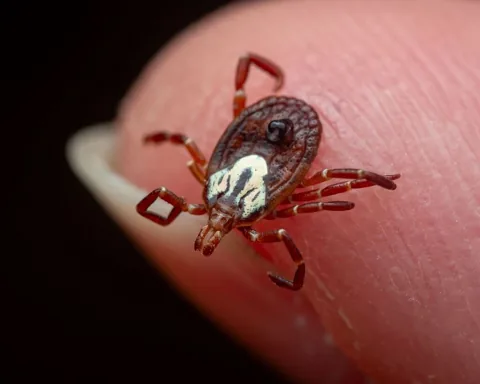 Gulf Coast Tick
Amblyomma maculatum
The Gulf Coast tick is a hard tick of grass prairies, coastal uplands and shrubby, recently disturbed ground with little or no tree cover. Adults bite people, and it is the principal carrier of Rickettsia parkeri, which causes a form of spotted fever, and of the parasite behind American canine hepatozoonosis in dogs.
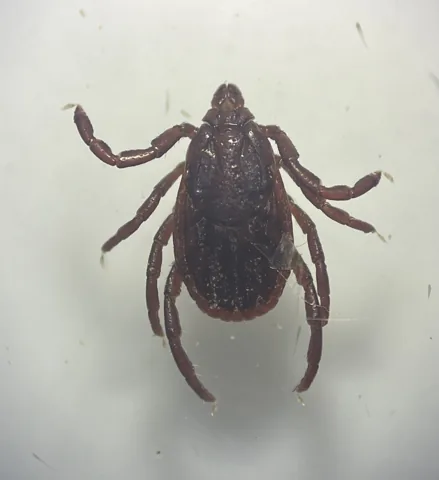 Brown Dog Tick
Rhipicephalus sanguineus
The brown dog tick is unusual: unlike most ticks, it can complete its entire life cycle indoors. It occurs across the United States, is met more often in the southern states, and can build up to high numbers on dogs and in homes and kennels. UF/IFAS Featured Creatures adds that this lets it set up populations even in colder climates.
How dogs get it: eating, not biting
Merck says the tick picks up the parasite while feeding on an infected animal. An uninfected dog then becomes infected by eating that tick, or an animal that ate a tick, not from the tick's bite.[1]
Merck's professional chapter explains that infection happens when infected ticks are swallowed; the parasite is released from the tick and enters the dog through the gut. Dogs can also get the American form by eating prey animals that carry a resting stage of the parasite in their tissues.[2]
That gives prey a double risk, Merck says: a rodent or rabbit a dog catches may carry infected ticks on its coat, and its own tissues may be infectious.[2]
Ohio State and the University of Rhode Island list Hepatozoon americanum among the germs the Gulf Coast tick carries, alongside Rickettsia parkeri spotted fever in people.[7][8]
Merck says dogs diagnosed with hepatozoonosis should not be bred, because passage from mother to pups has been documented for H canis and may be possible for H americanum.[1][2]
Where in the US it occurs
Merck says most US cases have been diagnosed in Texas (mainly along the Gulf Coast), Oklahoma and Louisiana, with cases reported as far east as Tennessee, Alabama, Georgia and Florida. The disease was first detected on the Texas Gulf Coast in 1978 and has spread mainly north and east from there.[1][2]
Merck's state table lists documented dog infections in Alabama, California, Florida, Georgia, Kentucky, Louisiana, Mississippi, Nebraska, North Carolina, New Jersey, Tennessee, Texas, Vermont, Virginia and Washington. Merck says the parasite's range mainly follows the Gulf Coast tick, with scattered cases elsewhere probably tied to travel.[3][2]
CDC says the Gulf Coast tick lives mainly in the southeastern United States, with focal populations in the Northeast, Midwest and Southwest. URI describes it along the Atlantic and Gulf coasts from New Jersey to Texas and into Oklahoma and Kansas.[5][8]
Ohio State says the tick has expanded dramatically across the eastern US since around 2000, and is common in the Southeast and Great Plains, with small, isolated populations in the Mid-Atlantic, Midwest and Northeast.[7]
Where to expect it: Ohio State says Gulf Coast ticks favor grassland prairies of grasses and shrubs with little or no tree cover, and recently disturbed ground with shrubs and long grass. Adults feed on larger mammals; larvae and nymphs mostly on birds and small mammals. URI says adults are active in April through October.[7][8]
For identification, see our Gulf Coast tick profile.[7]
Signs of American canine hepatozoonosis
Merck lists fever, depression, weight loss, poor body condition, muscle loss and weakness, discharge from the eyes and bloody diarrhea. The signs may come and go.[1][2]
Fever may swing between 102.7 and 106°F (39.3 to 41.0°C), Merck says.[1][2]
Severe sensitivity or pain near the spine is common, along with stiffness and a general reluctance to move. Merck's professional chapter also lists muscle and bone pain, lameness and lying down unable to rise.[1][2]
Many dogs keep a normal appetite, Merck notes.[1]
Merck says the American form causes severe signs even in healthy adult dogs, and that the disease can eventually lead to kidney inflammation or amyloidosis of the kidneys.[1][2]
When to call the vet
Call your vet if your dog has repeated fevers, a stiff or painful back or neck, won't move, is losing weight and muscle, or has eye discharge, and tell them where your dog lives and has traveled, whether it has had ticks and whether it hunts or eats wildlife. Merck says that history is important for diagnosis.[1][2]
Merck's owner page says that even if your pet picked up only a few ticks, you should have it checked for tick-borne disease, and that a tick bite site that turns red or swells warrants a prompt vet visit.[4]
CDC says to watch a pet closely for changes in behavior or appetite after known or suspected tick exposure.[6]
Diagnosis is your vet's job. Merck says muscle biopsy is considered the best test for the American form, with blood tests, looking for infected blood cells and x-rays also used. On x-rays, Merck says, the disease can show new bone growth on the surface of bones.[1][2]
Treatment and outlook, in brief
Merck calls hepatozoonosis a life-long infection: no known treatment completely clears the parasite from a dog's body.[1][2]
Merck says remission can now usually be achieved with newer drug combinations, which have markedly improved the outlook. Your vet will choose and supervise any treatment; this page does not cover drugs or doses.[1][2]
The brown dog tick form (Hepatozoon canis)
In most of the world, Merck says, the parasite is Hepatozoon canis, spread by the brown dog tick, and the disease is called Old World hepatozoonosis. Dogs get it the same way, by swallowing an infected tick.[1][2]
Merck says H canis was not thought to infect dogs in North America before 2008, but molecular evidence since then suggests it does. Its state table lists H canis in Alabama, Georgia, Louisiana, Mississippi, New Jersey and Virginia, sometimes together with H americanum.[2][3]
The H canis form is usually milder. Merck says healthy dogs generally tolerate it well and signs are most often absent to mild (fever, lethargy, depression, anemia), though life-threatening infections occur, and a weakened immune system from another disease seems to matter. Dogs older than about 4 to 6 months are usually resistant.[1][2]
Merck says the American form remains the more common and severe type in the United States.[2]
CDC says the brown dog tick is found worldwide and that dogs are its main host at every life stage. Our brown dog tick pages cover the tick itself and how to clear it from a home.[5]
Prevention
Merck says preventing access to ticks and preventing dogs from catching and eating prey are the most effective ways to control hepatozoonosis, and urges good tick control especially where the disease has been reported.[1][2]
Ask your vet which tick control product suits your dog. Merck's owner page says to contact your veterinarian for a recommendation and to mention other pets in the home; CDC also says to talk to your vet about the best tick prevention product.[4][6]
Check your dog for ticks daily, especially after time outdoors, and remove any you find, CDC says. Use tweezers close to the skin, Merck says, not bare hands or hot matches; our dog tick-removal guide has the steps.[6][4]
Because the dog has to swallow the tick, stop your dog from licking, chewing or eating ticks you remove, and do not let it eat rodents, rabbits or carcasses. Merck singles out predation on rodents and rabbits as a risk factor.[1][2]
Gulf Coast ticks favor tall grass and shrubby, open ground, Ohio State says, so keeping dogs out of those areas in tick season also lowers exposure.[7][8]
Can people catch it?
Merck says there is no known risk of hepatozoonosis spreading to humans.[1][2]
The Gulf Coast tick itself does bite people and can spread Rickettsia parkeri spotted fever, CDC says, so protect yourself in the same places you protect your dog.[5]
Common questions
- Can a tick bite give my dog hepatozoonosis?
- Not the bite itself, Merck says. The dog is infected by eating an infected tick, or an animal that ate one.[1][2]
- Is hepatozoonosis in dogs contagious to people or other dogs?
- Merck says there is no known risk to humans. Dogs are infected by eating ticks or infected prey, and Merck advises against breeding infected dogs because mother-to-pup passage is documented for H canis and may be possible for H americanum.[1][2]
- Which states have hepatozoonosis in dogs?
- Most US cases have been in Texas, Oklahoma and Louisiana, Merck says, with cases east to Tennessee, Alabama, Georgia and Florida, and its state table adds more states, mostly where Gulf Coast ticks live.[1][3]
- My dog still eats well. Can it still have hepatozoonosis?
- Yes. Merck notes that many dogs with American canine hepatozoonosis keep a normal appetite. Fever, stiffness and pain near the spine are reasons to call your vet.[1]
- Can hepatozoonosis be cured?
- Merck calls it a life-long infection that no known treatment completely clears, but says newer drug combinations can usually bring remission. Your vet guides treatment.[1][2]
- How do I prevent hepatozoonosis?
- Good tick control and keeping your dog from catching and eating prey, Merck says. Add daily tick checks, CDC advises.[1][2][6]
Photo credits
- Gulf Coast Tick: (c) Zachary Dankowicz, some rights reserved (CC BY) — via iNaturalist, CC BY 4.0
- Brown Dog Tick: (c) NoahM, some rights reserved (CC BY) — via iNaturalist, CC BY 4.0
Sources
- Merck Veterinary Manual, “Blood Parasites of Dogs (Dog Owners).” www.merckvetmanual.com/dog-owners/blood-disorders-of-dogs/blood-parasites-of-dogs (accessed 2026-11-15)
- Merck Veterinary Manual, “Old World Hepatozoonosis and American Canine Hepatozoonosis.” www.merckvetmanual.com/circulatory-system/blood-parasites/old-world-hepatozoonosis-and-american-canine-hepatozoonosis (accessed 2026-11-15)
- Merck Veterinary Manual, “Table: States in which H canis and H americanum infections in domestic dogs have been documented.” www.merckvetmanual.com/multimedia/table/states-in-which-h-canis-and-h-americanum-infections-in-domestic-dogs-have-been-documented (accessed 2026-11-15)
- Merck Veterinary Manual, “Ticks of Dogs (Dog Owners).” www.merckvetmanual.com/dog-owners/skin-disorders-of-dogs/ticks-of-dogs (accessed 2026-11-15)
- Centers for Disease Control and Prevention, “Where Ticks Live.” www.cdc.gov/ticks/about/where-ticks-live.html (accessed 2026-11-15)
- Centers for Disease Control and Prevention, “Preventing Ticks on Pets.” www.cdc.gov/ticks/prevention/preventing-ticks-on-pets.html (accessed 2026-11-15)
- The Ohio State University Extension, “Gulf Coast Tick (Amblyomma maculatum), ENT-0105.” ohioline.osu.edu/factsheet/ent-0105 (accessed 2026-11-15)
- University of Rhode Island TickEncounter Resource Center, “Gulf Coast Tick.” web.uri.edu/tickencounter/species/gulf-coast-tick/ (accessed 2026-11-15)