The short answer
- Look for a soft lump under the skin with a small hole in the middle, usually on the head, neck or body. Merck says the swelling is about 1 cm (0.4 inch) across, the hole is the larva's breathing pore, the hair over it is often matted, and it may ooze pus.[1][2][3]
- Do not squeeze it or try to pull the larva out yourself. Merck says squeezing can rupture the larva and lead to infection or, rarely, a severe allergic (anaphylactic) reaction. Your vet removes it in one piece.[2][3][1]
- Treat nervous-system signs as an emergency. Merck says larvae can wander to the brain, especially in cats, causing blindness, seizures, circling, loss of balance or odd behavior, often after an earlier bout of violent sneezing. Call your vet now.[3][1]
- Pets that roam and hunt are most at risk. Merck says the flies lay eggs around rodent and rabbit burrows and runways, pets pick them up passing through, and free-roaming cats are more likely to be affected than indoor cats.[1][3]
The fly behind the warble
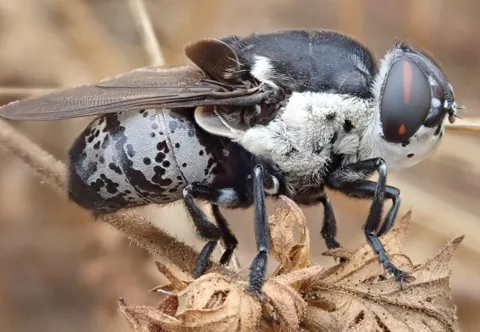
What Cuterebra is
Cuterebra are the rodent and rabbit bot flies. Merck says the adult flies are large, bee-like, and do not feed or bite; the problem is their larvae, which grow under the skin.[1][2]
Most bot flies stick to one host, but Merck says the rabbit Cuterebra is less host-specific and is the one usually found in dogs and cats.[1][2]
Dogs, cats and ferrets are abnormal hosts. Merck says that in them the larvae can wander off course to the head, brain, nasal passages, throat and eyelids.[1]
Our rodent bot fly profile covers the fly itself and the warbles you see on squirrels and rabbits; this page is about pets.[1]
How pets pick it up, and when
Female flies lay eggs around the openings of nests and burrows, along the runways of rodents and rabbits, and on stones or plants nearby. Merck says a female can lay 5–15 eggs per site.[1]
Merck says the eggs hatch in response to body heat from a passing animal, and the tiny larvae get in through the mouth or nose during grooming or, less often, through an open wound.[1]
That is why pets that hunt or nose around rabbit and rodent burrows are the usual cases. Merck says free-roaming cats are more likely than indoor cats to develop the lesions.[1][3]
Lesions are most common in summer and autumn, Merck says, and nervous-system signs in cats typically show up between July and September.[1][3]
What a warble looks like
Merck's owner pages describe a skin swelling about 0.4 inch (1 cm) across, with a breathing pore, around the head, neck and trunk. The hair over it is often matted and the skin swollen.[2][3]
In cats, the first thing you notice is often a patch of matted hair the cat keeps grooming hard, Merck says; looking closer shows the lump under the breathing hole.[1][3]
The swelling may be painful and discharge pus. Merck says pain is variable and usually linked to secondary infection, and that the most common thing it is confused with is an abscess or a foreign body.[1][2][3]
Larvae vary by stage. Merck says the late-stage larva vets most often find is dark, thick and heavily spined, roughly 3–4.5 cm long.[1]
Why you should not squeeze it out yourself
Merck says the lump should not be squeezed, because that can rupture the larva and lead to a lasting foreign-body reaction and secondary infection; there are also reports of a ruptured larva causing anaphylaxis.[1][2][3]
Your vet carefully enlarges the breathing pore, removes the larva in one piece, and flushes and cleans the wound, Merck says. The larva often backs into the hole, which is part of why this is a vet job.[1]
Merck says repeat abscesses at the same spot later suggest leftover larval pieces or infection, so tell your vet if the site swells again.[1]
Healing can be slow after removal, Merck says. Follow your vet's instructions for the wound; this page gives no medicines or doses.[2][3]
Emergency: wandering larvae in the brain, eye or airway
This is rare but serious, and cats are the usual cases. Merck says common nervous-system signs in cats include blindness, abnormal mental attitude, walking in circles and seizures, and that cats may lose balance, become uncoordinated or roll.[3][1]
Merck says a key clue is a sudden bout of violent sneezing some time before the nervous signs appear. Other signs include depression, lethargy, sneezing, upper respiratory infection, and a body temperature that is too high or too low.[3][1]
Merck's cat page says Cuterebra larvae deposited under the skin have been known to wander into the brain (the cerebrum or cerebellum), and that larvae can also develop in the nose, throat and eyelids.[4][3]
Any seizure, sudden blindness, circling, head tilt or loss of balance in a dog or cat needs a vet right away. Merck says CT or MRI can help find larvae in cats with nervous or breathing signs, and that medicines are used to eliminate larvae from the brain; your vet decides on them.[1][3][4]
Merck says Yorkshire terriers may be at higher risk and can develop a severe whole-body inflammatory reaction, so a sick small dog with a warble also needs prompt care.[1]
Lowering the risk
Keep cats indoors in summer and fall where you can. Merck says free-roaming cats are more likely to develop Cuterebra lesions than indoor cats.[1][3]
Keep dogs from digging into or nosing around rabbit and rodent burrows and runways, where Merck says the flies leave their eggs.[1][2]
Check your pet's head, neck and body for lumps and matted patches during late summer and early autumn, the peak season Merck describes, and have any lump with a hole looked at early.[1][2]
Merck says educating owners about the life cycle and risk factors helps avoid repeat episodes. Ask your vet whether the parasite products your pet already uses are suitable; for safe pesticide use around pets see our pet-safe pest control guide.[1]
Can people get it from a pet?
No. CDC says you cannot get myiasis (fly larvae in tissue) from another person and that only flies, ticks and mosquitoes spread it. A larva in your pet cannot jump to you.[5]
CDC says myiasis is not common in the US. Rare human Cuterebra cases happen the same way pets get them, from fly eggs outdoors; our rodent bot fly profile covers those.[5]
Common questions
- What is the lump with a hole in it on my cat's neck?
- In summer or fall it may be a Cuterebra warble: Merck describes a swelling about 1 cm across with a breathing pore, matted hair and sometimes pus, around the head, neck and trunk. An abscess can look similar, so have your vet check it.[1][3]
- Can I squeeze a bot fly larva out of my dog?
- No. Merck says squeezing can rupture the larva and cause infection or, rarely, anaphylaxis. A vet enlarges the hole and removes it whole.[2][1]
- Is a warble an emergency?
- A skin warble is not usually an emergency but needs a vet visit. Seizures, sudden blindness, circling, loss of balance or odd behavior are an emergency, Merck says, because larvae can wander to the brain.[1][3]
- Do bot flies bite pets?
- No. Merck says adult Cuterebra flies are large and bee-like and do not feed or bite; pets pick up eggs from the ground and plants.[2][1]
- Can my indoor cat get Cuterebra?
- It is much less likely. Merck says free-roaming cats are more likely to be affected than indoor cats, because the eggs are picked up outdoors around burrows.[1][3]
Photo credits
- Rodent and rabbit bot flies: (c) Jason Schock, some rights reserved (CC BY) — via iNaturalist, CC BY 4.0
Sources
- Merck Veterinary Manual, “Cuterebra Infestation in Small Animals.” www.merckvetmanual.com/integumentary-system/cuterebra-infestation-in-dogs-and-cats/cuterebra-infestation-in-dogs-and-cats (accessed 2026-11-15)
- Merck Veterinary Manual, “Flies and Mosquitoes of Dogs (Dog Owner Version).” www.merckvetmanual.com/dog-owners/skin-disorders-of-dogs/flies-and-mosquitoes-of-dogs (accessed 2026-11-15)
- Merck Veterinary Manual, “Flies and Mosquitoes of Cats (Cat Owner Version).” www.merckvetmanual.com/cat-owners/skin-disorders-of-cats/flies-and-mosquitoes-of-cats (accessed 2026-11-15)
- Merck Veterinary Manual, “Central Nervous System Disorders Caused by Parasites in Cats (Cat Owner Version).” www.merckvetmanual.com/cat-owners/brain-spinal-cord-and-nerve-disorders-of-cats/central-nervous-system-disorders-caused-by-parasites-in-cats (accessed 2026-11-15)
- U.S. Centers for Disease Control and Prevention (CDC), “About Myiasis.” www.cdc.gov/myiasis/about/index.html (accessed 2026-11-15)