On this page
How to identify it
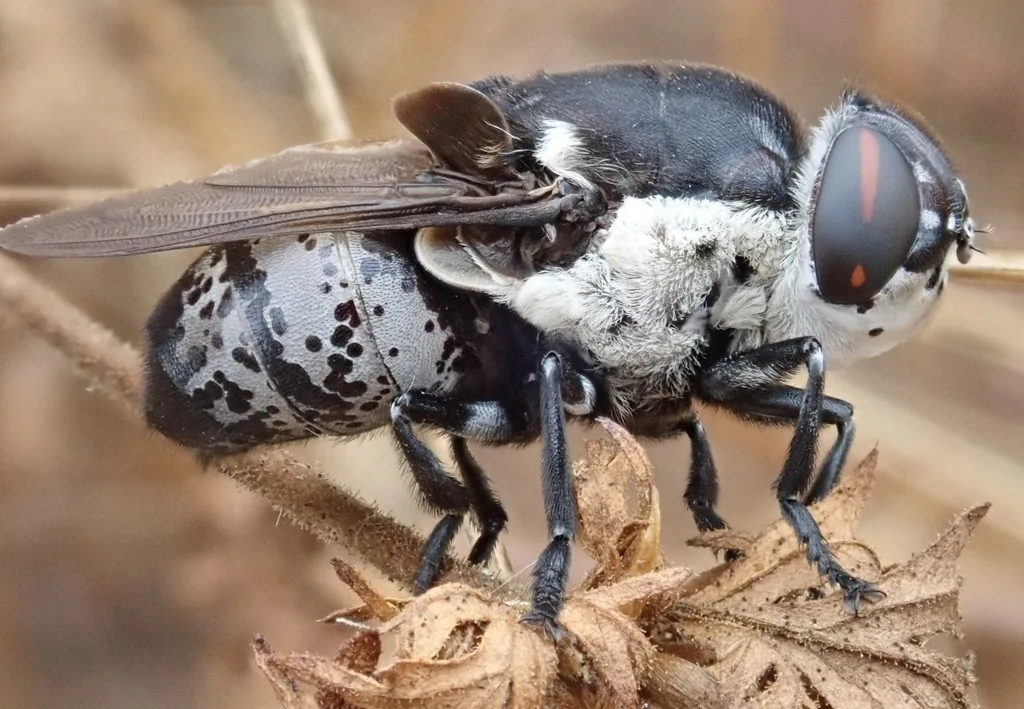
- Adult flies are large and bee-like, and they do not feed or bite.[3]
- A warble is a lump under the skin with a small breathing hole at the top; on a squirrel it looks like a hairless growth with a dark opening.[1][2]
- Grown larvae are dark brown, about 0.8 to 1.7 inches long and 0.3 to 0.4 inches wide.[1]
- In pets, look for a soft, well-defined swelling under the skin with a visible breathing pore.[3]
Look-alikes
| Look-alike | How to tell them apart |
|---|---|
| Squirrel fibromas (squirrel pox) | Fibroma growths look much like warbles but lack the large black opening in the center of each lump.[2] |
| Bumble bees | Adult Cuterebra flies look bee-like but cannot feed or bite, and you are far more likely to see the larval warble than the adult fly.[3][1] |
Where it lives
Several Cuterebra species occur throughout North America.[1]
Biology and life cycle
Females lay eggs where hosts will pass, such as at den or burrow entrances, along runways, or on nearby stones and plants.[1][3]
Body heat from a passing animal makes the eggs hatch, and the larvae enter through the mouth, nose, eyes or an open wound.[1][3]
Larvae settle under the skin and develop for several weeks, up to about seven, breathing through a hole in the skin.[2][3]
The full-grown larva leaves through the same hole, drops to the ground and pupates in the soil through winter before emerging as an adult fly.[2]
Warbles are noticed most often in late summer and early fall.[2][3]
Damage and signs
- Cuterebra mainly infest rodents and rabbits, but they have also been found in deer, foxes, mink, cattle, pigs, cats, dogs and people.[1]
- Warbles are rarely fatal to wild hosts, though heavy infestations or secondary infections can harm an animal, and large larvae can make small mammals walk awkwardly.[2][1]
- Bots and warbles do not appear to have a significant effect on wildlife populations in North America.[1]
Health risk
Human cases are rare. CDC says myiasis (fly larvae in human tissue) is not common in the U.S., and most U.S. patients picked it up while traveling in the tropics. Among cases acquired in North America without travel, Cuterebra species are the usual cause. Medical reviews describe a single boil-like lump in the skin as the usual form; children account for at least half of reported cases, which mostly appear in late August through October, especially in the northeastern U.S. and the Pacific Northwest (one review) or the northeastern and southern states (another). A Penn State entomologist documented three human cases at one western Pennsylvania hospital, all in the fall. CDC says you cannot get myiasis from another person, and that larvae under the skin usually stay under the skin rather than traveling through the body.[4][5][6][7]
Control
Prevention
Free-roaming outdoor pets are at higher risk than indoor pets, because they pick up eggs around rodent and rabbit burrows.[3]
Treating free-ranging wildlife is unnecessary and impractical; captive animals can be treated by removing the larvae and cleaning the wounds.[1]
When to call a professional
If a pet has a swelling with a breathing hole, take it to a veterinarian, who enlarges the pore and removes the larva in one piece, then flushes the wound.[3]
Do not squeeze the lump: rupturing the larva can cause a chronic foreign-body reaction.[3]
Warbles in pets
Dogs, cats and ferrets are abnormal hosts, and in them larvae sometimes wander to the head, nasal passages, throat, eyelids or brain.[3]
Wandering larvae in the brain can cause seizures, blindness or abnormal behavior, sometimes weeks or months after a bout of violent sneezing.[3]
Pets cannot catch warbles from other animals that have them.[2]
A review of 42 cases at a U.S. veterinary hospital found Cuterebra infection can cause severe whole-body illness in small dogs: 80% of the dogs weighed 10 lb or less, Yorkshire terriers were overrepresented, and all 6 dogs that died were in that small size group. Overall mortality was 17%, higher in dogs (30%) than cats (4.5%).[8]
Warbles in game animals
Warbles show up as large raised bumps on the meat of harvested rabbits and squirrels. The Pennsylvania Game Commission says they can easily be removed with a knife.[1]
Common questions
- What is the lump with a hole in it on my squirrel or rabbit?
- It is likely a warble, a bot fly larva growing under the skin; the hole lets it breathe, and the skin heals after the larva leaves.[2][1]
- Should I pull a bot fly larva out of my pet myself?
- No. A veterinarian should remove it whole; squeezing can rupture the larva and cause a lasting reaction.[3]
- Can people get warbles?
- Rarely. Cuterebra larvae have caused skin lumps in people, most often children, in late summer and fall, but CDC notes myiasis is uncommon in the U.S. and does not spread from person to person.[5][6][4]
- Are small dogs at greater risk from bot flies?
- A 42-case veterinary study found small dogs (10 lb or less), especially Yorkshire terriers, were the ones that developed severe whole-body illness; see a veterinarian promptly.[8]
- Can my dog catch warbles from a squirrel?
- No. NC Wildlife says pets can be accidental hosts but cannot get infected from other animals with warbles; the eggs are picked up around burrows and runways.[2][3]
Sources
- Pennsylvania Game Commission, “Bots and Warbles.” www.pa.gov/agencies/pgc/wildlife/wildlife-health/wildlife-diseases/bots-and-warbles (accessed 2026-11-12)
- North Carolina Wildlife Resources Commission, “Squirrel Diseases.” www.ncwildlife.gov/connect/have-wildlife-problem/common-wildlife-diseases/squirrel-diseases (accessed 2026-11-12)
- Merck Veterinary Manual, “Cuterebra Infestation in Small Animals (professional version, reviewed February 2025).” www.merckvetmanual.com/integumentary-system/cuterebra-infestation-in-dogs-and-cats/cuterebra-infestation-in-dogs-and-cats (accessed 2026-11-12). Written by Karen A. Moriello, DVM, DACVD, University of Wisconsin-Madison School of Veterinary Medicine; peer reviewed.
- U.S. Centers for Disease Control and Prevention (CDC), “About Myiasis.” www.cdc.gov/myiasis/about/index.html (accessed 2026-11-12)
- International Journal of Dermatology 47, 2008 (Delshad et al.), via PubMed, “Cuterebra cutaneous myiasis: case report and world literature review.” pubmed.ncbi.nlm.nih.gov/18377599/ (accessed 2026-11-12)
- Journal of the American Academy of Dermatology 21, 1989 (Baird, Baird & Sabrosky), via PubMed, “North American cuterebrid myiasis. Report of seventeen new infections of human beings and review of the disease.” pubmed.ncbi.nlm.nih.gov/2681284/ (accessed 2026-11-12)
- Journal of Medical Entomology 36, 1999 (Keth), via PubMed, “Three incidents of human myiasis by rodent Cuterebra (Diptera: Cuterebridae) larvae in a localized region of western Pennsylvania.” pubmed.ncbi.nlm.nih.gov/10593087/ (accessed 2026-11-12)
- Journal of the American Veterinary Medical Association 251, 2017 (Rutland et al.), via PubMed, “Systemic manifestations of Cuterebra infection in dogs and cats: 42 cases (2000-2014).” pubmed.ncbi.nlm.nih.gov/29190191/ (accessed 2026-11-12)
- iNaturalist, “Cuterebra taxon page (order and family).” www.inaturalist.org/taxa/154883 (accessed 2026-10-06)