The short answer
- Dots on the back: spongy moth caterpillars have five pairs of blue dots followed by six pairs of red dots. Forest tent caterpillars have white keyhole-shaped spots, and eastern tent caterpillars have one solid white stripe down the middle.[1][2][4][11][10][6]
- Silk: spongy moth caterpillars make no web or tent. Eastern tent caterpillars build a tent in the fork of branches in spring; forest tent caterpillars feed in groups with no webbed nest.[2][5][6][11]
- Fall webworm comes later: its loose webs cover leaves at the ends of branches in late summer and fall, while eastern tent caterpillar tents sit in branch crotches in spring and early summer.[5][7][13]
- Egg masses: spongy moth leaves fuzzy, buff to tan patches on bark, stones and outdoor gear. Tent caterpillar eggs are shiny bands wrapped around small twigs.[1][2][7][10]
Profiles on this site
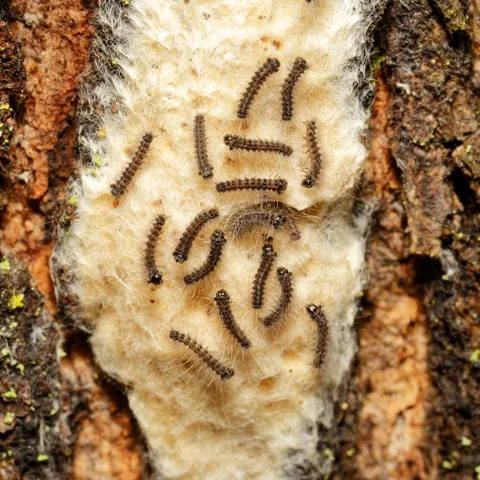 Spongy Moth
Lymantria dispar
The spongy moth, formerly called the gypsy moth, is an invasive defoliator from Europe whose caterpillars feed on the leaves of hundreds of kinds of trees and shrubs, oaks above all. Management changes with the season to target whichever life stage is present.
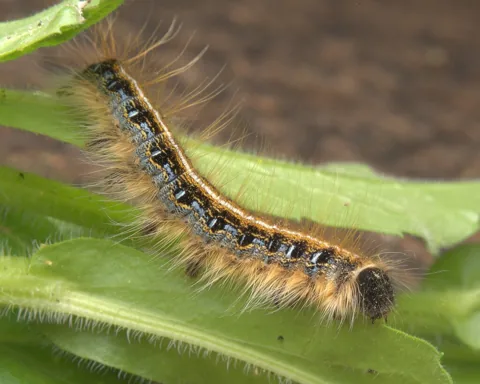 Eastern Tent Caterpillar
Malacosoma americana
Eastern tent caterpillars build silk tents in the crotches of wild cherry, apple and crabapple in spring. They can nearly defoliate a tree, but the tree usually recovers and puts out new leaves. It is a native insect with many natural enemies, and often no spraying is needed.
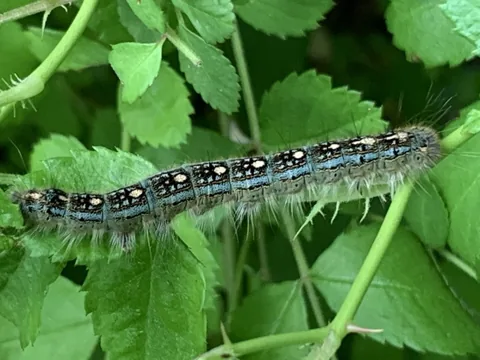 Forest Tent Caterpillar
Malacosoma disstria
Despite its name, the forest tent caterpillar doesn't build a tent, and it is often mistakenly called an armyworm because the caterpillars feed in groups. It is a native spring caterpillar that periodically defoliates aspen, oak, basswood, birch and other hardwoods, then crawls over buildings and roads in search of places to spin cocoons.
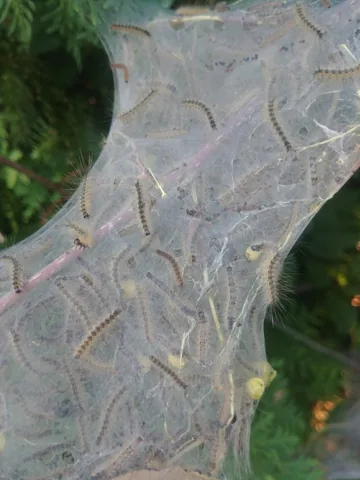 Fall Webworm
Hyphantria cunea
The fall webworm is a native caterpillar that spins large, loose webs over the ends of branches on a long list of deciduous trees and shrubs. The webs look alarming from midsummer into fall, but on healthy, established trees the damage is mostly cosmetic.
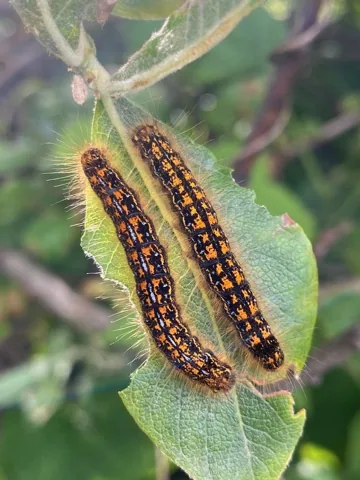 Western Tent Caterpillar
Malacosoma californicum
Western tent caterpillars hatch around budbreak and feed in groups inside silk tents on aspen, fruit trees, oak, willow and many other broadleaf hosts. Healthy trees tolerate the leaf loss, and natural enemies often keep numbers in check.
Side by side
Species and family: spongy moth is Lymantria dispar, a quarantined invasive species that UMass says was brought to Massachusetts from France. Eastern tent caterpillar (Malacosoma americana), western tent caterpillar and forest tent caterpillar (Malacosoma disstria, native to North America) are tent caterpillars, and fall webworm (Hyphantria cunea) is a webworm.[4][2][10][11][13]
Spongy moth caterpillar: hairy, with five pairs of blue dots followed by six pairs of red dots along the back. Newly hatched caterpillars are black and hairy.[1][2][4]
Eastern tent caterpillar: hairy, with a white stripe down the middle of the back flanked by yellow stripes; the rest of the body is mottled blue, yellow and black. Minnesota describes blue, black and orange markings with a white stripe.[6][8]
Forest tent caterpillar: mostly dark blue with wavy reddish-brown lines and a row of white spots down the back shaped like keyholes (UMass also says footprints or tiny penguins). Penn State points to these dots, instead of a solid line, as the way to separate it from the eastern tent caterpillar.[11][10][6]
Fall webworm: color varies a lot. Penn State describes it as usually greenish with a broad dark stripe along the back and a yellow stripe on each side; UC IPM describes gray, orangish or yellowish brown caterpillars with black, orange or white hairs growing from bumps along the body.[12][13]
Full-grown size: the sources differ for spongy moth. UMass says the caterpillars may exceed 3 inches by the time they pupate, and Minnesota says they can grow to two inches. Eastern tent caterpillars reach about two inches (Penn State, Minnesota), forest tent caterpillars up to 2 inches (UMass), and fall webworm up to 1 inch (UC IPM).[2][4][6][8][10][13]
Silk: UMass says spongy moth caterpillars make no silken webs or tents. Eastern tent caterpillars spin a tent in a crotch of the tree and leave it to feed. Forest tent caterpillars feed in groups on the leaves, not inside a webbed nest. Fall webworms spin loose webs that enclose the leaves they are eating.[2][5][11][13]
Egg masses: the winter clue
Spongy moth: a fuzzy egg mass covered with buff or yellowish hair from the female's abdomen, about 1-1/2 inches long and 3/4 inch wide on average (APHIS). UMass describes it as brown or tan and fuzzy.[1][2]
Where spongy moth lays: on tree trunks, stones, walls and logs, and on outdoor household items such as patio furniture, toys, lawn equipment, grills and trailers. Minnesota adds mailboxes and campers.[1][4]
Eggs per mass differ by source: APHIS says up to 1,000, UMass says 500 or more, and Wisconsin says egg masses often hold 600+ eggs.[1][2][3]
Eastern tent caterpillar: a mass that encircles a small twig, dark gray with a shiny coating and rounded or tapered ends, holding upwards of 350 eggs (UMass); Penn State gives 150-350 eggs. Penn State notes the smooth, shiny mass can be told from black knot fungus on cherry, which is rough and knotty.[7][6][5]
Forest tent caterpillar: also wrapped around twigs with a shiny coating, 1/2 to 1.5 inches long, but the ends are square instead of tapered.[10]
Season
Eastern tent caterpillar is the earliest. Eggs hatch in April as wild cherry leaves open, and the tents show in spring and early summer. Minnesota finds them on fruit trees in May and June.[7][5][8]
Spongy moth eggs hatch around the first week of May in Massachusetts, or by mid-to-late April in a warm spring. Caterpillars feed until about the third week of June and adults appear by late June or early July.[2]
Forest tent caterpillars hatch in early to mid-May in Minnesota, about when aspen leaves open, and older larvae wander in June.[9]
Fall webworm is the late one. Adults appear from mid-June, and the webs build through summer into fall. Penn State says there may be one or two generations a year depending on location; tent caterpillars have one.[12][13][11][10]
- Spring overlap is real: UMass notes spongy moth caterpillars are sometimes active at the same time as eastern tent caterpillars, so check the back pattern and look for a tent before deciding.[2]
Which trees they feed on
Spongy moth: oaks are preferred and often suffer the most. Apple, birch, poplar, willow and witch hazel are also favored, and when broadleaf hosts are stripped the caterpillars may move to spruce and white pine.[2]
Eastern tent caterpillar: mostly wild cherry, apple and crabapple, and also hawthorn, maple, cherry, peach, pear and plum.[5][7]
Forest tent caterpillar: quaking aspen, balsam poplar, basswood, oaks, ashes, birches, alder and fruit trees in Minnesota; it rarely feeds on red maple or conifers.[9]
- Fall webworm: more than 100 kinds of broadleaf trees, including birch, cottonwood, elm, fruit and nut trees, maple, mulberry, sycamore and willow.[13]
Damage and why the ID matters
Spongy moth outbreaks can strip whole trees; APHIS says a heavily infested forest looks barren and wintry in midsummer. UMass notes brown, rounded droppings and shredded leaves raining from the canopy.[1][2]
Eastern tent caterpillars rarely kill trees or shrubs, though the webbing is unsightly and leaf loss can weaken the plant. Forest tent caterpillar feeding generally does not kill deciduous trees, which can put out a second set of leaves the same season.[7][9]
Tent caterpillars are often held down by natural enemies, and UC IPM says they generally do not warrant insecticides. Forest tent caterpillar outbreaks usually collapse on their own.[11][10]
- Spongy moth is different because it is regulated. APHIS works to stop people from spreading it beyond the infested area and asks people outside quarantine areas to report it to their State plant health director or State plant regulatory official.[1]
Hairs and rash
MedlinePlus says most caterpillars are harmless, but some cause reactions when their hairs touch the eyes, skin or lungs.[14]
Spongy moth rash is documented. A 1984 public health study of the outbreaks in the Northeastern United States found itchy rashes far more common in a heavily infested town than a lightly infested one, and linked them to a caterpillar crawling on the skin, a rash the year before, and hanging laundry outside.[15]
A 2012 hospital review and survey in a heavily infested Japanese town found that most patients with this dermatitis had not noticed touching a caterpillar.[16]
- First aid from MedlinePlus: lift hairs off the skin with sticky tape, wash with soap and water, then ice. If hairs reach the eyes, flush with plenty of water and get medical help; get medical care if hairs are breathed in.[14]
How to confirm which one you have
Photograph a caterpillar's back up close. Paired blue and red dots mean spongy moth; a row of white keyholes means forest tent caterpillar; one solid white stripe means eastern tent caterpillar.[1][11][6]
Look at where the silk is: a tent in a branch fork in spring is eastern tent caterpillar, a web over leaves at the branch tip in late summer is fall webworm, and no silk at all fits spongy moth or forest tent caterpillar.[5][6][2][11]
In winter, check bark, outdoor furniture and firewood for fuzzy tan patches (spongy moth) and small twigs for shiny bands (tent caterpillars).[1][7][10]
- APHIS says homeowners in quarantine areas can ask their county Extension office about control, and people outside quarantine areas should report a find to state plant officials.[1]
What to do about each
Spongy moth egg masses: from mid-October to mid-April, scrape them into soapy water and soak for 2 days before throwing them away, or spray them with a horticultural oil labeled for spongy moth egg masses. Don't just scrape them onto the ground; many eggs survive.[3]
Spongy moth caterpillars: Wisconsin says Bt must go on in May while caterpillars are under 1/2 inch long. UMass says traps and bands may help with monitoring but do not give effective control, especially in outbreak years; see the sticky tree bands guide.[3][2]
Moving out of a quarantine area: APHIS says to inspect outdoor items such as patio furniture, grills, trailers and vehicles for egg masses, and that the self-inspection checklist is required by federal law in many areas. The federal rules are in 7 CFR 301.45, which still uses the name gypsy moth and lists firewood, boats, recreational vehicles and outdoor furniture among outdoor household articles.[1][17]
Tent caterpillars: remove egg masses from small trees in winter, and pull out or prune small tents in early spring. Kentucky warns against burning tents out with a torch, which can damage the tree.[5][7][9]
Fall webworm: prune out webs or twirl them into a ball with a brush on a pole. If spraying, Penn State says only the webs and the leaves around them need to be covered.[13][12]
- The tent caterpillars and webworms guide covers nest removal, Bt timing and wandering caterpillars in detail.[5]
Common questions
- Do spongy moth caterpillars make tents?
- No. Spongy moth caterpillars spin no web or tent. A silk tent in a branch fork in spring is eastern tent caterpillar.[2][5]
- What caterpillar has blue and red dots on its back?
- The spongy moth caterpillar: five pairs of blue dots followed by six pairs of red dots.[1][2][4]
- Is a forest tent caterpillar a spongy moth?
- No. The forest tent caterpillar is a native Malacosoma with white keyhole-shaped spots down the back and no blue and red dot pairs.[10][11]
- What do spongy moth egg masses look like?
- Fuzzy, buff to tan patches about 1-1/2 inches long on bark, stones, walls or outdoor gear.[1][2]
- Can spongy moth caterpillars cause a rash?
- Yes. Itchy rashes have been documented during spongy moth outbreaks, often in people who did not notice touching a caterpillar.[15][16]
Photo credits
- Spongy Moth: (c) Patrick Hanly, some rights reserved (CC BY) — via iNaturalist, CC BY 4.0
- Eastern Tent Caterpillar: (c) Norman Kuring, some rights reserved (CC BY) — via iNaturalist, CC BY 4.0
- Forest Tent Caterpillar: (c) Healthy Yards, some rights reserved (CC BY) — via iNaturalist, CC BY 4.0
- Fall Webworm: Andalyne Tofflemire, public domain (CC0), via iNaturalist
- Western Tent Caterpillar: Erin Springinotic, public domain (CC0), via iNaturalist
Sources
- USDA Animal and Plant Health Inspection Service, “Spongy Moth.” www.aphis.usda.gov/plant-pests-diseases/spongy-moth (accessed 2026-11-14)
- UMass Amherst Center for Agriculture, Food, and the Environment, “Spongy Moth (fact sheet).” www.umass.edu/agriculture-food-environment/landscape/fact-sheets/spongy-moth (accessed 2026-11-14)
- University of Wisconsin-Madison Extension, “Management Guide for Homeowners (Spongy Moth in Wisconsin).” fyi.extension.wisc.edu/spongymothinwisconsin/pest-management-2/management-guide-for-homeowners/ (accessed 2026-11-14)
- University of Minnesota Extension, “Spongy moth.” extension.umn.edu/yard-and-garden-insects/spongy-moth (accessed 2026-11-14)
- University of Kentucky Entomology, “Eastern Tent Caterpillar (EF423).” entomology.mgcafe.uky.edu/ef423 (accessed 2026-11-14)
- Penn State Extension, “Eastern Tent Caterpillar.” extension.psu.edu/eastern-tent-caterpillar (accessed 2026-11-14)
- UMass Amherst Center for Agriculture, Food, and the Environment, “Eastern Tent Caterpillar (fact sheet).” www.umass.edu/agriculture-food-environment/landscape/fact-sheets/eastern-tent-caterpillar (accessed 2026-11-14)
- University of Minnesota Extension, “Eastern tent caterpillars.” extension.umn.edu/yard-and-garden-insects/eastern-tent-caterpillars (accessed 2026-11-14)
- University of Minnesota Extension, “Forest tent caterpillars.” extension.umn.edu/yard-and-garden-insects/forest-tent-caterpillars (accessed 2026-11-14)
- UMass Amherst Center for Agriculture, Food, and the Environment, “Malacosoma disstria (Insect and Mite Guide).” www.umass.edu/agriculture-food-environment/landscape/publications-resources/insect-mite-guide/malacosoma-disstria (accessed 2026-11-14)
- University of California Statewide IPM Program, “Pest Notes: Tent Caterpillars.” ipm.ucanr.edu/home-and-landscape/tent-caterpillars/ (accessed 2026-11-14)
- Penn State Extension, “Fall Webworm.” extension.psu.edu/fall-webworm (accessed 2026-11-14)
- University of California Statewide IPM Program, “Fall Webworm (Pest Notes).” ipm.ucanr.edu/home-and-landscape/fall-webworm/ (accessed 2026-11-14)
- MedlinePlus, U.S. National Library of Medicine, “Caterpillars (Medical Encyclopedia).” medlineplus.gov/ency/article/002860.htm (accessed 2026-11-14)
- American Journal of Public Health, via PubMed, “Tuthill RW, Canada AT, Wilcock K, et al. An epidemiologic study of gypsy moth rash. Am J Public Health 1984;74(8):799-803.” pubmed.ncbi.nlm.nih.gov/6742270/ (accessed 2026-11-14)
- European Journal of Dermatology, via PubMed, “Kikuchi T, Kobayashi K, Sakata K, Akasaka T. Gypsy moth-induced dermatitis: a hospital review and community survey. Eur J Dermatol 2012;22(3):384-90.” pubmed.ncbi.nlm.nih.gov/22562801/ (accessed 2026-11-14)
- Electronic Code of Federal Regulations (eCFR), “7 CFR Part 301 Subpart E (Gypsy Moth), sections 301.45-1 and 301.45-2.” www.ecfr.gov/current/title-7/subtitle-B/chapter-III/part-301/subpart-E (accessed 2026-11-14)