On this page
How to identify it
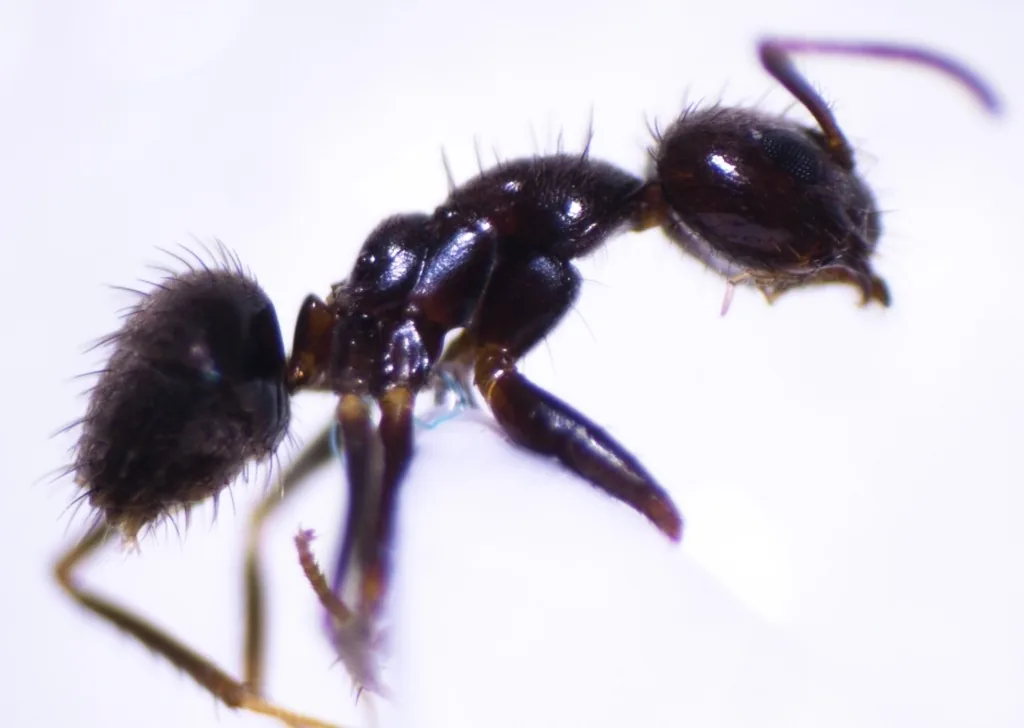
- Workers are brownish black to nearly or entirely black and move fast and erratically, the habit behind the name crazy ant.[2]
- Like other Nylanderia ants, the head, the top of the thorax, the antennal bases and the legs carry stiff hairs (setae).[4]
- It does not sting. By eye it is hard to separate from other small dark ants that also run erratically, including the longhorn crazy ant and white-footed ants.[2]
- UF/IFAS gives a worker length of 2.1 to 3.2 mm and says it has the largest workers of the dark brown to black Nylanderia species in the United States. The body is smooth and glossy, with abundant erect black hairs and fine gray hairs on the head, thorax, abdomen and legs.[5]
- In Florida the legs and antennae are dark; Pacific populations tend to have lighter, more yellow appendages. The antennae are 12-segmented and long, and males, about 2.5 to 2.75 mm long, are larger than any other dark-colored male ants in Florida.[5]
Look-alikes
| Look-alike | How to tell them apart |
|---|---|
| Tawny crazy ant | Another introduced Nylanderia crazy ant in Florida. The Mississippi Entomological Museum lists the tawny crazy ant for its huge supercolonies and for shorting out electrical equipment, while it lists the robust crazy ant only as a nuisance pest. UF/IFAS notes the robust crazy ant cannot defend food from red imported fire ants, while the tawny crazy ant outcompetes fire ants using defensive chemicals.[3][4][5] |
| Longhorn crazy ant | Also dark and erratic; the Maui Invasive Species Committee says the two are difficult to tell apart without magnification.[2] |
| White-footed ants | Small blackish ants that the Maui Invasive Species Committee also lists as easy to confuse with the robust crazy ant by eye. UF/IFAS says the two often share the same disturbed sites, but the robust crazy ant is noticeably glossier, and white-footed ants lack the long, erect hairs on the thorax that Nylanderia ants have.[2][5] |
Where it lives
Native to the Old World tropics and subtropics. In the New World it was first collected in Miami in 1924; a 2022 compilation of 446 New World sites found 89% of records in Florida, where it is known from 37 counties, and found that most, if not all, of the 14 records north of 30.5°N came from indoors; those northern finds include first reports for Missouri, New York and Washington. The Mississippi Entomological Museum lists it from scattered localities in Alabama, Florida, Georgia and South Carolina. It has also spread through the West Indies and has been in Hawaii since at least 1879. UF/IFAS says it is the most widespread species of its genus, has many records through the southernmost two-thirds of the Florida peninsula, with a first published Florida record in 1930, and is a fast recolonizer of islands in the Florida Keys. Historical records also exist from Mobile, Alabama, though it is unclear whether a population is established there.[1][3][2][5]
Biology and life cycle
In Florida it usually lives in wet, disturbed sites, including well-watered landscaped areas. In Hawaii it favors humid areas and is often common at beaches just above the high-tide mark.[2]
Colonies nest under rocks and in dead limbs and stalks. Workers hunt other insects, tend sap-feeding insects for their honeydew and feed at the nectar glands of many plants.[2]
UF/IFAS says colonies usually nest in soil and often move between temporary nest sites that may last only a few weeks. Nests are linked to places that flood often, such as mangroves and the edges of marshes and beaches, and shallow nests turn up in clumped vegetation or debris such as driftwood.[5]
Colonies eat other insects for protein and sugary honeydew from aphids and mealybugs for carbohydrates. Workers find and recruit to food quickly but cannot hold it against species that arrive later, such as the red imported fire ant.[5]
Colonies produce winged queens and males year-round; they fly on warm mornings before sunrise or after rain. Mated females are drawn to reflective surfaces such as wet walkways and standing water.[5]
Damage and signs
- A 1995 survey listed it among the top eight urban pest ants in peninsular Florida, but in practice it is mostly a picnic pest in outdoor eating areas. UF/IFAS, citing that survey, ranks it the eighth most abundant urban pest ant in peninsular Florida and calls it a minor nuisance in outdoor eating areas that rarely enters buildings in large numbers, probably only to shelter from cold weather. In Hawaii it is one of several invasive ants known to cause cosmetic damage to bananas with formic acid.[2][5]
- A 2022 review of its spread calls it a widespread but relatively minor household and agricultural pest in Florida.[1]
Health risk
No health risk is reported. It does not sting; the Maui Invasive Species Committee notes it is not aggressive toward people but may give a small nip if it gets squeezed inside clothing.[2]
Control
Prevention
Because it lives in damp areas, UF/IFAS says controlling excess moisture may help prevent infestation.[5]
Keep them out
UF/IFAS recommends sealing possible entryways, especially around doors and windows. If ants come indoors, UC IPM adds caulking cracks around foundations and cleaning up the food they are drawn to.[5][6]
Pesticides
UF/IFAS says little is known about controlling this ant specifically, but commercial liquid ant baits attract workers and should be effective, and broad pesticide applications should not be needed because it is a minor pest that is seldom indoors. UC IPM likewise calls baits the only type of insecticide recommended for nuisance ants in most situations.[5][6]
Where sources disagree
Native range: UF/IFAS says the species was introduced from the Old World tropics, but its profile calls it thought to be native to Southeast Asia in one place and to Australasia in another.[5]
Common questions
- Do robust crazy ants come inside?
- In Florida it is mainly an outdoor nuisance on patios and in damp landscaping. Farther north, most if not all records come from inside buildings. UF/IFAS says it rarely enters buildings in large numbers, probably only to shelter from cold weather.[2][1][5]
- What's the best way to control them?
- UF/IFAS says commercial liquid ant baits attract workers and should be effective, along with sealing entryways around doors and windows and reducing excess moisture; broad spraying should not be needed.[5][6]
- Does the robust crazy ant sting or bite?
- It has no sting. It may give a small nip if trapped against the skin in clothing.[2]
- Could it be confused with other crazy ants in Florida?
- Yes. UF/IFAS notes that identifying Nylanderia ants is hard because they look so alike. A close relative, Nylanderia vaga, is not yet in the New World but is a pest of concern that could thrive in Florida; robust crazy ant workers are distinctly larger.[5]
Sources
- Sociobiology 69(2): e7343 (peer-reviewed), “New-World Spread of the Old-World Robust Crazy Ant, Nylanderia bourbonica (Forel) (Wetterer 2022; abstract).” doi.org/10.13102/sociobiology.v69i2.7343 (accessed 2026-11-11)
- Maui Invasive Species Committee (University of Hawaii Pacific Cooperative Studies Unit), “Robust Crazy Ant, Nylanderia bourbonica.” mauiinvasive.org/pests/nylanderia-bourbonica/ (accessed 2026-11-11)
- Mississippi Entomological Museum, Mississippi State University, “Common Pest Ants of the Southeastern United States.” mem.org.msstate.edu/Researchtaxapages/Formicidaepages/faunal.lists/Common_Pest_Ants.html (accessed 2026-11-11)
- Insects, via PubMed Central, “A Review of the Tawny Crazy Ant, Nylanderia fulva, an Emergent Ant Invader in the Southern United States (Wang et al. 2016).” pmc.ncbi.nlm.nih.gov/articles/PMC5198225/ (accessed 2026-11-11)
- University of Florida IFAS Extension (EDIS), “Robust Crazy Ant (suggested common name), Nylanderia bourbonica (Forel), EENY-685/IN1183 (J. Williams and A. Lucky; Featured Creatures).” ask.ifas.ufl.edu/publication/IN1183 (accessed 2026-11-14)
- University of California Statewide IPM Program, “Pest Notes: Ants (Publication 7411).” ipm.ucanr.edu/PDF/PESTNOTES/pnants.pdf (accessed 2026-11-11)
- iNaturalist, “Nylanderia bourbonica taxon page (order and family).” www.inaturalist.org/taxa/625860 (accessed 2026-10-06)