On this page
How to identify it
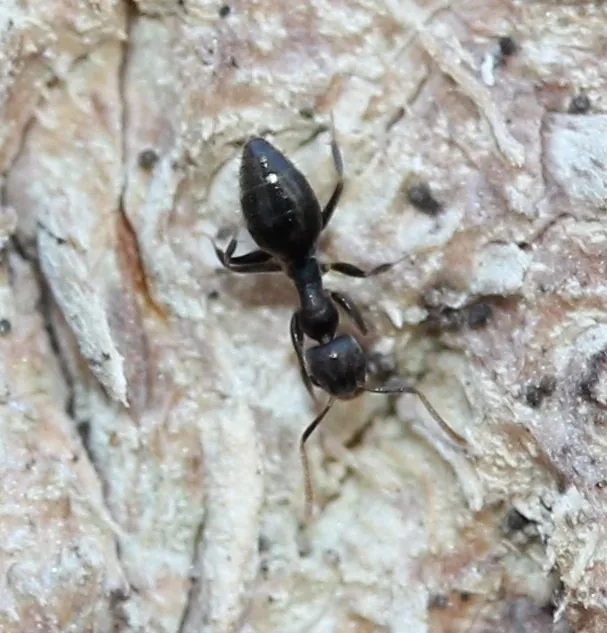
- Workers are black with pale yellow feet (tarsi) at the ends of the legs. Texas A&M puts them at a little over 1/8 inch long, and all workers are about the same size. UF/IFAS gives workers as 2.5 to 3 mm long, black to brownish-black, with yellowish-white feet.[3][5][4]
- The waist has a single flat segment (node) that is usually hidden from view by the abdomen.[3][5]
- Up close, the head, jaws and antennae are uniformly dark, there are a few erect hairs on the back, and the surface looks dull rather than shiny. Like its relatives, it lacks the small round opening (acidopore) at the tip of the abdomen that some other ants have.[5]
- Two close relatives, T. albipes and T. vitiensis, can only be told apart with a good microscope. Many records once filed as T. albipes were actually T. difficilis or T. vitiensis, and a 2007 revision of the genus by Bolton sorted this out. Texas A&M's page still uses the older name T. albipes in places. UF/IFAS notes that Florida's pest was long identified as T. albipes and was correctly identified as T. difficilis in 2007.[5][3][4]
- Under magnification, UF/IFAS lists five abdominal segments, 12-segmented antennae, few erect hairs and no sting.[4]
Look-alikes
| Look-alike | How to tell them apart |
|---|---|
| Odorous house ant | Both are dark ants whose single waist node is hidden under the abdomen. White-footed ants are slightly larger, a bit over 1/8 inch, and have pale yellow feet; odorous house ants are dark brown to shiny black and give off a very strong odor when crushed.[3][6] |
| Argentine ant | USDA's key separates white-footed ants from Argentine ants (Linepithema) by the waist node: flat in white-footed ants. UF/IFAS adds that the Argentine ant's waist node has an upright projection that the white-footed ant lacks.[5][4] |
| A crazy ant, Paratrechina bourbonica | In south Florida it is often mistaken for the white-footed ant. UF/IFAS says it is slightly larger, faster-moving and hairier, and gives off a slight fruity odor when crushed.[4] |
Where it lives
In the U.S. it was first found in Miami-Dade County, Florida, in 1986, and has since established in 22 nearby Florida counties and in Georgia, North Carolina, South Carolina and Louisiana. It was found in Texas in 2019, in Corpus Christi, where it arrived in a potted palm from Florida. It is also one of the ants most often found on Oahu, Hawaii. UF/IFAS adds five West Indian islands: Antigua, Nevis, Puerto Rico, St. Croix and St. Thomas. It was first collected in Florida at a nursery in Homestead in 1986, and moving infested landscaping plants and materials appears to be one of the most important ways it spreads.[1][2][4]
Biology and life cycle
Colonies have many queens and can hold hundreds of thousands of workers; connected satellite colonies can hold millions of ants. UF/IFAS cites colony estimates of 8,000 to 3 million individuals, and says neighboring colonies seem interconnected, so there is probably no way to mark where one colony ends.[3][1][4]
Intercastes, fertile wingless females with traits of both queens and workers, make up about half the colony's mass. They lay eggs and mate with related males inside the nest, so the colony keeps reproducing after its founding queen.[3][1]
Texas A&M reports winged females emerging in large numbers from late May to mid June. Colonies are started by winged queens after mating flights, but wingless intercastes then take over reproduction, and colonies also spread by budding. In south Florida, UF/IFAS says winged males and females are usually released between July and August.[3][1][4]
Outdoors they nest in piled items and damp, shaded spots; indoors, in wall voids and potted plants. In Texas most nests were in potted palm trees. UF/IFAS lists nests in trees and bushes, tree holes, under palm fronds and old leaf boots, in loose mulch, under debris, in leaf litter on the ground and in rain gutters, in wall voids and in attics; nests are found outside more often than inside.[3][1][4]
They tend aphids and mealybugs for their sugary honeydew, protecting these plant pests from their natural enemies. UF/IFAS adds that they feed on plant nectar and on dead insects and other protein, and that foragers lay scent trails that are often used between a nest and a food source for months.[1][4]
Foragers share food with nestmates by producing non-viable 'trophic' eggs.[4]
Damage and signs
- The trouble is nuisance foraging: workers trail inside and outside buildings in large numbers.[1][3]
- Foragers follow edges such as sidewalks, patio slabs and ledges, and get into buildings along tree limbs and branches that touch walls or the roof. UF/IFAS says foragers that get into wall voids follow electrical cables and come out in various rooms, especially kitchens and bathrooms, and that trails up house walls often enter soffit vents leading to the attic.[3][4]
- Because they tend honeydew-producing insects, they also cause crop and plant losses by shielding aphids and mealybugs from predators.[1]
- Elsewhere in the world, by tending honeydew producers it has helped spread pineapple wilt disease in Sri Lanka and caused local red scale outbreaks in South African citrus orchards.[4]
Health risk
White-footed ants are a nuisance ant. UF/IFAS says they do not bite or sting and lack a venomous sting altogether, and none of the other sources used here report bites, stings or disease.[4][3][5][1]
Control
Keep them out
Seal cracks in exterior walls, and pull mulch and plants back from the foundation so the area is less attractive.[3]
Traps and physical control
Follow the trails. Workers carrying food or water return to their nests, so trails on sidewalks, foundations and walls lead to nest sites or to the gaps where they enter.[3]
Cut back branches that touch the house or roof. UF/IFAS says the best policy is to have no vegetation touching exterior walls, and to trim back large infested trees overhanging the house so falling 'leaf nests' don't reinfest the roof. Trails coming from neighbors' vegetation, fences or lawns must be treated too.[3][4]
Pesticides
Perimeter sprays give only temporary relief from ants on the outside of the house, and every colony has to be treated. Nests in wall voids are treated through small drilled holes with an aerosol or dust, which is work for a professional. If you use any insecticide, read and follow the label.[3]
Sugar baits have worked against a close relative. On Hachijo Island, Japan, a sugar-water gel bait containing a low dose of insecticide, put out by residents around their homes, significantly suppressed the white-footed ant T. brunneus.[7]
In UF/IFAS laboratory tests from 2002 to 2005, baits were the only effective management method. Find every white-footed ant population on the property so each one has bait, and keep fresh liquid bait out until the ants are controlled, since liquid baits slowly dry out.[4]
For ants nesting in an attic, UF/IFAS suggests placing liquid baits along trails on the outside of the house; attics usually lack food, so the ants come out to feed. Residual and systemic sprays on surrounding plants can help by removing the honeydew-producing insects they feed on. Always follow label directions.[4]
When to call a professional
Texas A&M rates the white-footed ant the most difficult structure-infesting ant to control, so heavy infestations usually call for a pest management professional. UF/IFAS also advises hiring a professional pest control company in most cases.[3][4]
What the 2025 Texas and Florida study found
Texas A&M researchers compared white-footed ants from Texas and southern Florida. Both populations had low genetic diversity and shared one mitochondrial haplotype, which fits the Texas ants having come from Florida. The same haplotype turns up in introduced populations in Hawaii, Mexico, Panama, France and Germany.[1]
Florida colonies showed signs of inbreeding and were aggressive toward ants from other nests. Texas colonies were less aggressive and had more uniform surface chemistry, which may let nests cooperate more freely.[1]
Where the sources disagree
Mating flights: Texas A&M reports winged females emerging in large numbers from late May to mid June, while UF/IFAS says winged forms are usually released between July and August in south Florida.[3][4]
Size: Texas A&M puts workers at a little over 1/8 inch, while UF/IFAS gives 2.5 to 3 mm.[3][4]
Common questions
- Why don't sprays get rid of white-footed ants?
- A colony is spread over many connected nests and can number in the millions. Sprays along the outside of the house only give temporary relief, and every colony has to be found and treated.[3][1]
- Do white-footed ants bite?
- No. UF/IFAS says they do not bite or sting; they are a nuisance because of their numbers.[4][1]
- Why do I keep seeing ants on the walls of my house?
- White-footed ants follow edges and ledges and climb in on branches that touch the walls or roof. Trim branches back and seal cracks.[3]
- Do baits work on white-footed ants?
- UF/IFAS laboratory tests found baits the only effective method. The key is keeping fresh bait available to every population on the property.[4]
Sources
- Insect Science, via PubMed Central, “Colony and population genetic structure of the newly invasive white-footed ant (Technomyrmex difficilis) in the United States (Liu, Eyer, Helms, Puckett and Vargo 2025).” pmc.ncbi.nlm.nih.gov/articles/PMC12717334/ (accessed 2026-11-11)
- Insects, via PubMed, “Roadside Survey of Ants on Oahu, Hawaii (Tong, Grace, Krushelnycky and Spafford 2018).” pubmed.ncbi.nlm.nih.gov/29439503/ (accessed 2026-11-11)
- Texas A&M Center for Urban and Structural Entomology, “White-Footed Ant.” urbanentomology.tamu.edu/urban-pests/ants/white_footed/ (accessed 2026-11-11)
- University of Florida IFAS Extension (EDIS), “White-Footed Ant, Technomyrmex difficilis (=albipes) Forel, EENY-273/IN551 (J. Warner, R. H. Scheffrahn and B. Cabrera; Featured Creatures).” ask.ifas.ufl.edu/publication/IN551 (accessed 2026-11-14)
- USDA APHIS PPQ Identification Technology Program (IDtools), “Technomyrmex difficilis (PIAkey: Identification Guide to the Ants of the Pacific Islands, fact sheet).” www.idtools.org/id/ants/pia/Fact_Sheets/Technomyrmex_difficilis.html (accessed 2026-11-11)
- University of California Statewide IPM Program, “Key to Identifying Common Household Ants: Odorous House Ant.” ipm.ucanr.edu/TOOLS/ANTKEY/odorous.html (accessed 2026-11-11)
- Pest Management Science, via PubMed, “Development of an effective hydrogel bait and an assessment of community-wide management targeting the invasive white-footed ant, Technomyrmex brunneus (Sunamura et al. 2022).” pubmed.ncbi.nlm.nih.gov/35642574/ (accessed 2026-11-11)
- iNaturalist, “Technomyrmex difficilis taxon page (order and family).” www.inaturalist.org/taxa/430041 (accessed 2026-10-06)