On this page
How to identify it
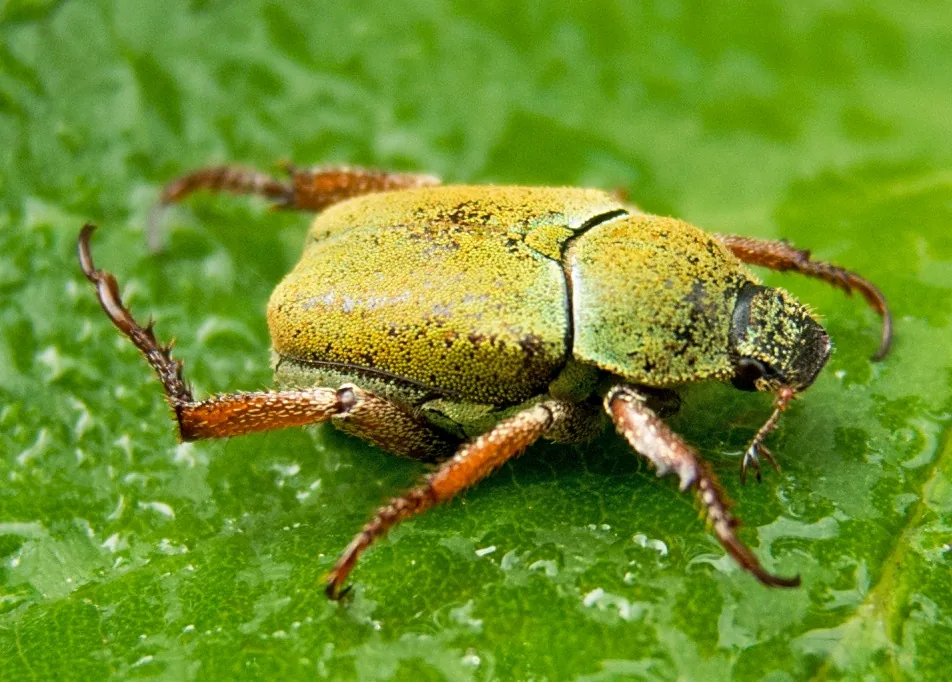
- Adults are oval and about 1/4 inch long, with a dark reddish-brown head and thorax, brown wing covers, and a silvery-green shimmer in sunlight.[1][4]
- Larvae are small, crescent- or C-shaped white grubs that live in the soil, similar to June beetle grubs.[1][2]
- The clearest sign is the damage: round holes chewed in the petals of open, light-colored flowers, with the leaves left untouched.[1][4]
Look-alikes
| Look-alike | How to tell them apart |
|---|---|
| Japanese beetle | Sometimes mistaken for it, but Japanese beetles are about twice as long and metallic green with coppery wing covers, and they are not established in California. UC IPM says to report a suspected Japanese beetle to the California Department of Food and Agriculture hotline (1-800-491-1899).[1][4] |
| Rose chafer | Often misidentified as rose chafer, which doesn't occur in California.[1] |
Where it lives
It's common in many parts of California, especially the Central Valley, where UC IPM says it is mainly a problem from Sacramento south to Bakersfield.[1][4]
Biology and life cycle
Females lay glossy white eggs in the soil of alfalfa fields, pastures and other undisturbed ground such as fence lines and ditches. The grubs feed on decaying plant matter and roots but not on woody roots, and they spend the winter in the soil.[1]
Adults emerge in early spring and are active from late March to early May; after a few weeks of feeding they fly back to their egg-laying sites. There is one generation a year, so the damage is usually limited to a 2- to 4-week period.[1][4]
Fun fact: the shimmer on hoplia beetles comes from tiny scales. In lab studies of two European cousins, Hoplia coerulea turned from blue to green when wet and Hoplia argentea shifted from green to brownish-red, changing back as they dried.[5][6]
Damage and signs
Health risk
It feeds on flowers; UC IPM's pest notes mention no risk to people or pets.[1][4]
Control
Prevention
Where these beetles are plentiful, plant darker roses such as reds, since the beetles prefer light-colored flowers.[1][4]
Traps and physical control
Check blooms often and handpick the beetles, or shake them out of the flowers straight into a bucket of soapy water. You can also clip off infested blooms and throw them away. Regular handpicking can lower next year's numbers nearby.[1][4]
Set white 5-gallon buckets of water with a few drops of detergent around the rose garden; beetles attracted to the white fall in and drown. UC IPM notes this hasn't been tested by research and may only reduce numbers somewhat.[1]
Pesticides
Sprays generally aren't recommended and should not be needed in a garden. The blossoms shield the beetles, systemic insecticides don't reach toxic levels in the flowers, and the grubs often live in soil outside the garden.[1][4]
More from UC Cooperative Extension
A 2003 UC Cooperative Extension report from Fresno and Merced counties describes hoplia grubs as a pest of strawberries: damage first appeared in a Fresno field in 1997, where the C-shaped grubs fed on new roots and stunted or killed plants, with 1 to 14 grubs per affected plant. Samples from strawberries and calla lilies sent to the California Department of Food and Agriculture in 2002 and 2003 were identified as Hoplia callipyge, and adults were seen emerging from holes in the soil around mid-April.[2]
Where sources disagree
Timing: the hoplia beetle pest note gives adult activity from late March to early May (and a problem period to May), while UC IPM's rose pest note describes damage as usually confined to a 2- to 4-week period in late spring.[1][4]
Common questions
- What's eating holes in my white roses in spring?
- In California, hoplia beetles are a likely cause from late March to May.[1]
- Should I spray?
- Generally no. Sprays work poorly because the beetles hide in the blooms; handpicking and removing infested flowers work better.[1][4]
- Do hoplia beetles eat rose leaves?
- No. Adults feed on petals, buds and flowers, not the leaves, and the grubs don't feed on rose roots.[1][4]
Sources
- University of California Statewide IPM Program, “Pest Notes: Hoplia Beetle (Publication 7499).” ipm.ucanr.edu/PMG/PESTNOTES/pn7499.html (accessed 2026-11-12)
- University of California Cooperative Extension, “Hoplia - A New Pest in Strawberries (July 2003, R. Molinar and M. Norton).” ucanr.edu/media/304497 (accessed 2026-11-12)
- iNaturalist, “Hoplia taxon page (order and family).” www.inaturalist.org/taxa/81486 (accessed 2026-11-12)
- University of California Statewide IPM Program, “Pest Notes: Roses: Insects and Mites (Publication 7466).” ipm.ucanr.edu/PMG/PESTNOTES/pn7466.html (accessed 2026-11-12)
- Scientific Reports (2016), via PubMed, “Liquid-induced colour change in a beetle: the concept of a photonic cell.” pubmed.ncbi.nlm.nih.gov/26758681/ (accessed 2026-11-12). Cited from the PubMed abstract.
- Frontiers in Zoology (2024), via PubMed, “Complex interplay between the microfluidic and optical properties of Hoplia sp. beetles.” pubmed.ncbi.nlm.nih.gov/39543736/ (accessed 2026-11-12). Cited from the PubMed abstract.