On this page
How to identify it
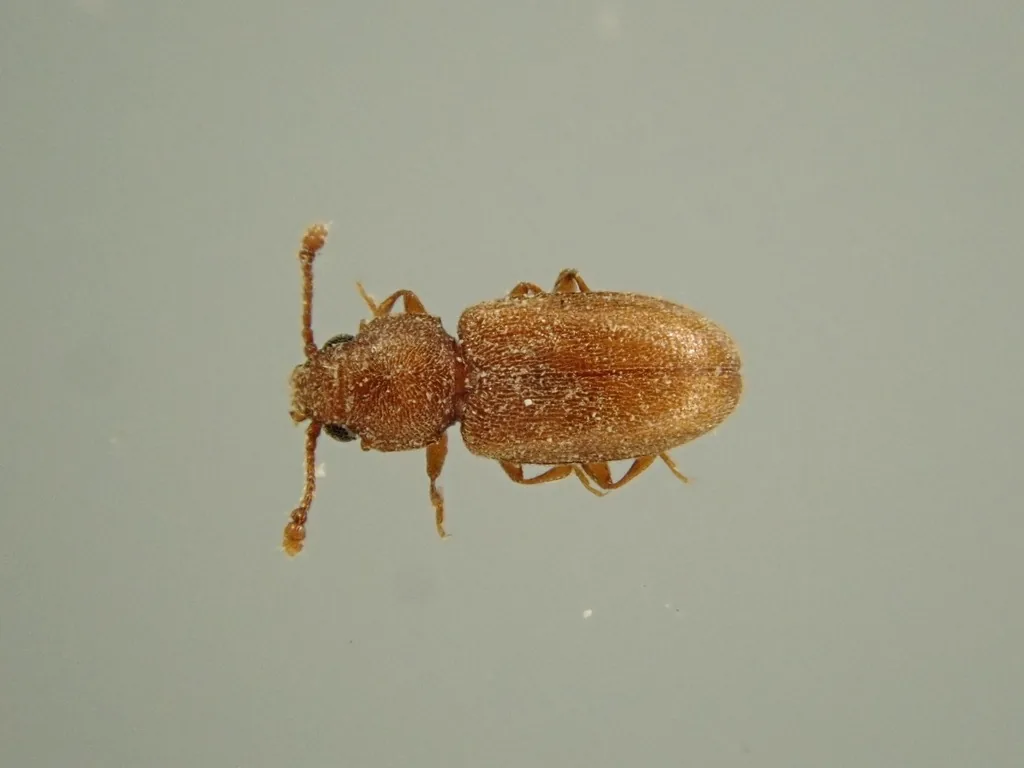
- Adults are flattened, reddish-brown beetles only about 2 mm long (see where the sources disagree on size).[3][4][1][2]
- The key feature is a small knob or peg-like projection on each front corner of the plate behind the head (the pronotum); Texas A&M describes the corners as projecting forward at a 45 degree angle. You need a good hand lens or a microscope to see it.[1][2][3]
- The antennae are a little under half the body length and end in a three-segmented club, and the wing covers carry rows of punctures and very fine hairs.[3][4]
- They fly well and are drawn to windows and lights, so they are sometimes mistaken for fruit flies or gnats, but they have a hard shell and their wings fold under wing covers. Adults can also climb the glass walls of jars.[2][1][4]
- The larvae are very small and whitish to yellow. UF/IFAS says mature larvae are yellowish white and 3.5 mm long.[4][5]
Look-alikes
| Look-alike | How to tell them apart |
|---|---|
| Sawtoothed grain beetle | Similar in size and in the same family, but it has six saw-like teeth along each side of the thorax instead of a single knob at each front corner.[1][3] |
| Merchant grain beetle | Also has six tooth-like projections on each side of the thorax and is more often a true pest of stored food.[3] |
| Flat and rusty grain beetles | Cryptolestes beetles lack the clubbed antennae and front-corner projections of the foreign grain beetle; Texas A&M notes their elongated antennae and raised lines along each side of the pronotum.[4][3] |
| Plaster beetles (minute brown scavenger beetles) | Other tiny mildew feeders in damp homes; their thorax is often hairy and distinctly narrower than the wing covers.[3] |
| Booklice | Also tied to high humidity and mildew, but booklice are pale insects only 1 to 2 mm long, with a bulging upper lip and a narrow thorax.[3] |
Where it lives
Found across Canada and throughout the world in both tropical and temperate regions; a 2025 review counts reports from 110 countries. Kentucky and Minnesota extension describe it as a common mid- to late-summer nuisance inside buildings. UF/IFAS also describes it as worldwide in distribution.[4][6][1][2][5]
Biology and life cycle
Adults and larvae feed on molds on damp grain and cereal products, poorly seasoned lumber and wet plaster or wallboard, and both can live on mold alone. A review notes they tolerate fungal aflatoxins better than other species and that females lay more eggs on the fungi their young grow best on. UF/IFAS lists bread, biscuits and other flour products among the moldy foods it feeds on, and notes it also eats dead insects in them.[1][2][3][6][5]
Eggs are laid singly or in clusters of two or three and hatch in 4 to 5 days; Texas A&M says females lay 1 to 4 eggs a day over a laying period of 20 to 30 days.[3][4]
A generation takes about three to four weeks under warm, humid conditions (see where the sources disagree on how long).[3][2]
Minnesota says they need relative humidity above 65 percent to reproduce and die off once it falls below 60 percent; Texas A&M notes the larvae require high humidity.[2][3]
Adults can live for months; Texas A&M reports average lifespans of 159 days for mated males and 208 days for mated females (see where the sources disagree).[3]
In new homes, beetles breed on mold in wall voids, often on construction sawdust, then exit around baseboards, outlets and light fixtures. Minnesota says they are most common in August and September and their numbers drop sharply by October.[2][1]
Outside homes they turn up in compost heaps, haystacks and manure, are often found in wheat right after harvest, and are frequently present in the field at harvest and then carried into bins.[6][4]
Damage and signs
- Indoors they are only a nuisance: they don't bite, don't damage wood, fabric or sound food, and don't infest furniture or clothing.[1][2]
- If you find them in stored food, the food is usually old, damp or moldy.[1][2][4]
- Their presence signals a moisture problem, such as damp new framing, plumbing leaks, condensation or poor ventilation.[1][3]
- In stored grain, their feeding usually isn't enough to cause economic loss, but contamination is a problem; in countries with zero tolerance for insects, their presence can get a load rejected. UF/IFAS says that because it feeds on molds rather than the food itself, it is not a major stored product pest.[4][6][5]
Health risk
Kentucky and Minnesota Extension say foreign grain beetles don't bite and are only a nuisance, and Kentucky adds that they don't damage wood, fabric or sound food. The mold they feed on is the bigger concern: CDC says damp, moldy places may cause a variety of health effects or none at all; some people get a stuffy nose, sore throat, cough or wheezing, burning eyes or a skin rash, and people with asthma or a mold allergy may have severe reactions.[1][2][7]
Control
Prevention
The real fix is drying out the wood and removing the moisture source; the beetles disappear along with the mold. Kentucky says most new homes dry out naturally within the first few years, and Minnesota says new-construction problems typically last one to two years.[1][2]
Speed drying with fans and air conditioning, more air exchange, a dehumidifier for up to a month, and bathroom vent fans during showers and baths.[1][2]
To keep mold from coming back, CDC advises keeping indoor humidity no higher than 50 percent, using kitchen and bathroom exhaust fans that vent outside, and fixing roof, wall and plumbing leaks. If mold is growing, clean it up and fix the moisture problem.[7]
Sanitation
In older homes, fix leaks and condensation, check crawlspace and attic ventilation, and clean up any spilled grain or moldy food.[2][3]
Traps and physical control
Vacuum up visible beetles; Kentucky says a vacuum works as well as a spray for removing them, and Minnesota calls it the best short-term control.[1][2]
Pesticides
Pesticides are rarely needed. Pyrethrin aerosols give only brief relief and must be repeated, while residual aerosols or dusts injected into the infested wall voids last longer. Texas A&M notes infestations persist until moisture drops enough to stop mold growth.[2][1][3]
Where the sources disagree
Size: Texas A&M and UF/IFAS say 2 to 3 mm, the Canadian Grain Commission about 2 mm, Kentucky about 1/16 inch and Minnesota about 1/12 inch.[3][5][4][1][2]
Development time: Texas A&M gives an average of 22 days from egg to adult at 80 °F and 75 percent relative humidity; Minnesota says the life cycle takes about 30 days. UF/IFAS says the life cycle can be as short as 2.5 weeks under favorable conditions.[3][2][5]
Lifespan: Texas A&M reports average lifespans of 159 days for mated males and 208 days for mated females; Minnesota describes the beetles as short-lived.[3][2]
Insecticides: Minnesota says pesticides are rarely if ever needed; Kentucky describes injecting residual aerosols or dusts into infested wall voids for longer-lasting relief.[2][1]
Egg numbers: UF/IFAS says a female lays 100 to 300 eggs in clusters of two or three, taking two days to lay each cluster, while Texas A&M gives 1 to 4 eggs a day over a laying period of 20 to 30 days.[5][3]
Common questions
- Why are tiny brown beetles coming out of the walls of my new house?
- New lumber and drywall often hold extra moisture that grows mold inside the walls. Foreign grain beetles feed on that mold and come out in late summer.[2][1]
- Will foreign grain beetles go away on their own?
- Usually. Each season they are a problem for about a month, and in new construction they typically return for only one to two years, until the wood dries and stops supporting mold.[2][1]
- Do foreign grain beetles mean I have toxic mold?
- They show that something is damp enough to grow mold, not what kind of mold it is. CDC says you don't need to know the type: if you see or smell mold, remove it and fix the moisture problem, and CDC does not recommend mold testing. Health effects vary from none at all to a stuffy nose, wheezing or itchy eyes, and people with asthma or a mold allergy may react severely.[2][7]
Sources
- University of Kentucky College of Agriculture, Entomology, “ENTFACT-610: Foreign Grain Beetle (revised March 2026).” entomology.mgcafe.uky.edu/ef610 (accessed 2026-11-13)
- University of Minnesota Extension, “Foreign Grain Beetles (reviewed 2024).” extension.umn.edu/nuisance-insects/foreign-grain-beetles (accessed 2026-11-13)
- Texas A&M AgriLife Extension Service, “Mildew-Feeding Insects in the Home (Insects in the City).” citybugs.tamu.edu/factsheets/household/misc-house/ent-2010/ (accessed 2026-11-13)
- Canadian Grain Commission, “Foreign grain beetle (Identify an insect: secondary insect pests).” www.canada.ca/en/grain-commission/services/grain-quality/manage-stored-grain/identify-insect/secondary-insect-pests/foreign-grain-beetle.html (accessed 2026-11-13)
- University of Florida, Department of Entomology and Nematology, “Foreign grain beetle, Ahasverus advena (UF/IFAS Stored Product Pests Photographs).” entnemdept.ufl.edu/projex/gallery/dl/stored_product_pests/text/foreign_grain_beetle.htm (accessed 2026-11-14)
- Insects, via PubMed, “Hagstrum DW, Subramanyam B (2025), Ecology of Ahasverus advena in stored products and other habitats, Insects 16(3):313.” pubmed.ncbi.nlm.nih.gov/40266819/ (accessed 2026-11-13). Cited from the PubMed abstract.
- U.S. Centers for Disease Control and Prevention, “Mold (page dated September 26, 2024).” www.cdc.gov/mold-health/about/index.html (accessed 2026-11-13)
- Global Biodiversity Information Facility (GBIF), “Ahasverus advena (Walt, 1832) (GBIF Backbone Taxonomy).” api.gbif.org/v1/species/1043858 (accessed 2026-11-13)
- iNaturalist, “Ahasverus advena taxon page (order and family).” www.inaturalist.org/taxa/212915 (accessed 2026-11-11)