On this page
How to identify it
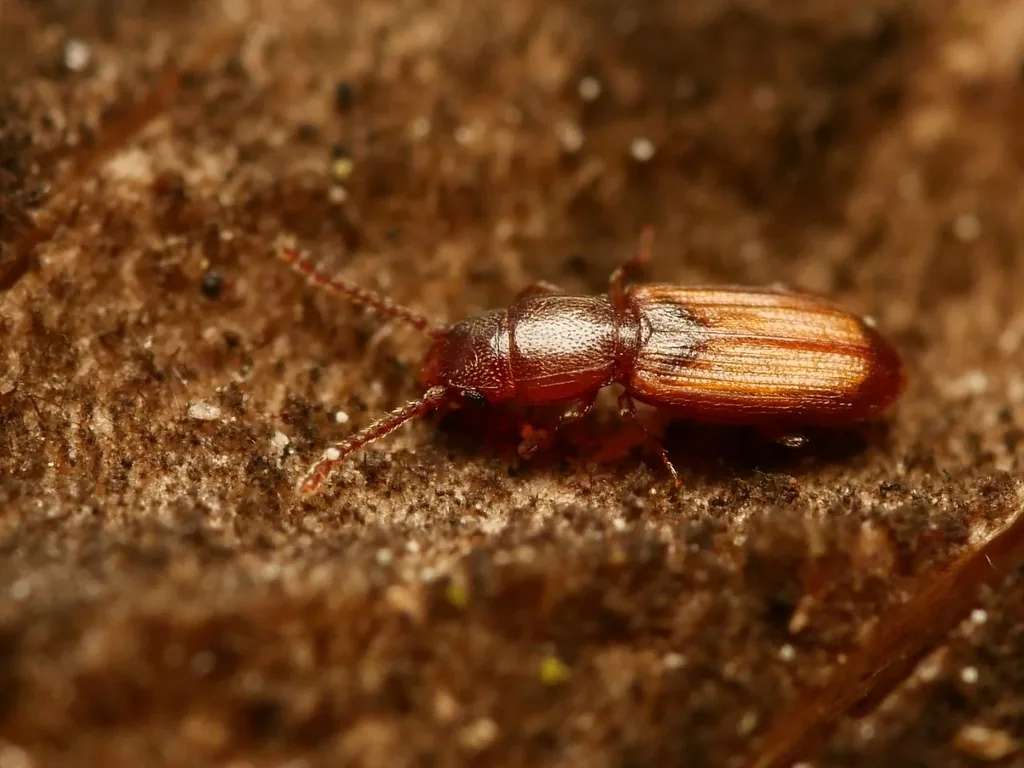
- Adults are flat, reddish brown and among the smallest stored-product beetles: Kansas State gives about 2 mm (1/12 inch), USDA about 1/16 inch. The antennae are long and slender.[2][1]
- Antenna length in males is the usual way to separate them. In the rusty grain beetle the antennae are no more than about half the body length, in both sexes; males of the flat grain beetle have antennae about two-thirds the body length, and males of the flour mill beetle have antennae as long as the body or longer.[1][2]
- In the rusty grain beetle the prothorax, the segment behind the head, is slightly longer than broad and tapers toward the rear; in the flat grain beetle it is nearly square in females and narrows only slightly in males.[2]
- Rusty grain beetle adults are cold hardy and fly well in warm weather.[3]
Look-alikes
| Look-alike | How to tell them apart |
|---|---|
| Rusty grain beetle and flat grain beetle | So alike in look and habits that the grain trade rarely tells them apart, and females of the flat grain beetle and flour mill beetle are almost impossible to separate; compare antenna length in males and the shape of the segment behind the head.[2][1] |
Where it lives
Worldwide. USDA calls the flat grain beetle cosmopolitan and one of the commonest stored-grain pests; the rusty grain beetle is more cold-tolerant and more common in stored grain in the northern United States and Canada, and Kansas State reports both as common in Kansas stored grain.[1][3][2]
Biology and life cycle
Females lay small white eggs in crevices in the grain or drop them loosely on flour and meal. Kansas State puts egg-laying at 200 to 300 eggs per female.[1][2]
When full grown, larvae build cocoons of a gelatinous substance with food particles stuck to it and pupate inside.[1][2]
In favorable conditions the flat grain beetle goes from egg to adult in about 5 weeks, though USDA puts the average summer cycle at about 9 weeks; Kansas State says the cycle can take as few as 22 days but is usually longer.[1][2]
Larvae also feed on dead insects.[1]
Damage and signs
- They cannot develop on completely sound kernels, but nearly every mass of grain holds damaged kernels, and they are often abundant in grain already infested by weevils.[2]
- Larvae feed mainly on the germ; in infested wheat many kernels are untouched except that the germ is gone.[1][2]
- The rusty grain beetle prefers high-moisture grain or moist, decaying food, and it often builds up to large numbers when conditions are right.[3]
- Both larvae and adults feed in grain, cereal products, nuts and other stored products, and they can infest leftover material in mills.[2]
- In a home the first sign is usually small beetles crawling on counters or shelves, and the fix is finding and destroying every infested product.[4][6]
Health risk
No diseases have been linked to pantry beetles, but their presence makes food unfit to eat.[6][4]
Control
Prevention
Move foods from cardboard, paper or plastic packages into jars or containers that seal tightly, inspect grain products when you buy them, and don't buy more than you will use in about two months.[4][6]
Sanitation
Find and throw out every infested product, bagged and put in an outdoor trash can with a tight lid. Check everything on the shelves, including under cans, then vacuum shelves and cracks thoroughly and empty the vacuum afterward.[4][6][5]
Traps and physical control
Lightly infested items can be saved by cold or heat, but the numbers differ: Illinois says freeze food at 27 degrees F or colder for at least 3 to 7 days or heat it in a 140 degree F oven for an hour; Kentucky gives 0 degrees F for 4 days in a freezer that does not self-defrost, or 155 degrees F for about 20 minutes with the oven door propped open, for decorative items and birdseed.[5][4]
Pesticides
Insecticide sprays are a last resort and not recommended by Clemson or Illinois; if used, follow the label, never spray food, and aim only at cracks and crevices.[6][5]
Where sources disagree
Size: Kansas State gives about 2 mm (1/12 inch) for the flat grain beetle; USDA describes it as about 1/16 inch long.[2][1]
Life cycle: Kansas State says as few as 22 days; USDA says about 5 weeks under favorable conditions and about 9 weeks on average in summer.[2][1]
Saving infested food: Illinois advises 27 degrees F or colder for 3 to 7 days or 140 degrees F for an hour; Kentucky advises 0 degrees F for 4 days or 155 degrees F for about 20 minutes.[5][4]
Common questions
- What are the tiny reddish-brown beetles in my flour?
- Very small (about 1/16 to 1/12 inch), flat, reddish-brown beetles with long, slender antennae in grain or cereal products are likely flat grain beetles such as the rusty grain beetle.[2][1]
- How do I get rid of beetles in my pantry?
- Throw out infested food, vacuum and clean the shelves, freeze or heat lightly infested items worth saving, and keep food in sealed containers.[4][5][6]
- Can flat grain beetles eat whole, undamaged grain?
- No. They need damaged kernels, broken grain or processed products, but most stored grain has some damaged kernels.[2]
Sources
- USDA Agricultural Research Service, “Stored-Grain Insects (Agriculture Handbook No. 500, issued 1978, revised 1986).” www.ars.usda.gov/ARSUserFiles/2863/pdfdocuments/StoredGrainInsects.pdf (accessed 2026-11-11)
- Kansas State University Research and Extension, “Stored Products Pest Control (Pesticide Application Training, Category 7B, S-16).” bookstore.ksre.ksu.edu/download/stored-products-pest-control-7b_S16 (accessed 2026-11-11)
- University of Minnesota, “Rusty Grain Beetle (Radcliffe's IPM World Textbook).” ipmworld.umn.edu/rusty-grain-beetle (accessed 2026-11-11)
- University of Kentucky Entomology, “Stored Product Pests in the Pantry.” entomology.mgcafe.uky.edu/ef612 (accessed 2026-11-11)
- University of Illinois Extension, “Common Pantry Pests.” extension.illinois.edu/sites/default/files/common_pantry_pests.pdf (accessed 2026-11-11)
- Clemson Cooperative Extension Home & Garden Information Center, “Pantry Pests (HGIC 2439).” hgic.clemson.edu/factsheet/pantry-pests/ (accessed 2026-11-11)
- iNaturalist, “Cryptolestes taxon page (order and family).” www.inaturalist.org/taxa/174094 (accessed 2026-11-11)