On this page
How to identify it
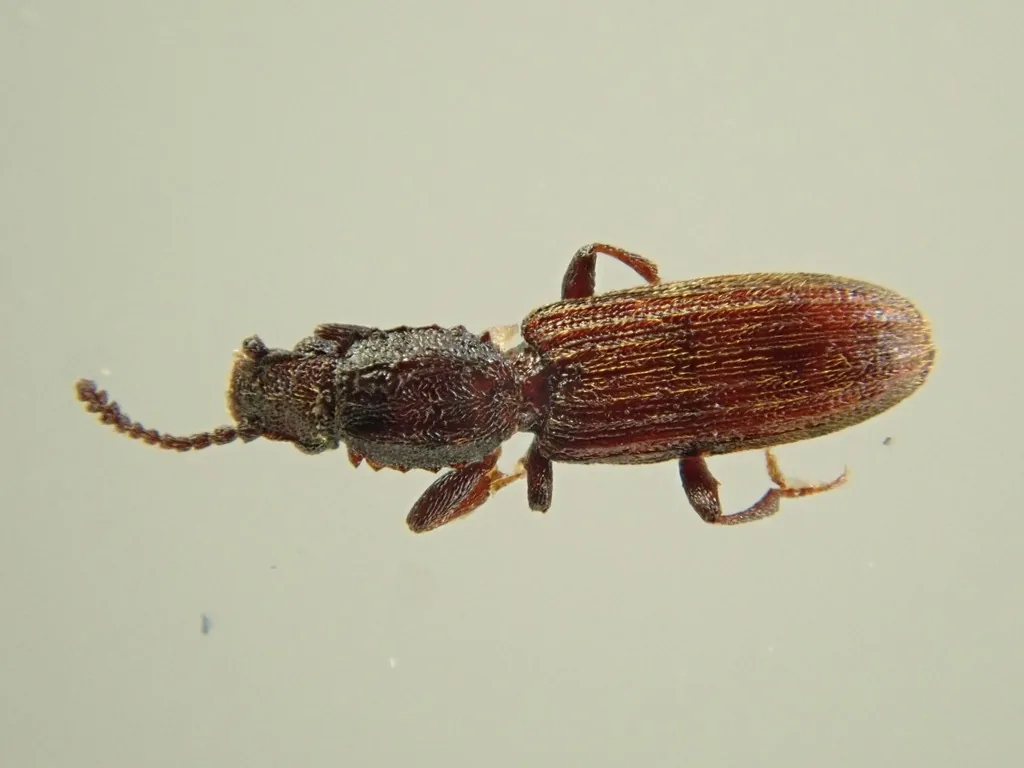
- Adults are slender, flat brown beetles about 1/10 inch long.[2][1]
- Six saw-like teeth line each side of the thorax, a trait it shares with the sawtoothed grain beetle.[2][1]
- The eyes are large, wider than the temple area behind them, and the head looks rectangular from above.[1][2]
- It is a bit larger and darker brown than the sawtoothed grain beetle, but at about 1/10 inch the difference is hard to see. Eggs and larvae of the two species can't be told apart without special training.[1]
Look-alikes
| Look-alike | How to tell them apart |
|---|---|
| Sawtoothed grain beetle | Has smaller eyes, a more triangular head and a wider area behind the eyes, and the adults can't fly.[1][2][3] |
| Red flour beetle | A shiny reddish-brown, oval beetle about 1/7 inch long whose antennae end abruptly in a three-segmented club.[2] |
Where it lives
Penn State calls it less common than the sawtoothed grain beetle. It usually arrives in infested food, but the adults fly well and can also come in from elsewhere. In a USDA trapping study in department and pet stores, and in a survey of eight Kansas pet stores, it was among the most abundant stored-product insects.[1][4][5]
Biology and life cycle
Both larvae and adults feed on foods of plant origin, and UC IPM says the two Oryzaephilus species share nearly identical biology and are managed the same way.[1][2]
Describing the two species together, UC IPM and Penn State say adults live 6 to 10 months on average and sometimes 3 years. Penn State gives 43 to 285 eggs per female, hatching in 3 to 5 days at 80 to 85°F.[2][1]
Larvae crawl about feeding and are full grown in about two weeks in warm weather. They then glue bits of food into a cocoon-like cover and pupate inside, and egg to adult takes about three to four weeks.[2][1]
Compared with the sawtoothed grain beetle, it handles cold less well and lays only one-half to two-thirds as many eggs.[1]
Damage and signs
- Its preferred foods are oilseed products such as nuts and sunflower seeds.[1]
- UC IPM lists flours, meals, breakfast cereals, coconut, nutmeats, candies and dried fruit among the foods these beetles attack, and they are common in pet food, bird seed and rodent bait.[2]
- In the Kansas pet-store survey, infested pet food taken from the stores held 65 to 656 adult insects per kilogram, all species combined.[5]
- Infested food is fouled by the insects' bodies and by-products, and some beetle larvae give food a bad odor and taste.[2]
Health risk
It doesn't bite people or pets; the risk is contaminated food, and UC IPM notes pantry pests may introduce microbes that can produce mycotoxins in warm, humid storage.[2]
Control
Prevention
Keep nuts, seeds, oats and mixes in jars or other containers with tight-fitting lids; plastic bags don't keep pantry beetles out.[2][3]
Sanitation
Search nut, seed and cereal products first, discard anything with live beetles, and keep checking other packages, since adults spread to new food.[3][1][2]
Vacuum cabinet shelves, corners and cracks with a crevice tool, and wash shelving with soap and water before restocking.[2]
Traps and physical control
Bird feed or decorative items can be heated at 155°F for about 20 minutes with the oven door propped open, or held at 0°F in a non-self-defrosting freezer for 4 days.[3]
Pesticides
Insecticides aren't recommended against pantry pests in the home; removing infested food and cleaning is what works. In stored grain, Penn State says fumigation is a last resort for a qualified applicator. Researchers have tested ozone as an alternative fumigant for this beetle and found eggs the hardest stage to kill when no food was present.[2][1][6]
Common questions
- Is a merchant grain beetle different from a sawtoothed grain beetle?
- Yes, but only slightly. The merchant grain beetle has bigger eyes and a squarer head, flies, and prefers nuts and seeds; both are managed the same way.[1][2]
- Why are there grain beetles in my trail mix or nuts?
- Nuts and other oilseed products are this beetle's favorite foods, so check them first when you find small, flat brown beetles.[1]
Sources
- Penn State Extension, “Sawtoothed and Merchant Grain Beetle (updated August 3, 2026).” extension.psu.edu/sawtoothed-and-merchant-grain-beetle (accessed 2026-11-11)
- University of California Statewide IPM Program, “Pest Notes: Pantry Pests, Publication 7452.” ipm.ucanr.edu/home-and-landscape/pantry-pests/ (accessed 2026-11-11)
- University of Kentucky Entomology, “ENTFACT-612: Stored Product Pests in the Pantry.” entomology.mgcafe.uky.edu/ef612 (accessed 2026-11-11)
- Journal of Economic Entomology, via PubMed, “Monitoring insect pests in retail stores by trapping and spatial analysis (Arbogast et al. 2000, USDA ARS).” pubmed.ncbi.nlm.nih.gov/11057728/ (accessed 2026-11-11)
- Journal of Economic Entomology, via PubMed, “Stored-product insects associated with a retail pet store chain in Kansas (Roesli et al. 2003).” pubmed.ncbi.nlm.nih.gov/14977139/ (accessed 2026-11-11)
- Journal of Economic Entomology, via PubMed, “Efficacy of Ozone Against the Life Stages of Oryzaephilus mercator (Mahroof et al. 2018).” pubmed.ncbi.nlm.nih.gov/29177449/ (accessed 2026-11-11)
- iNaturalist, “Oryzaephilus mercator taxon page (order and family).” www.inaturalist.org/taxa/210455 (accessed 2026-10-06)