On this page
How to identify it
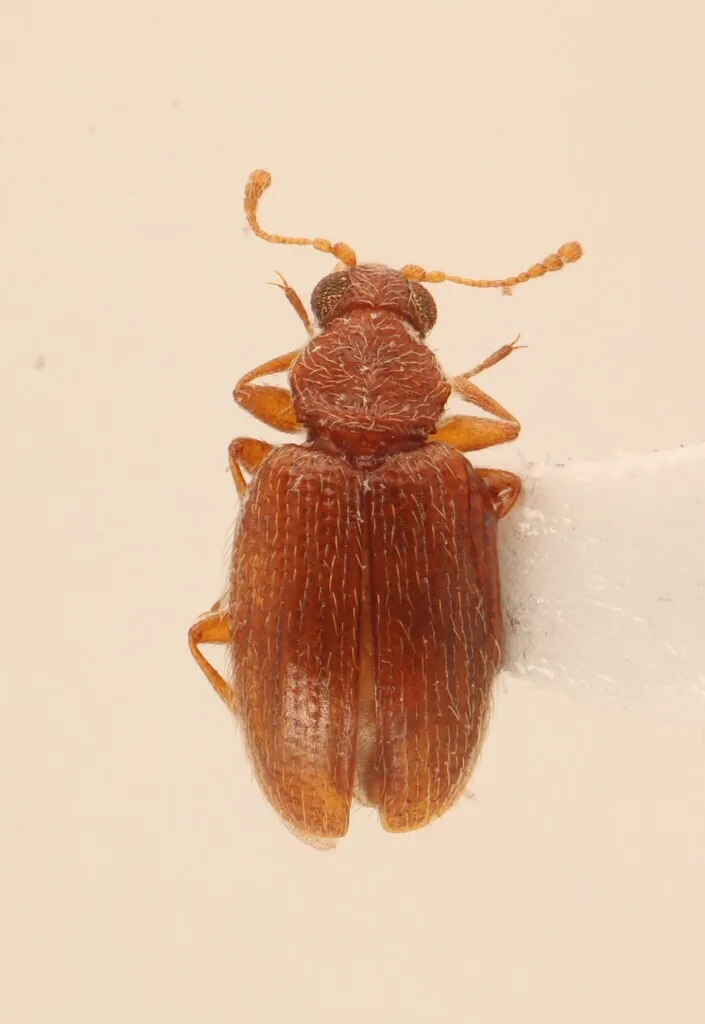
- They are very small and elongate, brown to black, about 1 to 2 mm (around 1/16 inch) long according to Washington State; Texas A&M gives about 2 mm for the Dienerella scavenger beetles found in Texas homes, and Ohio State says fungus beetles other than the foreign grain beetle are under 1/12 inch.[2][3][1]
- The plate behind the head is often hairy and distinctly narrower than the wing covers, and the feet have three segments.[3]
- Most fungus beetles like these have punctures on the body and clubbed antennae; a good hand lens or microscope is needed to see these features.[1]
- Ohio State Extension names Melanophthalma americana as the plaster or minute brown scavenger beetle, and Texas A&M notes Dienerella species in Texas homes. Dienerella alone holds 41 described taxa worldwide, so the sources treat the household species together.[1][3][5]
Look-alikes
| Look-alike | How to tell them apart |
|---|---|
| Foreign grain beetle | Another mold feeder with a knob on the corners of the thorax: Ohio State says the four corners and about 1/16 inch long, Texas A&M says the front corners project forward and gives 2 to 3 mm.[1][3] |
| Silken fungus beetles | Similar tiny mold feeders in a different family, Cryptophagidae; their thorax lacks prominent front-corner angles and their wing-cover punctures aren't in rows.[3][2] |
| Booklice | Share the same damp, mildewy places but are pale, 1 to 2 mm insects with a bulging upper lip, a narrow thorax and swollen hind legs.[3] |
Where it lives
Reported as household nuisances from the Pacific Northwest to Ohio and Texas, wherever damp conditions allow mold to grow indoors, and in homes and heritage buildings in Europe as well. Outdoors, members of the family also turn up in crop plantings, such as a Corticarina scavenger beetle found in Wisconsin hazelnut plantings. GBIF holds about 13,500 U.S. records of the family since 1990, most of them from California, then Alaska and Florida.[2][1][3][6][7][8][9]
Biology and life cycle
Adults and larvae of most species live in moldy materials, such as damp stored food and decaying plant matter, and feed on fungal spores and threads.[2][1]
Eggs are laid on moldy material such as green lumber, wet plaster and wallboard, or moldy grain, and the larvae develop in the mold.[1]
Development speeds up with warmth: Ohio State says fungus beetles can go from egg to adult in 25 to 36 days at 75 degrees F, 54 days at 65 degrees F, or five months or more when it is cooler. A review of stored-product pests gives a lower development threshold of 9.1 to 10.7 degrees C for the scavenger beetle Dienerella argus.[1][10]
Most complaints come in late July through September, often after rainy weather. The beetles are attracted to lights and can slip through window and door screens.[1]
Suspected indoor breeding spots include mildewed bathroom grout, scum in garbage cans and organic buildup in sliding-window tracks.[2]
Damage and signs
- They are a nuisance only: Ohio State says they don't bite, sting, spread disease or damage wood, food or fabric.[1]
- Heavy numbers may show up trapped in tubs and sinks or around lamps and TVs, and stored food can be soiled by their cast skins and droppings.[1]
- Their presence is a clue to excess moisture, such as a leak, poor ventilation or high humidity.[3][1]
Health risk
Plaster beetles don't bite or sting and don't spread human diseases. A dermatology journal notes that the minute brown scavenger beetle poses no threat to humans but sometimes turns up in specimens brought in by patients who believe they are infested, so doctors should recognize it.[1][4]
Control
Prevention
Dry out the damp conditions that let mold grow; the beetles fade with the mold. How long that takes is given differently: Ohio State says most new homes dry out naturally within a year or two, while Texas A&M says new homes with central air conditioning or heating may need several weeks of drying before an infestation runs its course.[1][3]
Use heating and ventilation to bring humidity down; Ohio State notes numbers drop during dry weather with humidity below 60 percent, and Texas A&M says there is no evidence infestations persist once moisture has dropped.[1][3]
Keep dry foods in insect-proof glass, heavy plastic or metal containers with tight lids.[1]
Sanitation
Find and clean breeding sites, such as mildewed grout, moldy window tracks, garbage-can residue and moldy stored food.[2][1]
Traps and physical control
A strong vacuum with crevice attachments will pick up many of the beetles.[1]
Pesticides
Spraying adults gives only temporary relief because it misses the breeding sites, and foggers rarely reach the wall voids where beetles develop. Ohio State adds that household pyrethroid sprays in crevices kill many beetles, and Texas A&M says pesticides generally give little control.[2][1][3]
When to call a professional
If cleanup and drying don't solve it, a pest control professional can apply products labeled for wall voids and other hard-to-reach spots.[1]
Plaster beetles in museums and old buildings
The same moisture problem shows up in historic buildings. A review of about 30,000 traps set in English Heritage buildings from 1998 to 2012 found plaster beetles were the third most frequently caught pest, after booklice and silverfish.[7]
The authors of a 2026 survey found fewer plaster beetles in the heritage interiors they studied and suggested those buildings were drier.[7]
A 2025 list of insects common to both homes and heritage sites in France includes several minute brown scavenger beetles, among them Dienerella argus, Cartodere constricta and Adistemia watsoni.[6]
Common questions
- What are the tiny brown beetles on my windowsills in a new house?
- They are often plaster beetles or other fungus beetles feeding on mold growing on damp new lumber, plaster or drywall.[1][3]
- Will bug bombs get rid of plaster beetles?
- Usually not. Ohio State says total-release foggers rarely reach the wall voids where the beetles develop; drying and cleanup work better.[1]
- Can plaster beetles bite or infest my skin?
- No. They feed on mold, don't bite or sting, and a dermatology review says they pose no threat to humans.[1][4]
Sources
- Ohio State University Extension, “Fungus Beetles, HYG-2084.” ohioline.osu.edu/factsheet/HYG-2084-10 (accessed 2026-11-11)
- Washington State University Puyallup Research and Extension Center, “Scavenger Beetles and Fungus Beetles, PLS-44 (updated June 2003).” wpcdn.web.wsu.edu/wp-puyallup/uploads/sites/408/2015/02/PLS-44-Scavenger-Beetles-and-Fungus-Beetles.pdf (accessed 2026-11-11)
- Texas A&M AgriLife Extension Service, “Mildew-Feeding Insects in the Home (Insects in the City).” citybugs.tamu.edu/factsheets/household/misc-house/ent-2010/ (accessed 2026-11-11)
- Cutis, via PubMed, “What's eating you? Minute brown scavenger beetle (Daveluy 2017).” pubmed.ncbi.nlm.nih.gov/28961292/ (accessed 2026-11-11)
- Zootaxa, via PubMed, “A new species of Dienerella from Kazakhstan, with an updated checklist of Dienerella species (Plewa and Rucker 2020).” pubmed.ncbi.nlm.nih.gov/32230638/ (accessed 2026-11-11)
- PeerJ, via PubMed Central, “Common insect pests in homes and cultural heritage sites (Hasnaoui et al. 2025).” pmc.ncbi.nlm.nih.gov/articles/PMC11737333/ (accessed 2026-11-11). PMID 39822973
- Insects, via PubMed Central, “Insect pests and arthropods in heritage interiors (Brimblecombe and Querner 2026).” pmc.ncbi.nlm.nih.gov/articles/PMC13026579/ (accessed 2026-11-11). PMID 41898971
- Journal of Insect Science, via PubMed Central, “Arthropod community in hybrid hazelnut plantings in the Midwestern United States (Chediack et al. 2022).” pmc.ncbi.nlm.nih.gov/articles/PMC9250698/ (accessed 2026-11-11). PMID 35780384
- Global Biodiversity Information Facility (GBIF), “Latridiidae: U.S. occurrence records since 1990 by state (GBIF occurrence search).” api.gbif.org/v1/occurrence/search?taxonKey=7834&country=US&hasGeospatialIssue=false&occurrenceStatus=PRESENT&year=1990%2C2026&facet=stateProvince&facetLimit=400&limit=0 (accessed 2026-11-11)
- Insects, via PubMed Central, “Minimal thermal requirements for development and activity of stored product and food industry pests (Stejskal et al. 2019).” pmc.ncbi.nlm.nih.gov/articles/PMC6571962/ (accessed 2026-11-11). PMID 31126156
- iNaturalist, “Melanophthalma americana taxon page (order and family).” www.inaturalist.org/taxa/177085 (accessed 2026-10-06)