The short answer
- Look at the color. Odorous house ants are brown to shiny black. Pharaoh ants are light yellow, honey-colored or orange to reddish brown, often with a darker rear end.[2][6][10][1][8][4]
- Look at the size. Odorous house ant workers are about 1/8 inch long. Pharaoh ant workers are about half that, around 1/16 inch, small enough that you may need a hand lens to see details.[2][5][1][8][9]
- Crush one and sniff. An odorous house ant gives off a strong smell that Minnesota Extension compares to rotten coconuts or blue cheese and Missouri calls fruity-coconut. The pharaoh ant fact sheets used here don't mention any smell.[9][10][6][2]
- Under magnification, count the waist bumps. The odorous house ant has one node, hidden under the abdomen, and no club on its antennae. The pharaoh ant has two nodes and antennae that end in a three-segmented club.[2][6][5][1][8][4]
Profiles on this site
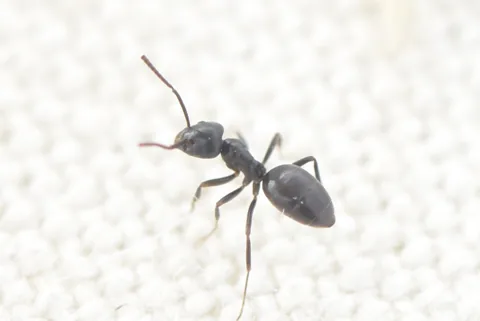 Odorous House Ant
Tapinoma sessile
The odorous house ant is a small native ant found across most of the United States that trails into homes for sweets and gives off a strong, rotten odor when crushed. Texas A&M says it ranges from Canada to Mexico but is rarely found in the southwestern deserts.
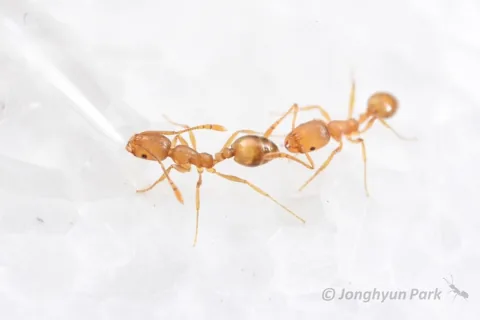 Pharaoh Ant
Monomorium pharaonis
The Pharaoh ant is a tiny, yellowish ant that nests inside heated buildings and is a serious pest in hospitals, apartments, hotels and food businesses. Texas A&M says it occurs throughout the United States but generally only in heated buildings, because it usually can't survive outdoors all year; it does nest outside in subtropical areas such as Hawaii, Florida and southern Texas.
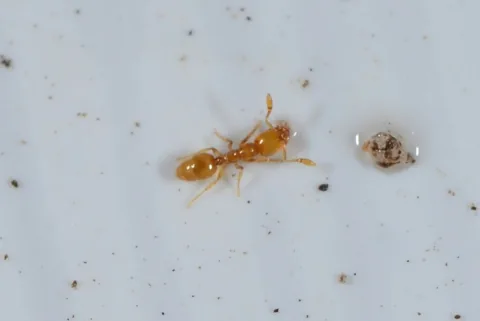 Thief Ant
Solenopsis molesta
The thief ant is a tiny native ant named for nesting near larger ants and stealing their food, larvae and pupae. Also called the grease ant, it trails indoors to greasy and protein-rich foods and is small enough to get into packaged food.
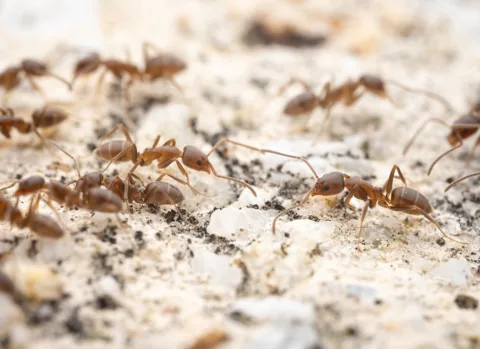 Argentine Ant
Linepithema humile
The Argentine ant is the most common ant in and around homes in California; its nests are linked into huge multi-queen supercolonies. It is native to Argentina and Brazil. Texas A&M says it was discovered in New Orleans in 1891, is now established in many places in the southern United States, and has been found in Arizona, California, Illinois, Maryland, Missouri, Oregon, Texas and Washington.
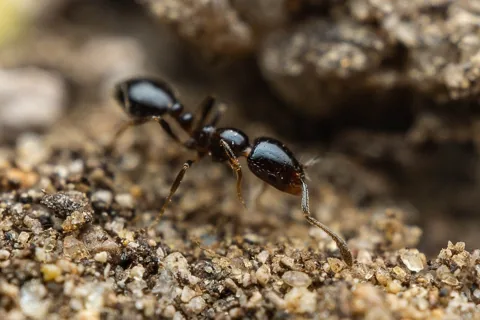 Little Black Ant
Monomorium minimum (iNaturalist files it under Monomorium carbonarium)
The little black ant is a tiny native ant that nests outdoors in lawns and under stones, and indoors in woodwork, wall voids and masonry. It is most noticeable when long foraging trails reach food cabinets and pantries.
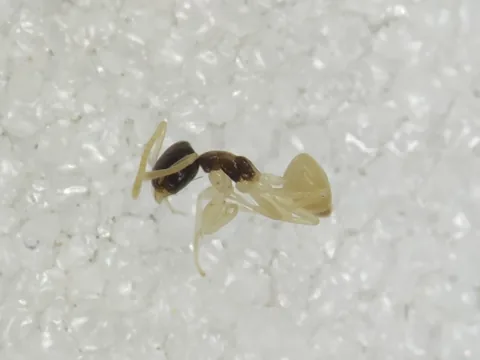 Ghost Ant
Tapinoma melanocephalum
The ghost ant is a tiny tropical tramp ant whose pale abdomen and legs make it hard to see. It nests indoors and out, forages on set trails and favors sweets, and because each colony is spread over many nests it is hard to eliminate.
Side by side
Each line compares the odorous house ant (Tapinoma sessile), a native ant, with the pharaoh ant (Monomorium pharaonis), an imported species probably from tropical Africa that now lives around the world in heated buildings.[6][5][9][4]
- Size: odorous house ant workers are 1/8 inch by UC IPM's and Texas A&M's measure, 1/16 to 1/8 inch (2.4-3.3 mm) by Penn State's, about 1/10 inch by Minnesota's and 2 to 3 mm by Missouri's. Pharaoh ant workers are about 1/16 inch (UC IPM, Ohio State, Minnesota), 1/12 to 1/16 inch (Texas A&M) or 1 to 2 mm (Missouri). In both species all the workers in a colony are the same size.[2][5][6][9][10][1][8][4]
- Color: odorous house ant is uniform brown to black (Penn State), dark brown to shiny black (UC IPM) or brown to dark brown (Minnesota). Pharaoh ant is yellow or honey-colored to orange (UC IPM), golden yellow to reddish brown (Texas A&M) or light tan (Missouri). Sources differ on which part of the pharaoh ant is darker: Ohio State says the abdomen, Minnesota says the thorax.[6][2][9][1][4][10][8]
- Waist (petiole): odorous house ant has one node, hidden by the abdomen and hard to see. Pharaoh ant has two nodes and no spines on the thorax.[2][6][9][1][8]
- Antennae: odorous house ant has 12 segments and no club at the tip. Pharaoh ant has 12 segments ending in a distinct three-segmented club.[5][6][1][4][8]
- Smell: a crushed odorous house ant gives off a very strong odor, described as rotten (Penn State), rotten coconuts or blue cheese (Minnesota) or fruity-coconut (Missouri). None of the pharaoh ant fact sheets used here mention a smell.[2][6][9][10]
- Behavior: disturbed odorous house ants run erratically with their abdomens raised in the air, and they travel in both wandering patterns and set trails. Pharaoh ants travel in set trails along carpets, countertops, cabinets and baseboards and may follow electrical wires and plumbing pipes from room to room.[2][1]
- Food: odorous house ants forage mainly for sweets indoors and favor aphid and scale honeydew outdoors, though they also take dead insects and grease. Pharaoh ants eat sweets, fats and proteins; UC IPM says thief and pharaoh ants prefer protein or greasy baits year-round.[2][6][1][3][4]
- Nests: odorous house ants usually nest outside in shallow soil nests under stones, boards, logs, mulch or debris, and move indoors into wall voids near water pipes, heaters and other warm, damp spots. Pharaoh ants nest in wall and cabinet voids, behind baseboards and refrigerator insulation, in hollow curtain rods and even in folds of sheets, clothes or paper. Minnesota says they nest strictly indoors in the north central states; Texas A&M says they can nest in soil outdoors in places like Hawaii, Florida and southern Texas.[2][6][5][1][9][4]
- Colony size: odorous house ant colonies range from a few hundred to 10,000 workers, usually with many queens. Pharaoh ant colonies can reach 300,000 or more, with several to hundreds of queens spread across many nests.[5][2][6][1][8][4]
- Swarms and spread: odorous house ants produce winged reproductives in May through July, and colonies also multiply when queens walk off with workers to start a new nest. Pharaoh ants don't have a mating swarm; they mate in the nest and spread by budding, and in heated buildings they breed all year.[6][5][10][9][8]
- Bites and stings: neither is a stinging pest. Texas A&M says pharaoh ants have a stinger that is not always visible and that they don't sting humans; Ohio State says they have no stinger at all.[4][8]
Two more look-alikes: thief ants and Argentine ants
Thief ants (Solenopsis molesta) are the usual mix-up for pharaoh ants. They are yellowish to tan or light brown, with two nodes, and Penn State says the two are often misidentified because of their similar size and color. The giveaway is the antenna: the thief ant has 10 segments with a two-segmented club, not three. Penn State gives the thief ant's length as 1/16 inch (1.5 mm); UC IPM gives 1/32 inch. Thief ants also have very tiny eyes.[7][8][3][9]
Minnesota Extension says a microscope is often needed to separate pharaoh ants from thief ants. Both are drawn to greasy and protein foods.[9][3][7]
Argentine ants (Linepithema humile) are the usual mix-up for odorous house ants. Clemson says the two are often confused. Both have one node and both are brown, but Argentine ants are a duller light to dark brown, and a crushed Argentine ant may give off a musty odor, while Clemson describes the odorous house ant's smell as sweet, like rotten coconuts. UC IPM measures Argentine workers at 1/8 inch, Clemson at about 1/16 inch.[11][3]
Argentine ants are the most common ant in and around homes in California, and their colonies link into one large supercolony with many queens.[3]
How to confirm which ant you have
Start with the crush test: pinch one worker and smell your fingers. A strong rotten-coconut or blue-cheese smell points to an odorous house ant.[9][10][6]
Then check color and size against the side-by-side above. A tiny yellow to light reddish-brown ant, 1/16 inch or smaller, is a pharaoh ant or a thief ant; a brown to black ant around 1/8 inch is more likely an odorous house ant or an Argentine ant.[1][8][7][2][11]
Use a hand lens or microscope for the waist and antennae. One hidden node and no antennal club means odorous house ant. Two nodes and a three-segmented club means pharaoh ant; two nodes and a two-segmented club means thief ant.[2][5][1][8][7]
Note where they are. Ants trailing in from outdoors along foundations, sidewalks and baseboards, or tending aphids on shrubs, fit the odorous house ant. Ants that follow electrical wires and pipes, cluster near heat in winter, and turn up in bathrooms and kitchens of apartments, hotels or care facilities fit the pharaoh ant.[2][8][1]
Ohio State suggests pre-baiting with dilute honey or peanut butter on index cards to find where ants are feeding. Seeing which ants come to which food also helps, since odorous house ants favor sweets and pharaoh ants also take fats and proteins.[8][2][1]
If you still can't tell, an entomologist can look at a sample. Texas A&M's urban entomology program, for example, has an insect sample submission form.[4]
Why the ID matters: sprays make pharaoh ants spread
When a pharaoh ant colony is disturbed, a queen and some workers carrying eggs, larvae and pupae leave and set up a new nest elsewhere. This is called budding, and Ohio State lists repellent pesticides among the triggers, along with overcrowding and seasonal changes in the building's heating and cooling.[8][9]
Texas A&M says repellent liquid or dust insecticides are not recommended indoors for pharaoh ants because they typically cause colony budding, which makes the problem worse. Minnesota Extension also says insecticides can cause pharaoh ants to bud.[4][9]
Lab studies back this up. In a Purdue study, the repellent pyrethroid cypermethrin made pharaoh ant colonies bud, though the response was delayed. In a Malaysian study, almost all workers moved the whole brood to a new nest within a day after a pyrethroid was applied to their nest.[13][12]
So the main tool for pharaoh ants is bait. Missouri calls baiting the only effective way to manage pharaoh ant colonies, and Texas A&M recommends bait stations placed extensively along trails throughout the building so that workers from all colonies feed on them.[10][4]
Slow-acting baits reach more colonies. In a USDA lab study with four linked colonies, a hydramethylnon bait quickly cut ants near the bait but the nests were reoccupied by ants from farther colonies, while the slower insect growth regulator pyriproxyfen spread to all nest sites and gave gradual, longer control.[14]
Odorous house ants are also controlled with baits: Penn State says to choose baits for sweet-loving ants, place them where ants are active, keep them stocked and expect two weeks or longer for control. Sources differ on sprays. Texas A&M says a residual perimeter treatment may repel foraging workers and keep them out, while a Purdue field study found odorous house ants became more frequent in treated zones over the eight weeks after barrier sprays.[6][5][15]
Pharaoh ants in hospitals
Pharaoh ants are a known pest in hospitals. A survey of hospitals in Poland found them in some of the hospitals checked, less often than German and Oriental cockroaches, and kitchens, laundries and lavatories were the places these insects most often infested.[17]
In a public hospital in Brazil, pharaoh ants were the most common ant collected and the most often contaminated with bacteria, and Pseudomonas aeruginosa was the pathogen isolated most often from the ants. The authors describe ants as potential mechanical vectors of bacteria that cause hospital infections and say pest control is a necessity in these institutions.[16]
These studies looked at hospitals, not houses. For a pharaoh ant problem in a hospital, nursing home or food business, see the pharaoh ant guide, which covers building-wide baiting.[16][17][4]
What to do for each
Odorous house ants: follow the trails to find where they come in and look for nests outside under stones, mulch and debris. Use a sweet bait where they trail and keep it stocked. Texas A&M also says nests found outside can be drenched with a residual insecticide, and nests in wall voids can be treated with an aerosol or dust through cracks. Minnesota Extension says persistent problems should go to a pest management professional. Our odorous house ant guide has the full steps.[5][6][9]
Pharaoh ants: don't spray, dust or fog. Place baits along every trail you find, inspect the stations and replace them as they empty. Texas A&M says a baiting program may take several months to a year, and Ohio State says control can take months to years in large buildings. Minnesota Extension recommends an experienced pest management service. In an apartment building, Ohio State says complete cooperation from the property manager and residents is essential. Our pharaoh ant guide has the full steps.[4][8][9]
Thief ants: Penn State recommends baits, which workers carry back to the nest. Argentine ants: UC IPM says refillable bait stations with borate in sugar water are best for severe infestations.[7][3]
Common questions
- Are "sugar ants" odorous house ants or pharaoh ants?
- "Sugar ant" isn't one species. Texas A&M lists it as another name for the pharaoh ant, and the pharaoh ant is yellow to reddish brown. Odorous house ants are sweet-feeders too; Penn State says they prefer foods high in sugars, so a small dark ant at spilled sugar may well be one.[4][6]
- Why do I smell coconut when I squash ants?
- That smell is the classic sign of the odorous house ant. Missouri describes it as fruity-coconut, and Minnesota compares it to rotten coconuts or blue cheese.[10][9]
- Can I just spray pharaoh ants with a store-bought ant spray?
- No. Repellent sprays and dusts typically make pharaoh ant colonies split into new nests, which spreads the infestation. Use baits instead.[4][8][9][13]
- Do odorous house ants bite?
- None of the fact sheets used here list them as a biting or stinging pest. They are a nuisance because they get into food; Penn State notes they can contaminate stored pantry items.[6]
- Why are pharaoh ants so hard to get rid of?
- Their nests are small and hidden, there can be many colonies in one building, and Ohio State says about 90 percent of a colony stays hidden in the nest, so killing the workers you see barely dents it. Missed colonies rebound quickly.[8][4]
Photo credits
- Odorous House Ant: Thompson Hyggen, public domain (CC0), via iNaturalist
- Pharaoh Ant: (c) Jonghyun Park, some rights reserved (CC BY) — via iNaturalist, CC BY 4.0
- Thief Ant: (c) Elias Freyhof, some rights reserved (CC BY) — via iNaturalist, CC BY 4.0
- Argentine Ant: Philipp Hoenle, public domain (CC0), via iNaturalist
- Little Black Ant: (c) Jake Nitta, some rights reserved (CC BY) — via iNaturalist, CC BY 4.0
- Ghost Ant: (c) Elias Freyhof, some rights reserved (CC BY) — via iNaturalist, CC BY 4.0
Sources
- University of California Statewide IPM Program, “Pharaoh ant (Key to Identifying Common Household Ants).” ipm.ucanr.edu/TOOLS/ANTKEY/pharaoh.html (accessed 2026-11-14)
- University of California Statewide IPM Program, “Odorous house ant (Key to Identifying Common Household Ants).” ipm.ucanr.edu/TOOLS/ANTKEY/odorous.html (accessed 2026-11-14)
- University of California Statewide IPM Program, “Ants (Pest Notes).” ipm.ucanr.edu/home-and-landscape/ants/ (accessed 2026-11-14)
- Texas A&M AgriLife Urban and Structural Entomology Program, “Pharaoh Ant, Monomorium pharaonis.” urbanentomology.tamu.edu/urban-pests/ants/pharoah/ (accessed 2026-11-14)
- Texas A&M AgriLife Urban and Structural Entomology Program, “Odorous House Ant, Tapinoma sessile.” urbanentomology.tamu.edu/urban-pests/ants/odorous-house-ant/ (accessed 2026-11-14)
- Penn State Extension, “Odorous House Ant.” extension.psu.edu/odorous-house-ant (accessed 2026-11-14)
- Penn State Extension, “Thief Ant.” extension.psu.edu/thief-ant (accessed 2026-11-14)
- Ohio State University Extension, “Pharaoh Ant (HYG-2136).” ohioline.osu.edu/factsheet/hyg-2136 (accessed 2026-11-14)
- University of Minnesota Extension, “Ants.” extension.umn.edu/insects-infest-homes/ants (accessed 2026-11-14)
- University of Missouri Extension, “Ants (G7392).” extension.missouri.edu/publications/g7392 (accessed 2026-11-14)
- Clemson Cooperative Extension, Home & Garden Information Center, “Argentine Ants.” hgic.clemson.edu/factsheet/argentine-ants/ (accessed 2026-11-14)
- Journal of Economic Entomology, via PubMed, “Induced Disturbances Cause Monomorium pharaonis Nest Relocation (Tay and Lee 2015).” pubmed.ncbi.nlm.nih.gov/26470251/ (accessed 2026-11-14)
- Journal of Economic Entomology, via PubMed, “Efficacy of simulated barrier treatments against laboratory colonies of Pharaoh ant (Buczkowski et al. 2005).” pubmed.ncbi.nlm.nih.gov/15889742/ (accessed 2026-11-14)
- Journal of Economic Entomology, via PubMed, “Bait distribution among multiple colonies of Pharaoh ants (Oi et al. 2000).” pubmed.ncbi.nlm.nih.gov/10985038/ (accessed 2026-11-14)
- Journal of Economic Entomology, via PubMed, “Impacts of residual insecticide barriers on perimeter-invading ants, with particular reference to the odorous house ant (Scharf et al. 2004).” pubmed.ncbi.nlm.nih.gov/15154488/ (accessed 2026-11-14)
- Journal of Medical Entomology, via PubMed, “Ants as Potential Mechanical Vectors of Pathogenic Bacteria in a Public Hospital in the Eastern Amazon, Brazil (do Nascimento et al. 2020).” pubmed.ncbi.nlm.nih.gov/32368780/ (accessed 2026-11-14)
- Przeglad Epidemiologiczny, via PubMed, “Occurrence of insect pests in hospitals in Poland (Gliniewicz et al. 2003).” pubmed.ncbi.nlm.nih.gov/12910602/ (accessed 2026-11-14)