On this page
How to identify it
- Workers are all one size and extremely small: 1.3 to 1.5 mm long according to Texas Invasives and the Mississippi Entomological Museum, or 0.05 to 0.06 inch according to Texas A&M. UF/IFAS also gives 1.3 to 1.5 mm and calls the workers monomorphic, meaning one-sized.[2][3][1][4]
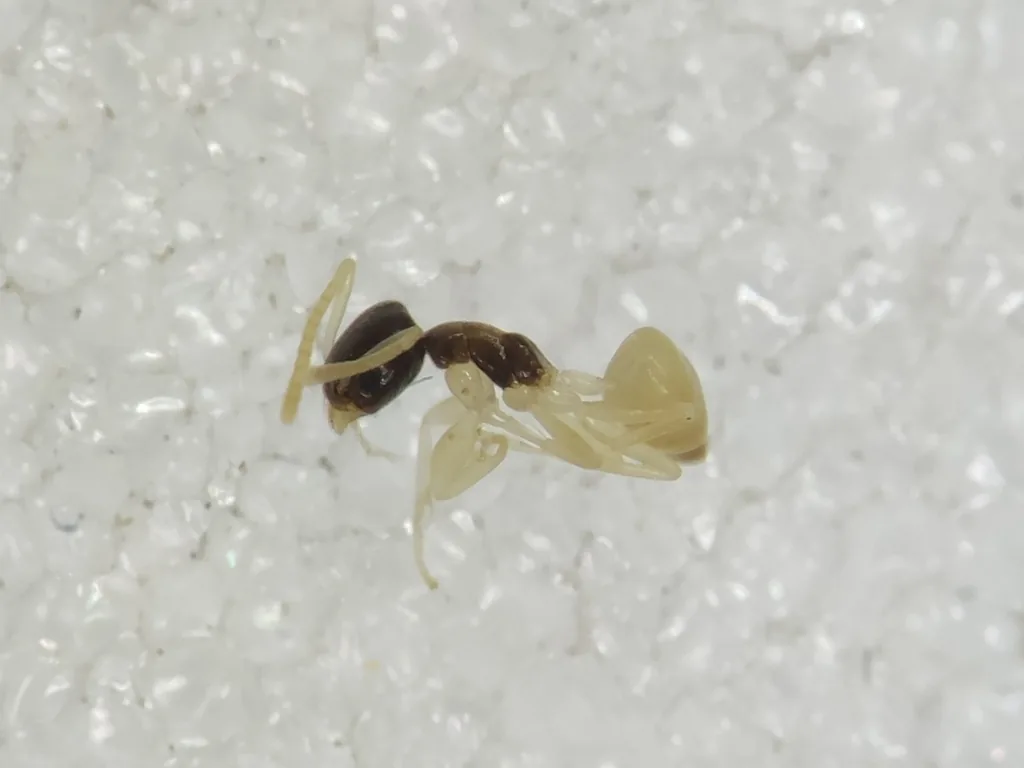
- The head and thorax are dark brown to blackish, while the gaster (the swollen end of the abdomen), waist, legs and antennae are milky white to pale yellowish, almost translucent.[1][3]
- The waist is a single segment with no distinct raised node and is often hidden by the gaster. There is no stinger, and the 12-segmented antennae have no distinct club. UF/IFAS adds that the antennal segments gradually thicken toward the tip and the thorax has no spines.[3][2][4]
- Disturbed workers run quickly and erratically, but trailing workers move slowly and some carry larvae and pupae. Crushed workers can give off an acrid, coconut-like odor. UF/IFAS compares the smell of crushed workers to rotten coconuts.[2][4]
Look-alikes
| Look-alike | How to tell them apart |
|---|---|
| Odorous house ant | A relative in the same genus, Tapinoma sessile, but larger, about 1/8 inch, and brown rather than two-toned. UF/IFAS describes the odorous house ant as entirely dark brown to black and the ghost ant as the smaller of the two.[5][4] |
| Pharaoh ant | Nests in similar places, but it is golden yellow to reddish-brown and its waist has two segments, the petiole and postpetiole. UF/IFAS says the two nest in similar ways, but the ghost ant has only one node on its waist to the Pharaoh ant's two.[2][6][4] |
| Other two-toned ants | UF/IFAS says other bicolored ants with a one-segment waist are either much larger or have a waist node that is visible from above; the ghost ant's is usually hidden by the gaster.[4] |
Where it lives
Native to the Old World tropics (Africa or Asia; the exact origin is unknown) and spread by commerce. In the U.S. it is established outdoors only in Florida, Hawaii, southern Texas and, more recently, southern Mississippi; it reached Texas in 1994 or 1995, probably on plants shipped from Florida. Farther north, as far as Winnipeg, Canada, it turns up in heated buildings and greenhouses. In Florida, UF/IFAS says it is mostly found from Sarasota to Orlando and south, but occurs as far north as Gainesville in Alachua County and Duval County. As late as 1988 it was considered only an occasional house pest there; by 1995 it was common in central and southern Florida and had become a major pest.[3][2][1][4]
Biology and life cycle
Colonies have multiple queens and many thousands of workers spread across several nests. Texas Invasives says colonies can grow so large that they overlap into sprawling nest sites with thousands and possibly millions of ants.[1][2]
New colonies form by budding: one or more queens leave with some workers and brood for a new site. Ants from nearby nests mix without fighting, and mating flights have not been observed.[1][2][3]
Outdoors they nest in disturbed areas, flowerpots, under objects on the ground, under loose bark, at the bases of palm fronds, in plant stems and in moist tufts of dead grass. Indoors they use wall voids, spaces between cabinets and baseboards, gaps between books, potted plants or almost any protected cavity.[2][3][1]
They favor sweets, tend honeydew-producing insects and also eat dead and live insects. Colonies are highly mobile and often move out of crowded nests.[2][1]
They need warm temperatures to survive and are weak to cold.[1][2]
Colonies often occupy small or short-lived sites such as moist tufts of dead grass and plant stems. UF/IFAS says the nest subunits exchange workers back and forth along odor trails, and that ants enter buildings from nests near the foundation or from plants touching the building.[4]
Besides honeydew, they hunt small prey; UF/IFAS notes the ant is reported as a significant predator of twospotted spider mites in greenhouses.[4]
Damage and signs
- Indoors they invade houses and businesses, nest there and get into food, and they are hard to spot because of their coloring.[3][2]
- Outdoors they compete with native ants for food and can drive them out of an area.[2]
- Ghost ants tend honeydew producers, and UC IPM notes that ants tending aphids, soft scales, whiteflies and mealybugs on plants protect those pests and increase their damage.[2][7]
- UF/IFAS counts it among the most important household ant pests in Florida: in a survey of Florida pest control employees, it tied with the red imported fire ant and the crazy ant as the most common of eight key pest ants, each making up 14 percent of samples.[4]
- Indoors it prefers sweets and has been seen feeding on sugar, cakes and syrups; foragers turn up on sinks, counters and floors in kitchens and bathrooms.[4]
- In greenhouses it can defend honeydew-producing plant pests against released biological control insects, and in Florida it has infested quarantine greenhouses where limits on insecticide use made it impossible to control.[4]
Health risk
Ghost ants have no stinger and can't sting. The problem is foraging workers in homes and their food.[3][2]
Control
Sanitation
UC IPM's general ant advice: store food in clean, sealed containers rather than plastic bags or open packaging, empty and clean food waste bins often, and manage sweet food sources next to the house, such as aphid-infested shrubs and ripe fruit.[7]
UF/IFAS calls cleanliness the best approach indoors: store food in tight containers, fix leaks and condensation, and remove plants that attract ants or control the aphids, whiteflies and other honeydew producers on them.[4]
Traps and physical control
Caulk the entry points ants use to get inside.[7]
Pesticides
Baits are the best tool because these ants favor sweets. Texas A&M and Texas Invasives say boric acid at 1 to 5 percent in sugar or honey water seems to work well, though few control studies have been done on this ant.[1][2]
Spraying a nest with a contact insecticide kills only the workers there; because a colony is spread over many nests, that is only a temporary fix.[1][2]
UC IPM says spraying ants indoors won't keep more from coming in, and pyrethroid sprays on driveways, sidewalks and foundations wash into and pollute waterways.[7]
UF/IFAS says to follow trails back to the nest if possible. When baiting trails, check within one or two days to see whether the ants are feeding and move the bait if they aren't; colonies nesting in wall voids can be controlled with baits.[4]
UF/IFAS says control is generally needed only where the ants are a nuisance in a home or greenhouse, and recommends barrier sprays at cracks, crevices and screens to hold back foragers coming in from outdoors (see where the sources disagree).[4]
Where the sources disagree
Treating the nest: UF/IFAS says to follow trails back to the nest and treat it if possible, while Texas A&M and Texas Invasives say spraying a nest kills only the workers there and is a temporary fix, because each colony is spread over many nests.[4][1][2]
Outdoor sprays: UF/IFAS recommends barrier sprays at entry cracks, crevices and screens, while UC IPM says spraying ants indoors won't keep more from coming in and that pyrethroid sprays on driveways, sidewalks and foundations wash into waterways.[4][7]
Common questions
- Why are they called ghost ants?
- Their pale, almost see-through abdomen and legs, plus their tiny size, make them hard to see; only the dark head and thorax stand out.[1][2]
- Can ghost ants live in cold climates?
- Not outdoors. In the U.S. they are established outside only in warm areas such as Florida, Hawaii and southern Texas; farther north they survive in heated buildings and greenhouses.[3][2]
- Do ghost ants sting or bite?
- They have no stinger. They are a nuisance because they trail through homes and get into food.[3][2]
- Where in Florida are ghost ants found?
- UF/IFAS says mostly from Sarasota to Orlando and south, though colonies occur as far north as Gainesville and Duval County.[4]
Sources
- Texas A&M Center for Urban and Structural Entomology, “Ghost Ant.” urbanentomology.tamu.edu/urban-pests/ants/ghost/ (accessed 2026-11-11)
- TexasInvasives.org, “Ghost Ant (Tapinoma melanocephalum), Texas Invasives pest database.” www.texasinvasives.org/pest_database/detail.php?symbol=14 (accessed 2026-11-11)
- Mississippi Entomological Museum, Mississippi State University, “Tapinoma melanocephalum (Fabricius, 1793) (J. A. MacGown and R. J. Whitehouse; last updated April 2016).” mississippientomologicalmuseum.org.msstate.edu/Researchtaxapages/Formicidaepages/genericpages/Tapinoma.melanocephalum.htm (accessed 2026-11-11)
- University of Florida IFAS Extension (EDIS), “Ghost Ant, Tapinoma melanocephalum (Fabricius), EENY310/IN532 (J. C. Nickerson, C. L. Bloomcamp and R. M. Pereira; Featured Creatures).” ask.ifas.ufl.edu/publication/IN532 (accessed 2026-11-14)
- Texas A&M Center for Urban and Structural Entomology, “Odorous House Ant, Tapinoma sessile.” urbanentomology.tamu.edu/urban-pests/ants/odorous-house/ (accessed 2026-11-11)
- Texas A&M Center for Urban and Structural Entomology, “Pharaoh Ant, Monomorium pharaonis.” urbanentomology.tamu.edu/urban-pests/ants/pharoah/ (accessed 2026-11-11)
- University of California Statewide IPM Program, “Ants (Pest Notes, home and landscape).” ipm.ucanr.edu/home-and-landscape/ants/ (accessed 2026-11-11)
- iNaturalist, “Tapinoma melanocephalum taxon page (order and family).” www.inaturalist.org/taxa/69122 (accessed 2026-11-11)