The short answer
- Smell: crush one. An odorous house ant gives off an unpleasant odor that people compare to rotten coconuts or blue cheese; Missouri calls it a fruity-coconut smell. None of the pavement ant fact sheets list an odor.[6][7][4][1][3]
- Waist: a pavement ant has two nodes (bumps) in its waist. An odorous house ant has one node, hidden under the abdomen, so the waist looks smooth.[3][4][6][1][2]
- Grooves and spines: under magnification a pavement ant's head and thorax are covered in fine parallel grooves, and two small spines point up and back from the rear of the thorax. Odorous house ants have neither.[1][6][3][7]
- Nest clues: little piles of sand at cracks in a slab floor or sidewalk point to pavement ants. Odorous house ants usually nest under objects outdoors or in wall voids near moisture and heat.[1][3][7][4]
Profiles on this site
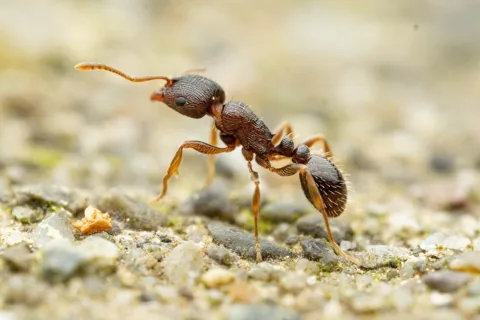 Pavement Ant
Tetramorium immigrans
The pavement ant is an introduced, soil-nesting ant that lives under sidewalks, slabs and stones. Penn State calls it one of the most commonly encountered house-infesting ants in Pennsylvania and says its range runs from New England to the Midwest and south through the Mid-Atlantic states to Tennessee, with populations in parts of California and Washington.
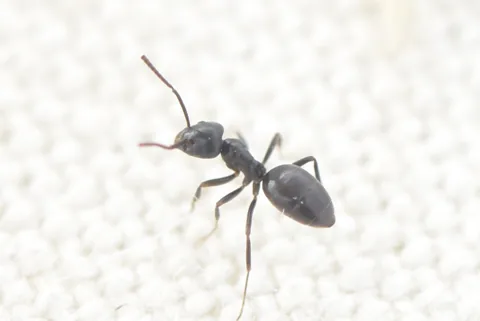 Odorous House Ant
Tapinoma sessile
The odorous house ant is a small native ant found across most of the United States that trails into homes for sweets and gives off a strong, rotten odor when crushed. Texas A&M says it ranges from Canada to Mexico but is rarely found in the southwestern deserts.
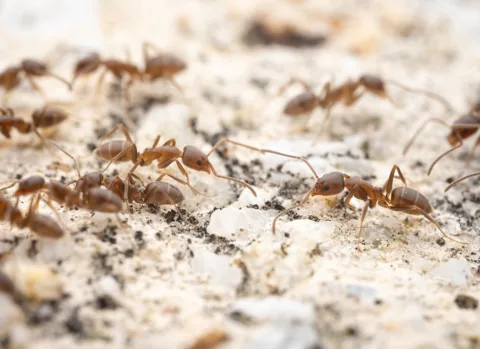 Argentine Ant
Linepithema humile
The Argentine ant is the most common ant in and around homes in California; its nests are linked into huge multi-queen supercolonies. It is native to Argentina and Brazil. Texas A&M says it was discovered in New Orleans in 1891, is now established in many places in the southern United States, and has been found in Arizona, California, Illinois, Maryland, Missouri, Oregon, Texas and Washington.
Side by side: pavement ant and odorous house ant
Each line gives the pavement ant first, then the odorous house ant.[3][4]
- Name: the pavement ant is Tetramorium immigrans (Minnesota notes it was formerly called Tetramorium caespitum, the name Penn State, Missouri and UC IPM still use). The odorous house ant is Tapinoma sessile.[6][1][7][3][2]
- Size: pavement ant workers are about 2.5 to 4 mm per Penn State, 2 1/2 to 3 mm per Missouri, about 1/8 inch per Minnesota and 3/16 inch per UC IPM. Odorous house ant workers are 1/16 to 1/8 inch (2.4 to 3.3 mm) per Penn State, 2 to 3 mm per Missouri, about 1/10 inch per Minnesota and 1/8 inch per UC IPM and Texas A&M. So size alone won't separate them.[1][7][6][3][2][4][8]
- Color: pavement ants are dark brown to black, with lighter legs and antennae per Missouri; Minnesota says reddish-brown to black. Odorous house ants are brown to black, and UC IPM describes them as dark brown to shiny black.[1][7][6][2][4]
- Waist: pavement ants have two nodes. In odorous house ants the single node is hidden by the abdomen and hard to see.[3][1][6][4][2]
- Thorax: pavement ants have one pair of spines on the back of the thorax and fine grooves on the head and thorax. Odorous house ants have an uneven thorax in side view, with no spines.[3][1][6][4][2]
- Antennae: both have 12-segmented antennae. The pavement ant's ends in a 3-segmented club; the odorous house ant's has no club.[3][2][8]
- Smell: odorous house ants give off a very strong odor when crushed. None of the pavement ant sources mention an odor.[4][5][6][7]
- Movement: UC IPM says pavement ants move in a slow, deliberate way, aren't easily disturbed and trail to food most often at night. Odorous house ants move rapidly in single file per Penn State, and UC IPM says they run erratically with their abdomens raised when disturbed.[3][2][4]
- Food: pavement ants take sweets, protein and grease, and UC IPM says they will feed on pet food indoors and outdoors. Odorous house ants mostly want sweets and honeydew but also take dead insects, grease and meats.[5][3][1][6][2]
- Nest: pavement ants nest in soil under sidewalks, driveways, slabs and stones and enter through cracks in the concrete. Odorous house ants nest shallowly under stones, boards and debris, and indoors in wall voids near water pipes and heaters.[1][6][7][4][5]
- Colony: UC IPM and Missouri say pavement ant colonies usually have one queen. Odorous house ant colonies have many queens and up to about 10,000 workers per UC IPM and Texas A&M.[3][7][4][8][2]
- Winged swarms: pavement ants usually swarm in spring (May through July per Minnesota), but can emerge indoors in fall and winter when the nest is under a heated slab. Odorous house ant swarms run May through July per Penn State, June through July per Minnesota.[1][6][2]
- Stinging: Penn State says pavement ant workers carry a stinger, and Missouri lists the pavement ant among the state's stinging ants. For the odorous house ant, Missouri's concern is food contamination rather than stings.[1][7]
- Origin: the pavement ant was likely brought to the United States in ship ballast soil from Europe in the 1700s to 1800s. The odorous house ant is native, ranging from Canada into Mexico.[1][2][8]
How to confirm which ant you have
Start with the smell test, since it needs no tools. Crush a worker between your fingers and sniff. Minnesota describes the odorous house ant's smell as unpleasant, like rotten coconuts or blue cheese, and Missouri calls it a fruity-coconut smell.[6][7]
Then look at the waist and back with a hand lens or a phone camera zoomed in. Minnesota and UC IPM both list the number of nodes and whether spines sit on the back of the thorax as the main checks. Two nodes plus a pair of spines means pavement ant; one hidden node and no spines fits the odorous house ant.[6][3][4]
Pavement ant grooves are fine. Minnesota says they show under magnification, so a sharp, close photo of the head from above is the one to take.[6][7]
Look at where the ants come from. Penn State says pavement ants leave sand piles and soil bits at cracks in slabs and at the top of foundation walls, and UC IPM says they build mounds along sidewalks, baseboards and foundations. Odorous house ant trails run along foundations, sidewalks, baseboards and carpet edges, and up tree branches, since they favor aphid and scale honeydew.[1][3][4]
If you still can't tell, Minnesota says to talk to an expert who can identify it.[6]
Winged ants indoors in winter
Winged ants coming up through the floor in late fall or winter can be pavement ants. Penn State says they have been known to swarm any time of year in heated buildings, even into February in colder climates, and Minnesota ties winter swarms to nests under heated slab foundations.[1][6]
Missouri says most pavement ant infestations are winged ants emerging indoors in spring from under baseboards, expansion joints, heat registers or false ceilings, and that this may go on for weeks. You can pick them up, vacuum them or swat them.[7]
Winged ants are also mistaken for termite swarmers. Minnesota says ants have a narrow waist, bent antennae and hind wings shorter than the front wings; termites have a straight-sided body, straight beaded antennae and four wings of equal size.[6]
Why the ID matters
Minnesota puts it plainly: knowing the species tells you where the ants are nesting, what they eat and the best way to treat them.[6]
Bait choice: Penn State tells you to pick baits made for sweet-loving ants for odorous house ants. UC IPM lists pavement ants as eating sweets, proteins and grease, and odorous house ants as eating sweets and sometimes proteins.[2][5]
Nest location: pavement ant colonies are usually outdoors in soil under concrete, and Missouri says to find and drench that outdoor nest. Odorous house ant colonies may be indoors in wall voids near moisture, and Texas A&M stresses surveying inside and outside to find every nest because these ants move often.[1][7][6][8]
Colony makeup: odorous house ants have many queens and Texas A&M says colonies multiply when fertile females leave with workers to start a new nest. UC IPM says foundation sprays kill only foraging ants, not the colony and its queens, and can even trap ants indoors.[8][4][5]
Odorous house ants matter beyond the kitchen. A Purdue study sampling 180 sites found that where odorous house ants were present in urban plots, ant species richness fell from 18 species to 7.[10]
What to do for each
For either ant, UC IPM advises cleaning up crumbs, grease and spills, wiping trails with soapy water, storing food in sealed containers and caulking the cracks where ants get in. Place baits where you've seen the ants and keep them away from children and pets, as Penn State advises. Penn State says it may take two weeks or longer to get control with baits.[5][1][2]
- Pavement ants: Minnesota says to look for and treat outdoor nests; a perimeter spray gives only temporary control if you can't find the nest, and baiting works best when the colony is under a heated slab. Penn State says they come in through cracks in foundation walls and interior slabs.[6][1]
- Odorous house ants: check under stones, firewood, bricks and boards outdoors, and deal with aphids and other honeydew insects nearby, which Minnesota says feed them. Missouri says they're best managed with sweet baits, and Minnesota suggests a pest management professional for persistent problems.[6][7]
- Indoor nests: Texas A&M says odorous house ant colonies in wall voids can be treated through cracks around baseboards, cabinets and door frames. Read and follow the product label for any pesticide you use.[8][2]
Other small dark ants they're confused with
The Argentine ant is another one-node ant about 1/8 inch long, but UC IPM describes it as dull brown, lists no strong odor for it, and says it nests outdoors in shallow mounds.[5]
Missouri describes the pharaoh ant as only 1 to 2 mm long and light tan, so a tiny pale ant on the counter is a different question; odorous house ants vs pharaoh ants has its own page on this site. Pavement ants also nest in lawns, per UC IPM, so lawn mounds can be theirs.[7][3]
Common questions
- Do pavement ants sting?
- They can. Penn State says pavement ant workers carry a stinger in the last abdominal segment, and Missouri lists the pavement ant as one of the stinging ants in that state.[1][7]
- Why do odorous house ants smell?
- They give off the odor when crushed. Minnesota compares it to rotten coconuts or blue cheese, and UC IPM calls it very strong. It's the quickest way to tell them from pavement ants.[6][4]
- Are pavement ants and odorous house ants native?
- The odorous house ant is native to North America, from Canada into Mexico. Penn State says the pavement ant was likely carried in from Europe in ship ballast soil in the 1700s to 1800s.[2][8][1]
- Why do odorous house ants show up after rain?
- Missouri says they feed on honeydew and nectar outdoors, and when rain washes those away they move into homes in large numbers looking for food, especially sweets in spring and fall.[7]
- How do pavement ants follow each other?
- By scent trails. A 2022 study identified the trail pheromone of Tetramorium immigrans as a single compound, methyl 2-methoxy-6-methylbenzoate, made in the workers' poison gland.[9]
Photo credits
- Pavement Ant: (c) Jake Nitta, some rights reserved (CC BY) — via iNaturalist, CC BY 4.0
- Odorous House Ant: Thompson Hyggen, public domain (CC0), via iNaturalist
- Argentine Ant: Philipp Hoenle, public domain (CC0), via iNaturalist
Sources
- Penn State Extension, “Pavement Ant.” extension.psu.edu/pavement-ant (accessed 2026-11-14)
- Penn State Extension, “Odorous House Ant.” extension.psu.edu/odorous-house-ant (accessed 2026-11-14)
- UC Statewide IPM Program, “Key to Identifying Common Household Ants: Pavement ant.” ipm.ucanr.edu/TOOLS/ANTKEY/pavement.html (accessed 2026-11-14)
- UC Statewide IPM Program, “Key to Identifying Common Household Ants: Odorous house ant.” ipm.ucanr.edu/TOOLS/ANTKEY/odorous.html (accessed 2026-11-14)
- UC Statewide IPM Program, “Pest Notes: Ants.” ipm.ucanr.edu/home-and-landscape/ants/ (accessed 2026-11-14)
- University of Minnesota Extension, “Ants.” extension.umn.edu/insects-infest-homes/ants (accessed 2026-11-14)
- University of Missouri Extension, “G7392: Ants.” extension.missouri.edu/publications/g7392 (accessed 2026-11-14)
- Texas A&M Urban and Structural Entomology Program, “Odorous House Ant, Tapinoma sessile.” urbanentomology.tamu.edu/urban-pests/ants/odorous-house-ant/ (accessed 2026-11-14)
- PubMed, U.S. National Library of Medicine, “Identification of the Trail Pheromone of the Pavement Ant Tetramorium immigrans (J Chem Ecol 2022).” pubmed.ncbi.nlm.nih.gov/34738201/ (accessed 2026-11-14)
- PubMed, U.S. National Library of Medicine, “Odorous house ants (Tapinoma sessile) as back-seat drivers of localized ant decline in urban habitats (PLoS One 2014).” pubmed.ncbi.nlm.nih.gov/25551819/ (accessed 2026-11-14)