The short answer
- Look at the mound. A red imported fire ant mound is fluffy, worked soil with no opening in the center, because the ants come and go through underground tunnels. Harvester ants have one central entrance in a bare cleared circle; native southern fire ants leave scattered soil with several hard-to-see entrances.[1][5][10][3]
- Look at the workers. Imported fire ant workers come in mixed sizes in the same mound, from about 1/16 to 1/4 inch. California harvester ant workers are all one size, and Texas A&M says many other ants are uniform in size too.[3][5][1]
- Disturb the mound gently with a long stick and watch. Fire ants pour out by the dozens to hundreds, run up grass stems and the stick, and sting repeatedly. Few native ants charge up vertical surfaces like that.[1][3]
- Under a hand lens, fire ants have two nodes in the waist and 10-segmented antennae ending in a 2-segmented club, with no spines on the thorax. Pavement ants and little fire ants have two spines on the thorax; harvester ants have 12-segmented antennae without a club.[5][6][12][17][10]
Profiles on this site
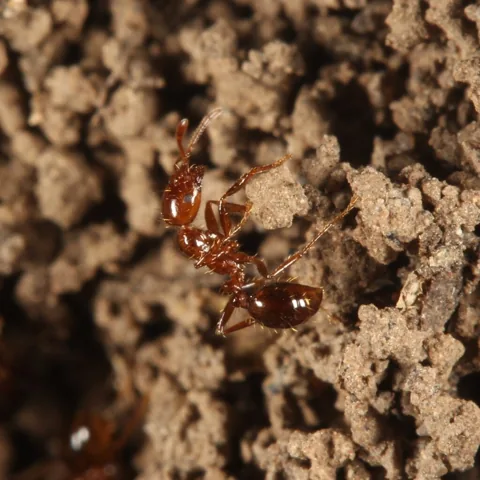 Red Imported Fire Ant
Solenopsis invicta
The red imported fire ant is an aggressive stinging ant that infests most of the southern United States and parts of California, building mounds in open, sunny areas such as lawns, parks and roadsides. USDA APHIS says imported fire ants came from South America, probably in soil on cargo ships, and now infest more than 367 million acres in Alabama, Arkansas, California, Florida, Georgia, Louisiana, Mississippi, North Carolina, Oklahoma, South Carolina, Tennessee, Texas, Virginia and Puerto Rico.
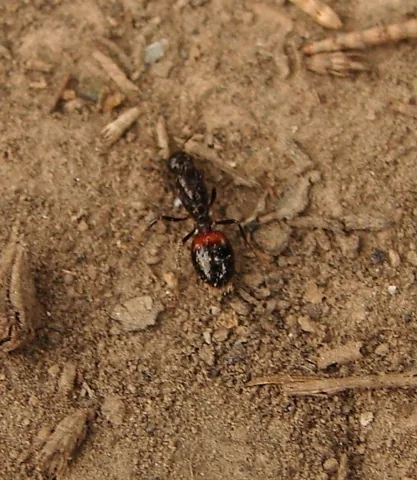 Black Imported Fire Ant
Solenopsis richteri
The black imported fire ant is a South American fire ant that reached Mobile, Alabama, decades before the red imported fire ant. Its range stays limited to northeastern Mississippi, northwestern Alabama and southern Tennessee.
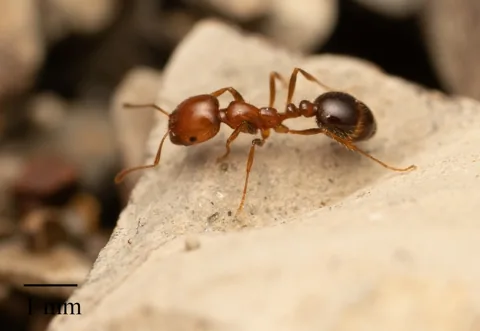 Southern Fire Ant
Solenopsis xyloni
The southern fire ant is a native fire ant of the Southwest. It nests in bare, sunny soil, swarms out to bite and sting when its nest is disturbed, and often wanders indoors for food in warm months.
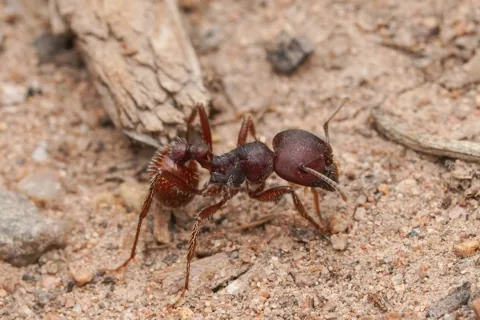 Red Harvester Ant
Pogonomyrmex barbatus
The red harvester ant is a large red ant of the southern Plains and Southwest that gathers seeds and stores them underground. It strips the plants from a circle around its nest entrance, and its sting is intensely painful.
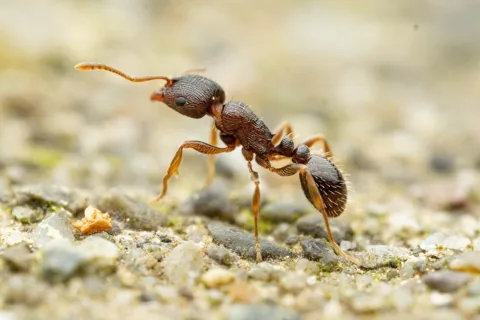 Pavement Ant
Tetramorium immigrans
The pavement ant is an introduced, soil-nesting ant that lives under sidewalks, slabs and stones. Penn State calls it one of the most commonly encountered house-infesting ants in Pennsylvania and says its range runs from New England to the Midwest and south through the Mid-Atlantic states to Tennessee, with populations in parts of California and Washington.
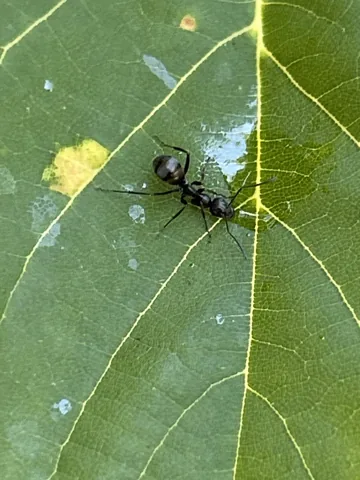 Field Ants
Formica species (e.g., F. subsericea, F. integra, F. exsectoides)
Field ants are medium to large ants in the genus Formica, among the most common ants in yards. They nest in soil, and in Wisconsin their mounds can reach three to four feet wide, spoiling lawns and making mowing difficult.
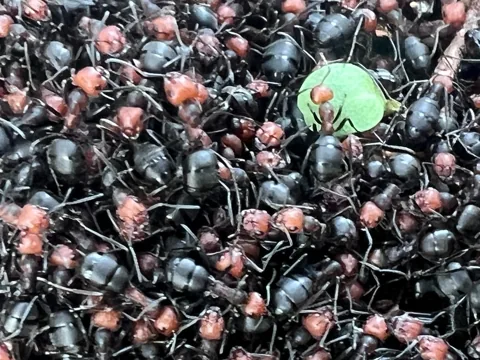 Thatching Ants
Formica obscuripes (western thatching ant) and related mound-building Formica
Thatching ants are medium to large red-and-black or black ants that build mounds of thatch such as fir needles and grass stems. They are native, beneficial predators and rarely come indoors, but they bite in numbers and spray formic acid when a mound is disturbed. Leave mounds alone where you can; where one sits in a path or play area, the whole mound has to be treated, not just the entrance.
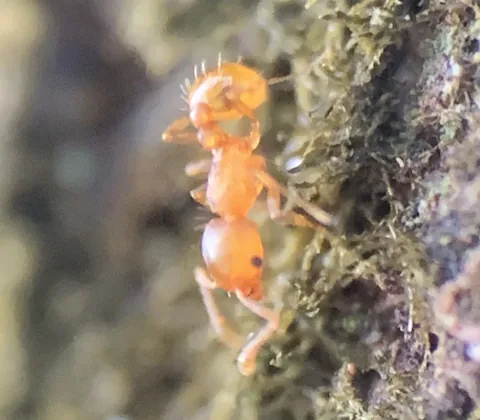 Little Fire Ant
Wasmannia auropunctata (listed on iNaturalist as Allomerus auropunctatus)
The little fire ant is an invasive ant from the American tropics whose sting, the Hawaii Department of Agriculture (HDOA) notes, is out of proportion to its tiny size. It was first found in Hawaii in 1999 and has spread there in plants, logs and green waste.
Side by side
These are the field marks extension entomologists use. Sizes differ a little between publishers, so each is given with its source. Color alone is not enough: University of Minnesota Extension notes that color can help but is not always definitive for identifying ants.[14][3]
- Red imported fire ant (Solenopsis invicta): workers 1/16 to 1/5 inch (UC IPM) or 1/16 to 1/4 inch (Kentucky), mixed sizes in one colony, dark reddish brown with a darker abdomen. NC State lists three worker sizes, from about 1/8 inch minims to about 1/4 inch majors. Two nodes in the waist; NC State says almost all other ants have one.[3][5][6]
- Imported fire ant mound: dome-shaped and up to 1 ft high when undisturbed (UC IPM); Texas A&M says pasture mounds can reach 18 inches but lawn mounds are usually a few inches tall, and Kentucky reports mounds 18-24 inches tall and up to 2 feet wide. No central opening. Mowed mounds in irrigated turf can look flat, like a gopher mound.[3][1][5]
- Native fire ants: the southern fire ant (Solenopsis xyloni) is about the same size and color as the red imported fire ant. Its nests are usually irregular, with scattered soil and several obscure entrances. Both get agitated when disturbed, but UC IPM says the imported fire ant is much more aggressive and climbs onto the person quickly to sting. Workers in the fire ant group are polymorphic (mixed sizes), the Mississippi Entomological Museum notes, so size mix alone will not separate imported from native fire ants.[3][4][7]
- Harvester ants (Pogonomyrmex): red to reddish brown; California harvester ant workers are all the same size, about 1/5 inch (UC IPM), and Colorado State gives 5-7 mm. A single nest opening in the middle of a cleared, bare area that averages about 12 feet across and ranges from 3 to 35 feet (Texas A&M). A row of hairs under the head for carrying seeds, and 12-segmented antennae without a club. Painful sting.[3][11][10][4]
- Pavement ant (Tetramorium caespitum): 2.5 to 4 mm long and dark brown to black (Penn State), so more brown-black than red. Parallel lines or ridges on the head and thorax, and two small spines on the back of the thorax. Leaves small piles of sand and soil at cracks in sidewalks, slabs and foundation walls rather than a mound.[12][13][14]
- Field and thatching ants (Formica): bigger than fire ants, 3/16 to 5/16 inch for thatching ants (WSU), black or red and black. Thatching ants pile plant debris such as fir needles on their mounds; Wisconsin reports field ant mounds three to four feet wide and over two feet tall. They bite and spray formic acid rather than sting.[15][16][14]
- Little fire ant (Wasmannia auropunctata): tiny, about 1.5 mm or about 1/16 inch, light brown to orange, slow moving, with two spines on the thorax. Lives in trees and plants, is easily knocked loose, and often stings people on the neck, arms and torso when ants fall from above. Its non-native range includes Hawaii, Florida and California (UF IFAS).[17][18]
Behavior and stings compared
Red imported fire ants climb onto and sting anything touching their mound or food. One worker can bite and sting repeatedly. A day or so later each sting usually forms a white, fluid-filled pustule, which Texas A&M says only fire ant venom causes; UC IPM says the pustules can take several weeks to disappear and can scar if they get infected.[3][1]
The other red ants defend themselves differently.[4][10][15]
- Harvester ants: a painful sting. UC IPM lists native fire ants and harvester ants as the most common stinging ants in California, and Texas A&M says people are often stung while playing in lawns and parks where red harvester ants nest.[4][10]
- Field and thatching ants: when their mounds are disturbed they bite in mass and spray formic acid, which stings. Wisconsin calls the bite painful and pinch-like.[15][16]
- Pavement ants: they carry a stinger, Penn State notes, but they are best known as a house-infesting ant that trails in through cracks to food.[12]
- Little fire ants: a surprisingly painful sting for so small an ant; welts can last for weeks.[17][18]
How to confirm what you have
Collect a few workers of different sizes and look at them with a hand lens or magnifier. Kentucky says conclusive identification needs magnification to count antennal segments, look for spines on the thorax and count the waist nodes.[5]
To separate the imported fire ant from native fire ants for certain, UC IPM says to count the teeth on the front edge of the head (clypeus) under a microscope: three in the red imported fire ant, two lateral teeth in the southern fire ant.[3]
- Check the mound a few days after a heavy rain, when fire ant mounds of fluffy soil show up best. If you shovel in, white brood (eggs, larvae and pupae) is visible.[1]
- Watch the edge of a bare circle: one central hole with ants carrying seeds points to harvester ants, not fire ants.[10][3]
- Take samples to your county extension office for identification. In California, UC IPM points to a statewide toll-free line staffed by the California Department of Food and Agriculture, 1-888-434-7326, to get a suspect ant identified. Kentucky's entomology department takes reports of suspicious mounds and stings.[6][3][5]
The federal fire ant quarantine
Federal rules define the imported fire ant as Solenopsis invicta (red imported fire ant), Solenopsis richteri (black imported fire ant) and hybrids of the two. Native fire ants are not covered.[9]
- USDA APHIS keeps quarantine areas where imported fire ant colonies are known, to stop people from spreading them. It works with states to regulate high-risk items such as nursery stock, baled hay, soil and soil-moving equipment, and moving a regulated article out of a quarantine area requires a certificate issued after inspection by state or federal personnel. APHIS has a state-by-state map and the list of regulated articles.[8][9]
Why the difference matters
Texas A&M says not every ant hill is a pest: native ants such as pyramid ants compete with fire ants, and the little black ant preys on fire ant queens. Texas A&M calls the native red harvester ant seldom harmful, though it can sting, and notes harvester ants are food for the horned toad.[2]
Stings: when to get help
Fire ant stings are most often painful, and in most cases bites and stings can be treated at home. People who are allergic to the venom can have anaphylaxis, a severe and potentially life-threatening reaction that needs emergency care.[19][20]
A medical review notes that imported fire ant sting rates are high where the ant is established, that stings now happen indoors too, and that the very young and very old are especially at risk because they cannot move away quickly.[21]
- Call 911 or the local emergency number for a severe reaction, check the person's airway and breathing, and begin rescue breathing and CPR if needed.[20]
- People with a history of severe reactions should carry an epinephrine auto-injector (EpiPen) and wear medical identification, NIOSH advises, and someone should stay with a person who was stung to watch for a reaction.[19]
- Pets: the Merck Veterinary Manual says fire ants attack animals that disturb their nests, each ant stinging up to 10 times. The pustule seen in people rarely develops in dogs, and anaphylaxis from fire ant stings has not been reported in companion animals.[22]
What to do for each
Once you know the ant, use the matching guide below. Imported fire ants respond best to labeled fire ant baits; native ants that cause no trouble can be left alone.[3][2]
- Red or black imported fire ants: follow a bait-based plan and keep away from mounds; see the fire ant yard guide.[3][6]
- Harvester ants: Texas A&M says any insecticide registered to control ants can be used where a nest makes a lawn or park unusable.[10]
- Field and thatching ants: WSU says they are fierce predators to protect where possible; when a mound must go, the nest goes deep, so treatment has to reach into it.[15][16]
- Pavement ants indoors: Penn State says foraging workers can be controlled with baits, and Minnesota calls baiting the most effective tactic when they nest under heated concrete slabs.[12][14]
- Little fire ants: in Hawaii, collect suspect ants and report them to the Statewide Pest Hotline, 643-PEST (7378); in Florida, UF IFAS maps established colonies starting from the Florida Keys.[18][17]
Common questions
- Are all red ants fire ants?
- No. Harvester ants are red, the southern fire ant is native, and many field and thatching ants are red and black. Look for a mound with no opening in the center, workers of mixed sizes and a fast, stinging swarm to point to imported fire ants.[3][1][15]
- How do I tell a fire ant mound from a harvester ant mound?
- A fire ant mound is a dome of fluffy soil with no central opening. A harvester ant nest has one obvious entrance in the middle of a bare, cleared circle that averages about 12 feet across.[1][10][3]
- What is the difference between red and black imported fire ants?
- They are two related invasive species, Solenopsis invicta and Solenopsis richteri; APHIS describes imported fire ants as reddish brown or black, and the federal quarantine covers both and their hybrids.[8][9]
- Can a fire ant sting hurt my dog?
- Stings are painful and fire ants attack animals that disturb their nests, but the Merck Veterinary Manual says the typical pustule rarely develops in dogs and anaphylaxis from fire ant stings has not been reported in companion animals.[22]
Photo credits
- Red Imported Fire Ant: (c) Natasha Taylor, some rights reserved (CC BY) — via iNaturalist, CC BY 4.0
- Black Imported Fire Ant: (c) Nicolas Olejnik, some rights reserved (CC BY) — via iNaturalist, CC BY 4.0
- Southern Fire Ant: Jesse Rorabaugh, public domain (CC0), via iNaturalist
- Red Harvester Ant: (c) Jonghyun Park, some rights reserved (CC BY) — via iNaturalist, CC BY 4.0
- Pavement Ant: (c) Jake Nitta, some rights reserved (CC BY) — via iNaturalist, CC BY 4.0
- Field Ants: Milwaukee County Parks - Natural Areas Program, public domain (CC0), via iNaturalist
- Thatching Ants: (c) Ryan McMinds, some rights reserved (CC BY) — via iNaturalist, CC BY 4.0
- Little Fire Ant: natalie, public domain (CC0), via iNaturalist
Sources
- Texas A&M AgriLife Extension, Texas Imported Fire Ant Research and Management Project, “How can I tell if I have fire ants?.” fireant.tamu.edu/manage/how-can-i-tell-if-i-have-fire-ants/ (accessed 2026-11-14)
- Texas A&M AgriLife Extension, Texas Imported Fire Ant Research and Management Project, “Native ants.” fireant.tamu.edu/learn/native-ants/ (accessed 2026-11-14)
- University of California Statewide IPM Program, “Red Imported Fire Ant (Pest Notes).” ipm.ucanr.edu/home-and-landscape/red-imported-fire-ant/ (accessed 2026-11-14)
- University of California Statewide IPM Program, “Ants (Pest Notes).” ipm.ucanr.edu/home-and-landscape/ants/ (accessed 2026-11-14)
- University of Kentucky Entomology, “Imported Fire Ants in Kentucky.” entomology.mgcafe.uky.edu/ef469 (accessed 2026-11-14)
- NC State Extension, “Red Imported Fire Ants in the Landscape.” content.ces.ncsu.edu/managing-fire-ants-in-your-yard (accessed 2026-11-14)
- Mississippi Entomological Museum, Mississippi State University, “Solenopsis geminata (Fabricius).” mem.org.msstate.edu/Researchtaxapages/Formicidaepages/genericpages/Solenopsis.geminata.htm (accessed 2026-11-14)
- USDA Animal and Plant Health Inspection Service, “Imported Fire Ants.” www.aphis.usda.gov/plant-pests-diseases/ifa (accessed 2026-11-14)
- Electronic Code of Federal Regulations (eCFR), “7 CFR Part 301 Subpart F, Imported Fire Ant (301.81-1 to 301.81-4).” www.ecfr.gov/current/title-7/subtitle-B/chapter-III/part-301/subpart-F (accessed 2026-11-14)
- Texas A&M AgriLife Urban and Structural Entomology Program, “Red Harvester Ants, Pogonomyrmex barbatus.” urbanentomology.tamu.edu/urban-pests/ants/red_harvester/ (accessed 2026-11-14)
- Colorado State University Extension, “Harvester Ants (Colorado Insects of Interest).” wci.extension.colostate.edu/wp-content/uploads/sites/14/2017/04/HarvesterAnts.pdf (accessed 2026-11-14)
- Penn State Extension, “Pavement Ant.” extension.psu.edu/pavement-ant (accessed 2026-11-14)
- NC State Extension, “Pavement Ant.” content.ces.ncsu.edu/pavement-ant (accessed 2026-11-14)
- University of Minnesota Extension, “Ants.” extension.umn.edu/insects-infest-homes/ants (accessed 2026-11-14)
- Washington State University Pestsense, “Thatching ants.” pestsense.cahnrs.wsu.edu/fact-sheet/thatching-ants/ (accessed 2026-11-14)
- University of Wisconsin-Madison Extension (Wisconsin Horticulture), “Field Ants.” hort.extension.wisc.edu/articles/field-ants/ (accessed 2026-11-14)
- University of Florida IFAS Extension (Featured Creatures), “Little Fire Ant, Wasmannia auropunctata (EENY-139/IN1351).” ask.ifas.ufl.edu/publication/IN1351 (accessed 2026-11-14)
- Hawaii Invasive Species Council, “Little Fire Ant (LFA).” dlnr.hawaii.gov/hisc/info/invasive-species-profiles/little-fire-ant/ (accessed 2026-11-14)
- CDC National Institute for Occupational Safety and Health, “Insects and Scorpions at Work.” www.cdc.gov/niosh/outdoor-workers/about/insects-and-scorpions.html (accessed 2026-11-14)
- MedlinePlus (U.S. National Library of Medicine), “Insect bites and stings.” medlineplus.gov/ency/article/000033.htm (accessed 2026-11-14)
- Current Opinion in Allergy and Clinical Immunology (PubMed 18596594), “The stinging impact of the imported fire ant (Tankersley, Curr Opin Allergy Clin Immunol 2008).” pubmed.ncbi.nlm.nih.gov/18596594/ (accessed 2026-11-14)
- Merck Veterinary Manual, “Wasp, Bee, and Ant Stings to Animals.” www.merckvetmanual.com/toxicology/insect-and-arachnid-stings-and-bites/wasp-bee-and-ant-stings-to-animals (accessed 2026-11-14)