On this page
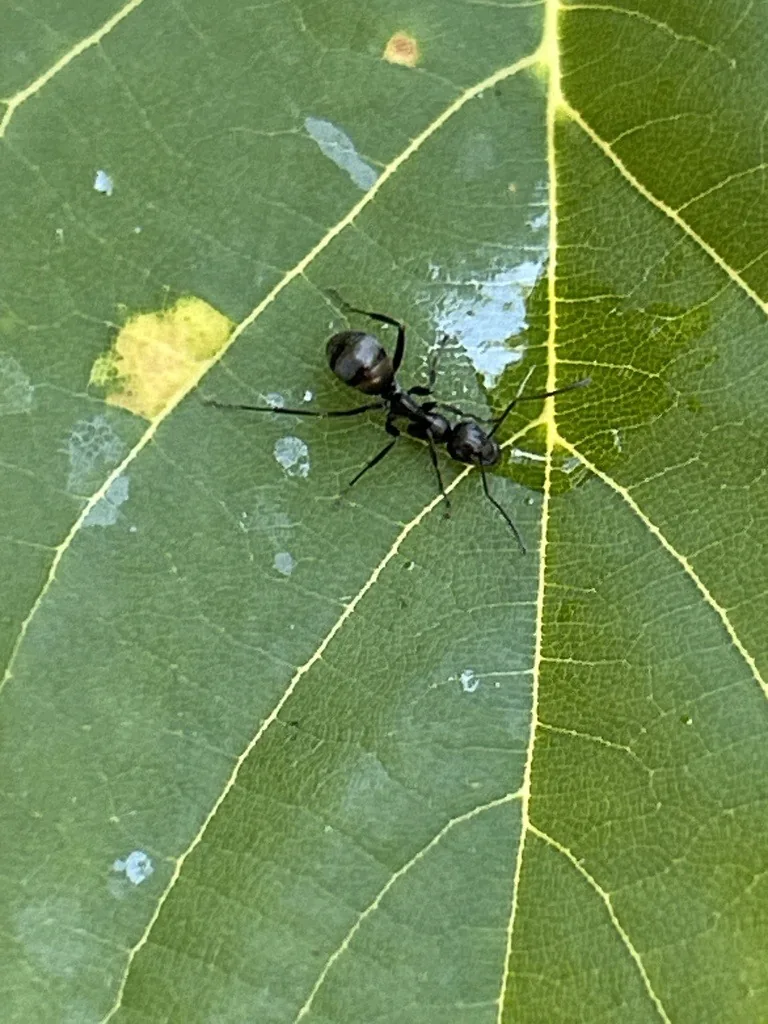
How to identify it
- Sizes vary by source: workers run 1/5 to 3/8 inch (Wisconsin), about 3/8 inch (Nebraska) or 1/8 to 1/4 inch (Minnesota). Minnesota notes that a colony has both major and minor workers.[1][3][4]
- Color varies by species: black, brown, tan, reddish, or red and black.[3][1][4]
- They have a single node in the waist, an uneven, bumpy thorax with a dip in the middle, and three tiny simple eyes (ocelli) on top of the head.[2][3][4]
- Many species exist; NC State highlights the all-black Formica subsericea, the red two-toned F. integra and the red-black Allegheny mound ant, F. exsectoides. This page uses F. subsericea as the example.[5]
Look-alikes
| Look-alike | How to tell them apart |
|---|---|
| Carpenter ants | Field ants are often confused with carpenter ants because of their size and color, but the dip in the field ant's thorax and its three ocelli set it apart, and it is less likely to forage indoors.[2][3][4] |
| Fire ants | Both build mounds in sunny turf, but field ants are not a human health hazard the way fire ants are, and fire ant baits do not attract them. Minnesota adds that fire ants do not occur in the upper Midwest, so mounds there are not fire ants.[5][4] |
| Cornfield ants | Cornfield ants make small mounds where lawn grass is thin or bare, while field ants can build larger, higher mounds in parts of the lawn that are growing well.[4] |
Where it lives
Found well beyond any one region: it is one of the most common ants in Wisconsin, Utah State calls it the most common ant in yards and gardens, NC State notes the Allegheny mound ant is prevalent in the eastern United States, and three mound-building species are abundant in Maine blueberry fields. GBIF holds about 48,000 U.S. records of the genus since 1990, the most from Colorado, Alaska, California and Arizona.[1][2][5][6][7]
Biology and life cycle
Colonies can survive 10 or more years; a queen lays the eggs that become workers and males.[1][5]
They prefer open, sunny, warm spots near sidewalks, slabs and pavement, and also nest under rocks, logs, landscape timbers, patio blocks and firewood. Minnesota says they do not nest inside buildings.[5][3][2][4]
They feed on live and dead insects and on honeydew from aphids and other sap-feeding insects; Minnesota adds household sweets.[1][2][4]
Sources differ on swarm timing: NC State says winged ants leave the colony to mate in spring and fall, while Minnesota gives July through September. Either way the swarms can be a nuisance.[5][4][2]
Field ants guard the honeydew producers they tend. On scale-infested maples in Kentucky the honeydew-seeking ants were mainly Formica subsericea; many of the ant species tending scales there attacked approaching lacewing larvae, and keeping ants off the trees let natural enemies cut scale numbers.[8]
Damage and signs
- Mounds are unsightly, can keep turf from growing, and can damage mowing equipment.[1][5][3]
- Mound size is another point of disagreement. Wisconsin reports mounds three to four feet wide and over two feet tall, Minnesota up to about 10 inches to a foot across, and Nebraska says nests in lawns have a low profile that rarely rises above the grass.[1][4][3]
- Some species kill nearby plants that shade their mounds; Wisconsin says they inject formic acid into the roots, and NC State says they severely damage nearby vegetation to keep shade off the mound.[1][5]
- Indoors, accounts differ. Wisconsin says field ants do not come indoors for food and Nebraska says they are not found indoors, while Utah State has seen them inside most often in spring and NC State says workers can enter buildings in large numbers looking for food. Minnesota calls field ants indoors usually a temporary problem that goes away on its own.[1][3][2][5][4]
Health risk
If disturbed, field ants can give painful, pinch-like bites to people and pets, but they don't pose the health hazard fire ants do.[1][5]
Control
Prevention
Tolerate them where you can. There is no need to control field ants where people aren't active, and ants play a useful role in the ecosystem.[1][5][4]
Keep them out
Seal possible entryways if workers come inside, and store food in airtight containers.[2]
Sanitation
Reduce food sources such as pet food, fallen fruit and bird seed, remove moist wood and debris, and control aphids, scales and mealybugs on nearby plants.[5][2]
Traps and physical control
Repeatedly disturbing a mound by digging or flooding it with a hose may not kill the colony but can push it to a less troublesome spot.[5]
Biological control
If ants are climbing trees and shrubs to tend scale insects, sticky bands combined with a basal trunk spray cut the number of honeydew-seeking ants going up large maples by 92 to 100 percent in a Kentucky study, and the trees ended up with fewer scales and less sooty mold.[8]
Pesticides
To kill the queen, which can be 2 to 3 feet deep in large mounds, rake debris off the mound, push four to six deep channels into it with a rod or dowel, and drench them with a labeled liquid insecticide such as bifenthrin, carbaryl, cyfluthrin, deltamethrin or permethrin, then put the debris back.[1]
Advice on formulation differs: Minnesota rates dusts or granules as most effective for nests, with liquids as the alternative, and NC State lists carbaryl or pyrethroids. Baits must be ones made for sweet-loving ants, since fire ant baits do not attract them; Nebraska lists outdoor granular baits and liquid bait stakes, and Wisconsin notes that hot water and borax do not work on field ants.[4][5][3][1]
Field ants as predators
Mound-building field ants are also predators. In Maine lowbush blueberry fields, the Allegheny mound ant (F. exsectoides) has been shown to prey on major blueberry pests, and lab tests found the commonly used insecticide phosmet toxic to it even after eight days of weathering, while some newer products such as acetamiprid had little effect.[6]
Common questions
- Are field ants carpenter ants?
- No. They are often mistaken for carpenter ants, but field ants nest in soil, rarely come inside for food, and have a dip in the thorax and three ocelli that set them apart.[2][1][3][4]
- Why doesn't treating the top of the mound work?
- The queen can live 2 to 3 feet underground in large mounds, so surface treatments don't reach her and the colony survives.[1]
- When do field ants swarm?
- NC State says winged field ants leave the colony to mate in spring and fall; Minnesota gives July through September and notes the outdoor swarms can be very conspicuous.[5][4]
Sources
- University of Wisconsin-Madison Extension, Wisconsin Horticulture, “Field Ants (XHT1204).” hort.extension.wisc.edu/articles/field-ants/ (accessed 2026-11-11)
- Utah State University Extension, “Field Ants (IPM nuisance pest notes).” extension.usu.edu/planthealth/ipm/notes_nuisance/field-ants (accessed 2026-11-11)
- University of Nebraska-Lincoln Extension, “Identification of Structure-Invading Ants in Nebraska (EC1570, revised October 2023).” extensionpubs.unl.edu/publication/421/pdf/view (accessed 2026-11-11)
- University of Minnesota Extension, “Ants (Garden and Home: Household insects).” extension.umn.edu/insects-infest-homes/ants (accessed 2026-11-11)
- NC State Extension, “Nuisance Ants in Turf (TurfFiles).” content.ces.ncsu.edu/formica-ants-in-turf (accessed 2026-11-11)
- Journal of Economic Entomology, via PubMed, “The influence of insecticides and vegetation in structuring Formica mound ant communities in Maine lowbush blueberry (Choate and Drummond 2013).” pubmed.ncbi.nlm.nih.gov/23786059/ (accessed 2026-11-11)
- Global Biodiversity Information Facility (GBIF), “Formica (genus): U.S. occurrence records since 1990 by state (GBIF occurrence search).” api.gbif.org/v1/occurrence/search?taxonKey=1314840&country=US&hasGeospatialIssue=false&occurrenceStatus=PRESENT&year=1990%2C2026&facet=stateProvince&facetLimit=400&limit=0 (accessed 2026-11-11). Exact count at access: 48,190 U.S. records since 1990 (Colorado 5,382; Alaska 5,326; California 5,189; Arizona 3,801; Utah 3,484).
- Environmental Entomology, via PubMed, “Ant-exclusion to promote biological control of soft scales on woody landscape plants (Vanek and Potter 2010).” pubmed.ncbi.nlm.nih.gov/22182548/ (accessed 2026-11-11)
- iNaturalist, “Formica subsericea taxon page (order and family).” www.inaturalist.org/taxa/133027 (accessed 2026-10-06)