On this page
How to identify it
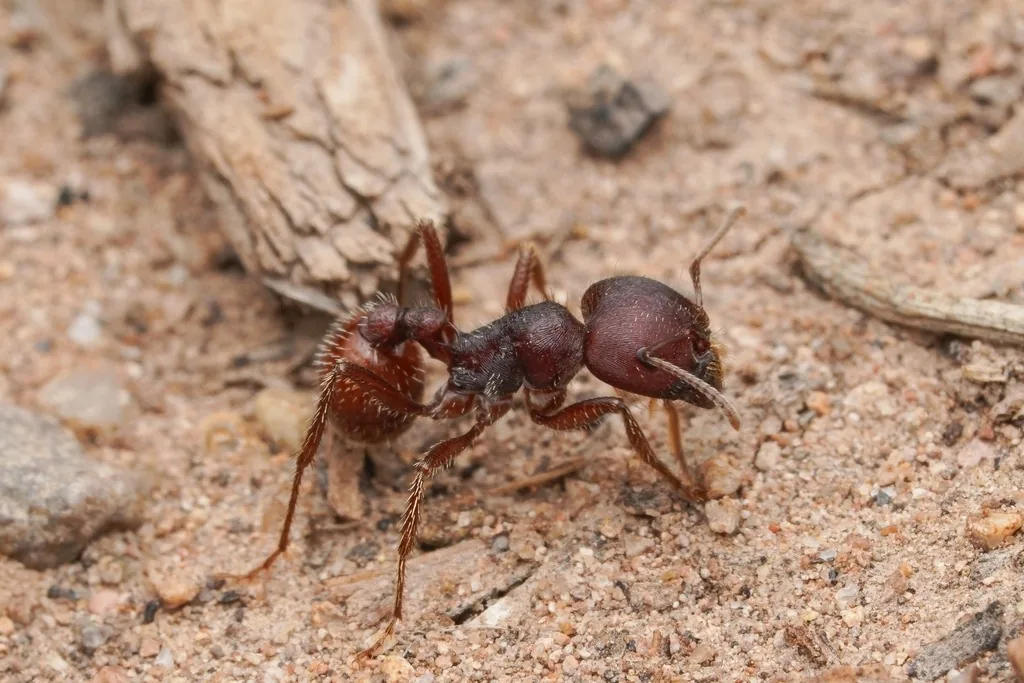
- Workers are red, with some lighter and darker variation. Harvester ant workers are moderately large: New Mexico State describes its harvester ants as nearly 1/4 inch long, and Colorado State gives 5 to 7 mm for its two species.[1][4][5]
- A beard of long hairs under the head, called a psammophore, lets them carry large loads.[1][4][5]
- Workers are one size (monomorphic), have 12-segmented antennae without a club, and carry a pair of short spines on the rear of the thorax and a well-developed stinger.[1][4]
- The nest is the giveaway: a single entry hole in a bare, cleared circle, often with one or more foraging trails leading out to surrounding plants.[1][5]
Look-alikes
| Look-alike | How to tell them apart |
|---|---|
| Florida harvester ant | The only harvester ant east of the Mississippi River. Its workers are strongly dimorphic, with big-headed major workers much larger than the minors, and it nests in deep sand, making crater-like nests often covered with debris.[6] |
| Pyramid ants | Much smaller ants that often nest on the cleared surface of harvester ant nests.[2] |
Where it lives
Ranges from Kansas and Oklahoma through western Texas, New Mexico and Arizona into Mexico, with scattered records in extreme southern Utah. It nests in soil on open land, possibly more often on cultivated than uncultivated ground, and has kept nesting in urbanizing south Texas.[1][15][16]
Biology and life cycle
Seeds are the main food. Workers prefer small seeds such as alfalfa, burr clover, Johnson grass, oats, wheat, Bermuda grass, wild sunflower and mesquite, and also scavenge dead insects and other arthropods.[1][5]
The cleared nest area averages about 12 feet across but ranges from 3 to 35 feet, and foraging trails can stretch 200 feet. Clearing the plants lets the sun keep the nest warm and dry.[1][5]
Nests can go very deep: Texas A&M reports one 15 feet deep with 436 chambers.[1]
Mating flights happen mostly after rain in August and September. A newly mated queen breaks off her wings and digs a new nest.[1][5]
Colonies are long-lived. A long-term study of red harvester ants in New Mexico found a colony can live 20 to 30 years, the lifespan of its founding queen, while each worker lives only about a year.[15]
In south Texas, red harvester ants have kept nesting as land turned peri-urban: a 2023 study found nests clustered near athletic fields, lawns, sidewalks and railroad tracks, favoring higher ground with little tree canopy.[16]
Damage and signs
- Building nests for its large colonies can seriously damage grass and cropland. Tunneling disturbs turf roots and dries the soil, turf thins, and big mounds make lumpy areas that can damage mower blades.[1][4]
- Colonies in lawns and city parks make those places unsuitable for play because people get stung.[1][16]
Health risk
Harvester ant stings cause intense, long-lasting pain, and researchers have traced that pain to venom peptides that act on nerve sodium channels and seem to have evolved to deter vertebrates. The venom of the related Florida harvester ant was more toxic to mammals than any other insect venom reported as of a 1978 study. Harvester ants (genus Pogonomyrmex) are among the ants documented to cause serious allergic reactions.[9][10][11][12]
Control
Prevention
Before treating, decide whether the colony is really a problem. Texas A&M AgriLife notes red harvester ant numbers are declining, which affects the threatened Texas horned lizard; many horned lizard species feed mainly on harvester ants.[3][17]
Traps and physical control
Regular discing and mowing that destroys nests and habitat may eliminate harvester ants without insecticides.[1]
Pesticides
Treat the mound, not the foragers: killing the queen is what controls the colony, and treating foraging ants gives very short relief. Baits labeled for harvester ants in lawns are very effective.[4][1]
A dust insecticide labeled for ants injected into the entry hole also works. Drenching the whole mound with a residual insecticide is the least desirable option.[1]
If you are stung
Wash the sting with soap and water, then apply ice wrapped in a cloth, 10 minutes on and 10 minutes off. An antihistamine or an anti-itch cream can help, and watch the site over the next few days for signs of infection.[7]
Anyone allergic to venom can have anaphylaxis, which needs emergency care. Call 911 for trouble breathing or wheezing, swelling of the face or mouth, throat tightness or trouble swallowing, weakness or turning blue, and use the person's epinephrine auto-injector if they carry one.[7][8]
After a severe, whole-body reaction, see an allergist. Allergy tests and venom immunotherapy are available for imported fire ants but not widely for other stinging ants such as harvester ants, and a 1977 study found harvester ant-sensitive patients reacted to related harvester ant species more than to bees, wasps or other ants.[7][13][14]
Where sources disagree
Nest size: Texas A&M gives an average cleared area of about 12 feet across for the red harvester ant. New Mexico State, writing about the harvester ants in its turf, says some nests are up to six feet across and eight feet or more deep.[1][4]
Lifespan: Colorado State says a harvester ant queen may live a decade or more; the New Mexico study of red harvester ants found colonies, and their founding queens, living 20 to 30 years.[5][15]
Common questions
- Why is there a bare circle in my yard with big red ants?
- Red harvester ants clear the plants around the nest so the sun keeps it warm and dry, leaving a bare circle around a single entry hole. Texas A&M says the circle averages about 12 feet across.[1][5]
- How bad is a harvester ant sting?
- Very painful and long-lasting: the venom contains peptides that switch on pain nerves. Most stings are local, but people allergic to the venom can have a severe reaction, so watch for trouble breathing or face swelling and call 911 if they appear.[9][7][11]
- Are these the ants sold in ant farms?
- Harvester ants in general, yes: Colorado State notes the workers live a long time and are easy to keep, so they have long been the species sold in children's ant farms.[5]
Sources
- Texas A&M Center for Urban and Structural Entomology, “Red Harvester Ant.” urbanentomology.tamu.edu/urban-pests/ants/red_harvester/ (accessed 2026-11-11)
- Texas A&M Center for Urban and Structural Entomology, “Pyramid Ant.” urbanentomology.tamu.edu/urban-pests/ants/pyramid/ (accessed 2026-11-11)
- Texas A&M AgriLife Extension, “Red Harvester Ants (publication listing).” agrilifeextension.tamu.edu/library/landscaping/red-harvester-ants (accessed 2026-11-11)
- New Mexico State University Cooperative Extension Service, “Ants (Ornamental and Turf Guide T-01).” plantclinic.nmsu.edu/documents/t-01-ants.pdf (accessed 2026-11-11)
- Colorado State University Extension, “Harvester Ants (Colorado Insects of Interest).” wci.extension.colostate.edu/wp-content/uploads/sites/14/2017/04/HarvesterAnts.pdf (accessed 2026-11-11)
- Mississippi Entomological Museum, Mississippi State University, “Pogonomyrmex badius (Latreille) (Ants of the Southeastern United States).” mem.org.msstate.edu/Researchtaxapages/Formicidaepages/genericpages/Pogonomyrmex.badius.htm (accessed 2026-11-11)
- MedlinePlus, U.S. National Library of Medicine, “Insect bites and stings (Medical Encyclopedia).” medlineplus.gov/ency/article/000033.htm (accessed 2026-11-11)
- Centers for Disease Control and Prevention, NIOSH, “Insects and Scorpions at Work.” www.cdc.gov/niosh/outdoor-workers/about/insects-and-scorpions.html (accessed 2026-11-11)
- Journal of Biological Chemistry, via PubMed, “Peptide toxins that target vertebrate voltage-gated sodium channels underly the painful stings of harvester ants (Robinson et al. 2024).” pubmed.ncbi.nlm.nih.gov/38110035/ (accessed 2026-11-11)
- Science, via PubMed, “A harvester ant venom: chemistry and pharmacology (Schmidt and Blum 1978).” pubmed.ncbi.nlm.nih.gov/653354/ (accessed 2026-11-11)
- Annals of Allergy, Asthma and Immunology, via PubMed, “Adverse reactions to ants other than imported fire ants (Klotz et al. 2005).” pubmed.ncbi.nlm.nih.gov/16312163/ (accessed 2026-11-11)
- Toxins, via PubMed, “Pain and Lethality Induced by Insect Stings: An Exploratory and Correlational Study (Schmidt 2019).” pubmed.ncbi.nlm.nih.gov/31330893/ (accessed 2026-11-11)
- Journal of Allergy and Clinical Immunology: In Practice, via PubMed, “Stinging Ant Anaphylaxis: Advances in Diagnosis and Treatment (McMurray et al. 2025).” pubmed.ncbi.nlm.nih.gov/39038538/ (accessed 2026-11-11)
- Journal of Allergy and Clinical Immunology, via PubMed, “Harvester ant sensitivity: in vitro and in vivo studies using whole body extracts and venom (Pinnas et al. 1977).” pubmed.ncbi.nlm.nih.gov/64481/ (accessed 2026-11-11)
- Philosophical Transactions of the Royal Society B, via PubMed, “The life history of harvester ant colonies (Gordon 2024).” pubmed.ncbi.nlm.nih.gov/39463251/ (accessed 2026-11-11)
- Environmental Entomology, via PubMed, “Tree canopy cover and elevation affect the distribution of red harvester ant nests in a peri-urban setting (2023).” pubmed.ncbi.nlm.nih.gov/37018488/ (accessed 2026-11-11)
- Biology Open, via PubMed, “Avoiding being stung or bitten: prey capture behaviors of the ant-eating Texas horned lizard (Fertschai et al. 2021).” pubmed.ncbi.nlm.nih.gov/33597202/ (accessed 2026-11-11)
- iNaturalist, “Pogonomyrmex barbatus taxon page (order and family).” www.inaturalist.org/taxa/1340200 (accessed 2026-11-11)