On this page
How to identify it
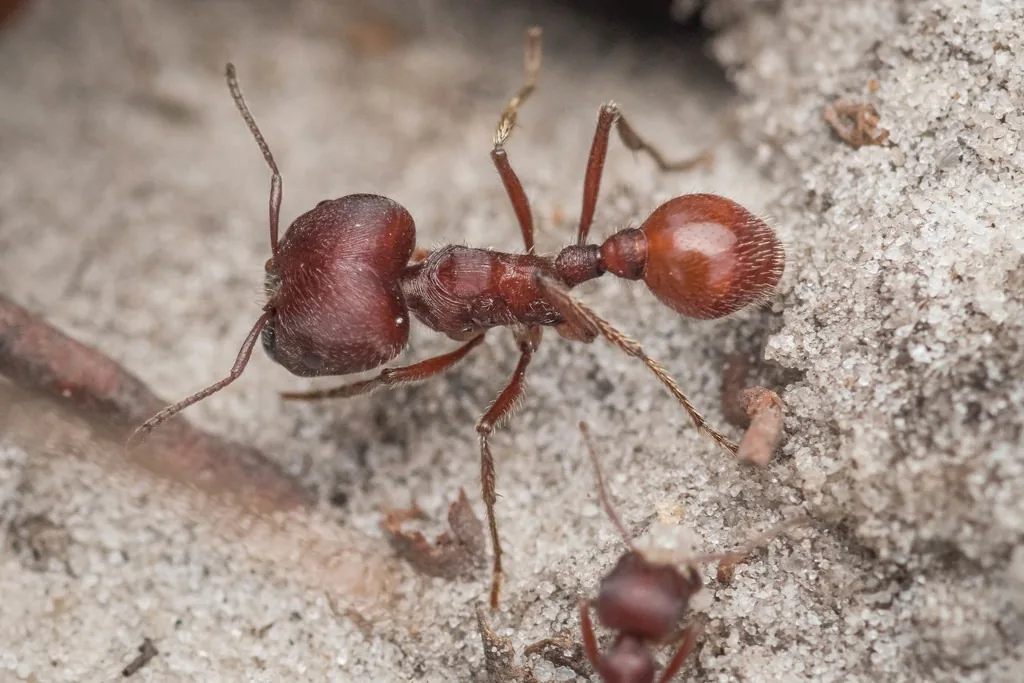
- Workers are large ants and come in two clearly different sizes: major workers have big heads and are much larger than the minor workers. Under the head is a psammophore, a row of long hairs.[1]
- Nests are crater-like piles of excavated sand, often covered with debris. In north Florida the ants decorate this disc of sand with bits of charcoal, mostly burned pine-needle tips, which stand out sharply against light sand.[1][3][4]
Look-alikes
| Look-alike | How to tell them apart |
|---|---|
| Red harvester ant | The Florida harvester ant is the only member of its genus found east of the Mississippi River, so a harvester ant nesting in deep sand in the Southeast is this species rather than one of the western harvester ants.[1][5] |
Where it lives
The Mississippi Entomological Museum lists it from Alabama, Arkansas, Florida, Georgia, Louisiana, Mississippi, North Carolina and South Carolina, nesting only in areas of deep sand. It was once thought gone from Mississippi because of imported fire ants and fire ant control, but since 2006 it has been found in many sandy areas there. Of about 5,800 U.S. GBIF records since 1990, about 4,300 are from Florida, followed by Georgia, South Carolina, Mississippi, North Carolina and Alabama, with only two each from Louisiana and Texas.[5][1][6]
Biology and life cycle
Workers collect a wide range of seeds and store large numbers of them in damp underground chambers. They open only the smaller seeds, so big seeds pile up to 70 percent or more of the store's weight; when those seeds sprout in storage, the ants remove them and feed them to the larvae.[7]
Seeds are kept in chambers 40 to 100 cm below ground. Foragers stay in the top 15 cm of the nest, while the brood and the workers tending it live mostly in the deepest parts, up to 2 m down.[8][9]
Colonies start producing winged males and queens once they reach about 700 workers. Those are reared only in spring, mating takes place in early summer, and the colony then raises workers until it goes dormant for the winter.[10]
Colonies move house about once a year on average, mostly between May and November with a peak in July. The average move is only about 4 m, and a colony digs the new nest in 4 to 6 days, piling an average of 4.8 kg of sand on the surface.[3][4]
Health risk
Its sting is intensely painful. In laboratory tests the venom was more toxic to mammals than any other insect venom reported, apparently as a defense against vertebrate predators, and a later comparison of 96 stinging insects places Pogonomyrmex among the ants whose stings are both very painful and highly toxic. A medical review lists Pogonomyrmex among ant genera reported to cause serious allergic or allergy-like reactions.[2][11][12]
Control
Prevention
Avoid disturbing nests: don't put your hands into them and avoid rapid, jerky movements around them. Colonies relocate about once a year, usually only a few meters and mostly between May and November, so a nest can reappear close to where it was.[13][3]
More from the research literature
A 2004 excavation study in the Journal of Insect Science found that young colonies' nests are usually 40 to 50 cm (about 16 to 20 inches) deep, while mature nests are commonly 2.5 to 3 m (8 to 10 feet) deep, with about half of the chamber space in the top quarter of the nest.[8]
If you are stung
Wash the sting with soap and water, then put ice wrapped in a cloth on it for 10 minutes, off for 10 minutes, and repeat. An antihistamine or anti-itch cream can help, and watch for signs of infection over the next few days.[13]
Call 911 for trouble breathing or wheezing, swelling of the face or mouth, throat tightness or trouble swallowing, weakness, or turning blue. Use the person's epinephrine kit if they carry one.[13]
Common questions
- Does the Florida harvester ant sting?
- Yes. The Mississippi Entomological Museum lists it as a stinging pest, and its venom is intensely painful.[5][2]
- Why is there charcoal on the ant mound?
- Florida harvester ants decorate the sand disc around their nest entrance with bits of charcoal, mostly the burned tips of pine needles.[3][4]
- How deep do Florida harvester ant nests go?
- Young colonies dig about 40 to 50 cm down; mature nests commonly reach 2.5 to 3 m.[8]
Sources
- Mississippi Entomological Museum, Mississippi State University, “Pogonomyrmex badius (Latreille), Ants of the Southeastern United States.” mississippientomologicalmuseum.org.msstate.edu/Researchtaxapages/Formicidaepages/genericpages/Pogonomyrmex.badius.htm (accessed 2026-11-11)
- Science, via PubMed, “A harvester ant venom: chemistry and pharmacology (Schmidt and Blum 1978).” pubmed.ncbi.nlm.nih.gov/653354/ (accessed 2026-11-11)
- PLoS One, via PubMed, “Nest relocation and excavation in the Florida harvester ant, Pogonomyrmex badius (Tschinkel 2014; full text via PMC).” pubmed.ncbi.nlm.nih.gov/25409332/ (accessed 2026-11-11)
- PLoS One, via PubMed, “Biomantling and bioturbation by colonies of the Florida harvester ant, Pogonomyrmex badius (Tschinkel 2015; full text via PMC).” pubmed.ncbi.nlm.nih.gov/25794047/ (accessed 2026-11-11)
- Mississippi Entomological Museum, Mississippi State University, “Common Pest Ants of the Southeastern United States.” mem.org.msstate.edu/Researchtaxapages/Formicidaepages/faunal.lists/Common_Pest_Ants.html (accessed 2026-11-11)
- Global Biodiversity Information Facility (GBIF), “Pogonomyrmex badius: U.S. occurrence records since 1990 by state (GBIF occurrence search).” api.gbif.org/v1/occurrence/search?taxonKey=1325394&country=US&hasGeospatialIssue=false&occurrenceStatus=PRESENT&year=1990%2C2026&facet=stateProvince&facetLimit=400&limit=0 (accessed 2026-11-11)
- PLoS One, via PubMed, “The Florida harvester ant, Pogonomyrmex badius, relies on germination to consume large seeds (Tschinkel and Kwapich 2016).” pubmed.ncbi.nlm.nih.gov/27893844/ (accessed 2026-11-11)
- Peer-reviewed literature (PubMed Central), “The nest architecture of the Florida harvester ant, Pogonomyrmex badius (Tschinkel, Journal of Insect Science, 2004).” pmc.ncbi.nlm.nih.gov/articles/PMC528881/ (accessed 2026-11-11)
- PLoS One, via PubMed, “Vertical organization of the division of labor within nests of the Florida harvester ant, Pogonomyrmex badius (2017).” pubmed.ncbi.nlm.nih.gov/29182686/ (accessed 2026-11-11)
- Journal of Insect Science, via PubMed, “The sociometry and sociogenesis of reproduction in the Florida harvester ant, Pogonomyrmex badius (2006; full text via PMC).” pubmed.ncbi.nlm.nih.gov/19537980/ (accessed 2026-11-11)
- Toxins, via PubMed, “Pain and lethality induced by insect stings: an exploratory and correlational study (Schmidt 2019).” pubmed.ncbi.nlm.nih.gov/31330893/ (accessed 2026-11-11)
- Annals of Allergy, Asthma and Immunology, via PubMed, “Stinging and biting ants other than imported fire ants that cause adverse reactions in humans: a review (2005).” pubmed.ncbi.nlm.nih.gov/16312163/ (accessed 2026-11-11)
- MedlinePlus, U.S. National Library of Medicine, “Insect bites and stings (Medical Encyclopedia).” medlineplus.gov/ency/article/000033.htm (accessed 2026-11-11)
- iNaturalist, “Pogonomyrmex badius taxon page (order and family).” www.inaturalist.org/taxa/228477 (accessed 2026-10-06)