On this page
How to identify it
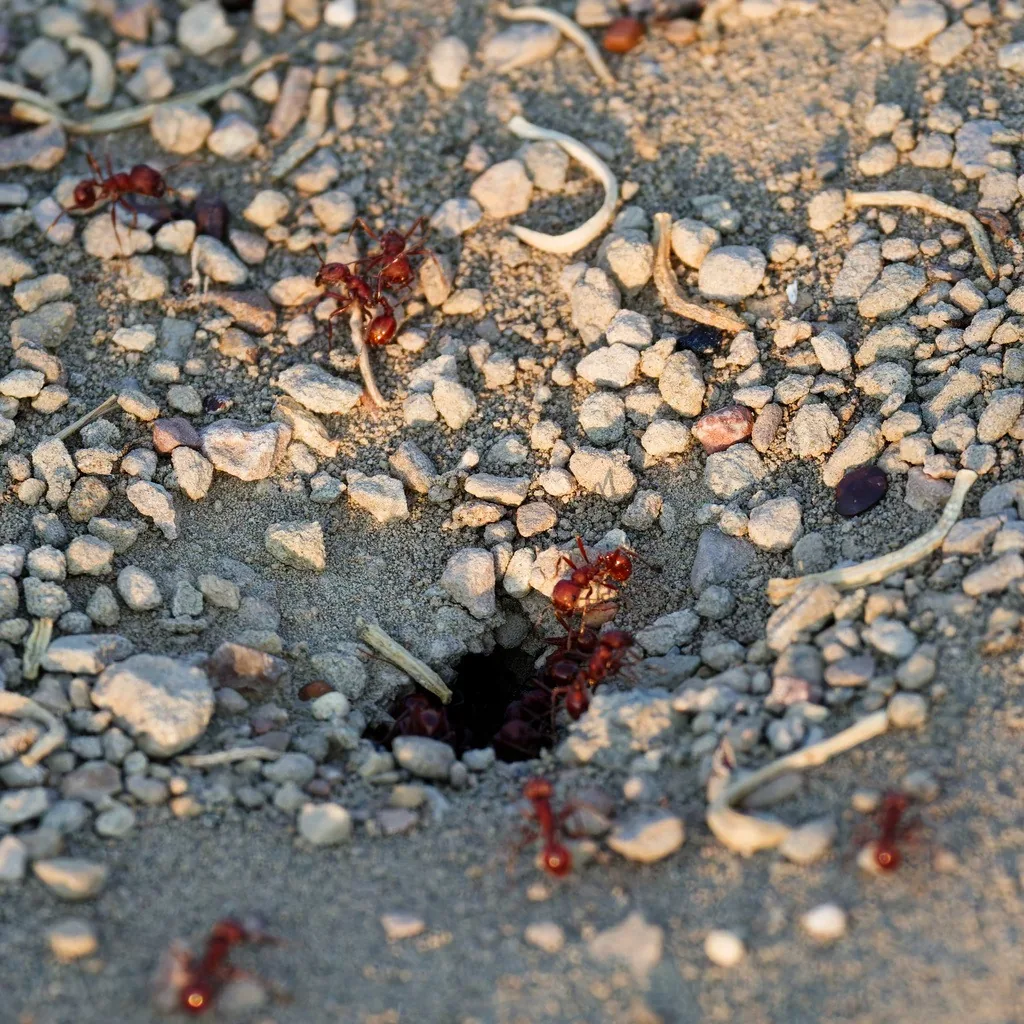
- Workers are moderately large ants, about 5 to 7 millimeters (roughly 1/5 to 1/4 inch) long, and reddish brown overall.[1]
- Their relatively large heads hold powerful jaws for cracking seeds, and brushy hairs on the front of the head help them carry food and other materials.[1]
- Look for the mound: broad and flat, built over a network of underground tunnels, often topped with small excavated pebbles and surrounded by a wide area cleared of plants. The main entrance most often faces southwest.[1]
Look-alikes
| Look-alike | How to tell them apart |
|---|---|
| Rough harvester ant | In Colorado, the rough harvester ant, found mainly in the southeast of the state, has a black head and thorax; the western harvester ant is reddish brown all over.[1] |
Where it lives
It is a grassland ant of open country. In Colorado, harvester ants are especially common on the eastern Plains and also live in the San Luis Valley and the grasslands of western Colorado, and the western harvester ant's swarming has been studied in Utah.[1][2]
Biology and life cycle
Harvester ants feed mainly on seeds, though they sometimes collect dead insects.[1]
The mound, its pebble covering and the cleared ring that keeps it from being shaded all help warm the nest.[1]
Winged males and would-be queens swarm to mate in summer, usually a few days after a heavy rain, and they gather at high points: swarms have been seen on hilltops, tall buildings, farmhouses and farm equipment, and mating balls have fallen down chimneys.[1]
Before a swarm, workers groom the winged ants outside the mound and guard them aggressively; a Utah study watched swarming and mating in July.[2]
Males die within 24 hours of leaving the colony. A newly mated queen breaks off her wings and lives on her flight muscles while she tries to found a colony, and if she succeeds she may live a decade or more as it grows.[1]
Newly mated queens probably ride on moving vehicles, which extends how far they disperse.[2]
Workers are long-lived and easy to keep in captivity, which is why harvester ants have long been sold in novelty ant farms for children.[1]
Across the harvester ant genus, the University of Arizona says nests are commonly three feet deep with one to three entrances, and workers usually gather one kind of seed until it runs out before switching to another.[4]
In Great Basin test plots, burning raised western harvester ant mound density by 126%, while the presence of seed-eating rodents cut it by 59%.[7]
Fun fact: in central Wyoming, places with more sage-grouse droppings also had more harvester ant mounds, and researchers call the ants ecosystem engineers of western rangelands.[8]
Damage and signs
Health risk
When the nest is directly disturbed, workers defend it vigorously and give very painful stings, though Colorado State says the stinger is relatively short and can't get through thicker skin. Researchers found the long-lasting pain comes from peptide toxins in the venom that act on sodium channels in pain-sensing nerves, toxins that appear to have evolved to deter vertebrates. The University of Arizona warns people who are allergic to insect stings to be especially careful. MedlinePlus advises washing a sting with soap and water, applying wrapped ice for 10 minutes on and 10 minutes off, and using an antihistamine or anti-itch cream if needed; call 911 for trouble breathing, swelling of the face or mouth, or throat tightness.[1][6][4][5]
Control
Prevention
Give mounds a wide berth, especially in summer when workers are guarding winged ants before a swarm; the ants sting when their nest is directly disturbed.[1][2]
Decide whether the nest needs treatment at all: the University of Arizona says only nests posing a threat to people or pets should be treated, and only after you have evaluated the situation.[4]
Pesticides
For a nest that must go, the University of Arizona recommends a pesticide bait labeled for harvester ants. The most common active ingredient is hydramethylnon, sold for example as Amdro Pro Fire Ant Bait; apply it in the hottest part of the day, when the ants are least active, and follow the label. Licensed applicators have access to other products.[4]
Where sources disagree
Worker size: Colorado State gives western harvester ant workers as about 5 to 7 millimeters; the University of Arizona, writing about harvester ants in general, says workers are usually between 1/4 and 1/2 inch.[1][4]
The stinger: Colorado State says the western harvester ant's stinger is short and can't get through thicker skin, while the University of Arizona notes some harvester ant species have barbed stingers that pull out when used, much like honey bees.[1][4]
Common questions
- Why is there a bare circle around the ant mound?
- Western harvester ants clear the plants around their mounds. The cleared ring, the low mound and its pebble covering keep the nest from being shaded and help warm it.[1]
- Do harvester ants sting?
- Yes, and painfully, mainly when their nest is directly disturbed. The stinger is short, so it can't get through thicker skin.[1]
- Why are swarms of winged ants on my roof after a summer rain?
- Harvester ants hold their mating flights in summer, usually a few days after a heavy rain, and the swarms head for high points such as hilltops, tall buildings and farmhouses.[1]
- How do I get rid of a harvester ant mound?
- Only treat a nest that poses a threat to people or pets. The University of Arizona says to use a pesticide bait labeled for harvester ants; the most common active ingredient is hydramethylnon (for example, Amdro Pro Fire Ant Bait). Apply during the hottest part of the day, when the ants are least active, and follow the label.[4]
- What should I do for a harvester ant sting?
- MedlinePlus says to wash the sting with soap and water, use wrapped ice 10 minutes on and 10 minutes off, and take an antihistamine or use an anti-itch cream if needed. Call 911 if the person has trouble breathing, swelling of the face or mouth, or throat tightness.[5]
Sources
- Colorado State University Extension (Western Colorado Insects), “Harvester Ants (Colorado Insects of Interest).” wci.extension.colostate.edu/wp-content/uploads/sites/14/2017/04/HarvesterAnts.pdf (accessed 2026-11-12)
- Great Basin Naturalist (Brigham Young University ScholarsArchive), “Swarming of the western harvester ant, Pogonomyrmex occidentalis (D. M. Allred, Great Basin Naturalist 40(2), Article 13, 1980; abstract).” scholarsarchive.byu.edu/gbn/vol40/iss2/13 (accessed 2026-11-12)
- iNaturalist, “Pogonomyrmex occidentalis taxon page (order and family).” www.inaturalist.org/taxa/69514 (accessed 2026-11-12)
- University of Arizona Cooperative Extension, “Harvester Ants (Backyard Gardener #16).” extension.arizona.edu/sites/extension.arizona.edu/files/attachment/HarvesterAnts.pdf (accessed 2026-11-12)
- MedlinePlus, U.S. National Library of Medicine, “Insect bites and stings (Medical Encyclopedia).” medlineplus.gov/ency/article/000033.htm (accessed 2026-11-12)
- Journal of Biological Chemistry (2024), via PubMed, “Peptide toxins that target vertebrate voltage-gated sodium channels underly the painful stings of harvester ants.” pubmed.ncbi.nlm.nih.gov/38110035/ (accessed 2026-11-12). Cited from the PubMed abstract.
- Oecologia (2024), via PubMed, “Rodent competition and fire alter patterns of mound and disk formation of western harvester ants.” pubmed.ncbi.nlm.nih.gov/39299969/ (accessed 2026-11-12). Cited from the PubMed abstract.
- Western North American Naturalist (2017), via PubMed, “An invertebrate ecosystem engineer under the umbrella of sage-grouse conservation.” pubmed.ncbi.nlm.nih.gov/37799165/ (accessed 2026-11-12). Cited from the PubMed abstract.