On this page
How to identify it
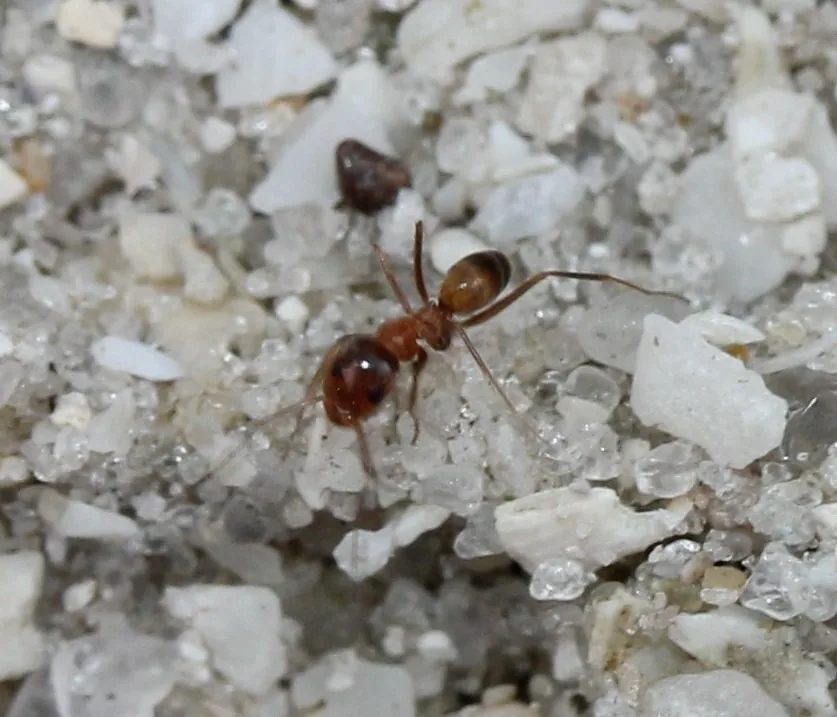
- Workers are about 1/8 inch long and all one size, with a pyramid-shaped projection on top of the thorax.[1][2]
- Color ranges from yellow or orange-brown to reddish with a black abdomen, or black, depending on the species.[1][2][3]
- They have a single node in the waist and 12-segmented antennae without a distinct club.[1][2]
- Workers move extremely fast and give off an unpleasant odor; several similar species exist, and D. bureni of the Southeast is used here as the example.[3]
- D. bureni workers are about 3.0 to 3.5 mm long, shiny yellowish orange to orangish brown with a brownish rear, and have long legs and antennae; queens are about 6.5 mm. Like other Dorymyrmex they have a cluster of long, curved hairs under the head.[3]
Look-alikes
| Look-alike | How to tell them apart |
|---|---|
| Red imported fire ant | Pyramid ants lack a sting and actually attack fire ant workers and newly mated queens, often leaving the bodies scattered around their crater.[3] |
| Red harvester ant | Pyramid ants often nest near other ants' nests, commonly right on the cleared ground around harvester ant nests.[1] |
| Other pyramid ants (Dorymyrmex) | D. flavopectus has longer antennae and a dark brown head and rear against a yellowish thorax; D. flavus is more western and usually has an angular hump on the thorax in profile.[3] |
Where it lives
Texas A&M says pyramid ants are widely distributed in the United States, probably more common in the South, and also occur in Mexico, South America and the West Indies. The Mississippi Entomological Museum calls D. bureni common in the Southeast and records it from Texas east to Florida and north to Maryland. GBIF holds about 15,000 US records of the genus since 1990 from 22 states, most from Florida, Arizona and Texas.[1][3][7]
Biology and life cycle
Colonies are usually small, with a single queen and a few hundred to a few thousand workers.[1]
Nests are dug in bare, sunny soil, often sandy, and the excavated soil forms a circular crater around the entrance; several colonies may sit close together.[1][3]
They eat live and dead insects and honeydew and prefer sweets.[2][3]
Winged ants swarm in summer; D. bureni mating flights happen on warm nights from spring through fall, sometimes after rain.[1][3]
D. bureni forages by day and can be seen on warm days all year, even in the hottest part of summer in Mississippi. Its crater is often littered with the bodies of insects it has killed, especially other ants.[3]
Mixed colonies of D. bureni and D. smithi occur; D. smithi is considered a temporary social parasite of D. bureni.[3]
In a field experiment in the Southeast, D. bureni tended aphids for honeydew only where fire ants had been suppressed. In the lab, colonies of native ants in its subfamily given honeydew plus insect prey had twice as many workers as colonies fed prey alone.[6]
Damage and signs
Health risk
Pyramid ants have no sting; Utah State notes they can bite, while Mississippi State reports D. bureni does not readily bite and is considered beneficial for its predatory habits.[2][3]
Control
Prevention
Mississippi State considers D. bureni beneficial because it preys on pest insects, including imported fire ants, so colonies away from the house can often be left alone.[3]
Keep them out
If ants are found indoors, follow them back to the foundation to find the entry point, and seal cracks and crevices.[2]
Biological control
Fire ant baits can let pyramid ants take over. In Texas trials, the native pyramid ant D. flavus became the dominant ant after a bait reduced fire ants, stayed at higher numbers for more than two years after the last treatment, and behaved aggressively toward fire ants, resisting their return.[4][5]
Pesticides
Because nest chambers are just below the surface, a colony can be treated by injecting a labeled insecticide directly into the entrance hole.[1][2]
Where workers are active but the nest can't be found, baits with a sweet attractant can work.[1][2]
Where sources disagree
Nest depth: Texas A&M says nest chambers sit just below the surface and Utah State calls nests small and shallow, while the Mississippi Entomological Museum says D. bureni colonies are relatively deep.[1][2][3]
Biting: Utah State says pyramid ants can bite; the Mississippi Entomological Museum says D. bureni does not readily bite.[2][3]
Swarming: Texas A&M says winged ants swarm in summer; the museum reports D. bureni mating flights on warm nights from spring through fall, busiest at dusk.[1][3]
Names: Texas A&M's page is headed D. bureni, but its distribution note names D. pyramicus.[1]
Common questions
- Do pyramid ants sting?
- No. Pyramid ants lack a sting, and Mississippi State notes D. bureni does not readily bite either.[3]
- Why is there a little sand volcano in my yard?
- In bare, sunny, sandy ground, a small crater of soil around a single hole is the typical nest entrance of pyramid ants.[1][3]
- Should I get rid of pyramid ants in my yard?
- Usually not if they're away from the house. The Mississippi Entomological Museum considers D. bureni beneficial, and in Texas trials a native pyramid ant helped hold off returning fire ants.[3][4]
Sources
- Texas A&M Center for Urban and Structural Entomology, “Pyramid Ant.” urbanentomology.tamu.edu/urban-pests/ants/pyramid/ (accessed 2026-11-11)
- Utah State University Extension, “Pyramid Ants (IPM nuisance pest notes).” extension.usu.edu/planthealth/ipm/notes_nuisance/pyramid-ants (accessed 2026-11-11)
- Mississippi Entomological Museum, Mississippi State University, “Dorymyrmex bureni (Trager), pyramid ant.” mem.org.msstate.edu/Researchtaxapages/Formicidaepages/genericpages/Dorymyrmex.bureni.htm (accessed 2026-11-11)
- Environmental Entomology, via PubMed, “Resurgence and persistence of Dorymyrmex flavus after reduction of Solenopsis invicta with a broadcast bait (Calixto et al. 2007).” pubmed.ncbi.nlm.nih.gov/17540063/ (accessed 2026-11-11). Cited from the PubMed abstract.
- Environmental Entomology, via PubMed, “Native ant responses to Solenopsis invicta reduction using broadcast baits (Calixto et al. 2007).” pubmed.ncbi.nlm.nih.gov/18284735/ (accessed 2026-11-11). Cited from the PubMed abstract.
- Oecologia, via PubMed, “Introduced fire ants can exclude native ants from critical mutualist-provided resources (Wilder et al. 2013).” pubmed.ncbi.nlm.nih.gov/23053235/ (accessed 2026-11-11). Cited from the PubMed abstract.
- Global Biodiversity Information Facility (GBIF), “Dorymyrmex (genus): US occurrence records since 1990 by state (GBIF occurrence search API).” api.gbif.org/v1/occurrence/search?taxonKey=1325593&country=US&hasGeospatialIssue=false&occurrenceStatus=PRESENT&year=1990%2C2026&facet=stateProvince&facetLimit=400&limit=0 (accessed 2026-11-11). State counts are records reported (iNaturalist research-grade, museum specimens, surveys), not abundance.
- iNaturalist, “Dorymyrmex bureni taxon page (order and family).” www.inaturalist.org/taxa/319444 (accessed 2026-11-11)