The short answer
- The abdomen: an acrobat ant's abdomen is heart-shaped when seen from above, and the ant raises it up over its body when disturbed. A carpenter ant has no heart shape; it has a fringe of hairs at the tip of the abdomen.[1][2][3][4][11]
- The size: acrobat ant workers are small, about 1/16 to 1/8 inch, and all the same size. Carpenter ant workers are among the largest ants, mostly 1/4 to 1/2 inch, and come in mixed sizes in one colony.[2][3][1][7][9]
- The side view: a carpenter ant has one node in its waist and an evenly rounded back. An acrobat ant has two nodes and a pair of spines on the rear of the thorax.[6][9][11][1][2][5]
- The wood: carpenter ants excavate moist, soft wood into smooth galleries. Acrobat ants often move into wood already damaged by moisture or other insects, such as old termite and carpenter ant galleries.[7][11][2][1]
Profiles on this site
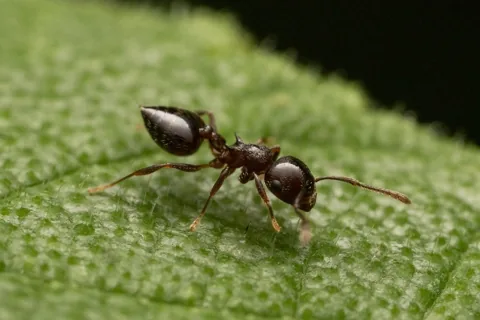 Acrobat Ants
Crematogaster species (e.g., C. lineolata)
Acrobat ants are small ants named for the way workers lift their heart-shaped abdomen up and over the rest of the body. Outdoors they live in trees, logs, firewood and under rocks, preferring wood softened by decay or fungi; indoors they favor framing that moisture or earlier insects have already damaged. When they nest in a house, UF/IFAS says, their presence points to wet or decaying wood.
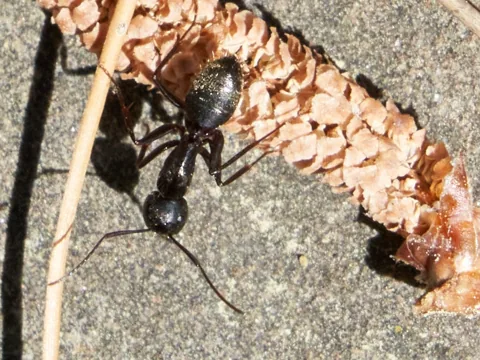 Carpenter Ants
Camponotus species
Carpenter ants don't eat wood the way termites do; they excavate it to nest, usually starting where wood is damp or decayed, and indoor nests are often satellites of a parent colony outdoors. Minnesota and Clemson extension both stress that they don't eat wood; they tunnel into it to make a nest.
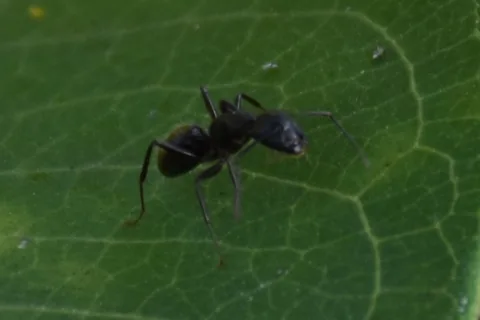 Black carpenter ant
Camponotus pennsylvanicus
The black carpenter ant is a common home invader in the northeastern United States and the most common carpenter ant in Ohio and Nebraska. Its large black workers come indoors looking for food, and colonies can set up satellite nests in moist or rotting wood and foam insulation inside the house.
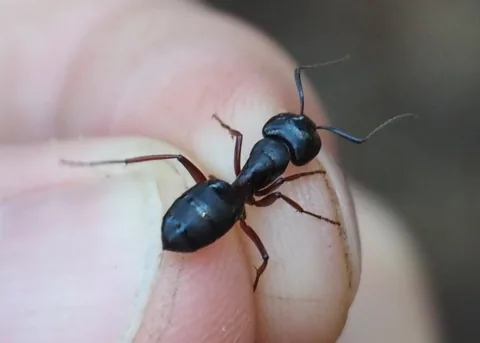 Western black carpenter ant
Camponotus modoc
The western black carpenter ant is a large black ant with dark red legs and one of the two most destructive carpenter ants in the western United States. It doesn't eat wood, but it hollows out galleries for its nest, often starting in wood that is already wet or decaying.
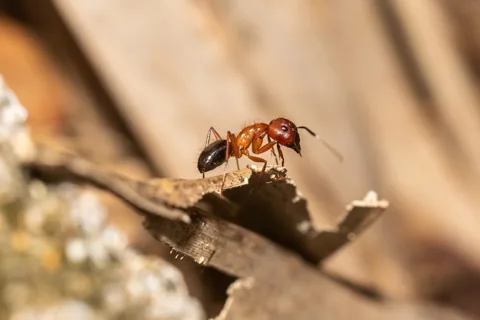 Florida Carpenter Ant
Camponotus floridanus
The Florida carpenter ant, called the bull ant in Florida for its strong bite, is a large two-toned carpenter ant of the Southeast and one of the more common ants found foraging and nesting in and around homes. UF/IFAS Featured Creatures calls carpenter ants one of the most common indoor insect pests in Florida and cites a survey of four Florida metropolitan areas in which Florida carpenter ants accounted for about 20% of all ant complaints by homeowners.
Side by side: acrobat ant and carpenter ant
Each line gives acrobat ants first (Crematogaster, most often Crematogaster lineolata in homes), then carpenter ants (Camponotus, such as the black carpenter ant, Camponotus pennsylvanicus).[1][6]
- Worker size: acrobat ants are 1/16 to 1/8 inch long (Clemson), just over 1/8 inch (NC State), or about 2.5 to 3.0 mm for Ashmead's acrobat ant (Mississippi Entomological Museum). Carpenter ant workers are 1/4 to 1/2 inch (Penn State, UC IPM, Texas A&M), with large workers up to 5/8 inch (Clemson).[2][3][5][7][9][6][10]
- Size within a colony: acrobat ant workers are all one size. Carpenter ant workers are polymorphic: minor workers of the black carpenter ant are about 1/4 inch and major workers about 1/2 inch.[1][2][6][11]
- Color: acrobat ants are light brown to dark brownish black, and some are two-toned with the abdomen darker than the rest of the body. Carpenter ants range from dull black to yellowish-red or black and dull red; the black carpenter ant is dull black all over with long yellow hairs on the abdomen.[1][2][3][6]
- Abdomen shape: heart-shaped in acrobat ants, best seen from above. Carpenter ants have no heart shape; look instead for a circle of hairs at the tip of the abdomen.[1][2][4][6][11]
- Posture: acrobat ants hold the abdomen up above the body and, when disturbed, bend it forward over the thorax and head.[2][3][1][5]
- Waist: two nodes in acrobat ants, with the second attached to the top of the abdomen. One node in carpenter ants.[1][2][5][6][9][11]
- Thorax from the side: acrobat ants have a pair of spines on the rear of the thorax. Carpenter ants have an evenly rounded, arched back.[2][5][6][9][11]
- Food: acrobat ants feed on honeydew from aphids and scales and on insects, and indoors on sweets and meats. Carpenter ants feed mainly on honeydew, and the workers forage for meats and foods with sugar and fat.[2][1][6][7]
- When you see them: carpenter ants forage mostly at night. Acrobat ants follow scent trails between food and the nest and often enter homes along utility lines and tree limbs.[7][10][11][3][2][4]
- Bite or sting: acrobat ants bite on occasion and give off an unpleasant odor when disturbed; NC State says they do not sting noticeably, and the Mississippi Entomological Museum says they can sting but are not a serious stinging pest. Carpenter ants cannot sting but can give a painful bite and spray formic acid into it.[2][3][5][9][6]
- Colony: acrobat ant colonies are usually small with one queen, though some reach thousands of workers. A single black carpenter ant colony may contain 15,000 workers.[1][6]
Nests, sawdust and damage
The biggest practical difference is what each ant does to wood. Carpenter ants do not eat wood, but they remove it to enlarge their nests. Acrobat ants nest in wood that is already soft, damaged or hollowed out, though they can tunnel through rotten wood much like carpenter ants.[6][8][2][3][4]
- Carpenter ant nests: the parent nest is in moist wood, often above 15 percent moisture from leaks, condensation or poor ventilation. Satellite nests can sit in drier spots such as insulation, hollow doors, sound wood and wall voids.[11][7][8]
- Carpenter ant galleries: smooth-sided and clean, with a sanded look, and no soil or fecal pellets inside.[7][8][11]
- Acrobat ant nests outdoors: decaying stumps, fallen trees and limbs, firewood, hollow stems and twigs, and under rocks.[1][2][3][4]
- Acrobat ant nests indoors: wall voids, baseboards and door and window framing, especially wood damaged by moisture or previously infested by other insects. They enlarge old termite and carpenter ant galleries, and rigid board insulation is another favorite site.[2][1][4]
- Debris: carpenter ants push out coarse, stringy wood particles mixed with dead insect parts, sifting from cracks in siding, behind moldings and in basements and attics. UC IPM notes this sawdust is fibrous, unlike the six-sided pellets of drywood termites. Acrobat ants also throw out debris, most visibly from rigid board insulation, and sawdust may collect at the entrance of an active nest.[7][9][2][3]
- Structural damage, carpenter ants: sources differ. Penn State says nests rarely cause structural damage, while UC IPM and Minnesota say nests can spread into sound wood and weaken it when damage is severe, and Clemson calls them a serious structural pest in the Southeast.[7][9][8][10]
- Damage, acrobat ants: an occasional structural pest. They have stripped insulation from electrical and telephone wires and caused short circuits, and Ashmead's acrobat ant has damaged insulated board and fiberboard.[2][5]
How to confirm which one you have
Clemson says successful control starts with correct identification. Collect a few workers and check these marks.[2]
- Look from above for the heart-shaped abdomen; that view shows it best.[2][1]
- Look from the side for the waist and the back: one node and a smoothly rounded back mean carpenter ant; two nodes and spines on the thorax mean acrobat ant.[6][9][11][2]
- Gently disturb a few workers. Acrobat ants raise the abdomen over the body.[1][2][3]
- Check sizes across several workers. Mixed large and small workers point to carpenter ants. Small workers that are all alike point to acrobat ants, but California's yellow and black carpenter ant, Camponotus clarithorax, is only a little over 1/8 to under 5/16 inch, so check the waist too.[6][2][9]
- For carpenter ants, watch foraging workers between sunset and midnight in spring and summer with a flashlight and follow them back to the nest.[8][7][10][6]
- Your county extension office can help identify a specimen. In South Carolina, Clemson's HGIC takes questions at 1-888-656-9988.[3][2]
Why the difference matters
A carpenter ant nest inside means a parent or satellite colony that may be enlarging galleries in the structure, and moisture is what draws and keeps them. Finding large numbers of winged carpenter ants indoors, from late winter through spring, is a sure sign of an indoor nest.[6][8][11]
Acrobat ants indoors usually point to wood that is already wet or damaged, or to an old termite or carpenter ant infestation, so Clemson advises looking for small holes, moisture damage and areas previously infested by other wood-nesting insects. Inside a home they may also be coming in from an outdoor nest.[2][1]
What to do for each
Texas A&M says the same treatment techniques used for carpenter ants work on acrobat ants. For both, finding and dealing with the nest is the most effective step, and for carpenter ants, removing moisture is essential because the parent nest needs it.[1][2][11]
- Fix leaks and moisture problems such as roof, flashing and plumbing leaks, blocked gutters and poorly ventilated attics or crawl spaces, and replace damaged or decaying wood with solid, dry lumber. This is the core of carpenter ant control, and acrobat ants also favor moisture-damaged wood.[11][6][7][2]
- For both: trim tree and shrub branches that touch the house, and seal cracks, gaps and openings for utility lines.[2][6][3]
- Carpenter ants: if you can't find the nest, slow-acting baits placed along foraging trails can work because workers share the food with the colony. Be patient, as baits can take weeks or months, swap a bait the ants ignore, and keep baits in childproof stations indoors.[8][11][9][10]
- Acrobat ants: baits may work where the ants are feeding; let them feed for several days, and keep food in sealed containers. If a nest can't be removed, sprays or dusts applied directly into the nest can work.[2]
- For both: do not spray where you are baiting. Clemson gives this for acrobat ants, and Ohio State says baiting should not be used where sprays or dusts have been applied.[2][11]
- Nests inside walls: a professional may drill small holes and puff insecticide dust into the nest voids. Indoors, Texas A&M says insecticides should go only into cracks, crevices and holes. Always follow the label.[8][6][1][2]
Common questions
- Can acrobat ants damage my house?
- Sometimes. They often use wood that is already damaged and can strip wire insulation and cause short circuits, but they can tunnel through rotten wood like carpenter ants.[2][5][4]
- Is a small ant with a heart-shaped abdomen a carpenter ant?
- No. The heart-shaped abdomen, which the ant raises over its body, is the mark of acrobat ants. Carpenter ants have one node and an evenly rounded back.[1][2][3][6][9]
- Do acrobat ants mean I have termites or carpenter ants?
- Not necessarily, but they often nest in moisture-damaged wood and in old termite or carpenter ant galleries, so it is worth inspecting the wood where you find them.[2][1]
- Do either of these ants sting?
- Carpenter ants cannot sting but can bite. Acrobat ants bite on occasion and have a weak sting that NC State says is not noticeable.[9][6][2][3][5]
- Are the treatments different?
- Not much. Texas A&M says carpenter ant methods work on acrobat ants. Both start with finding the nest and fixing moisture.[1][6][11]
Photo credits
- Acrobat Ants: (c) Emmett Collins-Sussman, some rights reserved (CC BY) — via iNaturalist, CC BY 4.0
- Carpenter Ants: (c) Linda Watson, some rights reserved (CC BY) — via iNaturalist, CC BY 4.0
- Black carpenter ant: (c) Zac Peterson, some rights reserved (CC BY) — via iNaturalist, CC BY 4.0
- Western black carpenter ant: (c) John G. Phillips, some rights reserved (CC BY) — via iNaturalist, CC BY 4.0
- Florida Carpenter Ant: (c) Richard Stovall, some rights reserved (CC BY) — via iNaturalist, CC BY 4.0
Sources
- Texas A&M AgriLife, Urban and Structural Entomology Program, “Acrobat Ant, Crematogaster sp..” urbanentomology.tamu.edu/urban-pests/ants/acrobat/ (accessed 2026-11-14)
- Clemson Cooperative Extension Home & Garden Information Center, “Acrobat Ants (HGIC 2400).” hgic.clemson.edu/factsheet/acrobat-ants/ (accessed 2026-11-14)
- NC State Extension, “Acrobat Ants.” content.ces.ncsu.edu/acrobat-ants (accessed 2026-11-14)
- University of Maine Cooperative Extension, “Acrobat Ants.” extension.umaine.edu/home-and-garden-ipm/fact-sheets/common-name-listing/acrobat-ant/ (accessed 2026-11-14)
- Mississippi Entomological Museum, Mississippi State University, “Crematogaster ashmeadi Mayr.” mississippientomologicalmuseum.org.msstate.edu/Researchtaxapages/Formicidaepages/genericpages/Crematogaster.ashmeadi.htm (accessed 2026-11-14)
- Texas A&M AgriLife, Urban and Structural Entomology Program, “Carpenter Ants, Camponotus sp..” urbanentomology.tamu.edu/urban-pests/ants/carpenter/ (accessed 2026-11-14)
- Penn State Extension, “Carpenter Ants.” extension.psu.edu/carpenter-ants (accessed 2026-11-14)
- University of Minnesota Extension, “Carpenter ants.” extension.umn.edu/insects-infest-homes/carpenter-ants (accessed 2026-11-14)
- University of California Statewide IPM Program, “Pest Notes: Carpenter Ants.” ipm.ucanr.edu/home-and-landscape/carpenter-ants/ (accessed 2026-11-14)
- Clemson Cooperative Extension Home & Garden Information Center, “Carpenter Ants.” hgic.clemson.edu/factsheet/carpenter-ants/ (accessed 2026-11-14)
- Ohio State University Extension, Ohioline, “Carpenter Ants (HYG-2063).” ohioline.osu.edu/factsheet/hyg-2063 (accessed 2026-11-14)