On this page
How to identify it
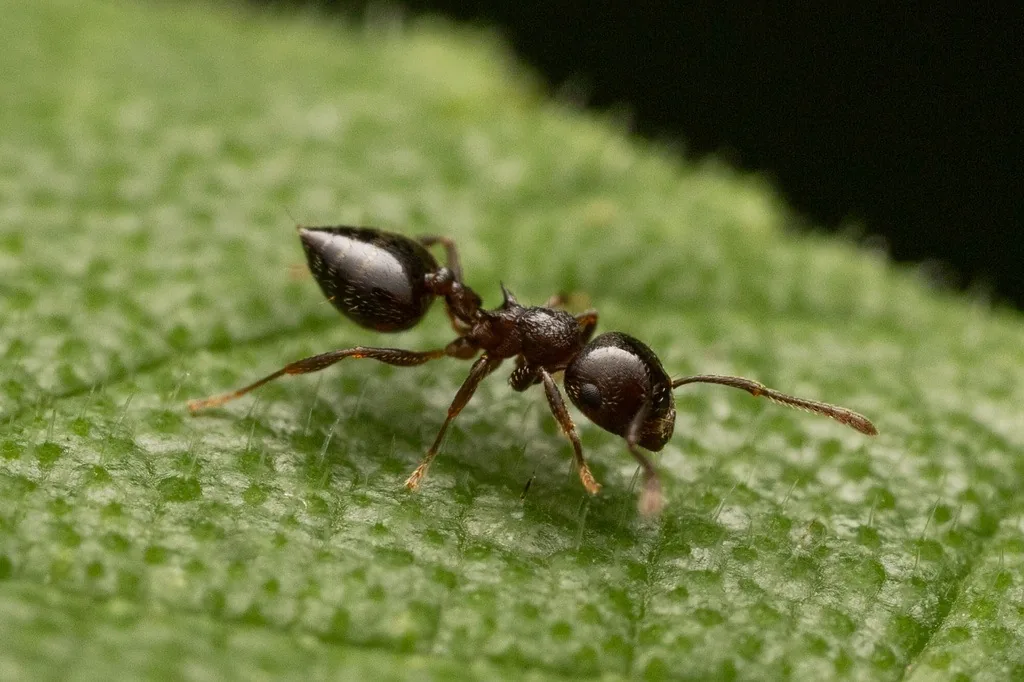
- Seen from above, the abdomen is heart-shaped. Workers raise it well above the body when disturbed, a defensive posture, and NC State says some species bend it so far forward over the thorax that they look like tiny spiders.[1][6][7]
- All the workers in a colony are about the same size. Clemson puts most species at 1/16 to 1/8 inch, NC State says just over 1/8 inch, and the Mississippi Entomological Museum (MEM) measures Ashmead's acrobat ant workers at about 2.5 to 3.0 mm. UF/IFAS measures Ashmead's acrobat ant at 2.6 to 3.2 mm and describes very shiny bodies from light red to brown or black.[6][7][3][4]
- Color varies. Texas A&M says light brown to dark brownish black; Clemson notes that a few species are two-toned, with the head or abdomen darker than the rest, and NC State says the abdomen is usually the darkest part.[1][6][7]
- Under a hand lens, look for a two-segmented waist and a pair of spines on the thorax. MEM adds that the waist attaches to the top of the abdomen, which separates this genus from the other ants in the region.[1][6][3]
- Sources count the antenna segments differently: Texas A&M describes 12-segmented antennae ending in a 3-segmented club, while MEM gives 11 segments with a 3-segmented club.[1][3]
- Several species occur in the US. Texas A&M says Crematogaster lineolata is the one most often found in homes, with C. ashmeadi, C. cerasi and C. clara among the eastern species and C. californica in the West. MEM lists C. ashmeadi, C. cerasi and C. pilosa as the pest acrobat ants of the Southeast.[1][2]
- Clemson says acrobat ants give off an unpleasant odor when disturbed and will bite on occasion.[6]
- UF/IFAS says there are perhaps 10 Crematogaster species in Florida and that they are hard to tell apart; Ashmead's acrobat ant can be picked out by the shiny sides of its pronotum and its generally dark color in live ants. The University of Maine notes another name for the group, Valentine ants, from the heart-shaped abdomen.[4][5]
Look-alikes
| Look-alike | How to tell them apart |
|---|---|
| Carpenter ants | Both can nest in soft or rotting wood, and NC State says acrobat ants may tunnel through soft wood much like carpenter ants. But acrobat ant workers are all one size and hold a heart-shaped abdomen up over the body, while carpenter ant workers come in several sizes and have a single node in the waist.[7][1][8] |
| Fire ants | NC State says acrobat ants look a little like fire ants but don't sting noticeably; their spatula-shaped stinger is used to wipe venom onto small prey. MEM says Ashmead's acrobat ant can sting but is not a serious stinging pest.[7][3] |
Where it lives
Acrobat ants occur throughout the United States, from the Pacific Coast to the Atlantic seaboard, and in the Rocky Mountains they have been found at 7,000 feet. The Mississippi Entomological Museum lists them as widespread in the Southeast, where Ashmead's acrobat ant is a common tree-nesting species in forests. UF/IFAS says Ashmead's acrobat ant is native to Florida, found in most counties and even on small mangrove islands in the Keys. The University of Maine says acrobat ants are more common in the Southeast than in the Northeast but still turn up there, especially in homes in wooded areas.[1][2][3][4][5]
Biology and life cycle
Most colonies are small with a single queen, though some grow to thousands of workers.[1]
New colonies start after mating flights; the queen picks decaying wood, a stump or a log, digs a cavity and raises the first workers herself.[1]
Winged males and females are usually reared in fall, according to NC State, and they often leave the nest in a swarm that looks like a cloud of gnats.[7]
Nests turn up in decaying stumps, fallen trees and limbs, logs and firewood, under rocks, and in old carpenter ant or termite galleries. NC State adds hollow stems and twigs; the ants narrow a large opening with a cardboard-like wall, and with no cavity available they build a carton nest on a branch.[1][6][7]
Their main food is honeydew from aphids, mealybugs and soft scales, along with live or dead insects. Indoors, Clemson says, they also feed on sweets and high-protein foods such as meat.[1][6][7]
Workers lay pheromone trails between food and the nest, and outdoors they build loose, coarse-fibered shelters over the scale insects they tend.[7]
Ashmead's acrobat ant, a common Southeastern species, is mainly a tree dweller that nests in trees, shrubs, vines and other cavities, MEM says.[3]
In north Florida's coastal plain pine forests, UF/IFAS says Ashmead's acrobat ant is the dominant tree-dwelling ant, making up 80%–90% of the ants there, and it is the most important food source for the endangered red-cockaded woodpecker.[4]
Each pine usually holds one colony, and the ants are so territorial that only one colony lives in a tree, though a large one may spread to up to three trees growing close together. Workers forage the full length of trees 30 to 40 m tall for living and dead insects and follow trail pheromone laid from the legs.[4]
A founding queen starts her colony alone in an abandoned wood-borer gallery in a dead branch of a longleaf pine sapling. After the first small workers arrive, she later moves with the brood to old termite galleries at or below ground level; colonies have one queen but may use several nest sites.[4]
Damage and signs
- Indoors they nest in wall voids, baseboards, insulation and the spaces around door and window frames, especially wood already damaged by moisture or other insects. Clemson says the rigid foam board insulation used in many newer homes is also a favored site. UF/IFAS adds decayed wood around porches and eaves outdoors, and indoors damp or rotting wood around windows and drain spouts.[1][6][4]
- The clearest sign of an indoor nest is the debris workers throw out, easiest to spot when they are living in foam board; NC State says sawdust may also collect at a nest entrance.[6][7]
- They sometimes strip the insulation from electrical and telephone wires and cause short circuits. MEM reports Ashmead's acrobat ants shorting out an air conditioner relay in Mississippi and rates the species an occasional structural pest.[6][3]
- In the landscape, NC State says acrobat ants are not pests of trees and shrubs themselves, but they protect scale insects and other insects that are.[7]
- UF/IFAS says acrobat ants do not nest in sound wood and do not damage trees themselves; they move into chambers other insects hollowed out. In houses they do minimal damage to wood, though the debris (frass) they push out can worry homeowners.[4]
- In a 1995 Florida survey cited by UF/IFAS, Ashmead's acrobat ant was the only Crematogaster species that showed up as a pest ant. It was found nine times, six of them indoors, so it is rated an occasional pest.[4]
Health risk
Acrobat ants are mainly an occasional nuisance. Clemson says they bite on occasion, and NC State says they don't sting noticeably. UF/IFAS says that, compared with other pest ants, they are usually of minimal nuisance to people.[3][6][7][4]
Control
Keep them out
Trim tree and shrub branches so they don't touch the house, and seal cracks in the foundation. Clemson says acrobat ants usually get in along utility lines, tree limbs, fences and decks, and also through small gaps around doors, windows and vents. UF/IFAS says control can usually be done by reducing access, and that cutting away branches and tree material touching the home further limits it.[6][7][4][5]
Sanitation
Keep food in tightly sealed containers so foragers have nothing to collect indoors.[6]
For colonies living in walls, UF/IFAS says to eliminate damp wood and other sources of moisture, often found around windows and drain spouts.[4]
Traps and physical control
Inspect inside and out, because ants seen indoors may come from an outdoor nest. Clemson calls nest removal the most effective approach; indoors, look for small holes, moisture damage, old insect galleries and piles of ejected debris.[6]
Removing rotten logs, stumps and dead branches near the home will usually remove the nest site and the problem, according to UF/IFAS.[4]
Pesticides
When a nest in the structure can't be removed, a spray or dust applied directly into it works. Texas A&M describes drilling small holes and dusting infested walls, the same method used for carpenter ants; Clemson suggests an aerosol with a straw attachment or a duster with a directional tip. UF/IFAS adds that injecting an insecticidal spray or dust into infested wall voids is the step to take if problems persist after moisture is fixed.[1][6][4]
Baits can work where the ants are feeding. Clemson says to make sure they are taking the bait, give them several days to carry it back to the nest, and not to spray where baits are set.[6]
Outdoors, Texas A&M says to treat colonies directly and to use a perimeter and foundation treatment to keep foragers out, and Clemson says nests in tree holes can be injected with a dust or aerosol. NC State notes that pyrethroids are very toxic to fish, so keep them away from pools, ponds and streams, and follow the label.[1][6][7]
When to call a professional
For a heavily infested area, Clemson says a perimeter treatment by a pest control professional may be needed.[6]
Common questions
- Why are they called acrobat ants?
- Workers hold their heart-shaped abdomen up over the rest of the body, especially when disturbed, which looks like an acrobat's balancing act.[1][6][7]
- Do acrobat ants damage wood like carpenter ants?
- Not usually in the same way. They prefer wood already softened by decay or fungi and often move into old termite and carpenter ant galleries. MEM calls Ashmead's acrobat ant an occasional structural pest, and Clemson says to check for moisture damage when hunting for an indoor nest.[6][3]
- Do acrobat ants bite or sting?
- Clemson says they bite on occasion and give off a repulsive odor when disturbed. They do have a stinger, but NC State says they don't sting noticeably.[6][7]
- Does finding acrobat ants indoors mean I have a moisture problem?
- Often, yes. UF/IFAS says acrobat ants nesting in a home infest damp or rotting wood, often around windows and drain spouts, or damp foam board and insulation, and that their presence indicates wet or decaying wood.[4]
Sources
- Texas A&M Center for Urban and Structural Entomology, “Acrobat Ant.” urbanentomology.tamu.edu/urban-pests/ants/acrobat/ (accessed 2026-11-14)
- Mississippi Entomological Museum, Mississippi State University, “Common Pest Ants of the Southeastern United States.” mem.org.msstate.edu/Researchtaxapages/Formicidaepages/faunal.lists/Common_Pest_Ants.html (accessed 2026-11-14)
- Mississippi Entomological Museum, Mississippi State University, “Crematogaster ashmeadi Mayr (species page).” mississippientomologicalmuseum.org.msstate.edu/Researchtaxapages/Formicidaepages/genericpages/Crematogaster.ashmeadi.htm (accessed 2026-11-14)
- University of Florida/IFAS Extension (Featured Creatures), “Acrobat Ant, Crematogaster ashmeadi Emery, EENY333/IN610 (Featured Creatures).” ask.ifas.ufl.edu/publication/IN610 (accessed 2026-11-14)
- University of Maine Cooperative Extension, “Acrobat Ants (Home and Garden IPM fact sheet).” extension.umaine.edu/home-and-garden-ipm/fact-sheets/common-name-listing/acrobat-ant/ (accessed 2026-11-14)
- Clemson Cooperative Extension Home & Garden Information Center, “Acrobat Ants (HGIC 2400).” hgic.clemson.edu/factsheet/acrobat-ants/ (accessed 2026-11-14)
- NC State Extension, “Acrobat Ants (PDIC factsheet, reviewed Oct. 2026).” content.ces.ncsu.edu/acrobat-ants (accessed 2026-11-14)
- Ohio State University Extension, “Carpenter Ants (HYG-2063).” ohioline.osu.edu/factsheet/hyg-2063 (accessed 2026-11-14)
- iNaturalist, “Crematogaster lineolata taxon page (order and family).” www.inaturalist.org/taxa/217741 (accessed 2026-11-14)