On this page
How to identify it
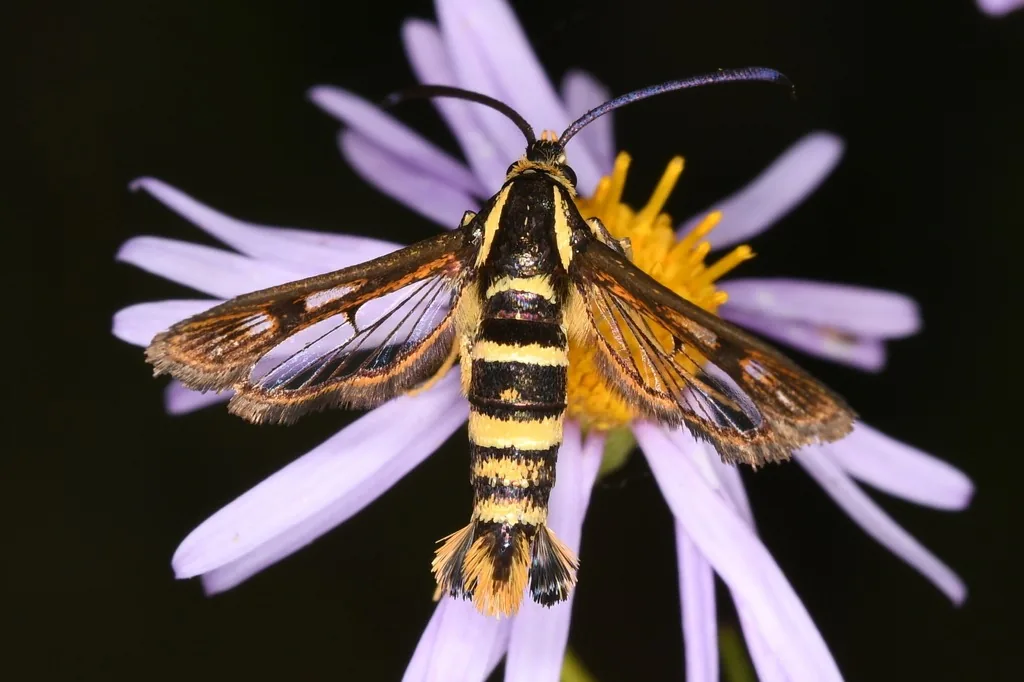
- Adults are 12 to 15 mm long, black with yellow markings, and look like yellowjackets. UC IPM says the body has two or three bright yellow marks on the thorax and abdomen and the wings are transparent.[1][2]
- Larvae are white with a brown head and 16 to 25 mm long when grown.[1][2]
- The eggs are brown, oval, sculpted on the surface and distinctly cupped on the sides.[1]
- Damaged plants separate easily from their roots at the crown when pulled, which sets this damage apart from root weevil injury.[1][2]
Look-alikes
| Look-alike | How to tell them apart |
|---|---|
| Yellowjackets | The adult moth strongly resembles a yellowjacket, black with yellow markings, but its wings are transparent clearwing moth wings.[1][2] |
| Root weevils | Plants hurt by crown moth larvae pull free from their roots easily; root weevil damage doesn't.[1] |
Where it lives
The Pacific Northwest handbook says it is native to the Pacific Northwest and has damaged strawberries in the northern Willamette Valley, most severely in Washington County, Oregon. Butterflies and Moths of North America gives its range as western North America from Montana south to Texas westward to the Pacific coast and from British Columbia to California. GBIF holds 818 U.S. records since 1990 from 11 states, the most from California (452), Oregon (150) and Washington (95).[1][3][4]
Biology and life cycle
Larvae overwinter in the crown, become active in April and May, and pupate after a short feeding period; Butterflies and Moths of North America says they resume feeding in spring, pupate and emerge about 23 days later, and UC IPM says adults emerge approximately 3 weeks after pupation.[1][2][3]
In Oregon's strawberry fields adults emerge in late June and July and lay eggs on leaves near the base of plants; Butterflies and Moths of North America gives a flight period of April thru August across the range. UC IPM says eggs hatch about 2 weeks later; young larvae feed on the crown's outside, then bore in.[1][3][2]
Hosts are in the rose family: Butterflies and Moths of North America lists strawberries (Fragaria), roses, raspberries and blackberries (Rubus) and cinquefoils (Potentilla).[3]
There's one generation a year, and damage is sporadic. The adults are low flyers.[1]
Damage and signs
Health risk
It feeds on strawberry crowns and roots. The Pacific Northwest handbook and UC IPM don't mention any risk to people or pets.[1][2]
Control
Prevention
The Pacific Northwest handbook says not to place new plantings next to infested fields, and that grain planted between a new and an infested field can block the low-flying moths.[1]
Sanitation
Remove and destroy stunted, early-reddening infested plants, which tend to occur in clumps, and replant the gaps. UC IPM adds: clean up any debris underneath plants.[1][2]
For larger beds, plow out infested plantings in August, September or October; thorough shredding of roots and crowns followed by deep plowing is needed to kill the larvae and pupae.[1]
Traps and physical control
In home gardens, cutting all the old leaves off June-bearers with hedge shears removes eggs and pushes fresh growth.[1]
Biological control
Beneficial nematodes are a research option: in a 2008 USDA-ARS study they infected most larvae in the lab but far fewer when applied in the field in October, when the soil was below the temperatures the nematodes need to establish.[5]
Pesticides
The Pacific Northwest handbook says chemical control has not proven effective and is not recommended for home use, and UC IPM says insecticides are usually not effective.[1][2]
More from the research literature
A 2008 Journal of Economic Entomology study by USDA-ARS researchers found that two beneficial nematodes, Steinernema carpocapsae and Heterorhabditis bacteriophora, infected 96% and 94% of strawberry crown moth larvae in lab tests, even inside the crown, but only 51% and 33% when applied in the field in October. The soil then averaged 11 °C a day, below the minimum establishment temperature of both nematodes for most of the period, and the authors say control in the field is likely to improve with applications in late summer to early fall, when larvae are in the soil and soil temperatures are more favorable.[5]
Where the sources disagree
Adult flight: the Pacific Northwest handbook says adults emerge in late June and July; Butterflies and Moths of North America gives a flight period of April thru August across the range.[1][3]
Where eggs go: the Pacific Northwest handbook says on leaves near the base of plants; UC IPM says on leaves or on the crown.[1][2]
Young larvae: the Pacific Northwest handbook says they feed on the outside of the crown before boring in; UC IPM says they feed on roots and the crown.[1][2]
Range: the Pacific Northwest handbook calls it native to the Pacific Northwest; Butterflies and Moths of North America describes a range from Montana to Texas and from British Columbia to California, and most GBIF U.S. records come from California.[1][3][4]
Common questions
- Why do my strawberry plants pull off at the crown?
- Strawberry crown moth larvae feed in the crown, so damaged tops separate easily from the roots.[1][2]
- What is the yellowjacket-like insect on my strawberries?
- It may be a strawberry crown moth, a clearwing moth that strongly resembles a yellowjacket.[1][2]
- Should I spray for strawberry crown moth?
- The Pacific Northwest handbook says chemical control has not proven effective and is not recommended for home use, and UC IPM says insecticides are usually not effective. Both advise removing infested plants, and UC IPM adds cleaning up debris under the plants.[1][2]
Sources
- Pacific Northwest Pest Management Handbooks (OSU, WSU, University of Idaho), “Strawberry: Strawberry crown moth (Insect Management Handbook).” pnwhandbooks.org/insect/small-fruit/strawberry/strawberry-strawberry-crown-moth (accessed 2026-11-13)
- University of California Statewide IPM Program, “Strawberry Crown Moth (Home and Landscape).” ipm.ucanr.edu/home-and-landscape/strawberry-crown-moth/ (accessed 2026-11-13)
- Butterflies and Moths of North America, “Strawberry Crown Moth, Synanthedon bibionipennis.” www.butterfliesandmoths.org/species/Synanthedon-bibionipennis (accessed 2026-11-13)
- Global Biodiversity Information Facility (GBIF), “Synanthedon bibionipennis: U.S. occurrence records since 1990 by state (GBIF occurrence API).” api.gbif.org/v1/occurrence/search?taxonKey=1940757&country=US&hasGeospatialIssue=false&occurrenceStatus=PRESENT&year=1990%2C2026&facet=stateProvince&facetLimit=400&limit=0 (accessed 2026-11-13). 818 records from 11 states; California 452, Oregon 150, Washington 95; fetched 2026-11-13.
- J Econ Entomol 2008;101(2):251-255, via PubMed, “Susceptibility of the strawberry crown moth (Lepidoptera: Sesiidae) to entomopathogenic nematodes.” pubmed.ncbi.nlm.nih.gov/18459385/ (accessed 2026-11-13)
- Global Biodiversity Information Facility (GBIF), “Synanthedon bibionipennis (Boisduval, 1869) (GBIF Backbone Taxonomy).” api.gbif.org/v1/species/1940757 (accessed 2026-11-13)
- iNaturalist, “Synanthedon bibionipennis taxon page (order and family).” www.inaturalist.org/taxa/319098 (accessed 2026-10-06)