On this page
How to identify it
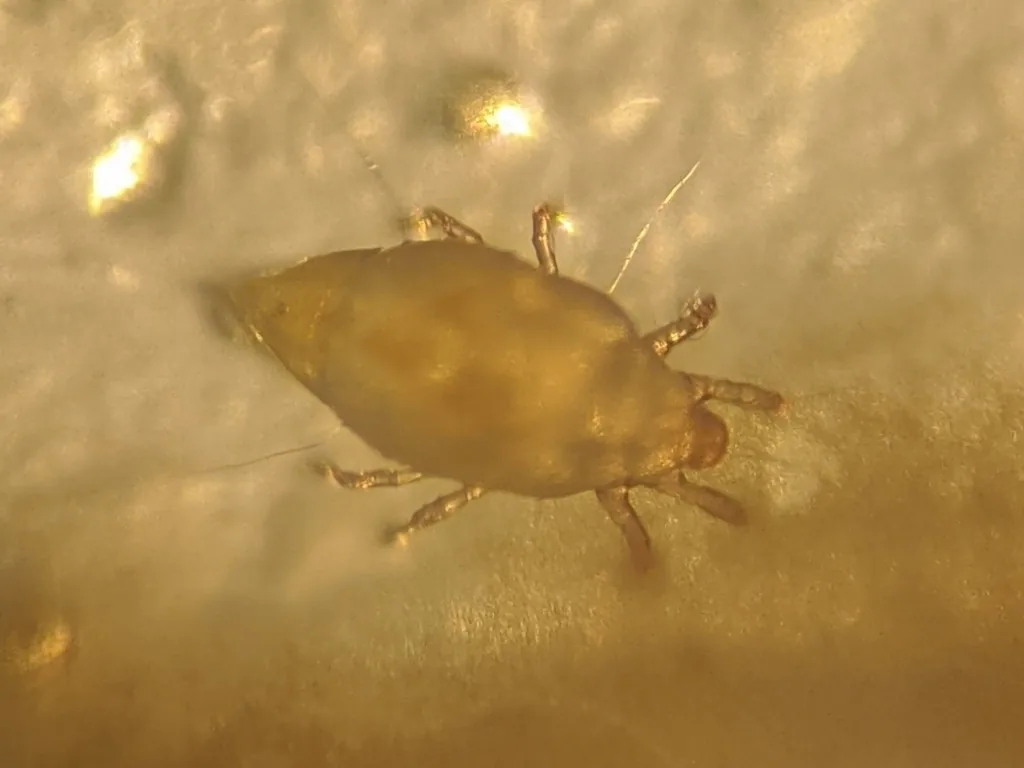
- Extremely small: USDA's stored-grain handbook says flour and grain mites are usually less than 1/50 inch long, and the Pacific Northwest handbook describes these mites as very small and light-colored, often with very long body hairs.[4][5]
- Individually they are barely visible without magnification, but large numbers can make the surface of infested food seem to move.[3][4]
- Heavy infestations leave a pale tan or light brown coating of mite dust, made of live and dead mites, shed skins and droppings, under and around the food.[3][1][5]
- Several similar species, such as the cheese mite, flour mite and grain mite, look alike and are hard to tell apart; they range from off-white and light yellow to brown.[2][4]
- UF/IFAS puts the mold mite, Tyrophagus putrescentiae, at about 0.28 to 0.41 mm long, with males smaller than females, and describes it as translucent and more slender than other mites.[6]
Look-alikes
| Look-alike | How to tell them apart |
|---|---|
| Booklice | Booklice are pale insects 1 to 2 millimeters long; USDA's handbook notes grain mites are much smaller. Booklice also feed on mold and thrive in humid rooms.[7][4] |
| Plaster beetles | Mildew-feeding beetles such as the minute brown scavenger beetle are about 2 millimeters long, while flour and grain mites are usually under 1/50 inch.[7][4] |
Where it lives
Found worldwide in stored products, bird nests, bee nests and mushrooms, wherever humidity is high; a 2024 genome study calls Tyrophagus putrescentiae a global species common in human-made habitats. UF/IFAS also lists small mammal nests and calls the species worldwide in distribution.[1][8][2][6]
Biology and life cycle
They develop only where there is moisture or high humidity, because they feed on molds and fungal spores; they are not predators or parasites.[1][2]
Numbers can climb fast. USDA's handbook says the grain mite, a close relative with similar habits, can go from egg to adult in slightly over 2 weeks under favorable conditions. For Tyrophagus putrescentiae itself, UF/IFAS says the life cycle can be as short as two to three weeks at optimum temperature and humidity.[4][6]
Tyrophagus putrescentiae favors foods rich in fat and protein, such as seeds, nuts, cheese and dried meats. UF/IFAS calls it a pest of stored products with a relatively high fat content and lists ham, cheese, flour, herring meal, grain, seeds, bulbs, straw, dried fruits and nuts, cereal foods, mushrooms and copra.[1][6]
Infestations have also been reported in wallpaper, furniture, straw and bulbs, always where humidity is high.[2]
The mite can walk through very tight spaces, such as the threads of screw caps, according to the 2024 genome study.[8]
UF/IFAS notes that T. putrescentiae is not the only mite living on mold in stored products, and that many of the others have similar habits.[6]
Damage and signs
- They infest flour, cereals, baking mixes, dried fruit, grain, bird seed and dry pet food. Iowa State says they can cause tremendous losses in stored food and grain, though they are usually just a nuisance. UF/IFAS likewise says mold mites are very common but usually go unnoticed until they become abundant, when they can cause tremendous losses.[3][1][2][6]
- Large numbers in grain cause sweating and leave a disagreeable odor, according to USDA's handbook.[4]
- Iowa State notes they don't harm furniture, house structures or clothing.[2]
- In barns they infest moldy hay and stored grain; the mites themselves aren't considered a hazard to animals, but the mold may produce toxins that poison animals eating the feed.[3]
Health risk
Only peer-reviewed sources are used here. A 2024 genome study says Tyrophagus putrescentiae, the mold mite, causes allergies, and a 2014 dermatology review lists grocer's itch among skin diseases associated with mites other than scabies mites. A 2025 European Academy of Allergy and Clinical Immunology task force report says allergy to storage mites is commonly reported in farm and food processing jobs and typically causes rhinitis and asthma. Eating foods made with mite-contaminated wheat flour can cause oral mite anaphylaxis, also called pancake syndrome: allergy reviews describe a severe, potentially lethal allergic reaction in allergy-prone (atopic) people, observed more often in tropical and subtropical areas. For pets, a 2019 veterinary review says storage mites, especially Tyrophagus putrescentiae, can multiply on protein- and fat-rich dry dog food, and that Tyrophagus mites can worsen allergy signs in laboratory dogs already sensitized to house dust mites.[8][9][10][11][12][13]
Control
Prevention
Fix the dampness first: lowering humidity and moisture where food is stored matters more than any other step. The Pacific Northwest handbook suggests a dehumidifier if needed.[1][2][5]
Buy susceptible foods in small amounts, store them in sealed containers with tight lids (the Pacific Northwest handbook prefers screw-type lids), and improve air circulation to keep mold from growing. A 2009 allergy review notes that storing wheat flour at low temperatures in the refrigerator has been recommended to prevent mite growth and oral mite anaphylaxis.[3][5][12]
For dry pet food, a 2019 veterinary review says storage mites do not bore holes in food packages but get into bags through defective seals, and multiply more when bags are kept warm and humid; it recommends keeping commercial dry pet food indoors and sealed.[13]
Sanitation
Throw out infested food and check what's left. Vacuum shelves and cracks, wipe them with hot soapy water, and let them dry completely before restocking.[3][1]
Seal the vacuumed debris in a plastic bag and dispose of it right away, and keep dry pet food in tight containers away from the pantry.[1][3]
Traps and physical control
Food you suspect may be infested can be treated with cold or heat, but the recommended settings differ. The Bohart Museum says put it in a freezer for a week or heat it to 54°C (120°F) for 20 minutes; the Pacific Northwest handbook says 0°F for seven days in a deep freeze, 140°F for 30 minutes in an oven using a shallow pan, or 5 minutes in a microwave.[1][5]
Pesticides
WSU says pesticides are not recommended in or near food storage areas and foods should never be sprayed. Iowa State says household sprays help only if they reach the source, and give temporary relief unless the moisture is corrected.[3][2]
When to call a professional
If a severe infestation persists after cleanup, call a pest management professional.[3]
Mold mites, booklice and plaster beetles share one cause
Mold mites, booklice and mildew-feeding beetles all feed on mold, so finding any of them points to a humidity problem.[7][2]
Texas A&M recommends sanitation, moisture reduction and better ventilation for mildew-feeding insects, noting that pesticides generally provide little control.[7]
In new homes with central heating or air conditioning, several weeks of drying out may be needed before a mildew-feeder infestation runs its course.[7]
Booklice can usually be controlled by bringing relative humidity below 58 percent, and Iowa State likewise puts removing humidity first against mold mites.[7][2]
Where the sources disagree
Freezing and heating: the Bohart Museum says a week in a freezer or 20 minutes at 54°C (120°F), while the Pacific Northwest handbook says seven days at 0°F, 30 minutes at 140°F in a shallow pan, or 5 minutes in a microwave.[1][5]
Pesticides: WSU says pesticide use is not recommended in or near food preparation and storage areas; the Pacific Northwest handbook says that if a pesticide is needed in the storage area, spot-treat cracks and crevices only; Iowa State says household sprays or fogs help only if they reach the source of the mites; Texas A&M says pesticides generally give little control of mildew-feeding insects.[3][5][2][7]
How much damage: Iowa State says they can cause tremendous losses in stored food and grain but are more usually a nuisance and damage is usually very slight, while USDA's handbook says large numbers of grain mites promote sweating, give grain a disagreeable odor and may damage it by feeding.[2][4]
Animals: WSU says the mites themselves are not considered a health hazard to animals eating infested feed, though the molds may produce toxins, while a 2019 veterinary review says Tyrophagus mites can worsen allergy signs in laboratory dogs sensitized to house dust mites.[3][13]
Color: Iowa State says mold mites can be brown, off-white or light yellow, USDA's handbook calls flour and grain mites pale grayish white, and the Pacific Northwest handbook calls them light-colored. UF/IFAS describes Tyrophagus putrescentiae as translucent.[2][4][5][6]
Common questions
- What is the brown dust under my flour or pet food?
- It may be mite dust, a tan layer of living and dead mites and their waste that builds up under heavily infested food.[3][1]
- Can I save food that might have mold mites?
- Throw out anything visibly infested. Food that only might be infested can be frozen (for a week per the Bohart Museum, or seven days at 0°F per the Pacific Northwest handbook) or heated: 120°F for 20 minutes per the Bohart Museum, or 140°F for 30 minutes per the Pacific Northwest handbook.[1][5]
- Do mold mites bite?
- No. The Bohart Museum says mold mites are not predators or parasites; they feed on fungal spores and the mold growing on damp products. UF/IFAS agrees that they feed on molds and are common only where mold and fungi can flourish.[1][6]
Sources
- Bohart Museum of Entomology, University of California, Davis, “Mold Mites (Information No. 042).” bohart.ucdavis.edu/sites/g/files/dgvnsk4616/files/media/documents/note_39_mold_mites.pdf (accessed 2026-11-13)
- Iowa State University Extension and Outreach, “Mold Mites (Yard and Garden encyclopedia).” yardandgarden.extension.iastate.edu/encyclopedia/mold-mites (accessed 2026-11-13)
- Washington State University Extension, PestSense, “Mites in stored foods (PestSense fact sheet, reviewed December 30, 2025).” pestsense.cahnrs.wsu.edu/fact-sheet/mites-in-stored-foods/ (accessed 2026-11-13)
- U.S. Department of Agriculture, Agricultural Research Service, “Stored-Grain Insects, Agriculture Handbook No. 500.” www.ars.usda.gov/ARSUserFiles/2863/pdfdocuments/StoredGrainInsects.pdf (accessed 2026-11-13)
- Pacific Northwest Pest Management Handbooks (Oregon State University, Washington State University, University of Idaho), “Nuisance and household pests: Cheese mite, grain mite, and mold mite.” pnwhandbooks.org/insect/structural-health/nuisance-household/nuisance-household-cheese-mite-grain-mite-mold-mite (accessed 2026-11-13)
- University of Florida IFAS, Entomology and Nematology Department, “Mold mite, Tyrophagus putrescentiae (UF/IFAS Stored Product Pests Photographs CD-ROM).” entnemdept.ufl.edu/projex/gallery/dl/Stored_Product_Pests/text/mold_mite.htm (accessed 2026-11-14)
- Texas A&M AgriLife Extension Service, “Mildew-Feeding Insects in the Home (Insects in the City).” citybugs.tamu.edu/factsheets/household/misc-house/ent-2010/ (accessed 2026-11-13)
- International Journal for Parasitology, via PubMed, “Genomic and metagenomic analyses of the domestic mite Tyrophagus putrescentiae (Klimov et al. 2024).” pubmed.ncbi.nlm.nih.gov/38992783/ (accessed 2026-11-13)
- Seminars in Cutaneous Medicine and Surgery, via PubMed, “Dermatoses associated with mites other than Sarcoptes (2014).” pubmed.ncbi.nlm.nih.gov/25577848/ (accessed 2026-11-13)
- Allergy (via PubMed), “Occupational Mite Allergy and Asthma: An EAACI Task Force Report (Suojalehto et al. 2025) (abstract).” pubmed.ncbi.nlm.nih.gov/40799117/ (accessed 2026-11-13)
- Current Opinion in Allergy and Clinical Immunology, via PubMed, “Oral mite anaphylaxis: who, when, and how? (2020).” pubmed.ncbi.nlm.nih.gov/31977450/ (accessed 2026-11-13)
- World Allergy Organization Journal, via PubMed, “Pancake syndrome (oral mite anaphylaxis) (2009).” pubmed.ncbi.nlm.nih.gov/23283016/ (accessed 2026-11-13)
- BMC Veterinary Research (via PubMed), “Critically Appraised Topic on Adverse Food Reactions of Companion Animals (8): Storage Mites in Commercial Pet foods (Olivry and Mueller 2019) (abstract).” pubmed.ncbi.nlm.nih.gov/31672139/ (accessed 2026-11-13)
- Global Biodiversity Information Facility (GBIF), “Tyrophagus putrescentiae (Schrank, 1781) (GBIF Backbone Taxonomy).” api.gbif.org/v1/species/2181932 (accessed 2026-11-13)