On this page
How to identify it
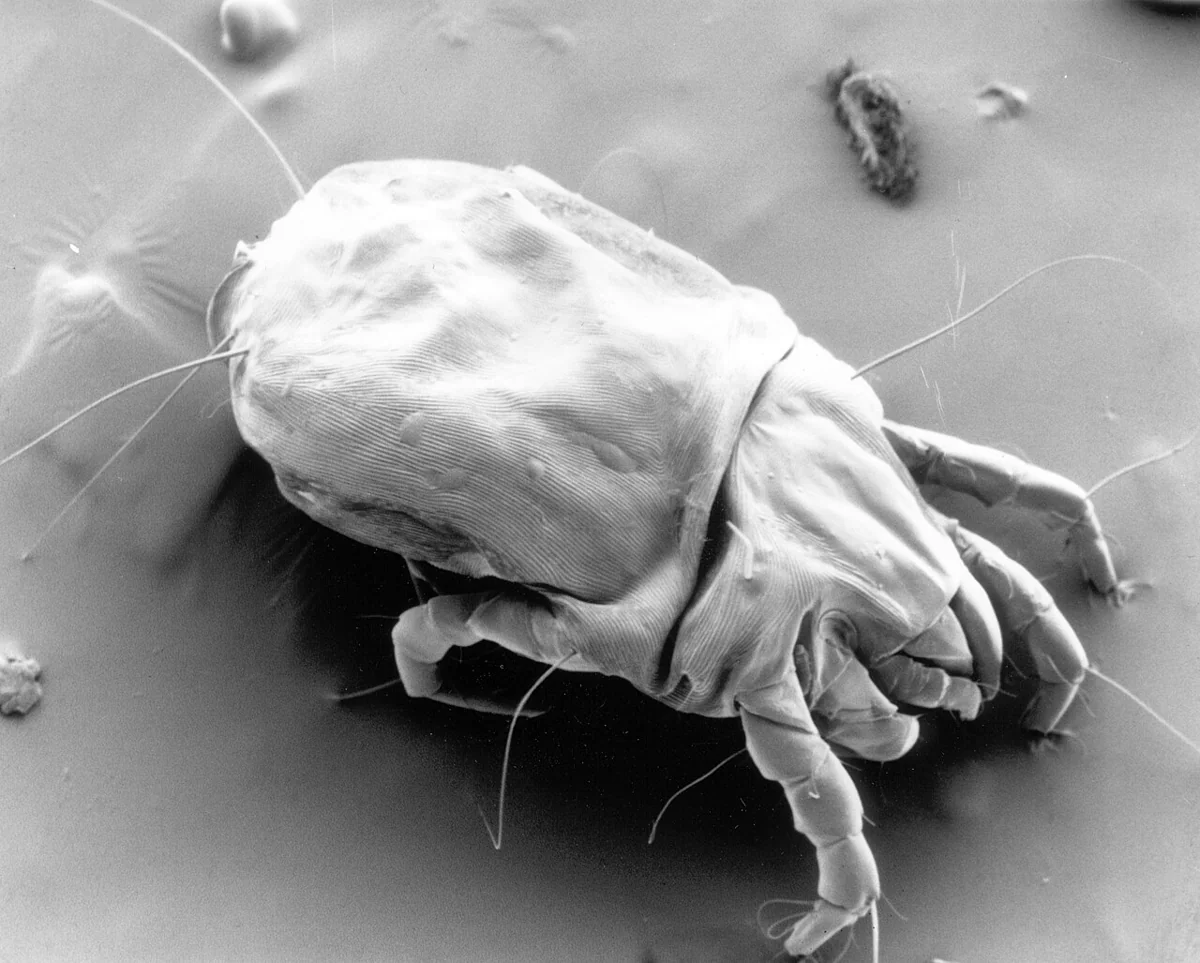
- Adults are only about 0.5 mm long, and the young are smaller still, so they can generally be seen only with a microscope.[1][5]
- Under magnification they are globular and clear to creamy white, with hairs on the legs and body.[1]
- Two species are common in U.S. homes: the North American house dust mite, Dermatophagoides farinae, and the European house dust mite, D. pteronyssinus. Worldwide, Euroglyphus maynei and the storage mite Blomia tropicalis also matter, and most homes hold more than one species.[1][8]
- You won't spot them by looking; a dust sample under a microscope confirms mites.[1]
- For the allergy itself, see a doctor: allergy testing, most often a skin test or, when that isn't possible, a blood test, shows what you react to.[2][6]
Where it lives
Found in homes worldwide wherever indoor humidity is high enough; they are rare or absent in dry climates unless humidity is raised. In the U.S., most homes probably have detectable levels, and a national survey found mite allergen in the beds of 84.2 percent of homes, with lower levels in the West.[8][1][7]
Biology and life cycle
They do best at about 75 to 80 degrees F and 70 to 80 percent relative humidity. They absorb and lose water through their skin and dry out easily.[1]
Humidity is the key to their survival. Below about 50 percent relative humidity they don't survive well, and in dry climates they are rare or absent unless indoor humidity is raised.[1][8]
They are most numerous in beds, overstuffed sofas and chairs, and nearby carpet, where skin flakes and moisture from sleeping and sitting people build up.[1][5]
They pass through five stages: egg, larva, protonymph, tritonymph and adult. In ideal conditions egg to adult takes about one month; adults live about 1 to 2 months, and a female lays about 50 eggs.[1]
Thousands of mites can be found in a single gram of dust, and an infested mattress can hold millions.[1]
Damage and signs
Health risk
Dust mite body parts and droppings can trigger asthma attacks in people allergic to them, and exposure can cause asthma in children who had no symptoms before. Dust allergy shows up as runny nose, sneezing, watery eyes, itching and coughing.[3][4][5][6]
Control
Prevention
Encase mattresses, box springs and pillows in zippered dust-proof, allergen-impermeable covers.[2][4][5][1]
Keep indoor humidity low with a dehumidifier or air conditioner: NIEHS says at or below 50 percent, CDC around 30 to 50 percent.[2][4][1]
Especially in bedrooms, swap wall-to-wall carpet, fabric curtains and slatted blinds, and upholstered furniture for hard floors, pull-down shades and wood, leather or vinyl. Skip down-filled pillows and comforters and choose washable stuffed toys.[2][5][4][1]
Sanitation
Wash sheets, blankets and pillowcases weekly in hot water, 130 to 140 degrees F, and dry them completely. NIEHS says non-washable bedding can be frozen overnight.[2][5][3]
Traps and physical control
Vacuum with a HEPA filter or double-layer microfilter bag and dust with a damp cloth, never a dry one. People with allergies should stay out of the room while it's vacuumed; NIEHS suggests waiting 20 minutes for dust to settle.[3][2][4]
HEPA filters in the heating and cooling system or in portable bedroom air cleaners can trap airborne particles, though Kentucky notes the benefit of portable units may be marginal.[1][5]
Pesticides
Mite-killing carpet treatments with benzyl benzoate exist; Kentucky treats them only as a supplement to bedding covers and furnishing changes, not a substitute.[1]
When to call a professional
A doctor can test for dust mite allergy. Medicines such as antihistamines and inhaled steroids give short-term relief, and allergy shots or under-the-tongue tablets (immunotherapy) may give longer-term control.[2][6]
How common are dust mites in U.S. homes?
A national survey of 831 U.S. homes found detectable dust mite allergen in a bed in 84.2 percent of them, and levels linked to allergic sensitization and asthma were common. Older homes, homes outside the West, single-family homes, musty or mildew odor and higher bedroom humidity all predicted higher levels.[7]
Mite species and allergen levels differ by region, from home to home, and even between rooms, and are generally low in public buildings and transportation compared with homes.[8]
Where sources disagree
Does every home have them? EPA says every home has dust mites. Kentucky says most U.S. homes probably have detectable levels, a national survey found mite allergen in 84.2 percent of beds, and a review notes mites are rare or absent in dry climates unless humidity is raised.[3][1][7][8]
Target humidity: NIEHS and Kentucky put the line at 50 percent or below; CDC suggests keeping humidity around 30 to 50 percent.[2][1][4]
Does cleaning help? EPA advises vacuuming carpets and furniture every week. Kentucky says vacuuming and cleaning have not shown much benefit in reducing mite numbers, though they remove some dust and dander. A 2025 meta-analysis of 17 randomized trials found avoidance measures cut dust and mite allergen levels but not enough to improve asthma, allergic rhinitis or quality of life.[3][1][9]
Common questions
- Can I get rid of dust mites completely?
- No. NIEHS says dust mites can't be completely eliminated from any home, no matter how clean, but their numbers can be reduced.[2]
- Do dust mites bite?
- No. House dust mites aren't parasites and can't bite or sting. They cause problems only through the allergens they leave behind.[1]
- Will air duct cleaning get rid of dust mites?
- Probably not. Kentucky doubts air ducts are humid enough for dust mites to breed, so duct cleaning is secondary to bedding covers, humidity control and furnishing changes.[1]
- Does washing bedding in hot water kill dust mites?
- Yes, NIEHS says weekly washing in water at 130 to 140 degrees F kills dust mites; MedlinePlus gives the same temperature range.[2][5]
Sources
- University of Kentucky Entomology, “ENTFACT-646: House Dust Mites (revised March 2026).” entomology.ca.uky.edu/ef646 (accessed 2026-11-11)
- National Institute of Environmental Health Sciences, NIH, “Dust Mites and Cockroaches (Allergens).” www.niehs.nih.gov/health/topics/agents/allergens/dustmites (accessed 2026-11-11)
- U.S. Environmental Protection Agency, “Asthma Triggers: Gain Control (Cockroaches and Pests; Pets; Chemical Irritants).” www.epa.gov/asthma/asthma-triggers-gain-control (accessed 2026-11-11)
- Centers for Disease Control and Prevention, “Controlling Asthma (asthma triggers).” www.cdc.gov/asthma/triggers.html (accessed 2026-11-11)
- MedlinePlus, U.S. National Library of Medicine, “Allergies, asthma, and dust (Medical Encyclopedia).” medlineplus.gov/ency/patientinstructions/000487.htm (accessed 2026-11-11)
- MedlinePlus, U.S. National Library of Medicine, “Allergic rhinitis (Medical Encyclopedia).” medlineplus.gov/ency/article/000813.htm (accessed 2026-11-11)
- Journal of Allergy and Clinical Immunology, via PubMed, “House dust mite allergen in US beds: results from the First National Survey of Lead and Allergens in Housing (Arbes et al. 2003).” pubmed.ncbi.nlm.nih.gov/12589364/ (accessed 2026-11-11)
- Current Allergy and Asthma Reports, via PubMed, “Dust mite allergens: ecology and distribution (Arlian et al. 2002).” pubmed.ncbi.nlm.nih.gov/12165207/ (accessed 2026-11-11)
- International Forum of Allergy & Rhinology, via PubMed, “Are there effective methods to reduce exposure to house dust mite allergens? A meta-analysis of randomized clinical trials (Sobczak et al. 2025).” pubmed.ncbi.nlm.nih.gov/40089899/ (accessed 2026-11-11)
- iNaturalist, “Dermatophagoides farinae taxon page (order and family).” www.inaturalist.org/taxa/262970 (accessed 2026-11-11)