On this page
How to identify it
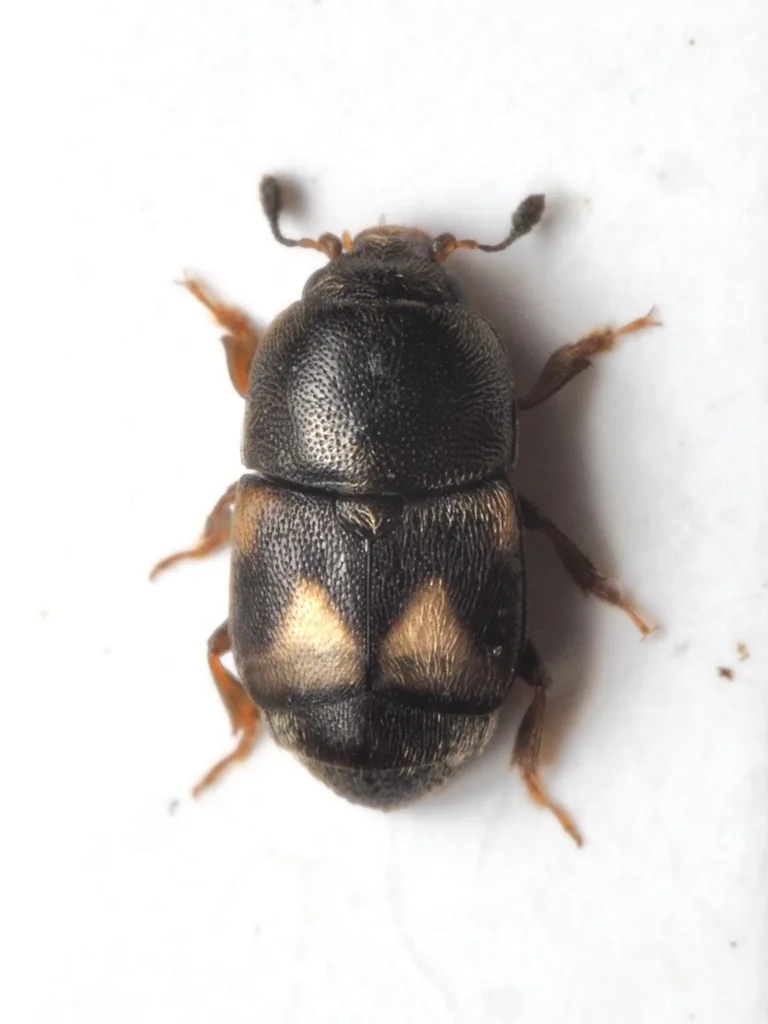
- Adults are small brown or black beetles, 1/10 to 1/5 inch long, with clubbed antennae. Depending on the species, driedfruit beetles may or may not have lighter spots on the wing covers. Purdue describes the dried fruit beetle itself as oval and black, 3 to 4 mm (1/8 inch) long, with two large yellow-brown spots on the wing covers that sometimes run together into one.[1][2][4]
- The wing covers are short and leave the last two or three abdominal segments exposed, as in other Carpophilus sap beetles. Purdue says very short wing covers that leave the tip of the abdomen showing mark a beetle as a sap beetle.[2][5][4]
- Larvae are white and 1/10 to 1/5 inch long when grown, with a tan head, three pairs of true legs and two hornlike projections at the tail end.[1][2]
Look-alikes
| Look-alike | How to tell them apart |
|---|---|
| Corn sap beetle and other sap beetles | The corn sap beetle is dark brown with lighter wing covers, 1/10 to 1/8 inch long, and breeds in damp, decaying grain. Picnic beetles are larger, about 1/4 inch, and black with four orange-rust spots. All sap beetles have a knob-like club at the tip of the antennae. Purdue gives the corn sap beetle as 2 to 3.5 mm and says it lacks the dried fruit beetle's yellow-brown spots.[5][6][4] |
| Dusky sap beetle | UF/IFAS describes it as about 2.8 mm (about 1/8 inch) long, uniform dull black and short-winged, with no spots; it is the main sap beetle on sweet corn.[7] |
Where it lives
It will infest any ripe or fermenting fruit, and it is the most common driedfruit beetle in California fig orchards and a key pest of dates. GBIF's 1990-2026 U.S. records are few and come mostly from California, then Utah, New Mexico, Hawaii and Arizona.[2][3][8]
Biology and life cycle
Eggs are laid on ripe and rotting fruit and hatch in 1 to 5 days, and the larvae feed as they move through the fruit. Purdue says eggs are laid singly, in the field or in stored products.[1][4]
Grown larvae enter the soil and pupate in earthen cells. Adults mate soon after they emerge and begin laying eggs 1 to 8 days later; in warm weather there can be a generation every 3 weeks. Purdue says larvae finish growing in 4 to 14 days and in stored products pupate inside the food, and adults emerge 4 to 16 days after a 3 to 8 day prepupal period. The cycle takes about 12 days at 32.2°C and up to 42 days at 18.3°C, and breeding is continuous in warm areas and heated buildings.[1][2][4]
Beetles can overwinter in orchards by feeding on moldy, mummified fruit left on the ground, and they can fly several miles to find ripe or fermenting fruit.[2]
They find fruit by smell. In wind-tunnel tests, banana inoculated with yeast drew about twice as many beetles as clean banana, and a blend of four fermentation odors (ethyl acetate, acetaldehyde, 2-pentanol and 3-methylbutanol) was enough to attract them.[9]
They are most active from a few hours before to just after sunset. In a culled-fig warehouse in Fresno, USDA researchers found a parasitoid, Cerchysiella utilis, attacking driedfruit beetles, a new record for California.[2][10]
Purdue says that when it is too cold to breed they overwinter as grown larvae, pupae or adults in soil, stored food or fruit left on the ground. Males generally live 146 days and females 103 days, and a female averages 1,071 eggs.[4]
Purdue says it needs humidity: egg-to-adult time rises from 19 days at 92% relative humidity to 24 days at 66%, and dry air nearly stops egg laying. Adults, though reluctant to fly, can travel up to 2 miles in 4 days.[4]
Damage and signs
- As fruit ripens it often develops an opening, such as the eye of a fig; beetles enter there or through any wound made mechanically or by other insects.[1][2]
- They carry organisms that sour fruit and make it more attractive to vinegar flies and navel orangeworm. In figs, beetles inside the fruit also get the crop downgraded or rejected.[1][2]
- In dates the infestation starts in the field and continues in storage.[3]
- In storage, Purdue says it can infest corn, cornmeal, wheat, oats, rice, beans, nuts, peanuts, cottonseed, copra, spices, bread, sugar and honey.[4]
Health risk
It is a fruit-spoilage pest: beetles carry souring organisms and infested fruit is downgraded or rejected. None of these sources describe any bite, sting or disease risk to people. Purdue says it spreads yeasts and bacteria that damage fruit before harvest, and UF/IFAS says sap beetles can carry mycotoxin-producing fungi to corn and strawberries.[1][2][4][7]
Control
Prevention
In figs, small-eyed varieties are less affected; pruning to let sun reach dropped fruit, or picking up dropped fruit quickly, may reduce problems. Harvesting early and fast removes infested fruit before larvae drop to the soil to pupate.[1][2]
Sanitation
Remove and destroy fallen fruit and cull piles right away. In orchards, clear out leftover cull fruit soon after harvest so beetles can't overwinter on it. UF/IFAS adds: harvest produce as soon as it ripens, remove damaged, diseased and overripe produce at regular intervals, and destroy it or bury it deep.[1][2][7]
Clean up grain and food spills right away so they don't decompose, and clean dumpsters regularly so spoiled food doesn't build up.[4]
Traps and physical control
Trap beetles in containers with an inverted-cone top baited with fermenting fruit and water, or with cull fruit, water and yeast. In orchards, trapping works best before the fruit starts to ripen.[1][2]
When to call a professional
In commercial fig orchards, insecticides may be needed once fruit begins to ripen, timed for when trap counts start to fall and applied around sunset. For stored dates, radio-frequency heating at 2500 V for 8 to 10 minutes drove nearly all adults out of infested fruit in trials. Purdue says labeled residual insecticides may be used in fruit processing facilities and fumigation may be needed for severe infestations.[2][3][4]
Where the sources disagree
Egg hatch: Purdue says 1 to 4 days; UC IPM says 1 to 5 days.[4][1]
Larva size: Purdue says about 1/4 inch; UC IPM says 1/10 to 1/5 inch when grown.[4][1]
Common questions
- What are the tiny black beetles in my fruit bowl or figs?
- Possibly driedfruit beetles or other sap beetles, which lay eggs on ripe and rotting fruit. Throw out infested fruit and clean up any that has dropped.[1][2]
- Do they infest dried fruit in storage?
- Yes. Dates infested in the field stay infested in storage, and USDA researchers studied the beetle and its parasites in a California warehouse of culled figs.[3][10]
- Can dried fruit beetles get into my pantry food?
- Yes. Purdue lists stored corn, cornmeal, wheat, oats, rice, beans, nuts, spices, bread, sugar and honey among the foods it can infest, and says it favors grain products that are already damaged.[4]
Sources
- University of California Statewide IPM Program, “Driedfruit and Sap Beetles (Home and Landscape).” ipm.ucanr.edu/home-and-landscape/driedfruit-and-sap-beetles/ (accessed 2026-11-14)
- University of California Statewide IPM Program, “Driedfruit Beetles (Fig: Pest Management Guidelines).” ipm.ucanr.edu/agriculture/fig/driedfruit-beetles/ (accessed 2026-11-11)
- Insects (MDPI), via PubMed, “Rosi MC et al. (2019), Emigration effects induced by radio frequency treatment to dates infested by Carpophilus hemipterus, Insects 10(9):273.” pubmed.ncbi.nlm.nih.gov/31461918/ (accessed 2026-11-11). Cited from the PubMed abstract.
- Purdue University Extension, Department of Entomology, “Dried Fruit Beetle and Corn Sap Beetle, E-229-W (L. J. Mason, October 2018).” www.extension.entm.purdue.edu/publications/E-229/E-229.pdf (accessed 2026-11-14)
- USDA Agricultural Research Service, “Stored-Grain Insects (Agriculture Handbook No. 500, issued 1978, revised 1986).” www.ars.usda.gov/ARSUserFiles/2863/pdfdocuments/StoredGrainInsects.pdf (accessed 2026-11-11)
- University of Minnesota Extension, “Sap beetles in home gardens.” extension.umn.edu/yard-and-garden-insects/sap-beetles (accessed 2026-11-11)
- University of Florida IFAS Extension (EDIS), “Sap Beetles (of Florida), Nitidulidae, EENY256/IN525 (Featured Creatures).” ask.ifas.ufl.edu/publication/IN525 (accessed 2026-11-14)
- Global Biodiversity Information Facility (GBIF), “Carpophilus hemipterus (driedfruit beetle): occurrence records in the U.S., 1990-2026 (GBIF occurrence search).” api.gbif.org/v1/occurrence/search?taxonKey=1044111&country=US&hasGeospatialIssue=false&occurrenceStatus=PRESENT&year=1990%2C2026&facet=stateProvince&facetLimit=400&limit=0 (accessed 2026-11-11). Few U.S. records; state counts are records reported (museum specimens, iNaturalist research-grade, surveys), not abundance.
- Journal of Chemical Ecology, via PubMed, “Phelan PL, Lin H (1991), Chemical characterization of fruit and fungal volatiles attractive to dried-fruit beetle, Carpophilus hemipterus, Journal of Chemical Ecology 17(6):1253-1272 (Ohio State University).” pubmed.ncbi.nlm.nih.gov/24259182/ (accessed 2026-11-11). Cited from the PubMed abstract.
- Journal of Economic Entomology, via PubMed, “Johnson JA, Valero KA, Hannel MM, Gill RF (2000), Seasonal occurrence of postharvest dried fruit insects and their parasitoids in a culled fig warehouse, Journal of Economic Entomology 93(4):1380-1390 (USDA-ARS, Fresno).” pubmed.ncbi.nlm.nih.gov/10985056/ (accessed 2026-11-11). Cited from the PubMed abstract.
- iNaturalist, “Carpophilus hemipterus taxon page (order and family).” www.inaturalist.org/taxa/216143 (accessed 2026-11-11)