On this page
How to identify it
- Young larvae are reddish orange with a brown head. Older larvae are generally cream colored but can take on the color of their food. All have a blackish crescent on each side of the second segment behind the head.[1]
- Last instars are up to 3/4 inch long.[1]
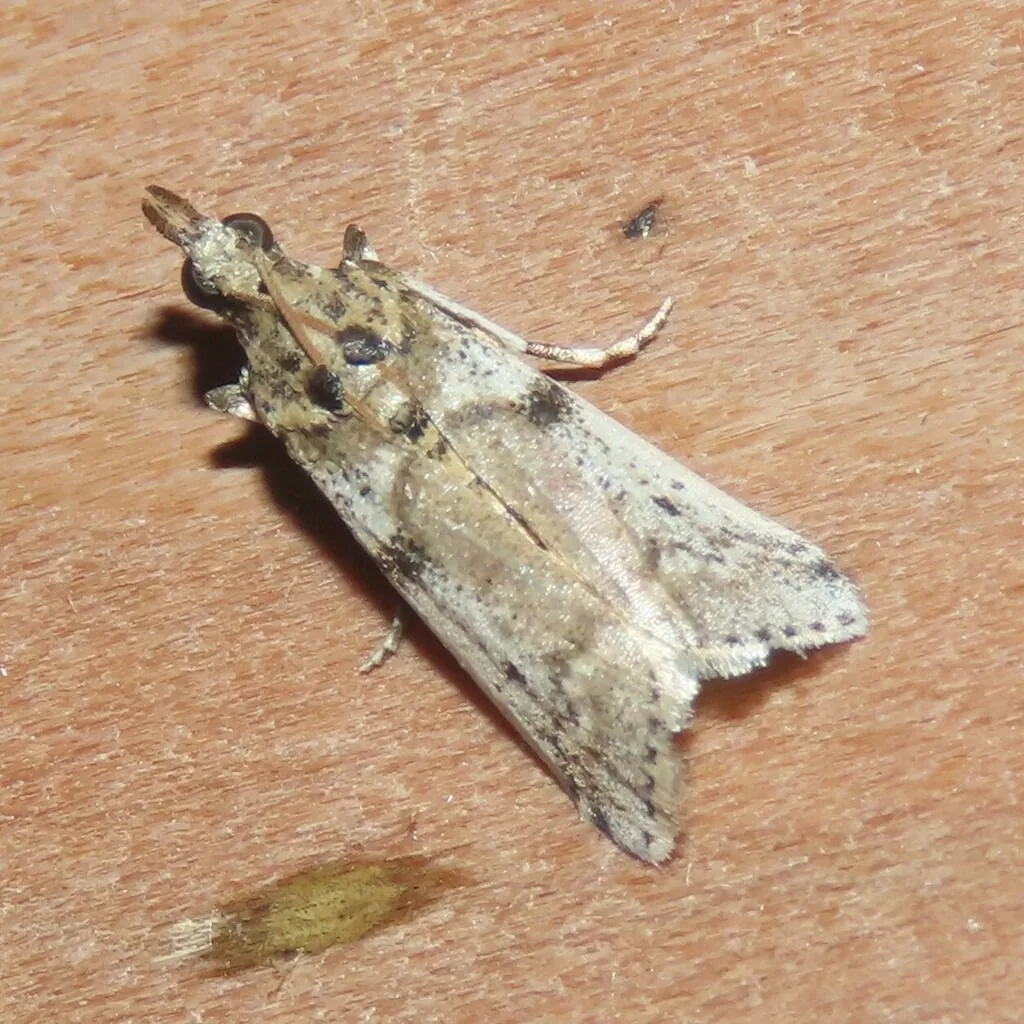
- Adults are a mottled mix of black and dark and light gray, about 2/3 inch long and 1 inch across the spread wings, with forward-pointing mouthparts that make the head look snoutlike.[1]
- Eggs are flattened ovals, reddish orange, yellowish or white. The brown pupae sit in silk inside the nut or fruit where the larva fed.[1]
Where it lives
It is a pest of California almonds, pistachios, walnuts and figs, and UC IPM adds pomegranate. In warmer than average seasons, especially in the central and southern San Joaquin Valley, it can fit in a fourth generation.[1][2]
Biology and life cycle
Larvae overwinter in old nuts and fruit (mummies) left on the tree or on the ground. They have no resting phase and keep feeding on warm winter days.[1]
Overwintered larvae pupate in spring and the first moths emerge in March or April. Emergence is spread out, so moths of each generation can be laying eggs for about two months.[1]
There are at least three generations a year, sometimes four in warm seasons.[1]
Early in the season eggs go on mummies and on green nuts already damaged by other causes. Later, most are laid after hull split or on overripe or injured fruit.[1]
In a large data set from commercial almond orchards, later-maturing almond varieties were infested more often, and earlier-maturing varieties were not hit harder.[4]
Damage and signs
- The first signs are pinhole-size entrances. As larvae grow they eat the whole kernel or fruit and leave heavy webbing and frass, and molds commonly follow.[1]
Health risk
Navel orangeworm damage to almonds is linked to aflatoxin, a toxin made by the mold Aspergillus flavus. USDA researchers showed in lab tests that larvae can carry the fungus into kernels and advise sorting out insect-damaged nuts. None of the cited sources describes a direct risk from the insect itself to people or pets.[3][4][1]
Control
Prevention
Harvest early, while numbers are lower. Avoid drought stress, which can cause early hull split or cracked fruit, and prevent other injury to fruit and nuts.[1]
Sanitation
Knock down old nuts and fruit, pick up the fallen ones and dispose of them before the overwintering larvae pupate in late winter. UC IPM calls this the most effective control.[1]
Biological control
Phytocoris bugs eat the eggs, and parasitic wasps (Copidosomopsis plethorica, Goniozus legneri, a Habrobracon species and Trichogramma egg parasites) attack it. Goniozus legneri is sold for release, mainly in organic orchards. Control ants, keep dust down and avoid broad-spectrum persistent sprays to protect them.[1]
Pesticides
UC IPM generally doesn't recommend insecticides on home fruit and nut trees, because timing is complex and sprays don't reach larvae in split hulls. If damage has been unacceptable despite good sanitation, Bt or spinosad at hull split gives some control.[1]
Research on fig orchards
A 2004 study in California fig orchards found moth numbers high during the first and third flights but lower in June and July. Because Calimyrna figs aren't attacked until mid-to-late July, the authors suggested pheromone mating disruption in figs could start later in the season.[2]
Common questions
- What's the webbing and frass inside my walnuts?
- Navel orangeworm larvae leave webbing, frass and mold inside nuts, often entering through a pinhole.[1]
- Why remove old nuts from the tree?
- Mummies are the main source of moths in spring, so removing them is the most important control.[1]
- Should I eat nuts with navel orangeworm damage?
- Sort them out. USDA researchers found aflatoxin was higher in almonds damaged by navel orangeworm carrying Aspergillus flavus, even without visible mold, and say insect-damaged kernels should be sorted out.[3]
Sources
- Plant Disease (via PubMed), “Spread of Aspergillus flavus by navel orangeworm (Amyelois transitella) on almond (Palumbo et al., 2014) (abstract).” pubmed.ncbi.nlm.nih.gov/30699615/ (accessed 2026-11-13)
- Journal of Economic Entomology (via PubMed), “Ecoinformatics can infer causal effects of crop variety on insect attack: a case study in almonds (Rosenheim et al., 2017) (abstract).” pubmed.ncbi.nlm.nih.gov/29029282/ (accessed 2026-11-13)
- Global Biodiversity Information Facility (GBIF), “Amyelois transitella Walker, 1863 (GBIF Backbone Taxonomy).” api.gbif.org/v1/species/1873071 (accessed 2026-11-13)