On this page
How to identify it
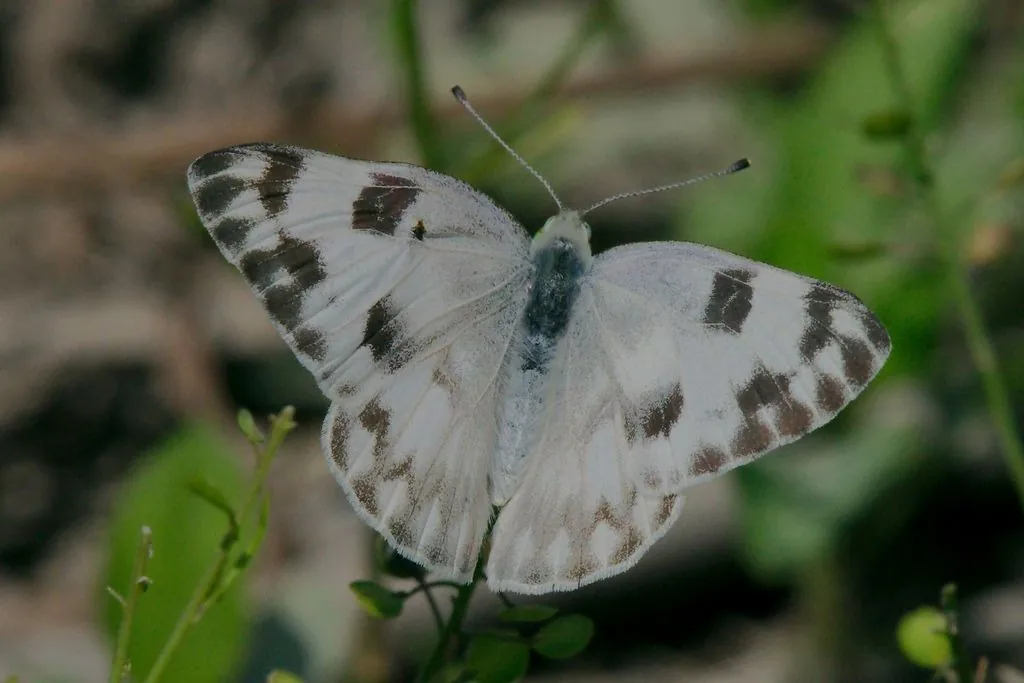
- Females are heavily checkered in black and white; males are whiter with sparser markings, but a dark square near the leading edge of the forewing shows above and below. Adults in early spring and late fall are darker and more heavily patterned.[1][2]
- The caterpillar has lengthwise stripes, yellow alternating with gray or grayish green, plus small black bumps and fine short hairs, and reaches about 1 inch.[1][3]
- Eggs are orange and laid one at a time on the host plant.[1][2]
Look-alikes
| Look-alike | How to tell them apart |
|---|---|
| Imported cabbageworm (cabbage white) | The southern cabbageworm's alternating gray and yellow stripes set it apart from the imported cabbageworm. On cabbage, checkered white caterpillars tend to eat the outer leaves, while imported cabbageworms bore into the head.[3][1] |
Where it lives
A permanent resident of the southern United States and northern Mexico with temporary populations farther north, in the northern states and southern Canada; BAMONA says it is absent from most of New England, and MDC finds it statewide in Missouri. GBIF lists about 28,400 US records since 1990, most from Texas, California, Arizona, New Mexico and Colorado, and only about ten from New England.[2][1][5]
Biology and life cycle
Adults fly from March to November. Missouri usually has two or three broods; BAMONA describes three flights, with a partial fourth in the South.[1][2]
It spends the winter as a chrysalis.[1][2]
Males patrol flat, open ground for females, and the sexes tell each other apart by how much ultraviolet light their wings reflect.[1][2]
Before laying, a female checks a flower cluster for other eggs. One cluster feeds only one caterpillar, and older caterpillars kill and eat younger ones.[1]
Numbers swing widely from year to year in many parts of its range.[1]
Damage and signs
- Caterpillars eat the flowers, buds and fruits of their host plants first and the leaves second.[1][2]
- Hosts are mustard-family plants and caper-family plants such as Rocky Mountain bee plant. Wild mustards such as Virginia pepperweed and shepherd's purse are preferred over garden crops.[2][4][1][3]
- Before the imported cabbage white arrived, it was an economically important cabbage pest in Missouri; it is now only a minor pest of cabbage-family crops.[1]
Health risk
None of the sources describes any risk to people or pets.[1][2]
Control
Prevention
It seldom needs control. It prefers wild mustards along roadsides and in waste ground, and on cabbage it mostly eats the outer leaves.[1]
Where sources disagree
Wingspan: 1 1/4 to 1 3/4 inches according to MDC, 1 1/2 to 2 1/2 inches according to BAMONA.[1][2]
Common questions
- What is the white butterfly with black checks?
- Most likely a checkered white, especially in open fields, vacant lots and roadsides.[1][2]
- Is the southern cabbageworm a garden pest?
- Only a minor one. It prefers wild mustards and, on cabbage, eats outer leaves rather than boring into heads.[1]
- How is it different from the imported cabbageworm?
- Look at the stripes: the southern cabbageworm has alternating gray and yellow stripes along its body.[3]
Sources
- Missouri Department of Conservation, “Checkered White (Field Guide).” mdc.mo.gov/discover-nature/field-guide/checkered-white (accessed 2026-11-11)
- Butterflies and Moths of North America (BAMONA), “Checkered White, Pontia protodice (species account).” www.butterfliesandmoths.org/species/Pontia-protodice (accessed 2026-11-11)
- Clemson Cooperative Extension, Land-Grant Press, “Identification of Common Insect Pests of Brassica Crops (LGP 1122).” lgpress.clemson.edu/publication/identification-of-common-insect-pests-of-brassica-crops/ (accessed 2026-11-11)
- Clemson Cooperative Extension Home & Garden Information Center, “Butterflies of South Carolina (HGIC 1735).” hgic.clemson.edu/factsheet/butterflies-of-south-carolina/ (accessed 2026-11-11)
- Global Biodiversity Information Facility (GBIF), “Pontia protodice: US occurrence records since 1990 by state (GBIF occurrence search API).” api.gbif.org/v1/occurrence/search?taxonKey=5137800&country=US&hasGeospatialIssue=false&occurrenceStatus=PRESENT&year=1990%2C2026&facet=stateProvince&facetLimit=400&limit=0 (accessed 2026-11-11)
- iNaturalist, “Pontia protodice taxon page (order and family).” www.inaturalist.org/taxa/59119 (accessed 2026-11-11)