The short answer
- Most likely termites. Termite wings fall off easily, and shed wings on windowsills, along floor edges, in spider webs and near indoor lights are a classic sign of a termite swarm. Ant queens also break off their wings after mating, so check the wings before you decide.[9][2][3][10]
- Wings that are all the same size and shape point to termites. Ants have front wings longer than the hind wings.[1][3][8][10]
- If termites swarmed indoors, there is usually an infestation somewhere in the house. The swarmers themselves can't damage wood and live only about a day.[5][3][1]
- Right now: save some wings, and any bodies, in a small vial of 70% alcohol, sweep or vacuum the rest, and get the sample identified before anyone treats.[3][5][1]
Related profiles on this site
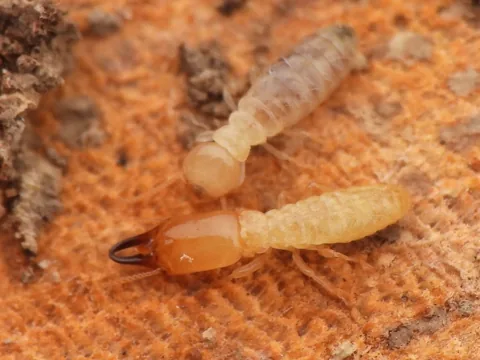 Eastern Subterranean Termite
Reticulitermes spp. (shown: R. flavipes)
Subterranean termites live in the soil and travel into buildings through earthen shelter tubes; they are the most destructive termites in most of the United States and usually warrant a professional.
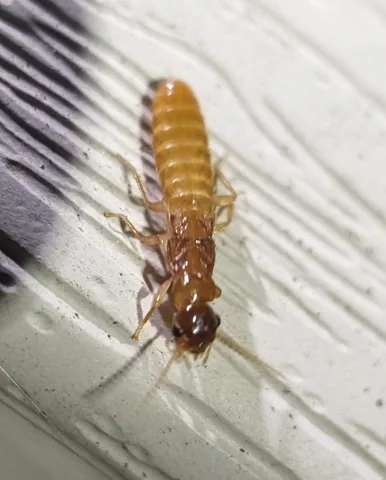 Formosan Subterranean Termite
Coptotermes formosanus
The Formosan subterranean termite is an invasive species from East Asia and one of the most aggressive and economically damaging termites in the world; its colonies are much larger than those of native subterranean termites. EPA lists it among the less common termites in the U.S., behind the native subterranean termite. UF/IFAS says it has consistently been listed among the 100 worst invasive species in the world.
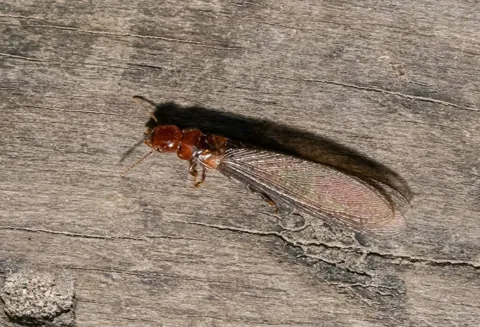 Western Drywood Termite
Incisitermes minor
Drywood termites live entirely inside wood without needing soil contact; the western drywood termite is California's second most important termite pest after subterranean termites. Clemson Extension says drywood termites get the moisture they need from humid air and are most common along humid coastal areas of South Carolina.
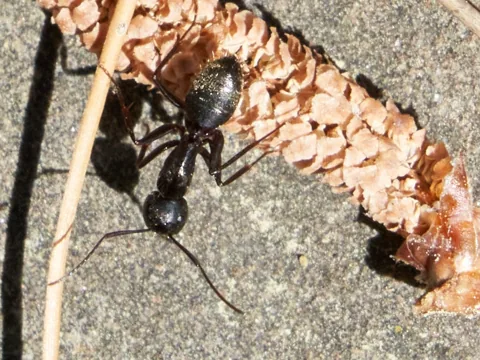 Carpenter Ants
Camponotus species
Carpenter ants don't eat wood the way termites do; they excavate it to nest, usually starting where wood is damp or decayed, and indoor nests are often satellites of a parent colony outdoors. Minnesota and Clemson extension both stress that they don't eat wood; they tunnel into it to make a nest.
What left the wings
Two groups of household insects fly out in large numbers to mate and then lose their wings: termites and ants. Both swarm at about the same time of year, which is why the two are so often confused.[1][9][3]
- Termite swarmers: dark-colored winged queens and kings with four wings of equal length that are much longer than the body. Their wings fall off easily and are usually found near where the termites came out. Subterranean swarmers are about 3/8 inch long.[10][9][3]
- Winged ants: queens and males that leave the nest in large numbers to mate. Their front wings are longer than the hind wings, and after mating the queens break or remove their wings. Winged carpenter ants are up to 3/4 inch long.[9][8][11][10]
- Body clues, if you find any: termites have straight antennae and a thick waist with no pinch; ants have elbowed antennae and a narrow, pinched waist. The side-by-side guide linked below has the full comparison.[1][8]
Does it mean termites are in the house?
Where the swarm happened matters most. NC State says swarmers found outdoors near tree stumps or landscape timbers do not mean your house is infested, but swarming indoors usually means an infestation somewhere in the house. Texas A&M also says swarming termites inside a house usually indicate an active infestation, and that swarmers outdoors show termites are present and may be attacking nearby structures.[5][3]
Wings that blew in under a door are not proof on their own. UC IPM cautions that seeing swarms of flying termites does not always mean the building is infested and that a professional inspection is usually needed to confirm it. Kentucky, on the other hand, calls winged termites emerging indoors a telltale sign of infestation.[6][1]
For ants, numbers tell the story. Minnesota Extension says large numbers of winged ants indoors are a sure sign of a nest inside, while one or a few winged queens are probably newly mated queens that wandered in looking for a nest site and are not proof of an indoor nest.[10][9]
- Wings plus tiny six-sided pellets on the same sill point to drywood termites. UC IPM says inspectors look for shed wings and fecal pellets, and that drywood pellets have six sides and are diagnostic for drywood termites.[7]
When wings usually show up
Termite swarms are why so many infestations are found in spring. Kentucky says spring is typically when large numbers of swarmers emerge inside homes, triggered by warmer temperatures and rainfall.[1][3]
- Native subterranean termites: NC State says North Carolina species begin swarming in late winter and continue into September or October, usually during the day and often on warm days after rain. Texas A&M says swarms begin in South Texas in January, and UC IPM describes swarms on warm, sunny days after fall or spring rains.[5][3][6]
- Formosan subterranean termites swarm at night and are attracted to lights, while native subterranean termites swarm during the day, usually in the afternoon, according to Texas A&M. Wings piled under a lamp or porch light after an evening flight fit that pattern.[4]
- Western drywood termites fly in the daytime during summer and fall, UC IPM says.[7]
- In Minnesota Extension's listing, carpenter ants swarm April through June, occasionally indoors in late winter on warm, sunny days. Larger yellow ants swarm April through September and can swarm indoors in winter when they nest under a heated concrete slab.[9][11]
How to save a sample
Save it before you clean up. Texas A&M says termite swarmers sent for identification must go in a vial of 70% alcohol to keep them from drying out and keep the wings intact, and that species are identified by body size and color, the wing veins and the time of year of the swarm.[3]
Keep a few whole insects if any are left on the sill or in nearby spider webs, since antennae and waist shape also separate termites from ants. NC State suggests showing them to a pest management professional or bringing specimens to your county Extension center for identification.[5][1]
What to do next
Clean up with a broom or vacuum. Kentucky says that is all the swarmers need, since they can't damage wood and live about a day.[1]
Skip the bug spray. NC State says spraying swarmers may kill the termites you can see but does not stop the infestation or protect the house from future attack.[5]
When to call a pro
If the sample is termites and they came out indoors, have the house inspected. Kentucky says subterranean termites usually warrant attention by a professional, and UC IPM advises calling a professional if you suspect an infestation.[1][6]
For drywood termites, UC IPM says residents should get help from pest control professionals, since the products needed to control them are not available to the general public.[7]
Common questions
- There are only wings, no bugs. Where did the termites go?
- Swarmers drop to the ground, shed their wings and pair off, and those that emerge indoors live only about a day. Texas A&M says wings and swarmers often turn up on windowsills, in spider webs and near indoor lights.[1][3]
- Can I tell termite wings from ant wings without the body?
- Often, yes. Termite wings are all about the same size and shape and much longer than the body. Ants have front wings longer than the hind pair.[9][8][3]
- I found wings outside on the porch, not inside. Is my house infested?
- Not necessarily. NC State says swarmers outdoors are not an indication that the house is infested, though Texas A&M notes they show termites are present nearby.[5][3]
- Will the swarmers eat my windowsill?
- No. Kentucky says swarmers emerging inside a home can't damage wood. The colony they came from is what does the damage.[1]
Photo credits
- Eastern Subterranean Termite: (c) Sam Kieschnick, some rights reserved (CC BY) — via iNaturalist, CC BY 4.0
- Formosan Subterranean Termite: (c) ncb1221, some rights reserved (CC BY) — via iNaturalist, CC BY 4.0
- Western Drywood Termite: (c) Jeremiah Degenhardt, some rights reserved (CC BY) — via iNaturalist, CC BY 4.0
- Carpenter Ants: (c) Linda Watson, some rights reserved (CC BY) — via iNaturalist, CC BY 4.0
Sources
- University of Kentucky Entomology, “ENTFACT-604: Termite Control: Answers for Homeowners (revised March 2026).” entomology.mgcafe.uky.edu/ef604 (accessed 2026-11-14)
- University of Kentucky Entomology, “ENTFACT-605: Protecting your Home Against Termites (revised March 2026).” entomology.mgcafe.uky.edu/ef605 (accessed 2026-11-14)
- Texas A&M AgriLife Extension, “Subterranean Termites, E-368 (R.E. Gold, K.M. Schofield, E. Brown and M. Keck, 9/10).” extensionentomology.tamu.edu/wp-content/uploads/sites/3/2017/01/Subterranean-termites-E368.pdf (accessed 2026-11-14)
- Texas A&M AgriLife Extension, “Formosan Subterranean Termites, E-367.” extensionentomology.tamu.edu/wp-content/uploads/sites/3/2017/01/Formosan-subterranean-termites-E367.pdf (accessed 2026-11-14)
- NC State Extension, “Termites: Biology and Control.” content.ces.ncsu.edu/termites-biology-and-control (accessed 2026-11-14)
- University of California Statewide IPM Program, “Pest Notes: Subterranean and Other Termites, Publication 7415 (May 2014).” ipm.ucanr.edu/legacy_assets/PDF/PESTNOTES/pntermites.pdf (accessed 2026-11-14)
- University of California Statewide IPM Program, “Pest Notes: Drywood Termites, Publication 7440 (August 2014).” ipm.ucanr.edu/legacy_assets/PDF/PESTNOTES/pndrywoodtermites.pdf (accessed 2026-11-14)
- U.S. Environmental Protection Agency, “Termites: How to Identify and Control Them.” www.epa.gov/safepestcontrol/termites-how-identify-and-control-them (accessed 2026-11-14)
- University of Minnesota Extension, “Ants.” extension.umn.edu/insects-infest-homes/ants (accessed 2026-11-14)
- University of Minnesota Extension, “Carpenter ants (Hahn and Kells; reviewed 2024).” extension.umn.edu/insects-infest-homes/carpenter-ants (accessed 2026-11-14)
- Penn State Extension, “Carpenter Ants.” extension.psu.edu/carpenter-ants (accessed 2026-11-14)