On this page
How to identify it
- Penn State gives females as 4.3 to 6.4 mm (0.17 to 0.25 inch) long and males as 4 to 5.5 mm; London's Natural History Museum gives an overall size of 8 mm. Clemson puts jumping spiders in general at 1/10 to 1/4 inch.[3][4][1]
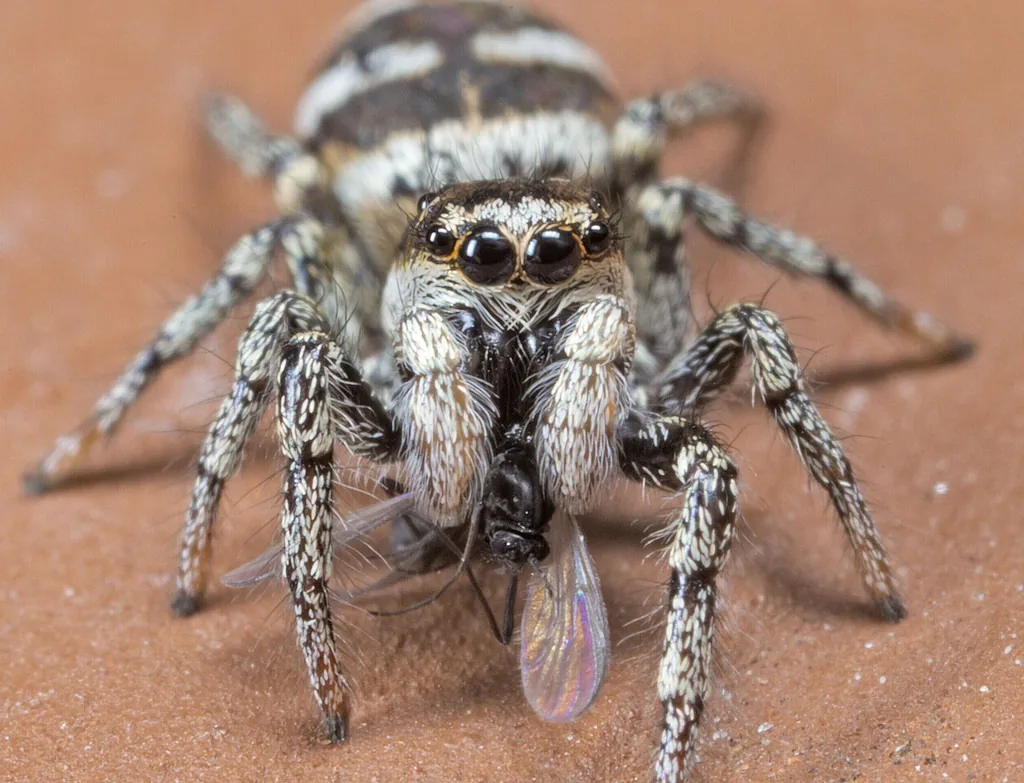
- Both sexes are blackish brown with white markings: a white band along each side of the front body section and opposing white stripes across the abdomen. Females are often lighter in color than males.[3][1]
- Males have very large, dark jaws (chelicerae) that project forward from the head.[3]
- Like other jumping spiders it has eight eyes, with a very large forward-facing middle pair. UC IPM describes jumping spider eyes in three rows: four in front, then two tiny eyes, then two medium-sized ones.[1][6]
- It moves in a jerky, start-and-stop way and jumps after prey.[4][1]
Look-alikes
| Look-alike | How to tell them apart |
|---|---|
| Bold jumping spider | A larger common jumping spider with three white to red dots on the abdomen instead of stripes.[1] |
Where it lives
Native to Europe and western Asia. Penn State says it now occurs through most of the United States and southern Canada, most commonly in the Northeast and on the West Coast, with very few records from the Southeast and Plains states. Clemson, writing for South Carolina, says it is commonly found indoors.[3][1]
Biology and life cycle
It hunts by day without a web, stalking small insects and pouncing on them. The Natural History Museum gives its season as spring through autumn.[4][6]
Penn State finds it under stones, in tall grass, on bushes and fences, and both on and inside buildings. It spins a silk retreat in cracks between boards and similar spots. Washington State notes jumping spiders on window sills, ceilings, outside walls and foundations.[3][5]
Mating happens in late spring and eggs are laid in June and July, depending on conditions. Clemson says female jumping spiders guard their eggs and make several egg sacs of 80 to 100 eggs each.[3][1]
Penn State says the earliest North American record may be a specimen collected in Illinois in 1933.[3]
Damage and signs
Health risk
Penn State says this species is not considered medically important and has no medically significant bite, and Clemson says jumping spiders usually flee once noticed. MedlinePlus notes that most spider bites are harmless. In a hospital study in northern Australia, jumping spiders (family Salticidae) caused 4 of 34 confirmed spider bites, and none of the 34 bites had severe effects.[3][1][7][9]
Control
Prevention
If a spider bite does happen, wash it with soap and water and put a cold, damp cloth or wrapped ice on it. Call 911 for trouble breathing, swelling of the face or mouth, throat tightness or fainting.[7][8]
Keep them out
Keep windows and doors closed and screened, seal them with weather stripping, and narrow gaps under door thresholds.[1][5]
Traps and physical control
To remove one, set a glass or jar over it, slide a piece of paper underneath and release it outside, or vacuum it up.[1][6]
Pesticides
Spraying isn't the answer. Clemson recommends removing jumping spiders rather than using a can of insect spray, and Washington State says pesticides are a temporary fix unless entry is prevented.[1][5]
Common questions
- What is the little striped spider on my window?
- Most likely a zebra jumping spider: small, black or dark brown with white stripes, moving in a jerky stop-and-start way while it hunts on walls and windows.[3][4][1]
- Is the zebra jumping spider native?
- No. Penn State says it was introduced from Europe and western Asia, and the earliest North American record may date to 1933 in Illinois.[3]
- Can a zebra jumping spider bite?
- Penn State says it has no medically significant bite, and UC IPM notes that most spiders' jaws are too small to bite people. MedlinePlus says most spider bites are harmless.[3][6][7]
Sources
- Clemson Cooperative Extension Home & Garden Information Center, “Jumping Spiders (HGIC factsheet).” hgic.clemson.edu/factsheet/jumping-spiders/ (accessed 2026-11-11)
- iNaturalist, “Salticus scenicus taxon page (order and family).” www.inaturalist.org/taxa/68901 (accessed 2026-11-11)
- Penn State Extension, “Zebra Jumper (S. Jacobs, revised by M. Skvarla 2023; updated January 19, 2026).” extension.psu.edu/zebra-jumper (accessed 2026-11-11)
- Natural History Museum, London, “Zebra jumping spider, Salticus scenicus (Spiders in your home).” nhm.ac.uk/take-part/identify-nature/spiders-in-your-home/zebra-jumping-spider.html (accessed 2026-11-11)
- Washington State University Extension, “Jumping spider (Pestsense fact sheet).” pestsense.cahnrs.wsu.edu/?p=581 (accessed 2026-11-11)
- University of California Statewide IPM Program, “Spiders (Pest Notes, Home and Landscape).” ipm.ucanr.edu/home-and-landscape/spiders/ (accessed 2026-11-11)
- MedlinePlus, U.S. National Library of Medicine, “Insect bites and stings (Medical Encyclopedia 000033).” medlineplus.gov/ency/article/000033.htm (accessed 2026-11-11)
- CDC / NIOSH, “Venomous Spiders at Work.” www.cdc.gov/niosh/outdoor-workers/about/venomous-spiders.html (accessed 2026-11-11)
- Medical Journal of Australia, via PubMed, “Isbister GK, Churchill TB, Hirst DB, Gray MR, Currie BJ (2001), Clinical effects of bites from formally identified spiders in tropical Northern Territory, Medical Journal of Australia 174(2):79-82.” pubmed.ncbi.nlm.nih.gov/11245508/ (accessed 2026-11-11). Cited from the PubMed abstract.