On this page
How to identify it
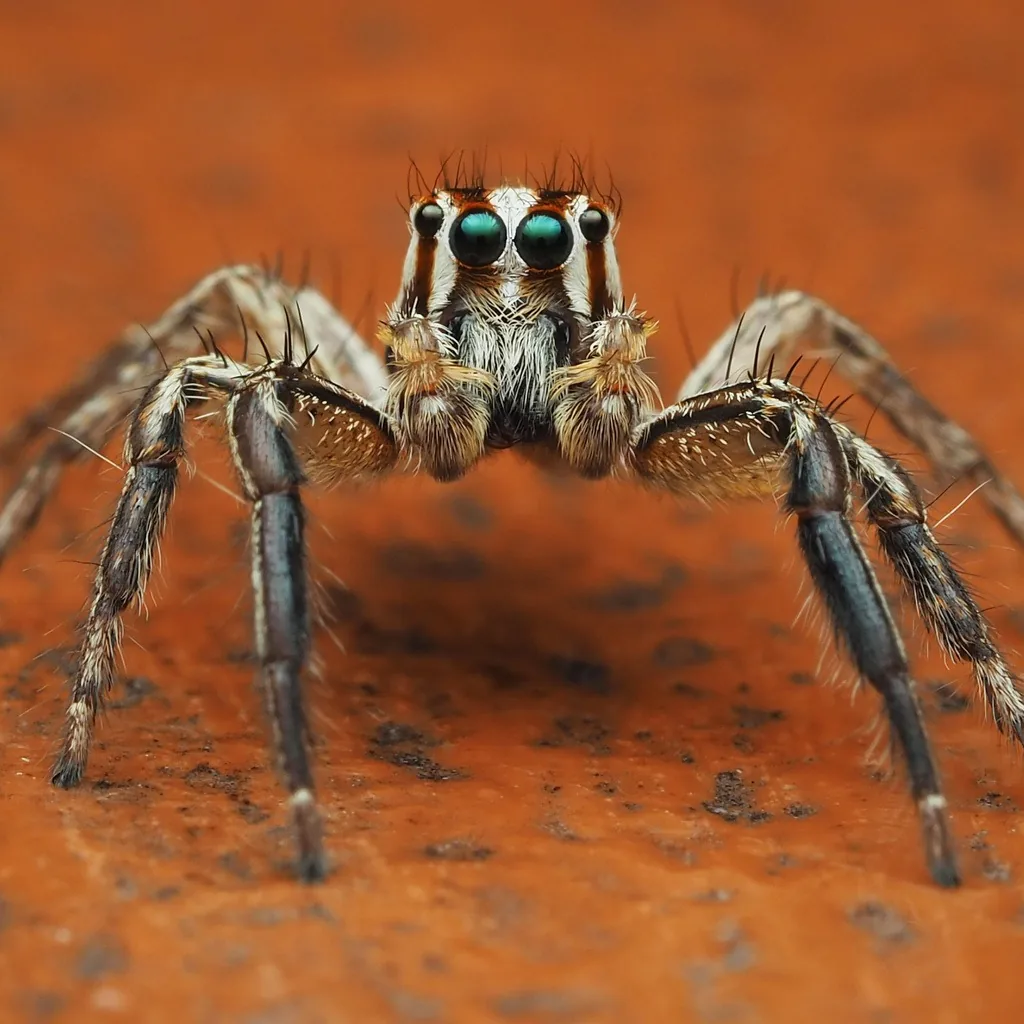
- Like all jumping spiders they have eight eyes, with a greatly enlarged pair facing forward, and often turn to look straight at you. Jumping spiders have the best eyesight of any spiders.[7]
- Gray wall jumper males measure 5 to 7 mm. The front body is brown to dark brown with a pale stripe of hairs down the middle and dark bands along the sides, the abdomen is covered in yellow or brown hairs with a dark central band, and the legs are yellowish brown with dark rings.[5]
- Gray wall jumper females are a little larger, 6 to 9 mm, with a dark stripe and lighter areas on both body parts, an irregular pattern on top of the abdomen and yellow, dark-ringed legs.[5]
- UF/IFAS describes the pantropical jumper as robust with a high front body; males are 9 to 11 mm and females 9 to 12 mm. Males are black and white striped, with a light central stripe on the abdomen bordered by dark stripes, a pair of white spots near the tip, and three white stripes on a black face.[6]
- Pantropical jumper females are brown, with a dull orange stripe on the rear slope of the front body and two short black stripes on the back half of the abdomen, each holding two white spots.[6]
- UF/IFAS says the gray wall jumper is flattened. Live males look striped black and white, with a dark central stripe on the abdomen bordered by light ones, the reverse of the pantropical jumper, and a white upside-down V on the jaws. Females are gray, with broad black stripes along the sides of the abdomen and an orange face.[6]
Look-alikes
| Look-alike | How to tell them apart |
|---|---|
| Zebra jumping spider | Clemson Extension describes the zebra jumping spider as having white stripes on a blackish-brown background and notes it is commonly found indoors.[7] |
Where it lives
The World Spider Catalog lists the pantropical jumper as African and introduced to both Americas, Europe, the Middle East, southern Asia, Australia and the Pacific islands, and the gray wall jumper as African and introduced to North, Central and South America, southern Europe, much of Asia, Australia and the Pacific islands. In the United States, GBIF records since 1990 for the pantropical jumper come mostly from Texas, then Florida, Georgia, Louisiana and Alabama, with fewer from California and Hawaii. Gray wall jumper records come mostly from Florida, California and Texas, then Louisiana and Hawaii. UF/IFAS says both were brought from the Old World tropics by people and occur from Florida to Texas and south to Paraguay, with the gray wall jumper also in California.[1][2][3][4][6]
Biology and life cycle
Jumping spiders hunt by day, indoors and out, and eat house flies, beetles, stink bugs, armyworms and other pests.[7]
Female jumping spiders guard their eggs in silk sacs; they make several sacs of 80 to 100 eggs each, and the spiderlings emerge within a few months and scatter. For these two species, UF/IFAS says gray wall jumper females guard 25 to 40 eggs in a flattened white sac about 1.5 cm across in a crevice, with spiderlings dispersing about three weeks later, while pantropical jumper females guard 35 to 60 eggs in a sac 2.5 to 3.5 cm across under boards or eaves or in crevices, and spiderlings disperse in three to four weeks.[7][6]
Spiders of Europe notes the gray wall jumper is often found close to buildings; in Europe it is an introduced species that has become established.[5]
Adults and young of both species are present all year; UF/IFAS says most mating and reproduction runs from fall to spring.[6]
Gray wall jumpers feed mainly on small flies that land on buildings but can catch crane flies twice their length; pantropical jumpers take flies, moths, smaller spiders and flying ants.[6]
Because they don't build webs to catch prey, they don't leave the cobwebs that bother many people.[6]
Health risk
Jumping spiders are not harmful and usually flee once they are noticed. MedlinePlus notes that most spider bites are harmless; for a minor bite, wash the site with soap and water and put ice wrapped in a cloth on it, 10 minutes on and 10 minutes off. Call 911 for trouble breathing.[7][8]
Control
Keep them out
Keep windows and doors closed, screened and sealed with weather stripping, and keep other insects under control so spiders have less reason to come in.[7]
Traps and physical control
To remove one from the house, trap it under a glass or dish and let it go outside; insect spray isn't the best approach.[7]
Biological control
No control is needed outdoors: jumping spiders eat many insects that bother people and gardens. UF/IFAS says dense populations around homes make them of considerable benefit in controlling flies, mosquitoes and other pests.[7][6]
What lab studies show about how they hunt
A 1997 Animal Behaviour study found that when hunting adult house flies, the pantropical jumper leapt from farther away on a background where it was easy to see; background made no difference when it stalked slow-moving maggots. It also approached more slowly when it was camouflaged.[9]
Experiments with the pantropical jumper have also been used to show how body postures and color patterns can make a spider's physical condition easier for rivals to judge.[10]
Retinal-tracking work on the gray wall jumper found that small, fast-moving thin stripes strongly suppressed its eyes' tracking response, evidence that rapid motion can help striped prey stay hidden.[11]
A 2024 study of eye pigments found possible blue-light receptors in the small side eyes of the gray wall jumper, suggesting these eyes may have some color vision.[12]
Where the sources disagree
Gray wall jumper size: Spiders of Europe gives males as 5 to 7 mm and females 6 to 9 mm, while UF/IFAS gives 8 to 9 mm for males and 8 to 10 mm for females.[5][6]
Eggs: Clemson Extension says jumping spiders in general make several sacs of 80 to 100 eggs, while UF/IFAS gives 25 to 40 eggs per sac for the gray wall jumper and 35 to 60 for the pantropical jumper.[7][6]
Common questions
- What are the striped jumping spiders on the outside walls of my house?
- In the Gulf states and California, one possibility is the gray wall jumper, which is often found close to buildings; the males have a pale stripe down the middle of the front body. UF/IFAS says both the pantropical jumper and the gray wall jumper gather around outdoor lights at night to hunt.[5][4][6]
- Are they dangerous?
- No. Jumping spiders are not harmful and usually run away. Most spider bites are harmless; wash a bite with soap and water and use a wrapped ice pack.[7][8]
- Do they leave cobwebs on my house?
- No. UF/IFAS says they don't build webs to catch prey, so they don't leave cobwebs.[6]
Sources
- World Spider Catalog, Natural History Museum Bern, “Plexippus paykulli (Audouin, 1826) (World Spider Catalog, version 27).” wsc.nmbe.ch/lsid/urn:lsid:nmbe.ch:spidersp:035670 (accessed 2026-11-11)
- World Spider Catalog, Natural History Museum Bern, “Menemerus bivittatus (Dufour, 1831) (World Spider Catalog, version 27).” wsc.nmbe.ch/lsid/urn:lsid:nmbe.ch:spidersp:034535 (accessed 2026-11-11)
- Global Biodiversity Information Facility (GBIF), “Plexippus paykulli: U.S. occurrence records since 1990 by state (GBIF occurrence search).” api.gbif.org/v1/occurrence/search?taxonKey=2171214&country=US&hasGeospatialIssue=false&occurrenceStatus=PRESENT&year=1990%2C2026&facet=stateProvince&facetLimit=400&limit=0 (accessed 2026-11-11)
- Global Biodiversity Information Facility (GBIF), “Menemerus bivittatus: U.S. occurrence records since 1990 by state (GBIF occurrence search).” api.gbif.org/v1/occurrence/search?taxonKey=2169064&country=US&hasGeospatialIssue=false&occurrenceStatus=PRESENT&year=1990%2C2026&facet=stateProvince&facetLimit=400&limit=0 (accessed 2026-11-11)
- araneae: Spiders of Europe, Natural History Museum Bern, “Menemerus bivittatus (Spiders of Europe datasheet).” araneae.nmbe.ch/data/2302 (accessed 2026-11-11)
- University of Florida IFAS Extension (EDIS), “Jumping Spiders, Gray Wall Jumper, and Pantropical Jumper, Menemerus bivittatus (Dufour) and Plexippus paykulli (Audouin), EENY-158/IN315 (G. B. Edwards Jr.; Featured Creatures).” ask.ifas.ufl.edu/publication/IN315 (accessed 2026-11-14)
- Clemson Cooperative Extension Home & Garden Information Center, “Jumping Spiders (HGIC).” hgic.clemson.edu/factsheet/jumping-spiders/ (accessed 2026-11-11)
- MedlinePlus, U.S. National Library of Medicine, “Insect bites and stings (Medical Encyclopedia).” medlineplus.gov/ency/article/000033.htm (accessed 2026-11-11)
- Peer-reviewed literature (PubMed), “The predatory response of a stalking spider, Plexippus paykulli, to camouflage and prey type (Bear A et al., Animal behaviour, 1997).” pubmed.ncbi.nlm.nih.gov/9344451/ (accessed 2026-11-11)
- Proceedings of the Royal Society B, via PubMed, “Body postures and patterns as amplifiers of physical condition (Taylor, Hasson and Clark 2000).” pubmed.ncbi.nlm.nih.gov/10853735/ (accessed 2026-11-11)
- iScience, via PubMed, “Motion enhances camouflage: Retinal evidence for flicker fusion camouflage in jumping spiders (Tan et al. 2026).” pubmed.ncbi.nlm.nih.gov/42662396/ (accessed 2026-11-11)
- Vision Research, via PubMed, “Secondary not subordinate: Opsin localization suggests possibility for color sensitivity in salticid secondary eyes (Steck et al. 2024).” pubmed.ncbi.nlm.nih.gov/38428375/ (accessed 2026-11-11)
- iNaturalist, “Plexippus paykulli taxon page (order and family).” www.inaturalist.org/taxa/125444 (accessed 2026-10-06)