On this page
How to identify it
- Like other jumping spiders it is small, with a stout body. Clemson gives 1/10 to 1/4 inch for jumping spiders in general. UF/IFAS gives 4 to 7 mm for this species.[2][3]
- Jumping spiders are easiest to recognize by their eyes: a very large forward-facing pair in front, which gives them the best eyesight of any spider.[2]
- It waves its palps (the short, leg-like appendages beside the mouth) during displays to other spiders, and the way it waves them is unusually variable. In the field, UF/IFAS says the easiest clue is the waving of the bright white flags on the palps. It moves in a hasty stop-and-go way, often waving its palps during pauses.[4][3]
- Older studies call it Corythalia canosa; it now sits in the genus Anasaitis, and iNaturalist spells the name Anasaitis canosus.[1][4][5]
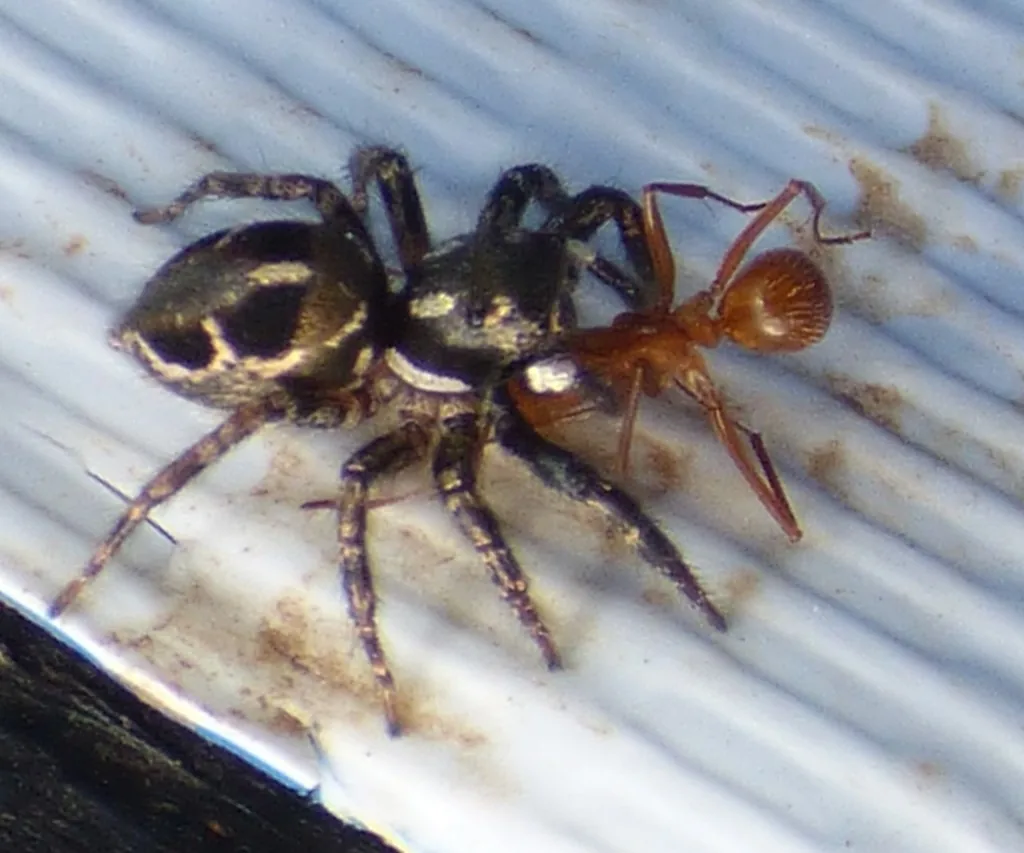
- Adults are dark brown or black, often with a golden sheen, with four white marks on the cephalothorax (the head end). Iridescent white markings in the center and along the edges of the abdomen outline four dark spots, according to UF/IFAS.[3]
- UF/IFAS says males are slightly smaller and less robust than females, and young spiders have paler legs and palps but still show the white palp flags.[3]
Look-alikes
| Look-alike | How to tell them apart |
|---|---|
| Bold jumping spider | The bold jumping spider is a common jumping spider of homes and gardens with three white to red spots on the abdomen.[2] |
Where it lives
The published research on its hunting and display behavior studied spiders from Florida. UF/IFAS says it is known from Alabama, Arkansas, Florida, Georgia, Louisiana, Mississippi, Oklahoma, South Carolina and Texas, and from Tamaulipas in Mexico. The range may reach farther north: specimens were recently found in Indiana, and iNaturalist records suggest North Carolina, Tennessee and Virginia.[1][4][3]
Biology and life cycle
It has a specialized technique for catching ants, different from how it catches other insects. In three kinds of prey-choice tests it took ants over other insects, and the preference did not depend on having met ants before. UF/IFAS says it has been documented eating over 21 species of ants, and small ants such as Pheidole are easier for it to subdue than larger, harder-bodied ones. It often uses logs or branches sticking out of the leaf litter as lookouts or paths, lines up with a sighted ant, then jumps on and grabs it by the back of the head or thorax so the ant cannot sting or bite back.[1][3]
It has a repertoire of 22 major displays. Males court a mature female away from her nest mainly with visual displays, switch to vibration signals if she is in her nest, and move in with a subadult female in her nest until she matures.[4]
Jumping spiders in general hunt by day, indoors and out. UF/IFAS says this species moves through leaf litter in shaded forests but is also common in and around houses and on pavilions and picnic benches. It builds no web to catch prey, but makes silk nests in leaf litter or under pine bark and uses silk for draglines, resting retreats and egg sacs.[2][3]
UF/IFAS says it can jump upwards of fifteen body lengths, from one surface to another or to escape predators.[3]
It is one of over 6000 described jumping spider species, and UF/IFAS says most jumping spiders that have been studied avoid ants, likely because ants sting and bite when attacked.[3]
Damage and signs
Health risk
The CDC names the black widow and brown recluse as the venomous spiders of concern in the U.S., and MedlinePlus says most spider bites are harmless. Jumping spider bites are rarely documented; in an Australian study of thirty-four bites from spiders identified by an expert, four were from jumping spiders and none of the bites caused severe effects.[6][7][8]
Control
Traps and physical control
Indoors, skip the spray: trap the spider under a glass or dish and put it outside. Screens, closed doors and weather stripping keep jumping spiders from wandering in.[2]
What research shows about its ant hunting
A 1991 study compared it with an Australian jumping spider and a New Zealand one. Both the twin-flagged jumping spider and the Australian species chose ants over other insects, but the twin-flagged spider's ant-catching behavior was the more specialized. The New Zealand species often attacked ants and then let them go, and did not eat them in the tests.[1]
Common questions
- What is the tiny black spider waving white flags?
- A small dark jumping spider waving its palps at you may be a twin-flagged jumping spider, an ant-eating species studied in Florida that waves its palps in displays. Jumping spider bites are rarely documented, and most spider bites are harmless.[4][1][8][7]
- Why is it called the twin-flagged jumping spider?
- UF/IFAS says the name comes from bright white scales on its pedipalps, the small appendages near the face, which look like little white flags when the spider waves them.[3]
- Where does the twin-flagged jumping spider live?
- In the southeastern United States and Mexico. UF/IFAS says it lives in forest leaf litter and is also common around houses and other structures, and records suggest it may range as far north as Indiana and Virginia.[3]
Sources
- Journal of Zoology (peer-reviewed), “Prey-capture techniques and prey preferences of Corythalia canosa and Pystira orbiculata, ant-eating jumping spiders (Araneae, Salticidae) (Jackson and van Olphen 1991).” doi.org/10.1111/j.1469-7998.1991.tb04389.x (accessed 2026-11-14). Abstract read via the Crossref API; the publisher page returned a bot challenge to our client.
- Clemson Cooperative Extension Home & Garden Information Center, “Jumping Spiders (HGIC factsheet).” hgic.clemson.edu/factsheet/jumping-spiders/ (accessed 2026-11-14)
- University of Florida/IFAS Extension (Featured Creatures), “Twin-flagged Jumping Spider, Anasaitis canosa (Walckenaer, 1837), EENY-802/IN1395 (Featured Creatures).” ask.ifas.ufl.edu/publication/IN1395 (accessed 2026-11-14)
- New Zealand Journal of Zoology (peer-reviewed), “Display behaviour of Corythalia canosa, an ant-eating jumping spider (Araneae: Salticidae) from Florida (Jackson and Macnab 1989).” doi.org/10.1080/03014223.1989.10422566 (accessed 2026-11-14). Abstract read via the Crossref API; the publisher page returned a bot challenge to our client.
- iNaturalist, “Anasaitis canosus taxon page (order and family).” www.inaturalist.org/taxa/311233 (accessed 2026-11-14)
- CDC, National Institute for Occupational Safety and Health, “Venomous Spiders at Work.” www.cdc.gov/niosh/outdoor-workers/about/venomous-spiders.html (accessed 2026-11-14)
- MedlinePlus, U.S. National Library of Medicine, “Insect bites and stings (Medical Encyclopedia).” medlineplus.gov/ency/article/000033.htm (accessed 2026-11-14)
- Medical Journal of Australia, via PubMed, “Clinical effects of bites from formally identified spiders in tropical Northern Territory (Isbister et al. 2001).” pubmed.ncbi.nlm.nih.gov/11245508/ (accessed 2026-11-14)